Matzav
President Donald Trump spoke by phone Thursday night with Israeli Prime Minister Bibi Netanyahu to review the rapidly developing situation in Iran, according to a report published Friday by Axios, citing two individuals with knowledge of the discussion.
The call marked the second direct conversation between the two leaders within 48 hours, as Trump considers a range of responses that include possible U.S. military action as well as renewed diplomatic efforts with an Iranian regime under pressure from mass protests and internal instability.
Officials from both the White House and the Israeli Prime Minister’s Office declined to provide details or comment publicly on the calls.
According to Axios, during an earlier conversation on Wednesday, Netanyahu pressed Trump to hold off on any immediate military strike, arguing that Israel needed additional time to prepare for potential retaliation from Iran. The report said that this appeal was one of several considerations that contributed to Trump’s decision to delay authorizing U.S. military action.
U.S. officials have indicated that force remains on the table if Iran resumes the killing of protesters, while Israeli officials believe that a strike is still possible in the near term despite the current pause.
Axios also reported previously that Netanyahu sent Mossad Director David Barnea to the United States to coordinate closely with American officials on Iran-related matters. Barnea is expected to hold talks Friday in Miami with White House envoy Steve Witkoff.
The report detailing the second Trump-Netanyahu call appeared before Trump addressed reporters’ questions about whether pressure from Arab or Israeli leaders influenced his decision not to strike Iran. Trump dismissed that notion, saying, “No one convinced me. I convinced myself.”
He pointed to recent developments inside Iran as a key factor, adding, “You had, yesterday, scheduled, over 800 hangings. They didn’t hang anyone. They cancelled the hangings. That had a big impact.”
Later Thursday night, speaking at an Israeli-American Council conference in Miami, Witkoff expressed optimism that diplomacy could still avert conflict. He said any agreement with Iran would need to tackle multiple core issues, including its uranium enrichment program, its stockpile of ballistic missiles, the removal of roughly 2,000 kilograms of enriched uranium held by Tehran, and an end to Iran’s backing of proxy forces across the region.
Describing Iran’s internal economic crisis, Witkoff said, “I think if Iran, which is stumbling it its economy. It’s a pretty serious situation. Inflation is well north of 50%.” He added that Tehran still has a path toward a negotiated outcome, saying, “If they want to come back to the League of Nations, we can solve those four problems diplomatically and that would be a good resolution and the alternative will be a bad one.”
{Matzav.com}
 Matzav
President Donald Trump said Friday that Iran’s leadership had halted a large number of planned executions of anti-regime protesters, crediting the move with averting what he described as an imminent wave of hangings.
In a post on Truth Social, Trump publicly acknowledged the Iranian government’s decision, writing: “I greatly respect the fact that all scheduled hangings, which were to take place yesterday (Over 800 of them), have been cancelled by the leadership of Iran. Thank you!”
Later, while speaking with reporters, Trump was asked whether pressure from Arab or Israeli officials had persuaded him to refrain from launching a military strike against Iran. He rejected that suggestion, responding, “No one convinced me. I convinced myself.”
 Vos Iz Neias
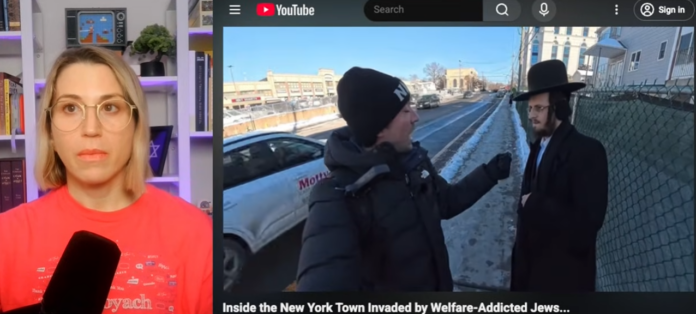
NEW YORK (VINnews) – A YouTuber who grew up in the Hasidic village of Kiryas Joel is pushing back against a viral online video that she says distorts the realities of Hasidic life and relies on provocation to gain attention.
Freide Vizel, a popular content creator and former member of the Satmar Hasidic community, released a response video after YouTuber Tyler Oliveira published a video titled “Inside the New York Town Invaded by Welfare-Addicted Jews,” which has drawn widespread online viewership.
Vizel said the video reinforces harmful stereotypes and presents a misleading picture of the community.

 The Lakewood Scoop
A late-night domestic disturbance in Berkeley Township that escalated into a forced entry and property damage has resulted in a former police officer receiving probation and forfeiting her law enforcement career.
Ocean County Prosecutor Bradley D. Billhimer announced that on January 16, 2026, Rebecca Sayegh, 32, of Toms River, was sentenced by the Honorable Guy P. Ryan, P.J.Cr.P., to a three-year term of probation in connection with a series of incidents that occurred on April 25, 2025. Sayegh previously entered guilty pleas to Burglary, Criminal Mischief, and Simple Assault.
 Matzav
President Donald Trump warned Friday that federal intervention in Minnesota would bring a swift end to unrest tied to immigration enforcement, declaring that state and local leaders are incapable of restoring order.
“In Minnesota, the Troublemakers, Agitators, and Insurrectionists are, in many cases, highly paid professionals. The Governor and Mayor don’t know what to do, they have totally lost control, and our currently being rendered, USELESS! If, and when, I am forced to act, it will be solved, QUICKLY and EFFECTIVELY! President DJT”
The statement was posted to Trump’s Truth Social account as protests continued to intensify in the Twin Cities following several high-profile encounters involving federal immigration agents.
Although Trump did not spell out what steps he might take, his warning came as tensions rose over the expanding role of federal authorities in immigration-related operations across Minneapolis and surrounding areas.
 Vos Iz Neias
By Rabbi Yair Hoffman
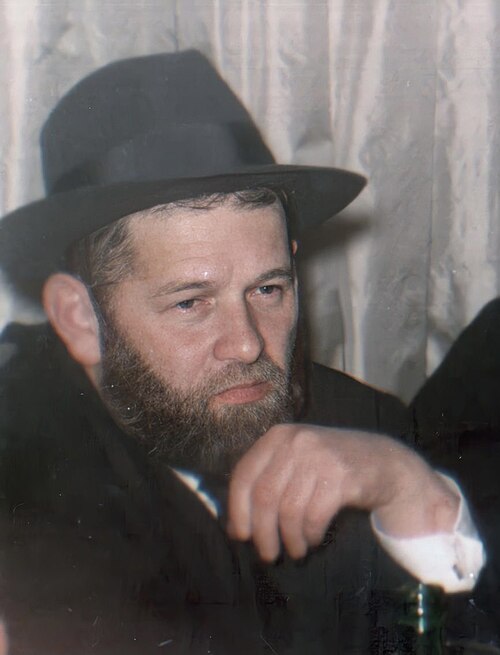
This Motzaei Shabbos, 29 Taives, markes the 63rd yahrtzeit of Rav Aryeh Leib Malin zt”l, While many know him as the founder of Beis HaTalmud in Brooklyn, fewer appreciate the pivotal role he played in one of the greatest rescue operations of the Holocaust: the escape of the entire Mirrer Yeshiva from Nazi-occupied Europe.
His Rebbetzin, Yaffa a”h, once reflected that attempting to portray his character presents an unusual challenge: “There are no ‘stories.’ A great man without ‘stories’—is it possible? Yet, that is indeed the truth. His was a wondrous character that is difficult to describe because it defies description.” What emerges from examining his life, however, is a portrait of a man who lived and breathed Torah with every fiber of his being—and who, at the most critical moment in Jewish history, rose to save an entire world.
 Matzav
President Donald Trump said Friday that he could impose tariffs on other countries if they resist his effort to bring Greenland under U.S. control, tying the issue directly to what he described as American national security interests.
“If they don’t go along with” his push, Trump said, economic penalties could be used. Speaking at the opening of a White House healthcare roundtable, he added, “We need Greenland for national security. So I may do that,” referring to the possible use of tariffs.
Trump has repeatedly argued in recent months that the United States must control Greenland for strategic reasons. The island is a self-governing territory within the Kingdom of Denmark, a status that has been a central point of dispute in Trump’s remarks.
 Matzav
A senior commander in Iran’s Islamic Revolutionary Guard Corps issued an explicit threat against President Donald Trump on Thursday, vowing violent retaliation in response to the president’s warnings about possible U.S. military action against Tehran.
Speaking publicly, Gen. Mohsen Rezaei warned that Iran would respond directly to Trump’s statements about the use of force. “Trump has said his hand is on the trigger. We will cut off his hand and his finger,” Rezaei said, according to Iran International.
Rezaei also made clear that Iran would reject any attempt at de-escalation once hostilities begin. “If we move forward, there will be no talk of a ceasefire anymore,” he said.
 Matzav
Agudath Israel of America commends the Trump administration for easing restrictions on religious workers through a newly issued Interim Final Rule published today in the Federal Register. The rule removes longstanding limitations on religious worker visas (R-1), marking an important step in supporting faith-based institutions and the communities that rely on them.
 Vos Iz Neias
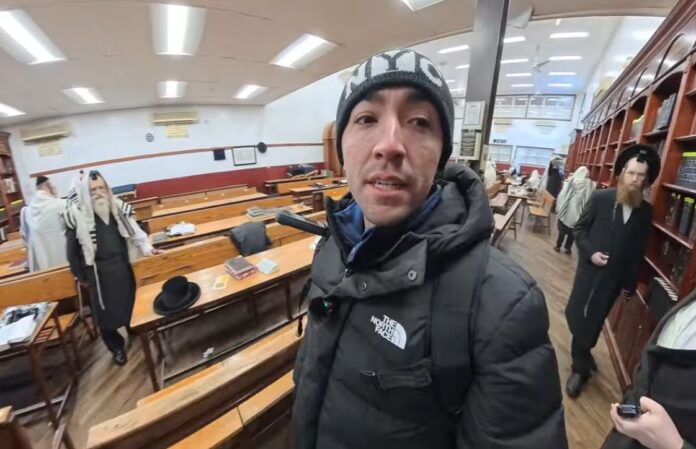
KIRYAS JOEL — Community members are raising alarms over a viral online video and related social media posts they say portray Orthodox Jewish communities in a hostile and inflammatory way, prompting fears the content could attract antisemitic harassment and outside agitators.
A concerned resident said the video’s creator Tyler Oliveira, has been circulating a YouTube video and related posts across multiple platforms and has a large online following. The resident, who shared screenshots of the posts, urged local leaders to warn community members not to speak with anyone attempting to film or provoke confrontations. A post circulating on Instagram claims Oliveira is “investigating Kiryas Joel,” a Hasidic village in Orange County, New York.
 Matzav
Mossad Director David Barnea arrived in the United States on Friday for discussions focused on developments in Iran, according to Israeli officials and others familiar with the visit.
The trip is part of ongoing coordination between Israel and the United States as large-scale protests continue inside Iran and Washington weighs possible military steps in response to the Iranian regime’s actions.
According to those familiar with the matter, Barnea is expected to meet in Miami with White House envoy Steve Witkoff, who has been managing a direct channel between the United States and Iran. Witkoff has remained in contact with Iranian Foreign Minister Abbas Araghchi throughout the unrest. It is still unclear whether Barnea will also meet with President Donald Trump at his Mar-a-Lago residence over the weekend.
 Matzav
The body of Moshe Ludmir, a talmid at the Boyan Yeshiva in Modiin Illit, was recovered on Friday, bringing an end to a days-long search after he disappeared earlier in the week.
Moshe had gone to the Modiin Stream near his yeshiva on Tuesday together with another student in order to enter the water. During the outing, he was carried away by the strong current. The second boy was rescued later that same day and alerted authorities, prompting an extensive search effort that continued until Friday.
Sixteen years old, Moshe was from Beitar Illit and had only recently begun studying at the Tiferes Yisrael Ruzhin Boyan Yeshiva in Modiin Illit, marking his first year at the yeshiva.
 Vos Iz Neias
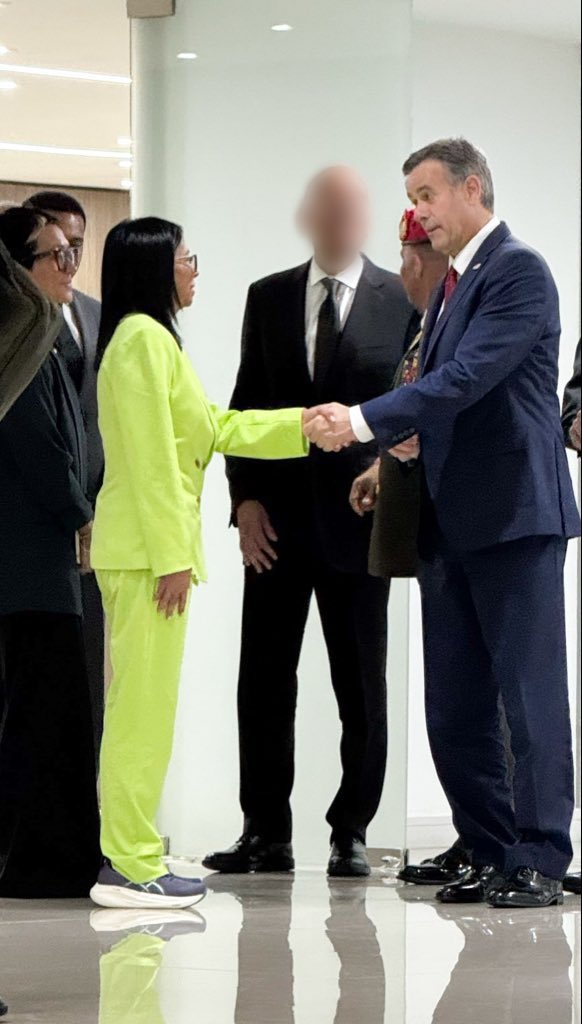
WASHINGTON (AP) — CIA Director John Ratcliffe has traveled to Venezuela to meet with acting President Delcy Rodríguez, becoming the highest-ranking Trump administration official to visit the South American country after the U.S. raid that captured former leader Nicolás Maduro.
The meeting Thursday in Caracas, the capital, lasted two hours, according to a U.S. government official who was not authorized to discuss the matter publicly and spoke Friday on condition of anonymity.
The official said the meeting came at the urging of President Donald Trump and was meant to demonstrate the desire by the U.S. for a better relationship with Venezuela. It occurred the same day Venezuelan opposition leader María Corina Machado presented her Nobel Peace Prize medal to Trump at the White House even as he has effectively sidelined her.
 Vos Iz Neias
WASHINGTON D.C (VINnews) — President Trump spoke by phone Thursday evening with Israeli Prime Minister Benjamin Netanyahu to discuss the ongoing situation in Iran, according to two sources familiar with the conversation.
The call marked their second discussion in two days as Trump weighs options for potential military action or diplomatic engagement with Iran’s regime, which has faced widespread protests and internal upheaval.
During their initial conversation on Wednesday, Netanyahu urged Trump to delay any U.S. military strike against Iran. The request was intended to provide Israel additional time to prepare for possible Iranian retaliation, sources said.
 Vos Iz Neias
LONDON (AP) — The chief of the British police force that recommended that fans from Israeli soccer team Maccabi Tel Aviv be banned from attending a football match against English Premier League side Aston Villa in Birmingham last year retired Friday following criticism of that decision.
Craig Guildford, the chief constable of West Midlands Police, will step down with immediate effect as the head of the force following mounting pressure for him to quit over the controversy. The development was announced by the locally elected police and crime commissioner Simon Foster outside police headquarters in Birmingham.
 Matzav
FOX Business’ Madison Alworth reports cities in Florida and Texas are ready to attract businesses and individuals fleeing New York City’s increasing regulations, rent freezes, and expanded city-run services.
WATCH:
 The Lakewood Scoop
A 40-year-old electric scooter rider was seriously injured after being struck and dragged beneath a pickup truck during a late-night crash in Brick Township last night, authorities said.
Ocean County Prosecutor Bradley D. Billhimer announced that the collision occurred at approximately 10:15 p.m. near Route 88 and Jack Martin Boulevard. Officers from the Brick Township Police Department responded to a report of a motor vehicle crash involving a pickup truck and an electric scooter. An investigation by the Ocean County Prosecutor’s Office Major Crime Unit–Vehicular Homicide Squad, in conjunction with Brick Township police, determined that a 1988 Ford pickup truck traveling westbound on Route 88 attempted to make a right-hand turn into a convenience store parking lot and failed to yield to an electric scooter traveling eastbound, resulting in a head-on collision.
 Vos Iz Neias
CAPE TOWN, South Africa (AP) — South Africa launched an investigation Friday over the participation of Iranian warships in naval drills off its coast after reports that organizers ignored the president’s instructions that the ships only take up observer status so as not to inflame tensions with the United States.
The investigation announced by the Defense Ministry came a day after the U.S. criticized South Africa’s move to host Iranian ships off the coast of Cape Town this week for joint drills that also included the Chinese, Russian and United Arab Emirates navies.
 Matzav
President Donald Trump revealed Thursday that a new governing body, described as a Gaza “board of peace,” has been established as part of the second phase of a U.S.-supported framework aimed at ending the war in Gaza.
Announcing the move on Truth Social, Trump wrote, “It is my Great Honor to announce that THE BOARD OF PEACE has been formed,” adding that the names of those appointed to the body would be released “shortly.”
Trump went on to praise the new panel in sweeping terms, declaring, “I can say with certainty that it is the Greatest and Most Prestigious Board ever assembled at any time, any place.”
The announcement follows the recent unveiling of a separate 15-member Palestinian technocratic committee that is intended to oversee the daily administration of Gaza once major combat operations conclude.
 Matzav
A major Siyum HaShas and Hachnasas Sefer Torah were held at Yeshiva Lev Eliyahu in the Ramat Shlomo neighborhood of Yerushalayim, drawing leading rabbonim and roshei yeshiva from across the spectrum of the Torah world.
The event took place in the yeshiva’s main beis medrash with the participation of Rav Yitzchak Yosef, alongside senior roshei yeshiva and rabbanim. The talmidim completed the study of the entire Shas in memory of the late rosh yeshiva, Rav Yaakov Zechariah and in memory of a close supporter of the yeshiva, Raphael Halevi Esther.
 Vos Iz Neias
NORTH MIAMI BEACH, Fla. — A tragic accident that claimed the life of a beloved bakery worker has sent shockwaves through the Jewish community in South Florida, as police investigate what they believe was an accidental incident involving industrial equipment at a kosher market.
Officers were called Friday morning to the South Florida Kosher Market, located at 1324 NE 163rd St., where Miki Mordechai Grubreger was found dead. Authorities said the incident appears to have involved an industrial dough mixer while Grubreger was preparing to make challah and that there are no signs of foul play.
 Vos Iz Neias
WELLINGTON, New Zealand (AP) — Social media companies have revoked access to about 4.7 million accounts identified as belonging to children in Australia since the country banned use of the platforms by those under 16, officials said.
“We stared down everybody who said it couldn’t be done, some of the most powerful and rich companies in the world and their supporters,” communications minister Anika Wells told reporters on Friday. “Now Australian parents can be confident that their kids can have their childhoods back.”
The figures, reported to Australia’s government by 10 social media platforms, were the first to show the scale of the landmark ban since it was enacted in December over fears about the effects of harmful online environments on young people. The law provoked fraught debates in Australia about technology use, privacy, child safety and mental health and has prompted other countries to consider similar measures.
 Vos Iz Neias
WASHINGTON D.C (VINnews)— U.S. Agriculture Secretary Brooke Rollins on Friday praised the recent reinstatement of whole milk in school cafeterias, describing it as a return to practical nutrition policy after more than a decade of restrictions.
“We got so off course 10, 15 years ago on what’s really good and healthy for American kids… but now, we’re getting back to real common sense,” Rollins said in comments widely shared on social media.
The remarks come days after President Donald Trump signed the Whole Milk for Healthy Kids Act into law on Jan. 14, 2026. The bipartisan legislation reverses Obama-era rules under the 2010 Healthy, Hunger-Free Kids Act that limited milk options in the National School Lunch Program to fat-free or low-fat varieties.
 Matzav
A storm has been brewing behind the scenes within the Israeli Agudas Yisroel’s Chassidishe leadership as pressure mounts over Israel’s proposed draft legislation. According to a report in Hamodia, the Moetzes Gedolei HaTorah of Agudas Yisroel in Eretz Yisroel has decided to reissue a formal resolution originally adopted in 5779 (2019), declaring firm opposition to any draft law that includes sanctions or mandatory enlistment targets and signaling an intention to vote against such legislation.
The decision follows intense internal deliberations within the Moetzes, against the backdrop of political pressure and looming legal threats related to yeshiva deferments. Senior Chassidic leaders made clear that, in their view, there can be no compromise at the expense of full-time Torah learners.
 The Lakewood Scoop
Pinny Braun, owner of Lagom Construction, founder of CJAB and Help Our Friends org, says he finally paid off his car financing, but a comment he received from a friend highlights a major issue with our culture.
Do you agree with this?
 Vos Iz Neias
NEW YORK — New York City Council Speaker Julie Menin on Friday unveiled a sweeping initiative to combat antisemitism, proposing new safety measures for houses of worship and schools as concerns grow over rising hate crimes targeting Jewish New Yorkers.
Menin, the first Jewish speaker in the Council’s history, said the package will include legislation to establish buffer zones around synagogues and religious institutions when protests take place nearby, allowing congregants to enter safely without intimidation.
🔴 LIVE: Speaker Menin and Council Members Announce Legislation and Initiatives to Confront Antisemitism and Hate
 Matzav
Russia has granted citizenship to former Gaza hostage Maksim Harkin, 36, shortly after his release in the most recent deal, the Russian Embassy in Tel Aviv announced on Thursday.
According to the embassy, Russian Ambassador Anatoly Viktorov met this week with Harkin and his mother, Natalia, and informed them of the decision. The report was first disclosed by Itamar Eichner on Kan 11.
In its statement, the embassy said that “Ambassador Viktorov emphasized that, on the instruction of Russian Federation President Vladimir Putin, focused efforts were undertaken to ensure Maksim’s swift return from captivity in Gaza. Russian diplomats maintained continuous contact with their Israeli counterparts and with all relevant parties on this issue, which was of the highest priority for us.”
 Vos Iz Neias
NEW YORK (AP) — Nearly a year into his second term, President Donald Trump’s work on the economy hasn’t lived up to the expectations of many people in his own party, according to a new AP-NORC survey.
The poll from The Associated Press-NORC Center for Public Affairs Research finds a significant gap between the economic leadership Americans remembered from Trump’s first term and what they’ve gotten so far as he creates a stunning level of turmoil at home and abroad.
 Vos Iz Neias
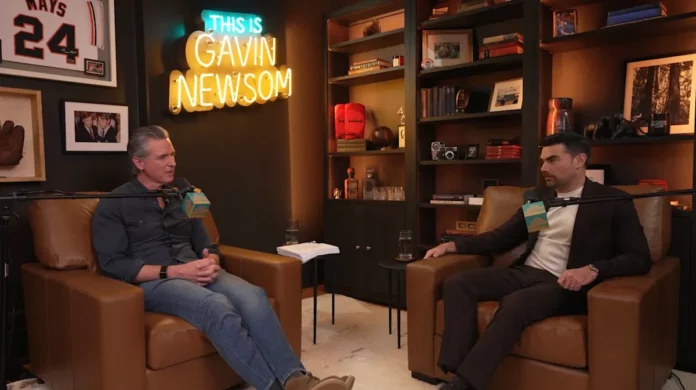
WASHINGTON — California Gov. Gavin Newsom hosted popular Jewish conservative commentator Ben Shapiro on his own podcast, “This Is Gavin Newsom,” in an episode that aired Thursday night, putting the Democratic governor at the center of a wide-ranging national debate over immigration, law enforcement and political rhetoric.
The episode marked one of Newsom’s most prominent conversations with a conservative figure and drew attention for his response to criticism of statements made by members of his own team about U.S. Immigration and Customs Enforcement. Pressed by Shapiro, Newsom said he does not view ICE agents as “terrorists” and does not support abolishing the agency, tempering earlier rhetoric that had sparked backlash.

A viral video circulating online in recent days has ignited backlash across New York’s Orthodox Jewish communities, with critics accusing its creator of trafficking in crude antisemitic tropes to drive engagement.
The video targets Kiryas Joel, a predominantly Chasidic village in Orange County, and was posted by an online influencer who framed the community as dependent on public assistance. The video relies on selective footage and inflammatory language to cast Orthodox Jews as grifters — a depiction mirroring long-standing antisemitic stereotypes.
 Matzav
President Donald Trump was overcome with emotion when a group of freed hostages and their families came to the White House last October, according to his Middle East envoy, Steve Witkoff, who shared the account Thursday night at a major pro-Israel gathering.
Speaking at the opening session of the Israeli-American Council National Summit, Steve Witkoff described a moment that followed the release of 20 hostages, saying the experience struck Trump on a deeply personal level.
“It was deeply personal to President Trump. When we got the 20 hostages home, the last 20, and their families came to the White House, the President pulled me aside. I saw the tears. He doesn’t like anyone to see tears. And he said to me, ‘This is the greatest day I’ve ever had in the White House,’” Witkoff said.
 Vos Iz Neias
HAVANA (AP) — Tens of thousands of Cubans crowded Friday into an open-air plaza known as the “Anti-Imperialist Tribune” across from the U.S. Embassy in Havana to decry the killing of 32 Cuban officers in Venezuela and demand that the U.S. government release former president Nicolás Maduro.
The crowd clutched Cuban and Venezuelan flags as part of a demonstration organized by the government as tensions between Cuba and the U.S. remain heightened after the U.S. struck Caracas on Jan. 3 and arrested Maduro.
“The entire Nation rises up!” wrote Cuba’s Foreign Ministry on X. “It is a resounding response to those who dare to threaten the peace and sovereignty for which we have fought so hard.”
 Vos Iz Neias
WASHINGTON (AP) — The Food and Drug Administration commissioner’s effort to drastically shorten the review of drugs favored by President Donald Trump’s administration is causing alarm across the agency, stoking worries that the plan may run afoul of legal, ethical and scientific standards long used to vet the safety and effectiveness of new medicines.
Marty Makary’s program is causing new anxiety and confusion among staff already rocked by layoffs, buyouts and leadership upheavals, according to seven current or recently departed staffers. The people spoke to The Associated Press on the condition of anonymity because they were not authorized to discuss confidential agency matters.
 The Lakewood Scoop
This week, officials of the Lakewood Board of Education were served with an Order to Show Cause issued by the New Jersey Commissioner of Education seeking to remove the duly elected Board of Education, fire the District’s administration, and place the Lakewood School District under full State takeover.
 Matzav
President Donald Trump has been cautioned by senior advisers that a broad military assault on Iran would probably fail to bring down the regime and could instead trigger a far-reaching regional conflict, according to U.S. officials cited by The Wall Street Journal.
The report said the administration is currently watching closely how Tehran responds to ongoing unrest, with officials weighing the regime’s treatment of protesters before deciding whether any military action is warranted and, if so, how extensive it should be.
U.S. officials said a large-scale operation would require a significant buildup of American forces in the Middle East, both to conduct a sustained strike and to protect U.S. troops and allies, including Israel, from retaliation. American and regional officials warned the White House that even an intense bombing campaign was unlikely to topple Iran’s leadership and could instead ignite a wider war. Limited strikes, they added, might encourage protesters but would not stop the regime’s violent crackdown.
 The Lakewood Scoop
Jackson Township has been awarded $204,000 through the federal Safe Streets and Roads for All (SS4A) Grant Program, a U.S. Department of Transportation initiative aimed at reducing roadway fatalities and serious injuries. Township officials said the funding will support data-driven planning efforts to improve safety for drivers, pedestrians, cyclists, seniors, and individuals with disabilities.
The competitive grant application was spearheaded by Mayor Jennifer Kuhn, whose direct involvement and leadership were credited as key factors in securing the award. Township officials noted that the application process required extensive coordination, organization, and follow-through, prompting the mayor to form an internal team, establish monthly meetings, and ensure consistent progress throughout the process.
 Matzav
President Donald Trump said Thursday night that the second phase of his 20-point peace initiative for Gaza is now underway, describing it as a major step following the ceasefire and expanded humanitarian access to the territory.
“As Steve Witkoff announced, we have OFFICIALLY entered the next phase of Gaza’s 20-Point Peace Plan!” Trump wrote in a post on Truth Social, citing remarks made Wednesday by Steve Witkoff.
Trump said his administration has already made significant progress since the ceasefire took effect. “Since the Ceasefire, my team has helped deliver RECORD LEVELS of Humanitarian Aid to Gaza, reaching Civilians at HISTORIC speed and scale. Even the United Nations has acknowledged this achievement as UNPRECEDENTED. These results have set the stage for this next phase,” he wrote.
 Vos Iz Neias
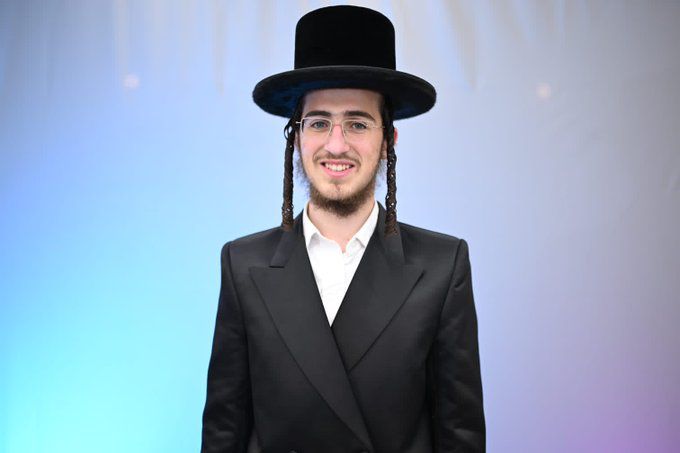
JUDEA-SAMARIA (VINnews)- BD”E After an intensive three-day search operation, emergency services in Israel have recovered the body of 16-year-old Moshe Lodimer, who was swept away by the powerful currents of the Nahal Modi’im stream in Judea and Samaria during a severe rainstorm on Tuesday.
The incident occurred amid heavy rainfall that caused flash flooding in the area near Modi’in Illit. Lodimer, a resident of Beitar Illit and a student at the Tiferet Yisrael Rozhin Boyan Yeshiva in Modi’in Illit, had gone to observe or approach the swollen stream along with a friend. Both were caught in the sudden surge of water, but the friend managed to escape and immediately alerted authorities.
 The Lakewood Scoop
Ongoing disagreements between Mayor Daniel Rodrick and the Township Council were again on display this week, following comments made by the mayor during a recent council meeting. The remarks centered on differences over police promotions, municipal operations, and animal shelter services.
At the meeting, Mayor Rodrick spoke against a proposed ordinance that would extend the current police promotional list. He said extending the list would only benefit a small number of individuals and maintained that creating a new list would be a fairer process for officers seeking advancement. The mayor also stated that the Police Chief does not support extending the existing list.
 Matzav
Large-scale protests across Iran have largely vanished not because the unrest has been resolved, but because heavily armed security forces have effectively confined residents to their homes, according to accounts shared with The New York Post.
After weeks of demonstrations against the regime that reportedly left thousands dead, an overwhelming security deployment has brought public dissent to a halt, with many Iranians now too frightened to leave their homes.
“There were tanks out — there’s tanks everywhere,” one source told The Post after speaking with relatives in Tehran about conditions on the ground.
“There’s trucks that are covered, with 10 people inside with machine guns just aiming them at everyone on the street.”

President Donald Trump and Israeli Prime Minister Benjamin Netanyahu held a phone call on Iran on Friday, according to Axios, underscoring the intensifying — and still apparently unsettled — debate inside the White House over whether to take military action against Tehran.
The conversation marked the second time the two leaders spoke in as many days, Axios reported. Both the White House and the Prime Minister’s Office declined to comment on the substance of the calls.
Behind the scenes, the discussions reflect growing tension between public threats and private caution. During the earlier call, Netanyahu reportedly asked Trump to delay any potential U.S. strike on Iran, arguing Israel would need additional time to prepare for the inevitable retaliation Tehran has promised, according to Axios.
 Vos Iz Neias
JERUSALEM (VINnews) — An Israeli Air Force Black Hawk helicopter crashed Friday morning in the Gush Etzion area of Judea-Samaria while being recovered after an emergency landing earlier this week due to severe weather, the Israel Defense Forces said.
The helicopter, known in the IAF as the Yanshuf (Hebrew for “Owl”), had made a precautionary landing Tuesday in an open area in the Etzion Brigade sector amid difficult weather conditions, according to the IDF.
During the recovery operation, the damaged aircraft became detached from the towing harness while being airlifted by another helicopter — reported as a CH-53 Yasur heavy-lift aircraft — and fell to the ground near residential areas. No injuries were reported in the incident.
 Matzav
California Governor Gavin Newsom appeared to distance himself from the language used by his own communications staff during a contentious interview Thursday with conservative commentator Ben Shapiro, signaling internal disagreement over recent political messaging.
Newsom sat down with Ben Shapiro on Shapiro’s podcast, “This is Gavin Newsom,” where the two sparred over immigration enforcement, political discourse, education policy, and gender identity in a wide-ranging and often combative exchange.
A central moment of tension arose when Shapiro challenged the governor about statements issued by Newsom’s office following the fatal shooting of Renee Good by an ICE officer in Minneapolis, language that described the incident as “state-sponsored terrorism.”
 Matzav
Venezuelan opposition leader Maria Corina Machado said Thursday that she handed President Trump her Nobel Peace Prize during a meeting at the White House, confirming a highly symbolic gesture that followed weeks of public discussion about the award.
“I presented the president of the United States the medal, the Nobel Peace Prize,” Machado told reporters on Capitol Hill.
An image obtained by The Post showed Trump standing in the Oval Office with the framed medal, while Machado stood beside him during the meeting.
The inscription on the medal read: “To President Donald J. Trump. In gratitude for your extraordinary leadership in promoting peace through strength, advancing diplomacy, and defending liberty and prosperity.”
 Matzav
LISTEN:
https://matzav.com/wp-content/uploads/2026/01/Bitachon4Life-Shiur-1682-Chikuy-Part-82-Reconnect.mp3
For more info, email bitachon4life@gmail.com.
 Vos Iz Neias
by Rabbi Yair Hoffman
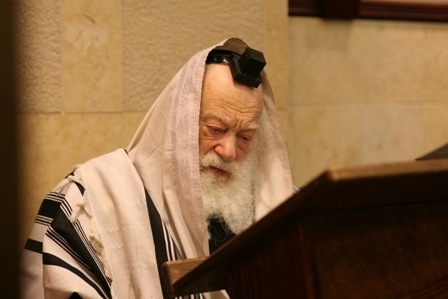
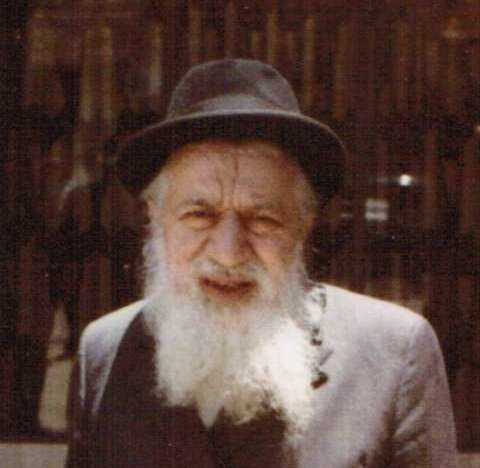
His life spanned vastly varied geographic areas. The cobblestoned streets of Knyszyn, Poland; the yeshiva halls of Baranovich and Mir; the frozen expanse of Siberia; the sweltering beis medrash in Shanghai, and finally to Ocean Parkway in Flatbush. Yet in truth, he never really moved at all. For Rav Shmuel zt”l was only in one place alone: the Beis Medrash with a blatt Gemara before him on a shtender. Sometimes the shtender was physical and sometimes it was figurative – but it was always there.
This Shabbos the 28th of Taives, marks the 17th yahrtzeit of one of the most towering Torah giants of the past century – a man whose legendary hasmodah and boundless love for his talmidim transformed thousands of American boys into bnei Torah. And a gadol whose radiant simchas haTorah illuminated the lives of all who knew him. He was one of the last binding links with the greatness, glory and grandeur of the Torah giants who learned and developed in the Eastern European Torah centers, and then came to the United States and reached out to American youth. Through this interaction, these marbitzei Torah helped transplant and create a flourishing Torah community in a place that had been a veritable Torah desert.
 Vos Iz Neias
By Rabbi Yair Hoffman
The Nazi storm trooper pulled out his revolver and aimed it at the young rabbi’s head.
“Say your last prayers,” he commanded. “Turn your face to the wall.”
It was Succos 1939. Pinchas Hirschprung was twenty-seven years old. Just moments earlier, the Gestapo had delivered devastating news: the Jews of Dukla—his hometown in southeastern Galicia—had exactly sixteen hours to leave. They could take only what they could carry. And he, the young Torah genius who had returned home to help his community, had been chosen to deliver this death sentence to his own people.

The head of the Anti-Defamation League is openly coordinating with conservative lawmakers and media figures to confront what he described as a growing strain of antisemitism on the American right.
Speaking during a panel discussion in Los Angeles, ADL CEO Jonathan Greenblatt said he has been working “behind the scenes” with Sen. Ted Cruz and other conservatives to counter figures he labeled “revolting lunatics,” naming Tucker Carlson and Nick Fuentes.
“I think the only way we are going to defeat the rise in antisemitism on the right is from the right,” Greenblatt said.
While criticizing Carlson, Fuentes and Candace Owens, Greenblatt praised responsible conservative voices, including Cruz, Ben Shapiro, Mark Levin and House Speaker Mike Johnson, for pushing back against extremist rhetoric.
The head of the Anti-Defamation League is openly coordinating with conservative lawmakers and media figures to confront what he described as a growing strain of antisemitism on the American right.
Speaking during a panel discussion in Los Angeles, ADL CEO Jonathan Greenblatt said he has been working “behind the scenes” with Sen. Ted Cruz and other conservatives to counter figures he labeled “revolting lunatics,” naming Tucker Carlson and Nick Fuentes.
“I think the only way we are going to defeat the rise in antisemitism on the right is from the right,” Greenblatt said.
While criticizing Carlson, Fuentes and Candace Owens, Greenblatt praised responsible conservative voices, including Cruz, Ben Shapiro, Mark Levin and House Speaker Mike Johnson, for pushing back against extremist rhetoric.

Clearing the vast devastation left across the Gaza Strip could take close to a decade, a senior United Nations official warned Friday, underscoring the scale of destruction even as a second phase of a U.S.-backed peace plan is set to begin.
After visiting Gaza, Jorge Moreira da Silva, the U.N. under-secretary-general and executive director of UN Office for Project Services, said the enclave is buried under more than 60 million tons of rubble — nearly enough to fill 3,000 container ships.
“It is likely to take over seven years to clear this rubble,” Moreira da Silva said in a statement. “Driving through endless roads of rubble, the level of destruction is overwhelming. Homes, schools, clinics, roads, water and electricity systems have been levelled or severely damaged.”

New York City Mayor Zohran Mamdani has weighed into a volatile immigration and free-speech fight, voicing public support for pro-Hamas activist Mahmoud Khalil after a federal judge cleared the way for the Trump administration to resume efforts to deport him.
“Last year’s arrest of Mahmoud Khalil was more than just a chilling act of political repression; it was an attack on all of our constitutional rights,” Mamdani wrote on X. “Now, as the crackdown on pro-Palestinian free speech continues, Mahmoud is being threatened with rearrest. Mahmoud is free — and must remain free.”

An Israeli Air Force Black Hawk helicopter crashed Friday morning during a recovery operation after it was forced to make an emergency landing earlier this week because of severe weather, the IDF said.
According to the military, the helicopter landed Tuesday in an open area in Gush Etzion after encountering difficult weather conditions. The aircraft was damaged in the landing but there were no injuries.
During efforts to airlift the helicopter out of the area on Thursday, the aircraft became detached mid-recovery and crashed, the IDF said. No personnel were hurt in the incident.

A hardline cleric leading Friday prayers in Iran’s capital publicly demanded the execution of protesters swept up in the regime’s nationwide crackdown, as Tehran weighs its next steps amid mounting domestic unrest and international pressure.
Speaking at Tehran’s main weekly prayers, Ahmad Khatam called for the death penalty for detainees accused of involvement in the protests and urged authorities to arrest “anyone who supported the rioters in any way.”
His sermon, broadcast live on Iranian state radio, drew chants from worshippers including, “Armed hypocrites should be put to death!”
The remarks come as executions — along with the killing of peaceful protesters — have been identified by Donald Trump as red lines that could trigger U.S. military action, sharply raising the stakes for Iran’s leadership as it seeks to reassert control.

Mossad Director David Barnea has arrived in the United States for a series of consultations focused on Iran’s violent crackdown on nationwide protests and the possibility of an American military response, according to a report by Axios.
The senior Israeli intelligence official is expected to meet with White House envoy Steve Witkoff in Miami. Witkoff is reportedly overseeing direct lines of communication between Washington and Tehran amid the growing crisis.
It remains unclear whether Barnea will also meet with US President Donald Trump, who is expected to spend the weekend at his Mar-a-Lago resort in Florida.
According to the report, Israel has urged President Trump to delay any potential military action against Iran, citing concerns that the Jewish state would likely face significant retaliation in the event of a major US strike.
 Vos Iz Neias
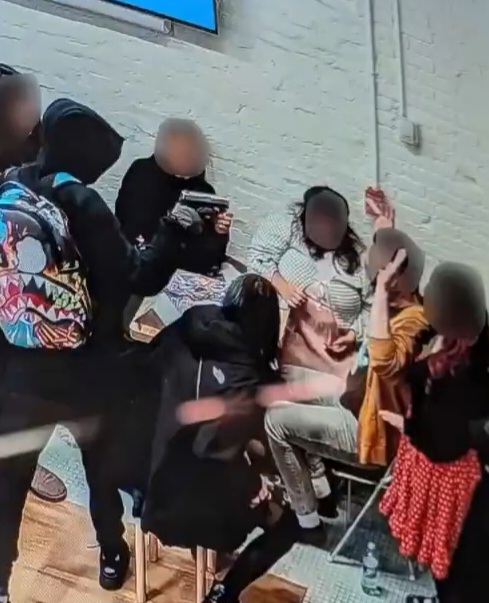
NEW YORK CITY (VINnews)-In a shocking incident that has left the Pokémon community rattled, three masked suspects stormed a popular Pokémon trading card store in Manhattan on Wednesday evening, holding dozens of customers at gunpoint and making off with more than $100,000 worth of merchandise.
The robbery occurred at The Poké Court, located at 412 West 13th Street in the Meatpacking District (also referred to as Chelsea or West Village areas), around 6:45 p.m. on January 14, 2026. The store, which opened last November, was hosting its first-ever community event—an arts and crafts gathering—with more than 40 customers and staff inside when the armed individuals burst in.

After days of searching, tefillos, and hope for a neis, the body of the yeshiva bochur, Moshe Ludmir, z’l, 16, was found on Friday, three days after he was swept into a stream near his yeshivah in Modiin Illit.
His body was pulled from the water by United Hatzalah volunteers, who searched for him for hours together with thousands of Jews from Modiin Illit and beyond.
The incident occurred on Tuesday when the niftar went with a friend to toivel in the stream, as was his minhag during the days of Shovavim. At the time, the water flow in the stream was particularly strong following heavy rains, and the two were caught in a sudden flash flood and a powerful water whirlpool.
After days of searching, tefillos, and hope for a neis, the body of the yeshiva bochur, Moshe Ludmir, z’l, 16, was found on Friday, three days after he was swept into a stream during a storm on Tuesday near his yeshivah in Modiin Illit.
The niftar, z’l, was born to his father, Reb Tzvi Hirsch Ludmir, a chashuve member of the Boyaner community in Beitar Illit.
His friends describe him as a masmid with much yiras Shamayim. He had a close relationship with the Boyaner Rebbe.
His father, who was with a family member abroad for medical care, rushed back to Israel when his son disappeared. Meanwhile, the chasunah of his daughter (the niftar’s sister) is in another week.
 Vos Iz Neias
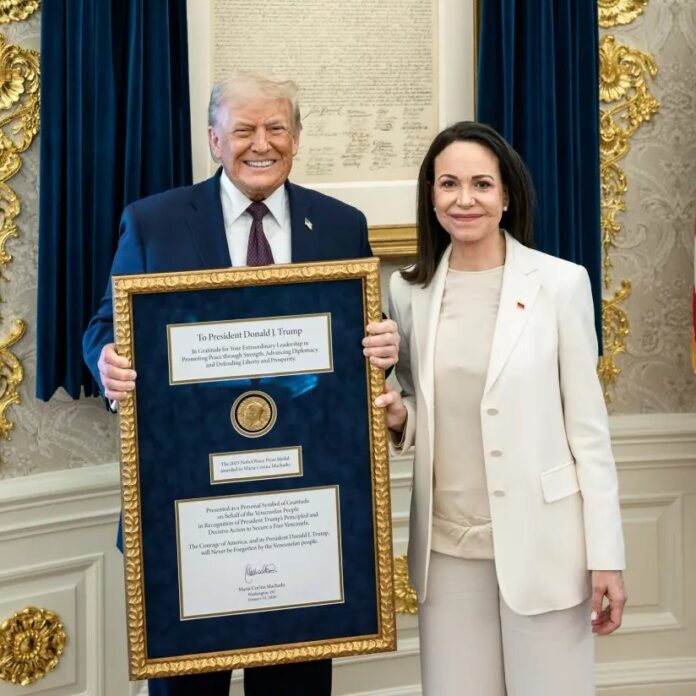
WASHINGTON D.C — Venezuelan opposition leader María Corina Machado presented President Donald Trump with her 2025 Nobel Peace Prize medal during a private meeting in the Oval Office on Thursday, a symbolic gesture recognizing his role in supporting Venezuela’s push for democracy.
The presentation took place beneath a portrait of George Washington. Machado told reporters afterward that she drew a historical parallel to an event 200 years ago, when Revolutionary War hero Marquis de Lafayette gave Simón Bolívar — Venezuela’s independence leader — a medal bearing Washington’s likeness.
 Matzav
A new video by independent journalist Nick Shirley is drawing fresh attention to allegations of widespread fraud within Minnesota’s Medicaid-funded transportation system, forcing long-ignored concerns into the public eye and prompting renewed scrutiny from both media outlets and federal officials.
In the footage, Shirley visits multiple locations in Minneapolis that he says operate as hubs for taxpayer-funded transportation services intended for low-income or medically vulnerable residents. At several stops, individuals he identifies as ethnic Somalis angrily confront him, but do not, in his account, provide proof that the organizations in question are delivering services to Americans as required under the programs.
 Matzav
A dramatic story of middah k’neged middah has emerged following the near-drowning of a yeshiva student in the Modiin area earlier this week, a rescue his family believes was foreshadowed by a powerful dream and preceded by a quiet act of kindness.
Search efforts have continued for a third day for Moishe Ludmir, a student at the Boyan yeshiva in Modiin Illit, who was swept away by strong currents. His close friend, Shimi Rosenblatt, attempted to save him and was himself carried into the rushing waters. Shimi survived the ordeal and escaped with his life, which his family describes as nothing short of a miracle.
 Vos Iz Neias
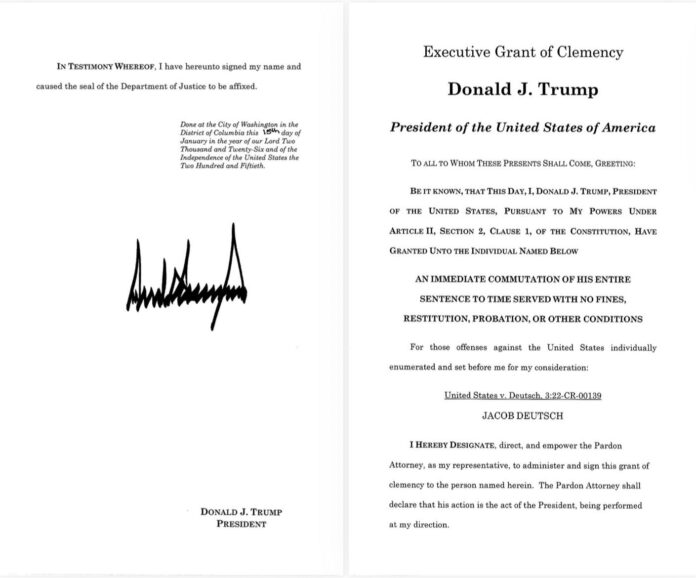
HARTFORD, Conn. — President Donald Trump has commuted the prison sentence of Jacob Deutsch of Williamsburg, leading to his release after nearly 22 months behind bars for his role in a wide-ranging mortgage fraud scheme involving apartment buildings in Hartford.
The decision followed sustained advocacy by the Tzedek Association, which argued that Deutsch’s punishment far exceeded what the facts of the case warranted. Supporters said the case involved no violence, no financial loss to lenders and no restitution owed, yet Deutsch received a sentence that was nearly three times longer than what prosecutors had sought.
 Vos Iz Neias
(AP) – A U.S. citizen on her way to a medical appointment in Minneapolis was dragged out of her car and detained by immigration officers, according to a statement released by the woman on Thursday, after a video of her arrest drew millions of views on social media.
Aliya Rahman said she was brought to a detention center where she was denied medical care and lost consciousness. The Department of Homeland Security said she was an agitator who was obstructing ICE agents conducting arrests in the area.
That video is the latest in a deluge of online content that documents an intensifying immigration crackdown across the midwestern city, as thousands of federal agents execute arrests amid protests in what local officials have likened to a “federal invasion.”
Vos Iz Neiasby Rabbi Yair Hoffman
His life spanned vastly varied geographic areas. The cobblestoned streets of Knyszyn, Poland; the yeshiva halls of Baranovich and Mir; the frozen expanse of Siberia; the sweltering beis medrash in Shanghai, and finally to Ocean Parkway in Flatbush. Yet in truth, he never really moved at all. For Rav Shmuel zt”l was only in one place alone: the Beis Medrash with a blatt Gemara before him on a shtender. Sometimes the shtender was physical and sometimes it was figurative – but it was always there.
 Matzav
Renaming the Department of Defense as the Department of War could cost American taxpayers anywhere from a few million dollars to as much as $125 million, depending on how aggressively the change is carried out, according to a new analysis released Wednesday by the Congressional Budget Office, the AP reports.
President Donald Trump authorized the use of “Department of War” as a secondary title for the Pentagon through an executive order signed in September. At the time, Trump said the move was meant to project American strength abroad and criticized the existing department name as being “woke.”
The executive order was issued as the U.S. military launched a series of lethal airstrikes against suspected drug-smuggling vessels in South America. In the months that followed, U.S. forces carried out a dramatic operation that resulted in the capture of Venezuelan President Nicolás Maduro, while the Trump administration publicly weighed potential military action involving Iran and even Greenland.
 Matzav
Rav Yitzchok Refoel Abuchatzeira was elected on Thursday evening as the new chief rabbi of the city of Ramla, securing an overwhelming majority of 31 votes out of 36 cast by the municipal rabbinical electoral body.
The announcement was made at the conclusion of the official vote count by the election committee responsible for selecting the city’s chief rabbi. The appointment marks the tenth chief rabbi selected during the current term.
Rav Abuchatzeira is the son of Rav Yechiel Abuchatzeira, the outgoing chief rabbi of Ramla, and the grandson of the renowned kabbalist and former chief rabbi of the city, the . He is also the nephew of Rav Avraham Abuchatzeira, another prominent rabbinic figure in the city.
 Matzav
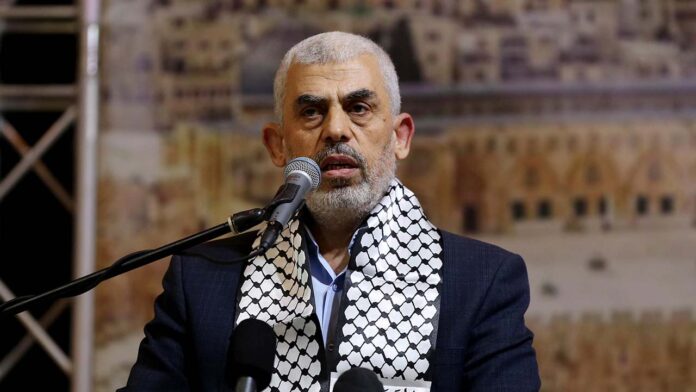
The commander of the ground unit that killed Hamas leader Yahya Sinwar has spoken publicly about the mission for the first time, describing the intelligence trail, the moment of identification, and the emotions that followed the elimination of the October 7 mastermind.
Lt. Col. Ran shared his account during an interview on Shlomi Adler’s All in podcast, explaining that the night before the operation was filled with uncertainty and disbelief. “I was awake all night,” Ran recounted. “I kept telling myself, you’re imagining it. Don’t try to connect the dots. I gathered the company commanders, showed them yesterday’s drone image, and said: tell me, who does this look like?”
After zeroing in on a suspicious structure, the force moved in on foot, entered the building, and conducted a thorough search that led to Sinwar’s identification. Ran described the scene that followed the confirmation. “We’re standing over the body, smiling at each other, and saying: ‘Wow, this is Sinwar.’ It’s an insane closing of the circle.”
 Matzav
Following the announcement that MK Yisrael Eichler has been appointed Deputy Communications Minister and has rejoined the coalition, a sharp public exchange erupted between senior Agudas Yisroel figure Moti Babchik and media personality Yinon Magal.
As reported earlier, Israeli Prime Minister Bibi Netanyahu succeeded in bringing Eichler, a representative of the Belzer chassidus, back into the government by awarding him the deputy ministerial post, despite opposition within parts of Agudas Yisroel, particularly from the Gerer chassidus. The move effectively returned Agudas Yisroel to the coalition.
Magal quickly mocked the development on social media, posting sarcastically: “Breaking: Babchik’s car has been found abandoned at Tzuk Beach.” The jab alluded to Babchik’s reputation as a dominant power broker within Agudas Yisroel and suggested—tongue in cheek—that he had been outmaneuvered by Belz following Eichler’s return.
 The Lakewood Scoop
I am writing to respectfully share a perspective regarding the role of eating during class time and its potential impact on student behavior and learning.
Although it is commonly believed that eating during class can be distracting, my personal experience shows that this is not necessarily true. Since I started attending college, having small, light snacks during class has actually helped me focus and stay engaged, allowing me to absorb and retain information more effectively.
Allowing students to have small snacks—such as chips, pretzels, or similar items provided by the school—during longer class periods can help keep them occupied in a positive way and support their attention. When children’s minor physical needs are met, they are less likely to become restless or distracted, which benefits both learning and classroom behavior.
 Matzav
President Donald Trump said that while Reza Pahlavi comes across as personable, he is unconvinced that Iranians would embrace the exiled shah’s son as a leader if the current Islamist regime were to collapse, and he suggested the situation has not yet reached the stage where succession planning is appropriate.
Speaking to Reuters, Trump also indicated that the wave of unrest sweeping Iran — now in its second week and marked by heavy-handed repression — has not progressed to the point where discussions about who might replace Supreme Leader Ali Khamenei should take place.
Opposition groups say demonstrations have erupted in as many as 195 cities since late December, with protesters demanding an end to the hardline rulers who have governed since 1979. Authorities have responded with mass detentions and lethal force, mirroring past crackdowns. Some estimates claim up to 20,000 people may have been killed over the past month. Despite the scale of the unrest, there has been no clear emergence of a single opposition figure capable of leading a post-Khamenei transition, leaving the question of future leadership unresolved.
 Vos Iz Neias
FORT LAUDERDALE, FLA. (VINnews) — Spirit Airlines, the Dania Beach-based ultra-low-cost carrier, announced Thursday it will expand service to 15 destinations from its South Florida hubs this spring, offering more options for travelers during the peak March spring break season.
The airline said it will increase frequencies to 13 destinations from Fort Lauderdale-Hollywood International Airport (FLL) starting March 12. From Miami International Airport (MIA), Spirit will boost service to Chicago O’Hare and Detroit to twice daily.
 Matzav
President Donald Trump said Wednesday that he is not currently planning to remove Federal Reserve Chair Jerome Powell, even as the Justice Department conducts a criminal investigation involving the central bank leader, adding that it is still too soon to decide what steps he may ultimately take.
Responding to questions from Reuters about whether he intended to dismiss Powell, Trump said, “I don’t have any plan to do that,” signaling no immediate action against the Fed chair.
Pressed on whether the existence of the investigation could justify Powell’s removal, Trump indicated that the situation remains unresolved. “Right now, we’re (in) a little bit of a holding pattern with him, and we’re going to determine what to do. But I can’t get into it. It’s too soon. Too early.”
Trump also pointed to potential successors should a change occur, naming former Federal Reserve Governor Kevin Warsh and National Economic Council Director Kevin Hassett as leading possibilities. He said Treasury Secretary Scott Bessent would not be considered, explaining that Bessent prefers to remain in his current role. “The two Kevins are very good,” Trump said. “You have some other good people too, but I’ll be announcing something over the next couple of weeks.”
 The Lakewood Scoop
A bill that would require all electric bikes in New Jersey to be licensed, registered and insured is now just one step away from becoming law following passage by both houses of the state Legislature, which sent it to Governor Murphy for his signature.
The bill, which is sponsored by Senate President Nick Scutari, would eliminate all e-bike classifications and redefines “motorized bicycle” to include any pedal bicycle with an electric motor that assists pedaling or can exclusively propel the bike via throttle.
 Matzav
Venezuelan opposition figure Maria Corina Machado held talks with President Donald Trump on Thursday in a meeting the White House described as constructive, even as Trump has publicly questioned her political standing at home and mused aloud about whether he, rather than Machado, deserved a Nobel Peace Prize.
Trump has repeatedly said that Machado lacks broad backing among Venezuelans following the removal of longtime leader Nicolas Maduro, and he has instead expressed support for Maduro’s deputy, Delcy Rodriguez, who now serves as interim president.
Seeking to maintain a favorable relationship with Trump, the 58-year-old opposition leader has gone so far as to suggest sharing her Nobel Peace Prize with him. Trump has indicated that such a gesture could occur when the two meet.
 The Lakewood Scoop
ONLY 3 Days Left!!
Win $100,000.00!
ONLY $36 a Ticket!
1 For $36
8 For $100
ONLY 3 Days Left!!
Win $100,000.00!
ONLY $36 a Ticket!
1 For $36
8 For $100
 Vos Iz Neias
 The Lakewood Scoop
 Matzav
The Kremlin said Thursday that it shares President Donald Trump’s view that Ukrainian President Volodymyr Zelenskyy, rather than Russia, is responsible for the lack of progress toward a deal to end the war in Ukraine.
Trump’s remarks, delivered in an interview with Reuters, diverge from the position of many European governments, which argue that Moscow has little incentive to stop the fighting and is instead seeking to seize additional territory while avoiding harsher Western sanctions.
Speaking from the Oval Office on Wednesday, Trump expressed confidence in Russian President Vladimir Putin’s willingness to reach an agreement. “I think he’s ready to make a deal,” Trump said of Putin when speaking to Reuters in the Oval Office on Wednesday. “I think Ukraine is less ready to make a deal.”
 Vos Iz Neias
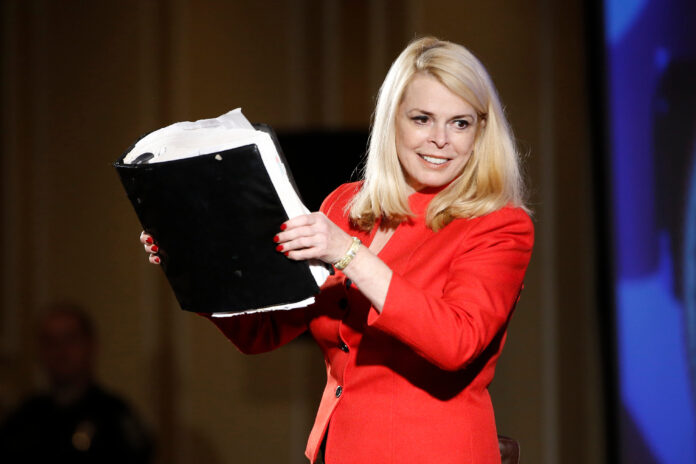
HARTFORD, Conn. (AP) — Betsy McCaughey, a Republican former lieutenant governor of New York who switched parties in an unsuccessful 1998 bid to unseat then-Gov. George Pataki, is now running for governor of Connecticut.
McCaughey, 77, currently a conservative host on Newsmax and columnist for the New York Post, filed the official paperwork on Thursday to seek the Republican nomination to challenge Democratic Gov. Ned Lamont, who is running for a third term. She first announced her candidacy on Wednesday evening.
McCaughey (pronounced like McCoy), a resident of the wealthy New York City suburb of Greenwich, Connecticut, said her friends and social media followers urged her to run for governor.
 Vos Iz Neias
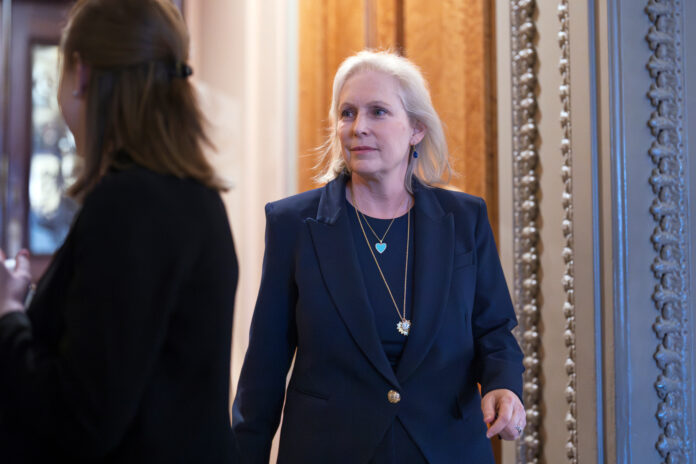
WASHINGTON (AP) — Two senators from opposite parties are joining forces in a renewed push to ban members of Congress from trading stocks, an effort that has broad public support but has repeatedly stalled on Capitol Hill.
Democratic Sen. Kirsten Gillibrand of New York and Republican Sen. Ashley Moody of Florida on Thursday plan to introduce legislation, first shared with The Associated Press, that would bar lawmakers and their immediate family members from trading or owning individual stocks.
It’s the latest in a flurry of proposals in the House and the Senate to limit stock trading in Congress, lending bipartisan momentum to the issue. But the sheer number of proposals has clouded the path forward. Republican leaders in the House are pushing their own bill on stock ownership, an alternative that critics have dismissed as watered down.
 Matzav
In response to the unique challenges faced by bnei Torah arriving from abroad, Gedolei Yisroel have released a special letter of chizuk directed to yeshiva bochurim from France. The letter was issued by the leader of the Olam HaTorah, Rav Moshe Hillel Hirsch, together with Rav Dovid Cohen, calling on French bochurim to unite under a new initiative of Ichud Bnei HaYeshivos designed to ease their integration into yeshiva life.
The letter publicly endorses the establishment of a dedicated spiritual support framework for bochurim from France, marking the first time that Ichud Bnei HaYeshivos has expanded its activities beyond Israel’s borders into the international arena.
 The Lakewood Scoop
 Matzav
A new poll released Thursday evening by Channel 14 presents an updated snapshot of Israel’s political landscape, pointing to a significant internal shakeup within the left-wing bloc, even as the ruling party remains firmly on top.
According to the survey, the Likud continues to lead the field with 35 seats, maintaining its position as the largest party if elections were held today. In contrast, the momentum of Naftali Bennett appears to have stalled, with his party slipping to 11 seats, down from 13 in the previous poll.
At the same time, the biggest gainer of the week is the Democrats party led by Yair Golan, which surged by three seats to reach 11 mandates, signaling a notable shift within the left-wing camp.
 Vos Iz Neias
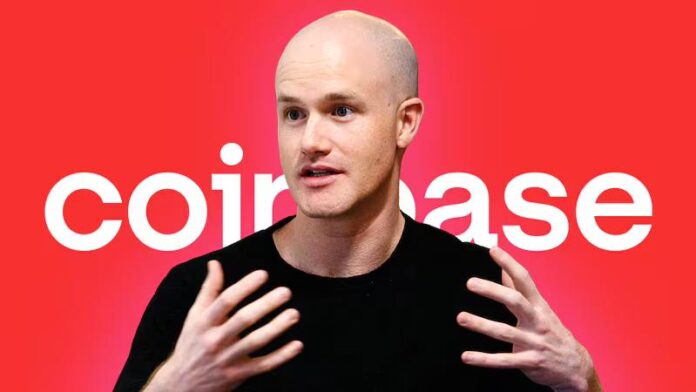
WASHINGTON D.C (VINnews)— Coinbase CEO Brian Armstrong voiced strong opposition Thursday to a major cryptocurrency regulation bill during a CNBC interview on Capitol Hill, hours after the Senate Banking Committee postponed a planned markup session amid industry pushback.
The legislation, unveiled Monday by the Senate Banking Committee and known as the Digital Asset Market Clarity Act, aims to classify crypto tokens as securities, commodities or other categories while clarifying oversight between the Securities and Exchange Commission and the Commodity Futures Trading Commission.

 Boropark24
By Y.M. Lowy
Verizon says it is offering a $20 account credit to customers affected by Wednesday’s outage.
The credit can be found in the myVerizon app once it becomes available, and customers should receive a text message when it shows up. Business customers will be contacted directly.
The outage began late Wednesday morning and impacted wireless calls and data across the country. For hours, phones could not make regular calls or use data, though emergency 911 calls were still able to go through. Verizon says service was fully restored later that night and recommends restarting your phone if you’re still having trouble.
In a statement, Verizon admitted it did not meet expectations during the outage and said the credit is meant to cover multiple days of service on average.
 Matzav
Apartment seekers in Manhattan saw little relief this winter, with rents remaining near historic highs and competition showing few signs of easing.
Data from appraiser Miller Samuel Inc. and brokerage Douglas Elliman show that the median rent for new leases signed last month reached $4,720, representing an increase of nearly 9% compared with December a year earlier. That figure was only $30 below November’s median rent, which marked the highest level ever recorded by the firms.
Although New York’s rental market usually slows during the holiday season, that pattern failed to materialize. Competition for available apartments stayed strong throughout the year, even as the number of listings shrank. Inventory in December was down 16% from the same month last year, the steepest annual decline since the surge in leasing activity seen during the pandemic-era rush in August 2022.
 Vos Iz Neias
WASHINGTON (AP) – The average long-term U.S. mortgage rate is now down to its lowest level in more than three years.
The benchmark 30-year fixed rate mortgage rate eased to 6.06% this week, down from 6.16% last week, mortgage buyer Freddie Mac said Thursday. One year ago, the rate averaged 7.04%.
The last time the average rate was lower was Sept. 15, 2022, when it was at 6.02%.
Meanwhile, borrowing costs on 15-year fixed-rate mortgages, popular with homeowners refinancing their home loans, also fell this week, dropping to 5.38% from 5.46% last week. A year ago, that average rate was at 6.27%, Freddie Mac said.
 The Lakewood Scoop
In a small, old 40-square-meter apartment in Yerushalayim, lives R’ Yosef Kornblit – a true Yirei Shamayim, a father of 15 children, raising each one with love, simplicity, and deep Emunah.
Eight are already married.
Now – three more children got engaged, one after the other.
The first wedding is just three weeks away.
—
On the table lie three wedding invitations.
But no way to make them happen.
 Vos Iz Neias
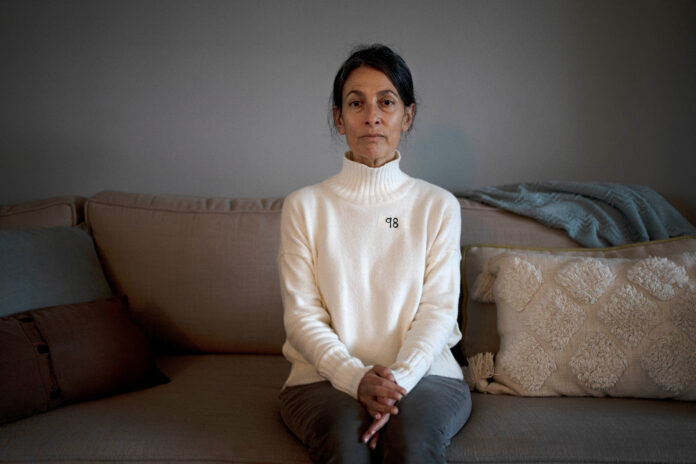
NEW YORK (AP) — Rachel Goldberg-Polin, who has become known worldwide for her advocacy on behalf of her son and others abducted by Hamas-led militants on Oct. 7, 2023, has a memoir coming out this spring.
Random House, an imprint of Penguin Random House, announced Thursday that “When We See You Again” will be published April 21.
“I sat down to write my pain, and out poured loss, suffering, love, mourning, devotion, grief, adoration and fracturedness,” Goldberg-Polin, a Chicago-born educator who now lives in Jerusalem, said in a statement. “This book recounts the first steps of a million-mile odyssey that will take the rest of my life to walk on shattered feet.”
 Matzav
Israeli Prime Minister Bibi Netanyahu asked President Donald Trump to hold off on any military action against Iran, according to a report published by The New York Times.
The two leaders spoke by phone around midnight, as protests continued across Iran and U.S. officials weighed whether to move forward with a possible strike.
During the call, Netanyahu conveyed concern that Israel is not fully prepared for an Iranian retaliation if the United States were to launch an attack, and he therefore requested that Trump postpone any military operation.
Trump has said he was informed by what he described as reliable sources inside Iran that the regime had stopped executing protesters and halted violent crackdowns, a development that could suggest efforts to reduce tensions.

President Donald Trump on Thursday commuted the federal prison sentence of R’ Yaakov Chaim Deutsch, a 60-year-old resident of Williamsburg, bringing an early end to a punishment that advocates and supporters long argued was grossly disproportionate to the offense.
Deutsch had been serving a 62-month prison sentence and had already completed approximately 24 months behind bars at the time of the commutation. The sentence drew widespread criticism because federal prosecutors in the case had sought a maximum of 18 months, yet the court imposed more than three times that amount.
The offense was non-violent, resulted in no victims, and caused no financial loss, with no restitution ordered. Several co-defendants in the same matter received no prison time at all, further intensifying arguments that Deutsch’s punishment was unusually harsh.

Venezuelan opposition leader María Corina Machado said she presented her Nobel Peace Prize medal to President Donald Trump at the White House on Thursday even as he has questioned her credibility to take over her country after the U.S. ousted then-President Nicolás Maduro.
The Nobel Institute has said Machado could not give her prize to Trump, an honor that he has coveted. Even if it the gesture proves to be purely symbolic, it was extraordinary given that Trump has effectively sidelined Machado, who has long been the face of resistance in Venezuela. He has signaled his willingness to work with acting President Delcy Rodríguez, who had been Maduro’s second in command.

After weeks of escalating tension, U.S. and Iranian officials faced each other Thursday at the U.N. Security Council, where America’s envoy renewed threats against the Islamic Republic despite President Donald Trump’s efforts to lower the temperature between the two adversaries.
The U.S. was joined by Iranian dissidents in rebuking the government’s bloody crackdown on nationwide protests that activists say have killed at least 2,677 people.
“Colleagues, let me be clear: President Trump is a man of action, not endless talk like we see at the United Nations,” Mike Waltz, U.S. ambassador to the U.N., told the council. “He has made it clear that all options are on the table to stop the slaughter. And no one should know that better than the leadership of the Iranian regime.”

The White House says that Iran halted hundreds of planned executions after President Donald Trump warned Tehran against killing protesters, marking a dramatic — and unverified — pause amid a brutal crackdown by the Islamic Republic.
White House press secretary Karoline Leavitt told reporters that as many as 800 executions scheduled to take place the previous day were called off following direct U.S. messages to Iranian officials.
“The president and his team have communicated to the Iranian regime that if the killing continues, there will be consequences,” Leavitt said. “The president understands today that 800 executions that were scheduled and supposed to take place yesterday were halted.”
 Vos Iz Neias
NEW YORK (AP) — For a moment, Eric Adams was riding high.
Fresh off trips to Dubai and the Democratic Republican of Congo, the now jobless ex-mayor of New York City was back in Times Square on Monday to announce his first initiative as a private citizen: a new cryptocurrency coin that would also serve to beat back antisemitism and “anti-Americanism.”
“We’re about to change the game,” he promised, without describing how, exactly, the digital asset would support those lofty ambitions. “This thing is going to take off like crazy.”
But after surging to a nearly $600 million valuation within minutes of its launch, the new coin, dubbed NYC Token, went into free fall, losing nearly 75% of its value by that evening. The drop came after an account linked to the token’s creation withdrew $2.5 million worth of coins, according to the crypto-analytics firm Bubblemaps.

A U.S. Jewish legal organization is urging New York’s attorney general to widen her scrutiny of political activism, two days after her office announced a settlement with the far-right Jewish group Betar.
Attorney General Letitia James said Tuesday that Betar had harassed individuals based on Arab, Muslim and Jewish identities, agreed to halt those activities, and would cease operations in New York. The action drew a reaction from the National Jewish Advocacy Center, which now wants similar investigations opened into two prominent anti-Zionist groups: Within Our Lifetime and Al-Awda.
In a letter to James, the group cites alleged antisemitic hate crimes linked to an activist affiliated with Within Our Lifetime, chants supporting Hamas outside a synagogue attributed to Al-Awda, and protest activity involving property damage, confrontations with police, intimidation of Jews and disruptions to public life.
 Boropark24
Republican gubernatorial candidate Bruce Blakeman stopped by the neighborhood this morning as part of his campaign trail.
Blakeman began the visit with a brief press conference at the corner of 9th Avenue and 63rd Street, where he took questions from residents and members of the media. Among the questions raised was congestion pricing. In response, Blakeman said that if elected, he would move to abolish the program on his first day in office.
Following the press conference, Blakeman walked through the neighborhood, meeting with community members, stopping for photos, and speaking informally with residents as assemblyman Lester Chang joined him during the walk.

A senior Hamas official said Wednesday that an Israeli strike in central Gaza killed a top commander in the group’s armed wing, calling the attack a major escalation that threatens to unravel the ceasefire.
Hamas official Osama Hamdan confirmed the killing of Muhammad al-Hawli, a commander in the al-Qassam Brigades, during an attack in the Deir al-Balah area of central Gaza. Hamdan said at least five others were also killed, including Hawli’s wife and daughter.
“This is a dangerous escalation and reveals Israel’s intent to undermine the ceasefire agreement,” Hamdan said in a statement.
He urged U.S. President Donald Trump and Trump’s Middle East envoy, Steve Witkoff, to intervene.
 Vos Iz Neias
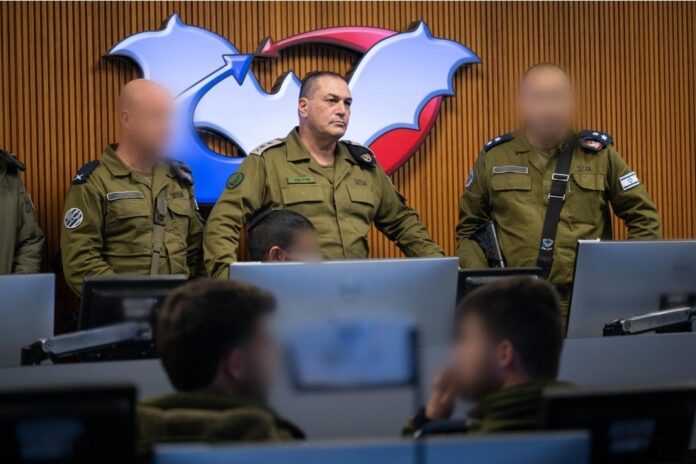
JERUSALEM (VINnews) — Israel’s Chief of the General Staff, Lt. Gen. Eyal Zamir, visited an Arrow missile defense battery Thursday evening to review operational readiness and participate in a simulated missile attack exercise, the Israel Defense Forces said.
Accompanied by the commander of the Aerial Defense Array, Brig. Gen. K., and other senior officers, Zamir observed the battery’s response to a hypothetical ballistic missile scenario targeting Israel.
In remarks to commanders and troops, Zamir emphasized the IDF’s constant vigilance.
He went on to emphasize the significance of the reported reversal by Tehran, saying, “You had, yesterday, scheduled, over 800 hangings. They didn’t hang anyone. They cancelled the hangings. That had a big impact,” according to his remarks.
Trump’s comments followed earlier statements made two days prior, when he asserted that the killing of protesters in Iran had stopped at a moment when a potential U.S. military action appeared close. At that time, he told reporters in the Oval Office, “We have been notified pretty strongly that the killing in Iran is stopping, and there’s no plan for executions or an execution.”
He added that the information had come from reliable sources but cautioned that the situation would continue to be monitored. “I’ve been told that in good authority. We’ll find out about it, I’m sure. If it happens, we’ll be very upset.”
Additional details emerged Thursday night from Trump’s Middle East envoy, Steve Witkoff, who spoke at the opening session of the 10th Israeli American Council National Summit in Florida. Witkoff said that, acting on Trump’s instructions, the United States had contacted Iranian officials on Wednesday to convey concerns over reports of impending mass executions. “And that’s been shut down, I think, as everyone knows, the President has announced that. He’s the only one in the world who has that indomitable strength that can bend people. I watch it happen. It’s quite remarkable to watch it happen.”
When asked whether he anticipated military action against Iran, Witkoff said he hoped diplomacy would prevail. “Well, I hope there’s a diplomatic resolution. I really do. There are four issues: Nuclear enrichment, missiles, they have to cut back on their inventory, the actual material that they have, which is roughly 2,000 kilograms which is enriched anywhere between 3.67% to 60%, and the proxies, of course.”
{Matzav.com}
“Absolutely disgusting,” Vizel said, calling the video a shock piece that is “decontextualized” and designed to mislead viewers. She said it exploits residents’ reluctance to share private financial information with outsiders in order to portray Hasidic men as unemployed.
“It uses people’s unwillingness to discuss personal economic details to create a portrait of a bunch of people who don’t work,” Vizel said.
Vizel acknowledged that Kiryas Joel, like many insular communities, has real challenges and legitimate areas for criticism, including scrutiny over its relationship with government welfare programs. But she said portraying the community as broadly dependent on public assistance ignores economic realities on the ground.
According to Vizel, the vast majority of Hasidic men in the community are gainfully employed and work long hours across a wide range of industries. She said she has previously documented the scope of Hasidic-owned businesses by reviewing phone directories and business listings.
Absolutely disgusting- shock piece by @tyleraloevera ,
decontextualized, and uses people’s reluctance to share private economic information with outsiders to create a portrait of a bunch of people who don’t work. https://t.co/ivCr2iJyfI— Frieda Vizel (@FriedaVizel) January 16, 2026
Vizel accused Oliveira of leaning into inflammatory language to drive engagement, arguing that shock value has replaced nuance in much viral content about religious and minority communities.
She described her response as a raw, first-reaction video recorded while watching Oliveira’s content in real time, acknowledging its emotional tone. Vizel said her goal was not to portray the community as flawless, but to highlight its complexity.
“This is a complicated and imperfect community,” she said. “It deserves honest criticism, but not caricature.”
Oliveira has not publicly responded to Vizel’s criticism. Vizel said she hopes the debate encourages viewers to approach viral portrayals of insular communities with greater skepticism and care.
Just a reminder that I made a video on how Hasidic Jews earn a living (with vasts amount of sources, not by accosting anxious lay people in the streets) and it has well over a million views.https://t.co/PjFuEwRval
— Frieda Vizel (@FriedaVizel) January 16, 2026
According to authorities, at approximately 11:20 p.m. on April 25, 2025, officers from the Berkeley Township Police Department responded to a residence on Evernhan Avenue following a report of a domestic disturbance. Upon arrival, officers determined that Sayegh—who was off duty at the time and employed as a Toms River Township police officer—had smashed the front glass door of the home and entered the residence. Investigators further determined that she damaged the hood of a vehicle belonging to one of the victims that was parked in the driveway.
Sayegh was located at the scene and taken into custody after resisting officers’ efforts to peacefully place her under arrest. She was subsequently released from the Ocean County Jail in accordance with New Jersey Bail Reform.
As part of her sentence, Judge Ryan ordered that Sayegh have no contact with the victims and pay restitution for the damage she caused. She was also required to forfeit her position as a Toms River Township police officer effective November 17, 2025, the date she pled guilty, and she has forfeited all future public employment in the State of New Jersey.
Demonstrations escalated sharply after the Jan. 7 fatal shooting of Renee Good, a 37-year-old Minneapolis woman, during an incident connected to Immigration and Customs Enforcement activity.
The growing unrest has also placed renewed focus on the tactics used by immigration officers during vehicle stops and arrests, prompting public criticism and legal scrutiny.
The Associated Press reported Friday that Aliya Rahman, a U.S. citizen, was pulled from her car and detained by immigration officers in Minneapolis, an incident that further fueled anger among demonstrators.
Also on Friday, the AP reported that a federal judge ordered the release of a Liberian man arrested by immigration agents in Minneapolis, ruling that the detention violated Fourth Amendment protections.
Trump’s remarks followed earlier comments in which he suggested he could invoke the Insurrection Act, a rarely used law that allows a president to deploy military forces domestically under narrowly defined circumstances.
Minnesota officials have urged residents to remain calm while condemning what they describe as an expanded federal footprint, as protests continue and multiple investigations and court challenges move forward.
{Matzav.com}
Rav Leib Malin was born in 1906 in Bialystok, a major industrial city in the Grodno Governorate of the Russian Empire. At the time, this region of northeastern Poland was under Tsarist rule, home to a dense concentration of Jewish life and learning. His father, Rav Avraham Moshe Malin, served as the local dayan and traced his lineage back to Rav Isser Yehuda Malin, a prominent rav in Brisk. The young boy—known affectionately as “Leib Bialystoker”—showed remarkable aptitude for learning from his earliest years.
His first major stop was the Shaar HaTorah Yeshiva in Grodno, situated about fifty miles northwest of his hometown. During the interwar period, Grodno had earned a reputation as a powerhouse of Torah scholarship. The bochurim there used to say that just as a person cannot survive without breathing air, so too in Grodno one could not exist without breathing Torah. Under the tutelage of Rav Shimon Shkop, the young Leib quickly distinguished himself as a talmid of unusual depth.
An incident from those years left an indelible impression on him. Together with his close friend Rav Dovid Lifshitz zt”l (who would later become the Suvalker Rav and a Rosh Yeshiva at RIETS), young Leib once approached Rav Shimon to discuss a personal matter. After an extended conversation, the two bochurim apologized profusely for consuming time that their rebbi could have devoted to his own learning. Rav Shimon’s response surprised them. He invoked the Gemara’s teaching of “aser bishvil she’tis’asher“—give a tenth so that you may become wealthy—and explained that this principle extends beyond monetary matters. When a rebbi invests time in his talmidim, he explained, he doesn’t lose; rather, his own Torah grows richer as a result. This lesson about the reciprocal nature of teaching and learning would profoundly shape Rav Leib’s future approach to chinuch.
Rav Leib subsequently spent time learning under Rav Elchonon Wasserman hy”d in Baranovitch, located in what was then the newly independent Second Polish Republic, and under Rav Baruch Ber Leibowitz zt”l. He also forged a lifelong bond with his Bialystok compatriot Rav Moshe Shmuel Shapiro zt”l, with whom he learned b’chavrusa; Rav Shapiro would eventually lead Yeshivas Be’er Yaakov in Eretz Yisrael.
Yet it was in the Mirrer Yeshiva that Rav Leib Malin discovered his true calling. Mir—a small town surrounded by forests in Belarus, roughly sixty miles southwest of Minsk—had become a magnetic center for the most talented young scholars in the yeshiva world. There, Rav Leib earned his place among an elite cadre of senior talmidim who wielded significant influence over the yeshiva’s direction. They were known informally as the “lions of Mir,” and Rav Leib—whose very name means “lion” in Yiddish—emerged as the leader among them.
The Mir of that era was unusual among Lithuanian yeshivos in the extraordinary role played by its Mashgiach, Rav Yeruchem Levovitz zt”l. While Rosh Yeshiva Rav Leizer Yudel Finkel handled administrative and financial matters with characteristic humility, it was Rav Yeruchem who shaped the spiritual character of the institution and its talmidim. His magnetic personality drew the cream of the yeshiva world to Mir’s doors.
Rav Leib became one of Rav Yeruchem’s closest disciples. The depth of his attachment to his rebbi was legendary. Rav Shmuel Berenbaum, who came to Mir only after Rav Yeruchem’s passing in 1936, testified that even years later the reverence for the Mashgiach remained palpable in the yeshiva’s halls. He recounted that Rav Leib had viewed Rav Yeruchem with such overwhelming awe that he considered himself as mere dust before his rebbi—and that had Rav Yeruchem commanded him to walk into fire, he would have obeyed without hesitation.
For Rav Leib, Rav Yeruchem’s mussar discourses were not merely ethical instruction; they constituted an entire approach to understanding Torah. The precision and analytical rigor that the Mashgiach brought to interpreting the words of Chazal, Rav Leib later explained, served as a template for how one should approach every aspect of Torah study.
One encounter with Rav Yeruchem crystallized a principle that would guide Rav Leib throughout his life. Disturbed by a situation in the yeshiva, the young Leib Malin organized a group of bochurim to stage a walkout in protest. As they rose from their seats and headed toward the door, they suddenly noticed Rav Yeruchem standing in the doorway, his arms folded across his chest, his eyes blazing with an intensity that stopped them in their tracks. Without a word being spoken, the group retreated to their places.
Sometime later, Rav Yeruchem summoned Rav Leib for a private conversation. What he told his talmid was unexpected. “I disagreed with your intended course of action,” the Mashgiach acknowledged. “But clearly you had thought it through and concluded it was correct. So why did you reverse yourself simply because you saw me standing there? Once you determine that something is right, you must have the courage to see it through. A person must take achrayus—responsibility.”
That charge—to shoulder responsibility and stand behind one’s convictions—became the driving force of Rav Leib’s life. It would propel him to lead the rescue of an entire yeshiva when others counseled caution, and later to rebuild a bastion of Torah on foreign shores when easier paths beckoned.
Rav Leib’s command of Rav Yeruchem’s teachings was so comprehensive that he was entrusted with editing the second volume of Da’as Chochmah U’Mussar, the published collection of the Mashgiach’s discourses. When Rav Yeruchem passed away on the 18th of Sivan 5696 (June 1936), his devoted talmidim—led by Rav Leib along with the Mashgiach’s sons—undertook to preserve his teachings for posterity. Rav Leib presided over the first yahrtzeit commemoration and oversaw the initial publication of a volume of maamarim in Vilna in 1940, even as the clouds of war gathered. Remarkably, they continued issuing additional pamphlets of Rav Yeruchem’s teachings throughout their years of exile in Shanghai.
What set the Mir apart from other yeshivos of the era was the remarkable autonomy granted to its senior students. These elite talmidim—each of whom possessed the stature to lead his own yeshiva—exercised genuine authority over the institution’s daily operations. They assigned incoming bochurim to study groups and often served as the primary teachers for these chaburahs. Both the student body and the official hanhalah accorded them the respect due to Torah leaders in their own right.
Rav Sholom Shapiro, a veteran of those years, left a vivid description of the yeshiva’s physical layout and social hierarchy. Contrary to what one might expect, the most distinguished scholars did not occupy the prestigious eastern wall (mizrach). Instead, they sat along the western wall, on benches at the rear of the beis medrash. In the first position sat Rav Yonah Karpilov (known as “Rav Yonah Minsker”), and parallel to him sat Rav Aryeh Leib Malin. Whenever a bochur encountered difficulty in his learning, these were the addresses to which he turned—and he invariably came away with clarity.
The esteem in which younger talmidim held the “lions” bordered on reverence. When Rav Leizer Yudel Finkel selected a group of outstanding students to travel to Brisk for advanced study, one of those chosen was Rav Simcha Sheps. Upon learning that Rav Yonah Karpilov would be part of the same delegation, Rav Simcha withdrew. His explanation: Rav Yonah occupied the status of “mori v’rabi” to him, and it would be inappropriate for a talmid to study alongside his rebbi as equals at the feet of a third party.
An episode involving Rav Meir Shapiro illustrates the intellectual firepower concentrated among the Mir’s senior students. Before establishing Yeshivas Chachmei Lublin, the renowned Polish Torah leader toured several Lithuanian yeshivos to observe their methods. When he visited Mir and delivered a shiur, Rav Leib and his peers engaged him in vigorous debate. The give-and-take grew so spirited that it seemed the walls might shake. When the dust settled, Rav Meir Shapiro—not yet forty years old—smiled wryly at those assembled and remarked: “When I reach your age, perhaps I’ll know as much as you ‘lions of the Mir’ do!”
A pivotal chapter in Rav Leib’s development began in 1929, when Rav Isser Zalman Meltzer traveled from Yerushalayim to Poland for the dedication of a new building at the Kletsk Yeshiva. During that visit, he remarked to Rav Leizer Yudel Finkel that the unique brilliance of Rav Yitzchok Zev Soloveitchik—the Brisker Rav—was not being adequately transmitted to the next generation. Rav Leizer Yudel acted swiftly. Despite the severe financial constraints imposed by the onset of the Great Depression, he arranged for a select group of his finest talmidim to travel to Brisk (Brest-Litovsk, situated on the Bug River near the Soviet border) to study under the Rav.
Among this elite delegation were Rav Leib Malin, Rav Yonah Karpilov Hy”d, Rav Michel Feinstein, Rav Henoch Fishman, Rav Naftali Wasserman, and Rav Ephraim Mordechai Ginsburg. The Brisker Rav developed a particular fondness for Rav Leib, treating him almost as a son. Blessed with a phenomenal memory and an exceptional ability to capture complex ideas in writing, Rav Leib transcribed the Rav’s shiurim on Seder Kodshim; these notes would later circulate in stencil format and become prized possessions in the yeshiva world.
The Brisker Rav’s trust in Rav Leib extended to an extraordinary privilege: permission to borrow and study his personal notebooks containing his own chiddushei Torah, as well as manuscripts of his father, Rav Chaim Brisker. Rav Leib would commit these precious insights to memory, return the notebooks, and receive another set to absorb. The Rav also engaged Rav Leib as a tutor for his son, the future Rav Yosef Dov Soloveitchik of Brisk in Yerushalayim.
So thoroughly did Rav Leib internalize the Brisker approach that it became virtually indistinguishable from his own thinking. Rav Dovid Finkel, another close talmid of the Brisker Rav, related a telling incident. Rav Leib once sent a letter to his rebbi containing original Torah insights. After studying the contents, the Brisker Rav expressed bewilderment: “Who authored these chiddushim—Rav Leib or myself? The letter came from him, yet I feel as though I wrote every word.”
Years later, when the Brisker Rav read Rav Leib’s introduction to HaTevunah—a philosophical treatise on the nature of Torah study—he offered the highest praise imaginable: “Since the time of Rav Chaim Volozhiner, no one has articulated the essence of Torah in this manner.” In that introduction, Rav Leib had written: “If even the greatest man has not been deeply involved in Torah study at every moment, if the finest conduit within him is empty of Torah, he enters a general state of bittul Torah… Torah’s essence is that it has no interruption; there are no difficult circumstances that can interrupt it. By nature, it never stops.”
The force of Rav Leib’s personality made a profound impression even on those who encountered him briefly. In the mid-1930s, Reb Menashe Karmel—a prosperous businessman and communal leader in Krakow—sought guidance from his Rebbe, the Imrei Emes of Gur, regarding his sons’ education. The Gerrer Rebbe’s advice was unexpected: send them to study under Rav Yeruchem Levovitz in distant Mir. For a family rooted in cosmopolitan Galician chassidus, dispatching their boys to a remote Lithuanian yeshiva town was virtually unheard of. Nevertheless, Reb Menashe complied. His second son, Avraham Yitzchak, arrived in Mir as a sixteen-year-old in 1937.
The Rosh Yeshiva, Rav Leizer Yudel Finkel, assigned the young Galicianer to learn with Rav Leib Malin. A deep bond formed quickly between them. Though Rav Leib was still technically a bochur himself, he became a surrogate father figure to the impressionable teenager.
As the summer of 1939 drew to a close and the threat of war loomed ever larger, Reb Menashe Karmel wrote to his son instructing him to return home to Krakow. The boy shared his father’s request with Rav Leib. The response was characteristically direct: “Azoi vi ich farshtei doss—the way I understand the situation, your place is here with the yeshiva.”
When Reb Menashe learned of Rav Leib’s assessment, he faced an agonizing decision. His fatherly instincts urged him to bring his son home to safety. Yet he had met Rav Leib and experienced firsthand the power of his conviction and the clarity of his judgment. Despite the stakes involved, Reb Menashe deferred to the young talmid chacham’s wisdom.
In a heartrending letter—written with the implicit understanding that father and son might never see each other again in this world—Reb Menashe urged Avraham Yitzchak to remain with the yeshiva no matter what transpired. “Stay with Rav Leib and the yeshiva,” he wrote, “for like a rare flower blooming in a desert, you will always remain a ben Torah no matter what befalls you and no matter where circumstances take you.” That letter proved prophetic. The son who stayed with the yeshiva survived; his father and family who remained in Poland were murdered by the Nazis. Through his survival, Avraham Yitzchak Karmel established generations of bnei Torah.
By the eve of World War II, Rav Leib Malin—though only in his thirties, unmarried, and holding no official title—had emerged as one of the most respected figures in the yeshiva world. When the war erupted in September 1939, Rav Avraham Kalmanowitz of the Vaad Hatzalah offered him a personal escape route to America. Rav Leib declined without hesitation. Abandoning his talmidim and colleagues was unthinkable.
Together with his close friend Rav Chaim Visoker (Wysoker), Rav Leib assumed the mantle of responsibility for saving the Mir Yeshiva. What followed ranks among the most extraordinary rescue operations of the Holocaust.
The Maharal writes that there is a distinction between individual holiness and collective holiness—and that certain exceptional souls feel compelled to shoulder responsibility for the entire community. This quality, his Rebbetzin later observed, “could be discerned in Reb Leib throughout his life, both in the old Yeshivas Mir and when he was in Lithuania at the height of the dreadful war.”
The geopolitical situation shifted with terrifying rapidity. On August 23, 1939—just days before the German invasion of Poland—Nazi Germany and the Soviet Union signed the Molotov-Ribbentrop Pact. A secret protocol attached to the agreement divided Poland between the two totalitarian powers. Following Germany’s invasion on September 1st, Soviet forces swept into eastern Poland from the other direction, swallowing up the region that housed many of the great yeshivos.
In an unexpected development, Moscow ceded the city of Vilna and its surrounding territory to Lithuania, which remained nominally independent. The gadol hador, Rav Chaim Ozer Grodzensky zt”l, recognized this as a narrow window of opportunity and urged all yeshivos to relocate to the Vilna region, where they could escape both Nazi and Soviet control without crossing an international border. After Simchas Torah, the Mir Yeshiva made the journey and established itself in Kehdan, a small town in the Lithuanian countryside.
The respite proved brief. By the summer of 1940, the Soviets had absorbed Lithuania into the USSR. Religious life now faced an existential threat—not yet from the Nazis (whose invasion lay a year in the future), but from Communist authorities determined to eradicate Torah observance. For young men whose entire existence revolved around learning and mitzvah observance, remaining under Soviet rule was spiritually untenable.
Reb Moshe Zupnik, who played a crucial operational role in the escape, later offered this assessment: “Many have recounted this story without stating the facts accurately. The person who deserves primary credit for the rescue is Rav Leib Malin. The conventional wisdom at the time—shared even by the greatest Torah authorities—was that attempting to obtain Soviet exit visas was reckless and would likely result in deportation to Siberia. Rav Leib saw the situation differently. He believed that remaining under a regime committed to destroying Torah, Shabbos, and Yiddishkeit was the greater danger. One had to pursue any possible avenue of escape, even if it appeared to be merely a crack in the wall.”
Reb Moshe Zupnik recalled Rav Leib framing the imperative in historical terms: just as the Kohanim in the time of the Chanukah story had been willing to sacrifice their lives fighting the Greeks who sought to sever the Jewish people from their Torah, so too the bnei yeshiva had to take extraordinary risks to escape the godless Communists. Acting on this conviction, Rav Leib orchestrated an effort to secure Polish passports for the hundreds of yeshiva students who were Polish citizens. These documents were obtained through the Polish government-in-exile, which operated out of the British consulate in Kovno. The passports, he hoped, would provide the legal basis for departure.
Word of the escape plans reached Rav Chaim Ozer Grodzensky, the acknowledged leader of world Jewry in that era and the patron of the refugee yeshivos. Rav Chaim Ozer harbored grave reservations. The proposed course of action struck him as dangerously impractical—far more likely to land the young men in Siberian labor camps than to deliver them to freedom. It must be remembered that at this point, no one foresaw the Nazi death machine; the calculus centered entirely on how best to navigate Soviet oppression.
As Rav Chaim Ozer lay in his final illness, Rav Chaim Visoker visited him. The gadol hador inquired about the mood in the Mir: “What is the consensus among the ‘lions’?” When Rav Chaim Visoker reported that Rav Leib Malin and his circle were actively formulating an escape plan, Rav Chaim Ozer’s response was remarkable. Rather than insisting on his own contrary judgment, he declared: “A yeshiva iz gresser vi der gadol hador!” A unified decision by the yeshiva’s senior talmidim, he acknowledged, carried a weight that could override even his own assessment.
This concept—that the yeshiva as a collective entity possessed a sanctity and wisdom exceeding that of any individual, however great—lay at the heart of Rav Leib’s approach. He insisted, against the prevailing tendency of the time, that the Mir must escape as a unified body rather than scattering as individuals seeking their own paths to safety. His conviction was that the yeshiva’s spiritual wholeness would itself generate the divine assistance needed to survive the perilous journey.
Beyond the Mir, an escape route was beginning to crystallize. A Dutch student at the Telz Yeshiva named Nathan Gutwirth had discovered that the honorary Dutch consul in Kovno, Jan Zwartendijk, could stamp passports with a notation indicating that no visa was required to enter Curaçao, a Dutch possession in the Caribbean. Zorach Warhaftig, a Mizrachi leader and tireless rescue activist, succeeded in extending this arrangement to Polish citizens. The next critical link was obtaining transit visas from Chiune Sugihara, the Japanese consul in Kovno, permitting passage through Japan en route to the supposed final destination.
The moment Rav Leib Malin grasped the potential of this chain, he sprang into action. “The moment that an avenue of deliverance opened up,” his Rebbetzin later wrote, “he knew no rest and urged the rest of the group to lose no time in nervous dithering from giving in their papers in order to obtain a visa and escape from their place of approaching danger.”
Rav Leib dispatched operatives to handle the practical details. Yaakov Ederman, Eliezer Portnoy, and Moshe Zupnik served as his agents on the ground. Zupnik actually worked inside Sugihara’s office, processing documents and compiling lists of visa recipients. Meanwhile, Rav Avraham Kalmanowitz, who had reached America in early 1940, worked feverishly to raise the substantial funds needed for train tickets across the Soviet Union. So urgent was his mission that he famously traveled on Shabbos to meet with potential donors.
Rav Kalmanowitz later shared the inner drive that fueled his superhuman efforts. He had encountered a Midrash Tanchuma describing how the lion aboard Noach’s Ark attacked Noach for being late with its feeding. How, he wondered, could Noach be punished so severely for a minor delay when he was single-handedly caring for countless animals? The answer struck him with force: this was no ordinary lion—it was the last surviving member of its species. Every moment of its care was infinitely precious. “I suddenly understood,” Rav Kalmanowitz explained. “The Mirrer bochurim are not ordinary yeshiva students. They are the last of the lions—the final remnant of a world. How could I allow myself to be tired?”
To coordinate the escape, Rav Leib and four other senior talmidim—Rav Yonah Karpilov, Rav Chaim Visoker, Rav Michel Feinstein, and Rav Yaakov Brabrovsky—established a formal committee. They maintained ongoing communication with Rav Kalmanowitz in America, providing updates on conditions in Lithuania and the progress of the visa effort.
Not everyone escaped. Rav Yonah Karpilov, one of the greatest of the “lions,” ultimately decided not to leave. He was brutally murdered in Slabodka in June 1941, shortly after the German invasion. His loss represented an incalculable blow to the Torah world.
Throughout the frantic weeks of visa processing, opposition surfaced within the yeshiva itself. Some feared that these activities would provoke Soviet retaliation, bringing catastrophe upon everyone. Rav Leib refused to waver. The survival of Torah was at stake; calculated risk was not merely justified but obligatory.
When about forty bochurim declined to accept their visas, Reb Moshe Zupnik held onto the documents despite the mortal danger this posed—possession of such papers could mean execution or deportation if discovered by the NKVD. Among those forty reluctant recipients were three men who would become towering figures in the postwar Torah world: Rav Shmuel Berenbaum, Rav Shmuel Brudny, and Rav Nachum Partzovitz. The visas Zupnik preserved eventually saved their lives.
Then came the most perilous gamble: applying to the Soviet authorities for exit visas. Against all expectations, permission was granted. During the winter of 1940-41, hundreds of refugees—the Mir talmidim among them—embarked on the Trans-Siberian Railroad for the nearly six-thousand-mile journey across the frozen expanse of Russia to Vladivostok on the Pacific coast.
The logistics were Byzantine and dangerous. Payment for the train tickets had to be made in American dollars—currency that was illegal for Soviet citizens to possess. This meant that the very act of purchasing tickets constituted registration with the authorities as someone seeking to flee. Funds from Rav Kalmanowitz, Rav Moshe Feinstein, Reb Shraga Feivel Mendlowitz, and Irving Bunim in America made the journey possible.
From Vladivostok, the refugees crossed by ship to Kobe, Japan, where they found temporary haven for approximately eight months. Rav Leizer Yudel Finkel, the Rosh Yeshiva, had by this time reached Palestine, where he hoped the yeshiva would eventually join him.
As 1941 progressed, the Japanese military began preparing for the attack on Pearl Harbor that would bring America into the war. To minimize the risk of espionage, they expelled all foreign nationals from the Japanese mainland. Refugees who lacked onward visas—including the majority of the Mir students—found themselves deposited in the international zone of Shanghai, a city under Japanese occupation. There they would remain for the next five years.
Throughout the Shanghai years, Rav Leib remained a pillar of the yeshiva’s existence. His Rebbetzin later testified that he “was one of the pivotal figures in maintaining contact, by letter and telegram, with those who were working to save the yeshiva and deliver it from its exile.” His unwavering faith that their rescue reflected Hashem’s plan to preserve Torah in the world sustained the community through grinding hardship.
Conditions in Shanghai were brutal. The students were confined to a ghetto called Hongkew and required to wear identifying letters on their clothing—”A” for Americans, “B” for British. The Japanese referred to all foreigners as “Naquni.” This author’s mother-in-law, Mrs. Sally Hirsch (née Cohen), who later traveled with the Mir contingent to America, recalled those years vividly. Despite the deprivations, the bochurim maintained their commitment to learning and even reached out to teach Torah to Shanghai’s established Sephardic Jewish community. “They gave classes in the main Sefardic shul,” Mrs. Hirsch remembered. “They were single bochurim and they made us all frummer. Many of them became important Rabbis later in America.” The Mir students conducted their own maariv minyan in the Sephardic synagogue and even held weddings there at night.
The young Shmuel Berenbaum, who later became one of the generation’s leading Roshei Yeshiva, shared quarters with Rav Leib during part of the Shanghai exile. He marveled at how Rav Leib maintained exactly the same standards of conduct and dignity that had characterized him in Mir. While the oppressive heat and humidity—temperatures frequently topped one hundred degrees Fahrenheit—led most students to abandon their jackets when venturing outside, Rav Leib refused to compromise. His sole concession was to drape his jacket over his shoulders rather than wearing it fully. The diet consisted almost entirely of rice, yet Rav Leib sustained fourteen-hour days of intensive study in the sweltering beis medrash. Torah was his sustenance.
Rav Leib’s intensity could be intimidating. When asked whether he had ever approached Rav Leib during those five shared years in Shanghai to discuss a point in learning, Reb Simcha Nadborny replied immediately: “Me? I was young. The younger talmidim were nervous to speak with Rav Leib! We stood in awe of him. The only person our age who conversed with him regularly about Torah was Rav Nachum Partzovitz.” Indeed, disciples of Rav Nachum would later attribute their rebbi’s distinctive methodology—the meticulous reading and analysis of texts to extract every nuance of meaning—to those countless hours of study alongside Rav Leib in Shanghai.
Rav Chatzkel Levenstein, the Mashgiach who accompanied the yeshiva throughout its wanderings, later characterized the Shanghai years as a period of remarkable spiritual achievement. The yeshiva, he said, functioned as a “greenhouse”—insulated from the surrounding chaos. Yet those living through it experienced genuine suffering. For most of the war, the refugees had no reliable information about events in Europe. Word of the horrors in the Warsaw Ghetto reached Shanghai in 1942, and gradually the terrible truth about systematic mass murder became known. The senior bochurim, including Rav Shmuel Charkover, worked constantly to bolster the spirits of those tormented by uncertainty about their families’ fates.
Before leaving Kobe for Shanghai, the yeshiva received communication from Rav Leizer Yudel Finkel in Palestine relaying the Chazon Ish’s ruling on the international dateline—a halachic question with immediate practical implications. According to the Chazon Ish, Shabbos in Japan should be observed on the day the civil calendar designated as Sunday. This placed Rav Leib at the center of one of the era’s most intriguing halachic controversies.
Two young cousins under Rav Leib’s care, Nechemia and Meir Malin, brought independent corroboration: their father, Rav Isser Yehuda Malin, possessed a tradition from Rav Chaim Brisker himself that aligned with the Chazon Ish’s position. (This Rav Isser Yehuda Malin should not be confused with Rav Leib’s ancestor of the same name.) It bears noting that not all authorities agreed. This author’s rebbi, Rav Dovid Kviat zt”l, followed the alternative “Chassidish” view and observed Shabbos on the civil Saturday throughout his time in Japan and Shanghai.
What Rav Leib did next defies ordinary calculation. He and twenty-one other Mir students had actually obtained American visas that would have allowed them to proceed directly to the United States. They chose not to use them. One obstacle was timing: the ship was scheduled to depart on Erev Yom Kippur, and the dateline complication would have required fasting for two consecutive days—an impractical burden to impose on such a large group.
But the primary reason ran far deeper. In a letter to Rav Kalmanowitz, Rav Leib explained: “For all of us who received the visas, our souls are bound with the souls of all the bnei hayeshivah. Our goals and aspirations are to be constantly in the company of our yeshivah in its entirety… It is difficult for us to separate from the rest of the holy yeshivah. It would be inconceivable for a significant group to depart on Erev Yom Kippur, a time when everyone should be gathering together to bask in the presence of the yeshivah on this holiest day of the year… It is very important to us to travel together. In this way, we will be a joint foundation for the future edifice, and we will strengthen each other in Torah and yirah through our shared efforts. Whereas if we were to disperse, then perhaps some individuals won’t be able to hold their own without the group.”
This decision extended Rav Leib’s exile by five years. He could have reached American shores in relative comfort and safety; instead, he remained with his yeshiva through years of deprivation in Shanghai. The reasoning was perfectly consistent with his lifelong philosophy: the leader does not abandon his flock; the yeshiva survives as a whole or not at all.
On July 18, 1946, a large contingent of Mir talmidim disembarked in San Francisco from the General M.C. Meigs, having crossed the Pacific from Shanghai. Among them were Rav Leib Malin and Rav Chaim Visoker—the two architects of the rescue, arriving together in the land where they would labor to rebuild what had been destroyed.
Mrs. Sally Hirsch, then an eighteen-year-old, traveled with a later group of Mir-connected refugees on the same vessel. Her ship departed Shanghai on January 1, 1949 and arrived January 24th. The accommodations were spartan: third-class passage with no private rooms, just rows of beds in open dormitories, men and women housed separately.
“Almost everyone was sick the entire time,” she recalled. The ship made stops in Guam (for supplies, though passengers remained aboard) and Honolulu, where the local Jewish community received them with extraordinary warmth. “They gathered us in one house. The people were so kind. They loaded us up with sardines and canned goods.”
Keeping kosher during the voyage proved challenging. “The cooks kept trying to convince us to eat, insisting that this or that pot contained no pork and was therefore kosher. But we were all shomer Shabbos and wouldn’t rely on that. We ate what kosher food we had brought.” The question of Shabbos travel had been resolved before departure: since they boarded several days before Shabbos, the journey was deemed permissible.
Remarkably, the American Navy charged nothing for the passage. Upon arrival in San Francisco, HIAS (the Hebrew Immigrant Aid Society), working with various Torah organizations, arranged three days of hotel accommodation before the refugees boarded trains for New York. “The Mir boys went straight to the Yeshiva in Brooklyn,” Mrs. Hirsch remembered. “They were taken into the dormitories. Room was made for them.”
The late 1940s witnessed the first stirrings of Torah’s postwar renaissance in America. Yeshivos established footholds and began to grow. The Mir students who had survived Shanghai as a cohesive unit gradually dispersed—some married and entered business, others secured teaching positions in various yeshivos, still others made their way to Eretz Yisrael. A significant number remained with Rav Avraham Kalmanowitz, who reestablished the Mirrer Yeshiva in Brooklyn.
Yet Rav Leib Malin and Rav Chaim Visoker felt that none of the existing options captured the authentic spirit of what they had known in prewar Europe. They yearned to recreate the atmosphere of the Kelm Talmud Torah and the Mir under Rav Yeruchem—an environment of total immersion in Torah and mussar, unsullied by compromise. Armed with little beyond their vision—no significant funding, no wealthy backers—Rav Leib set out to honor his rebbi’s charge.
In the final period before his death, Rav Yeruchem had addressed a gathering of Mir alumni in Lodz. Rav Leib came to regard that address as his rebbi’s ethical will: “Who more than you understands what the authentic form of a yeshivah [tzuras hayeshivah] should be? To dwell in the depths of Torah study… You are all students of our holy yeshivah and I see that beyond the vast Torah knowledge you’ve acquired—an external achievement—you’ve internalized the essence and spirit of what a holy yeshiva truly is… You can influence those who never entered the yeshiva’s walls. Through their connection to you, they too will be considered its talmidim. Through this merit, you will remain talmidim of the holy yeshivah for eternity.”
Meanwhile, a parallel story was unfolding in Eretz Yisrael. In 1947, a young woman named Yaffa Kreiser—daughter of Rav Dovid Dov HaLevi Kreiser zt”l, who had served as a maggid shiur in Rav Aharon Kotler’s yeshiva in Kletsk—received an unexpected package from her brother-in-law, Rav Dovid Povarsky zt”l (who would later lead Yeshivas Ponevezh). It was a newly published sefer titled HaTevunah, Part One. Rav Dovid asked her to read the introduction. She read it once, then again. When she searched for the author’s name, she found none. “Who wrote this?” she asked. Rav Dovid’s reply was simple and direct: “Reb Leib Malin. And you are going to America…”
Two weeks before Rosh Hashanah 5708 (1947), with Tel Aviv under nighttime curfew amid the turbulent final days of the British Mandate, Yaffa Kreiser learned she would be departing for America that Sunday. She boarded a ship and arrived in New York on the second day of Rosh Hashanah. On Asarah B’Teves the couple became engaged; in Adar Sheini they married in Canada.
Upon reaching America, Rav Leib received two distinguished offers: Rav Moshe Feinstein invited him to head Yeshivas Tiferes Yerushalayim; Rav Avraham Kalmanowitz sought him as a Rosh Yeshiva at the newly reconstituted Mirrer Yeshiva in Brooklyn. He declined both. His sense of mission pointed in a different direction.
Shortly after the wedding, a historic gathering convened in the Malins’ modest living room. Present were the luminaries of the Mir’s senior generation, united by a shared determination to resurrect the world that had been destroyed. From that meeting emerged Beis HaTalmud.
The founding cohort read like a roster of the Mir’s greatest: Rav Chaim Visoker, Rav Shmuel Charkover, Rav Leizer Horodzeisky, Rav Levi Krupenia, Rav Leibel Shachar, Rav Simcha Zissel Levovitz (son of the Mashgiach), Rav Betzalel Tannenbaum, Rav Binyomin Paler, Rav Avrohom Levovitz, Rav Sholom Menashe Gottlieb, Rav Yisroel Perkowski, and Rav Binyomin Zeilberger. Initially conceived as an elite kollel for these seasoned scholars, Beis HaTalmud would gradually expand to include younger talmidim. In the early years, they lived in “stanzias”—family-style boarding arrangements—just as they had in the original Mir.
The Rebbetzin’s recollection of that founding generation is poignant: “These men were Torah princes who carried blood-soaked memories of the dreadful war with them. They had lost their families and all that they held dear. It took strength and determination to bear the burden of their pain and grief. However, they did not swerve from their customary conduct and they remained firmly bound together as a group, occupying themselves with Torah and Mussar.”
Rav Yeruchem’s charge to preserve and transmit the “tzuras hayeshivah“—the authentic form and spirit of the yeshiva—became the animating principle of Beis HaTalmud. In his introduction to HaTevunah, Rav Leib had articulated this vision with crystalline clarity, describing how Rav Yeruchem “guarded the tzuras hayeshivah as his most precious possession, ensuring it never deviated in the slightest from the tradition received from our ancestors… Within the yeshivah’s walls, one sensed the presence of Hashem’s sovereignty… The entire atmosphere was saturated with Torah… The Shechinah dwelt there.”
Beis HaTalmud’s physical circumstances were humble. After beginning in East New York, the yeshiva found space in a small beis medrash belonging to Polish chassidim in Crown Heights. The Malins’ tiny apartment served multiple functions; its covered balcony became the yeshiva’s administrative office. Eventually they acquired a modest three-story building at 351 Bradford Street: kitchen on the ground floor, beis medrash on the middle level, dormitory upstairs.
The material poverty was deliberate. Beis HaTalmud was designed as a place of total spiritual immersion, stripped of worldly distraction. One story captures this ethos perfectly. A veteran talmid recounted: “It was Yom Kippur afternoon, during Minchah. Ne’ilah needed to begin before sunset, but the Beis HaTalmud tradition—inherited from Kelm—called for a brief mussar session before Ne’ilah. Time was running short, and the chazzan was about to begin Avinu Malkeinu when Rav Leib brought his hand down on his shtender with a decisive bang: ‘Tzvei minut mussar seder!‘ Two minutes for mussar! Avinu Malkeinu was omitted to preserve the sacred custom.” The talmid concluded: “That was the most powerful mussar experience of my life. Rav Leib’s absolute clarity about priorities—that defined Beis HaTalmud.”
Rav Leib challenged his students to reconceptualize their relationship to the yeshiva’s physical spaces. “You imagine that you learn in the beis medrash, sleep in the dormitory, and eat in the dining room? Wrong. You learn in the beis medrash, you sleep in the beis medrash, and you eat in the beis medrash. The dormitory is simply the beis medrash designated for sleeping; the dining room is the beis medrash designated for eating.”
When attendance at morning davening began to slip, Rav Leib addressed the problem with a single devastating sentence: “If the bochurim won’t come to Shacharis, we will have to close the yeshiva. This is not the tzurah of a yeshiva.” A talmid recalled: “Nothing more needed to be said. Of course we all came to davening after that. We knew Rav Leib meant every word.”
On another occasion, Rav Leib entered the beis medrash to deliver his shiur. He surveyed the room, sat in silence for a long moment, then rose and left without saying a word. When someone asked why he hadn’t taught, his answer cut to the bone: “The talmidim weren’t sufficiently thirsty for my Torah.”
A bochur once approached him with a complaint: “My chavrusa isn’t working out well, and the food here is also lacking.” Rav Leib’s retort was instantaneous: “If your chavrusa and the food appear in the same sentence, you haven’t yet entered the yeshiva’s atmosphere.” He had a term for students who hadn’t fully absorbed the institution’s values: “nisht arein“—not yet inside.
Rav Michel Shurkin, later a prominent maggid shiur at Yeshivas Toras Moshe in Jerusalem, once inquired which tractate the yeshiva would study the following semester. “Menachos,” Rav Leib replied. Rav Michel mentioned that another yeshiva was also learning Menachos that term. Rav Leib fixed him with a penetrating gaze: “S’iz an anderer Menachos“—it’s a different Menachos entirely. The level of immersion possible at Beis HaTalmud, free from all distraction, would produce a qualitatively different mastery of the material.
Rav Leib’s presence exerted a transformative effect on those around him. Rav Chaim Ozer Gorelick described a Rosh Hashanah meal at the Malin home. Virtually no conversation took place. The eimas hadin—the awesome weight of the Day of Judgment—filled the room. The Rebbetzin served the food; Rav Leib occupied himself with Mishnayos Rosh Hashanah. The day was stifling—air conditioning was rare in 1950s Brooklyn—and Rav Chaim Ozer found himself desperately thirsty. A bottle of soda stood on the table within easy reach. “Yet I couldn’t bring myself to pour a glass,” he recalled. “It was Rosh Hashanah. How could one think about soda? In Rav Leib’s presence, materialism simply ceased to exist. Pure, unalloyed yiras Shamayim was the only reality.”
Reb Chaim Stein of Brooklyn related that as a young bar mitzvah boy, he brought friends from Mesivta Rabbeinu Chaim Berlin to observe davening at Beis HaTalmud. “We watched Rav Leib Malin daven a regular weekday Shemoneh Esrei. He looked like someone davening Ne’ilah on Yom Kippur.”
The Rebbetzin’s intimate recollections reveal further dimensions. Rav Leib was indifferent to money—”and it,” she observed, “seemed equally indifferent to him.” Yet he insisted that every dollar entering the yeshiva come from untainted sources. On multiple occasions, she watched him decline contributions that would have eased their constant financial strain rather than compromise this principle.
His exacting standards regarding schedules and davening times coexisted with deep emotional sensitivity. He shared fully in the joys and sorrows of his colleagues. When Rav Leibel Shachar—his closest partner in the yeshiva—fell gravely ill, Rav Leib’s devotion exceeded all bounds. When Rav Shmuel Charkover was hospitalized, Rav Leib spent hours at his bedside, neglecting meals and rest. It is worth noting that Rav Leib and his Rebbetzin were never blessed with children, yet guests at a bris would never have guessed this from the genuine joy radiating from his face.
The Rebbetzin remembered Shabbos nights when Rav Leib was summoned from the middle of their meal to take a phone call from a hospitalized patient who urgently needed his guidance. “He lived in such close connection with the members of the chaburah, and he always had time for those in distress.”
Sometimes, exhausted from the day’s labors, Rav Leib would find himself unable to return to the yeshiva in the evening. On those nights, he would sit at home and study mussar, chanting in the ancient traditional melody. The Rebbetzin described its effect: “That niggun had the power to transport the listener to a world of beauty, consolation, and peace. It echoes in my ears to this day. I still long to hear it.”
The East New York neighborhood deteriorated rapidly during the 1950s, leaving Beis HaTalmud increasingly isolated as the last Orthodox institution in the area. One day in 1961, as Rav Leib walked from the yeshiva to his home on Pennsylvania Avenue, he was attacked by a local assailant and suffered serious injuries, bleeding from the mouth. A specialist he consulted the following day delivered a sobering assessment: the trauma had come perilously close to affecting his brain. He was fortunate to be alive.
The death of his dear friend Rav Shmuel Charkover had already taken a toll on Rav Leib’s health. He grew weaker and experienced chest pains. Yet he refused to slow down. His great dream was to construct a proper building complex for the yeshiva. Land had been acquired, and the Rebbetzin accompanied him to meetings with an architect to develop plans for the new facility.
On Thursday evening, January 4, 1962 (29 Teves 5722)—just weeks after the assault—a fundraising meeting took place at Congregation Ohab Zedek on Manhattan’s Upper West Side. The shul’s rabbi, Theodore Adams, was related to the Rebbetzin and had long supported the yeshiva. Reb Shabse Frankel attended, as did Rav Chaim Visoker, who arrived late because he had been helping prepare for the yeshiva’s annual dinner scheduled for that Motzaei Shabbos.
In the middle of the meeting, Rav Leib suddenly collapsed. His soul returned to its Maker. He was fifty-six years old.
The American Torah world had never witnessed an outpouring of grief like that which followed. Rav Aharon Kotler was so stricken that he became bedridden. After recovering sufficiently to travel, he accompanied the aron to Eretz Yisrael for burial and delivered a hesped that revealed the magnitude of the loss.
“Iz avek der groise baal achrayus!” Rav Aharon cried. “The great bearer of responsibility has departed!” He then disclosed what he had often told his own talmidim in Lakewood: he had believed that Rav Leib would be the one to assume responsibility for American Torah Jewry in the next generation.
Rav Aharon was mourning not only a towering scholar but a leader who possessed that rarest quality: genuine achrayus. He invoked the blessing bestowed upon Yehudah: “Your brothers will acknowledge you.” Yehudah began as one of the twelve tribes yet rose to kingship through his willingness to lead. So too Rav Leib had started as one member of the Mir chaburah and ascended to become something extraordinary.
Rav Yisroel Gustman, who had known Rav Leib since their Grodno days, offered a different image in his hesped. The Menorah in the Beis HaMikdash, he noted, was adorned with elaborate decorative elements. The Aron HaKodesh, by contrast, was utterly plain. Why? Because the Aron contained the Torah itself, and Torah requires no embellishment—it shines with its own light. “Veil di Aron iz gevein Torah!” Rav Leib needed no external trappings because he embodied Torah in its purest form.
Rav Leib was laid to rest on Har HaMenuchos in Jerusalem, in the section reserved for rabbinic leaders, directly adjacent to the grave of his beloved rebbi, the Brisker Rav. In death as in life, the bond between them remained unbroken.
The architectural rendering of the planned Beis HaTalmud building remained hanging on the wall of the Malin apartment for years afterward—a poignant reminder of the dream left unfulfilled. The yeshiva eventually acquired the building of the Kalever Rebbe in Bensonhurst and relocated there. Rav Chaim Visoker, Rav Leib’s partner from the earliest days of the rescue through the founding of Beis HaTalmud, continued leading the institution for another thirty-seven years until his own passing in 1985. He lived at 2122 82nd Street in Bensonhurst, and his mussar discourses were renowned for their profound depth.
The Rebbetzin, reflecting on her husband’s life, invoked the lamentation of the prophet Yirmiyahu: “How the gold has dimmed, the sacred stones scattered at every street corner.” She explained the metaphor: when a clay vessel shatters, only worthless shards remain. But when a golden crown studded with precious gems is broken, each gem retains its brilliance. “That was how Reb Leib eulogized the Alter of Kelm,” she said. “And it applies equally to him. There are rare individuals who are like precious stones—they continue to sparkle and gleam even after they are gone.”
The author can be reached at [email protected]
Inside the administration, officials have examined a range of approaches to the issue, including the idea of purchasing the territory, though no formal proposal has been announced.
Greenland and Denmark have consistently rejected the notion, stating that the island is not for sale and has no desire to become part of the United States.
Denmark’s position has been echoed by several European leaders, who have publicly backed Copenhagen and said Washington has no right to take control of the Arctic island.
Trump’s comments marked the first time he publicly suggested tariffs as a potential tool to advance his stance on Greenland.
{Matzav.com}
In his remarks, the general accused the United States of ignoring Iran’s restraint and cautioned against further escalation. “You do not pay attention to the restraint and strategic patience we have shown,” Rezaei added. “Stop right now. Step back, otherwise none of your bases in the region will be safe.”
The comments were delivered amid reports that the United States has begun repositioning military assets closer to the Middle East. Sources confirmed that at least one U.S. aircraft carrier has been moved toward the region as tensions between Washington and Tehran intensify.
Officials have not disclosed which carrier is involved. Military officials say the voyage could take roughly a week, with additional forces potentially deploying afterward, expanding the range of military options available to Trump.
Rezaei is a longtime powerbroker within Iran’s military and political establishment. He led the IRGC from 1980 until 1997 and currently holds several senior roles, including vice president for economic affairs and secretary of Iran’s Supreme Council for Economic Coordination. He is also a prominent figure within the Principlist Resistance Front of Islamic Iran.
Internationally, Rezaei has faced legal and financial consequences. In 2006, Argentine authorities issued an international arrest warrant for him over his alleged role in the 1994 bombing of the AMIA Jewish community center in Buenos Aires. The U.S. Treasury Department later sanctioned him in 2020, citing his involvement in advancing destabilizing activities.
The escalating rhetoric comes as Iran faces growing internal unrest. According to the Human Rights Activists News Agency, at least 2,677 people have been arrested, with another 1,693 cases currently under investigation.
{Matzav.com}
Under prior regulations, non-citizens in the US serving in religious capacities on R-1 visas were required to leave the United States for a minimum of one year once their visa expired at the end of its five-year term before they could apply for and obtain a new R-1 visa. This requirement imposed significant hardships on religious workers as many of them serve in leadership positions such as rabbis and teachers causing serious disruptions for the schools and institutions they serve. The new rule eliminates this mandatory waiting period, allowing religious workers to apply for and receive a new R-1 visa without being forced to spend a fixed period of time outside the United States.
“Agudath Israel of America welcomes the Department of Homeland Security’s thoughtful and much needed rule change regarding religious workers.” said Mr. David Grunblatt, partner at Fragomen, Del Rey, Bernsen & Loewy, LLP and chair of Agudath Israel of America’s Immigration Committee. “For too long, religious organizations have faced the painful loss of dedicated rabbis, ministers, teachers, and other essential religious workers simply because their temporary visas expired before the lengthy green card process could be completed. By removing the requirement for religious workers to leave the country for a full year after reaching the maximum period of stay, DHS is providing much needed stability for our institutions and the communities they serve. This interim final rule promulgated by USCIS, recognizes the vital role that religious workers play in American society and helps ensure that synagogues, churches, and other faith-based organizations can continue their sacred mission without unnecessary disruption. We commend DHS and USCIS for their commitment to supporting religious life in the United States.”
Agudath Israel of America has long advocated for reforms to the R-1 visa program and continues to urge Congress to pass the bipartisan Religious Workforce Protection Act. That legislation would eliminate the need for individuals on an R-1 visa to leave the US at all while further strengthening protections for people of faith in the workforce.
{Matzav.com}
The resident specifically called on leaders to tighten access to synagogues and community institutions and to advise residents to avoid interviews or on-camera interactions with visitors seeking to “agitate” or “investigate.” The creator’s official social media presence includes a YouTube channel under his name @tyleroliveiraofficial.
Community members said their immediate goal is to alert residents and local leadership, reduce the risk of escalation, and prevent people from engaging with this Anti-Semite.
Barnea’s visit follows a phone call earlier this week between President Trump and Prime Minister Benjamin Netanyahu that centered on the situation in Iran. During the conversation, Netanyahu reportedly asked the United States to hold off on any military action in order to give Israel additional time to prepare for a possible Iranian response.
Israeli officials have raised concerns that potential U.S. strikes, as currently under discussion, would focus primarily on Iranian security forces and might not significantly weaken the regime itself. U.S. officials, meanwhile, have said that military action remains on the table if Iran resumes deadly force against protesters. Israeli assessments suggest that even with a delay, a U.S. strike could still take place in the near future.
At the same time, U.S. military preparations are continuing, with additional forces and equipment being moved into the region. These reportedly include the aircraft carrier USS Abraham Lincoln and its strike group, along with expanded air defense systems, fighter jets, and possibly submarines.
In parallel, Abbas Araghchi has suggested reviving nuclear negotiations during his contacts with Witkoff. Israeli officials are concerned that Tehran could use renewed talks to ease international pressure and buy time, though some believe the current crisis may push the Iranian regime to consider concessions it has previously refused.
{Matzav.com}
Describing the operation, Lieutenant Commander Shlomi Harosh, who heads the Binyamin Region of the Israel Fire and Rescue Service, said: “This is a tragic event in which a young man lost his life. This was a complex and challenging search because there was a lot of drift in the stream and in the water crossings under the bridges along the stream, as well as the stormy weather that prevailed during the first days of the search.”
Police officials stated that search activity was carried out without interruption over the course of four days, involving close coordination among law enforcement, rescue services, and civilian volunteers.
A police spokeswoman provided further details, saying: “On the morning of the fourth day of searches conducted by the Judea and Samaria District police, along with numerous emergency security and rescue personnel, alongside hundreds of volunteers, the body of the missing young man who had been swept away in the Modi’im Stream was located.”
{Matzav.com}
Ratcliffe’s visit is likely to be seen as another sign of Trump’s willingness to work with Rodríguez, who had been Maduro’s second in command until the audacious U.S. military operation two weeks ago that spirited him to the United States to face drug trafficking charges.
The visit, which included a small team of American officials and was first reported by The New York Times, was intended to lay the groundwork for additional cooperation between the Trump administration and Venezuela’s new leaders, the official said.
Ratcliffe discussed potential economic collaboration between the two countries and warned that Venezuela can never again allow the presence of American adversaries, including drug traffickers, the official said.
The CIA played a key role in the operation to apprehend Maduro, providing critical intelligence support, as well as mounting an earlier drone strike on a dock used by cartels, U.S. officials have said.
Rodríguez used her first state of the union message as acting president Thursday to advocate for opening the crucial state-run oil industry to more foreign investment following the Trump administration’s pledge to seize control of Venezuelan crude sales.
That appeal was a key factor in Trump’s decision to postpone orders for U.S. forces to proceed with a strike, according to officials briefed on the matter.
U.S. officials emphasized that military action remains under consideration should Iran resume violent suppression of protesters, including killings. Israeli officials, meanwhile, believe a U.S. strike could still occur in the coming days despite the current delay.
The discussions come amid reports that Iran has halted planned executions and reduced lethal force against demonstrators, information that Trump cited Wednesday as a reason for stepping back from immediate action. White House officials have confirmed ongoing monitoring of the situation, with all options still on the table.
Trump has repeatedly warned Tehran of severe consequences if the crackdown continues, while highlighting intelligence indicating a temporary pause in the violence.
The phone calls reflect close coordination between Washington and Jerusalem on the Iranian crisis, with Netanyahu maintaining frequent contact with Trump administration officials, including Secretary of State Marco Rubio, in recent days.
Arab nations, including Saudi Arabia, Qatar, Oman and Egypt, have also urged the U.S. to refrain from strikes to avoid broader regional escalation, according to diplomatic sources.
The situation in Iran remains fluid, with protests entering their second week amid reports of thousands of deaths and ongoing internet restrictions.
Guildford’s position has been precarious since Wednesday’s publication of a report into the decision to ban Maccabi fans from attending the match at Villa Park on Nov. 6. The report found the decision last year overstated the threat posed by Maccabi fans and understated the risk to them.
Following its publication, Home Secretary Shabana Mahmood said she had lost confidence in Guildford and urged him to stand down.
Mahmood said she didn’t have the power to fire Guildford as a result of a policy change by the previous Conservative government in 2011, but she was looking to reinstate that power to home secretaries. Currently, locally elected police and crime commissioners have that power.
The ban came at a time of heightened concerns about antisemitism in Britain following a deadly attack on a Manchester synagogue and calls from Palestinians and their supporters for a sports boycott of Israel over the war with Hamas in Gaza.
West Midlands Police said at the time it had deemed the match to be high risk “based on current intelligence and previous incidents,” including violence and hate crimes that took place when Maccabi played Ajax in Amsterdam last season.
As a result of the impact, the scooter’s operator was ejected and dragged beneath the pickup truck for a short distance. The victim was transported to Jersey Shore University Medical Center in Neptune, where he is listed in serious but stable condition.
As a result of the investigation, Lloyd Ferrara, 30, of Toms River, was charged on January 16, 2026, with operating a motor vehicle with a suspended driver’s license while involved in a motor vehicle crash resulting in serious bodily injury. Investigators further determined that the license plates on the pickup truck were fictitious.
Responding officers also observed that Ferrara appeared to be intoxicated at the scene. He was unable to successfully perform standardized field sobriety tests and was charged with driving under the influence. Ferrara was placed under arrest and transported to Ocean University Medical Center in Brick Township, where a blood draw was obtained pursuant to a court-authorized warrant. The results of the blood draw are pending.
Ferrara was subsequently transported to the Ocean County Jail, where he remains lodged pending a detention hearing.
In a statement posted on X, the U.S. Embassy in South Africa said it was “unconscionable that South Africa welcomed Iranian security forces as they were shooting, jailing, and torturing Iranian citizens engaging in peaceful political activity” — a reference to the ongoing protests in Iran and a bloody crackdown by authorities that has killed more than 2,600 people, according to the U.S.-based Human Rights Activists News Agency.
The U.S. Embassy said it had noted with concern reports in the South African media that President Cyril Ramaphosa’s instruction that Iran only have observer status in the drills may have been flouted by South Africa’s Defense Ministry or its military officials.
The Trump administration has been critical of South Africa over its diplomatic ties with Iran, citing them as an example of South Africa taking what it called an anti-American stance in its foreign policy. South Africa says it follows a neutral, non-aligned foreign policy and is open to diplomatic discussions with Iran.
It’s not clear what Ramaphosa ordered over the drills. The president hasn’t commented on the issue, and his spokesperson didn’t immediately respond to a request for comment from The Associated Press.
The Defense Ministry said in its statement that Defense Minister Angie Motshekga ensured Ramaphosa’s instructions were “clearly communicated to all parties concerned” without detailing what they were. The investigation would find out if Ramaphosa’s instructions were “misrepresented and/or ignored,” the Defense Ministry said.
The South African armed forces said Iran sent two warships to take part in the drills, while the AP saw a third Iranian warship anchored in a harbor in Simon’s Town, near Cape Town alongside Chinese and Russian warships.
The drills, which were due to end Friday, were led by China and organized under the BRICS bloc of developing nations. South Africa, China and Russia are longtime members of the bloc, while Iran joined in 2024 and this week’s naval drills were its first with BRICS.
The expanding BRICS group was created as a counter to perceived U.S. and Western dominance of the global economy and international institutions and has often been used by China and Russia as a forum to criticize the West.
South Africa’s ties with the U.S. have plummeted since U.S. President Donald Trump returned to office, with his administration also making baseless claims that South Africa’s government is allowing the violent persecution of its white minority Afrikaner people in order to seize their land.
According to Trump, that committee will operate under the authority of the newly created board of peace, which he said he will personally chair.
The broader plan also envisions the arrival of an International Stabilisation Force that would be tasked with maintaining security in Gaza and assisting in the training of approved Palestinian police units.
Reacting to the developments, senior Hamas official Bassem Naim said Thursday, “The ball is now in the court of the mediators, the American guarantor and the international community to empower the committee.”
The U.S.-backed initiative originally took effect on Oct. 10, leading to the release of all hostages held by Hamas and bringing an end to active fighting between Israel and the Palestinian terrorist organization in Gaza.
While the second phase of the plan has now begun, it is unfolding amid continued claims of humanitarian aid shortages and sporadic violence.
For Palestinians, a central unresolved issue remains the complete withdrawal of Israeli forces from the Gaza Strip, a provision included in the framework but one that lacks a specific implementation schedule.
At the same time, Hamas has declined to publicly agree to full disarmament, a condition Israel has stated is non-negotiable.
Addressing the issue earlier this week, Trump’s special envoy Steve Witkoff wrote on Truth Social that Washington expects Hamas to “comply fully with its obligations.”
Separately, Hamas has begun preparations for internal elections intended to reconstitute its leadership, much of which has been eliminated during the war.
A Hamas official told AFP on Monday that the vote is expected to take place “in the first months of 2026.”
Trump shared Witkoff’s remarks on Thursday and added his own endorsement of the transitional leadership, writing, “These Palestinian leaders are unwaveringly committed to a PEACEFUL future!”
He also outlined broader regional backing for the initiative, stating, “With the support of Egypt, Turkey and Qatar, we will secure a COMPREHENSIVE Demilitarization Agreement with Hamas, including the surrender of ALL weapons, and the dismantling of EVERY tunnel.”
{Matzav.com}
Among the speakers were Rav Yitzchak Yosef; Rav Yechiel Chaim Sofer, rosh yeshiva of Kaf HaChaim; Rav Shlomo Yedidya Zafrani; Rav Ovadia Chazan; Rav Elchanan Sharabani, rosh yeshiva of Lev Eliyahu LeTze’irim; members of the yeshiva’s staff; and the yeshiva’s director-general, Meir Zechariah.
Speakers recalled the mesirus nefesh of the late rosh yeshiva zt”l for Torah learning and teaching, and offered words of chizuk to the bochurim during a period they described as one of mounting pressure on those dedicated to Torah study.
In a forceful address, Rav Shlomo Yedidya Zafrani told the bochurim: “If they come to arrest you, tell them that you are already detained by the Torah. Why is the Yom Tov called Atzeres? Because we received the Torah and we are ‘held’ by the Torah. If you want not to be detained, be detained by the Torah. Give yourselves over to Torah learning. Fortunate are you that you merit completing the entire Shas together.”
Following the remarks, a formal Siyum HaShas was conducted by Rav Eliyahu Moshe HaKohen Saban, one of the yeshiva’s rabbeim who spearheaded the initiative and encouraged the bochurim throughout their intensive learning of the masechtos. The evening concluded with the writing of letters in a new, beautifully crafted Sefer Torah, which was brought into the yeshiva in a celebratory procession marked by song and dance in honor of the Torah.
ישיבת לב אליהו (42)
ישיבת לב אליהו (1)
ישיבת לב אליהו (2)
ישיבת לב אליהו (3)
ישיבת לב אליהו (4)
ישיבת לב אליהו (5)
ישיבת לב אליהו (6)
ישיבת לב אליהו (7)
ישיבת לב אליהו (8)
ישיבת לב אליהו (9)
ישיבת לב אליהו (10)
ישיבת לב אליהו (11)
ישיבת לב אליהו (12)
ישיבת לב אליהו (13)
ישיבת לב אליהו (14)
ישיבת לב אליהו (15)
ישיבת לב אליהו (16)
ישיבת לב אליהו (17)
ישיבת לב אליהו (18)
ישיבת לב אליהו (19)
ישיבת לב אליהו (20)
ישיבת לב אליהו (21)
ישיבת לב אליהו (22)
ישיבת לב אליהו (23)
ישיבת לב אליהו (24)
ישיבת לב אליהו (25)
ישיבת לב אליהו (26)
ישיבת לב אליהו (27)
ישיבת לב אליהו (28)
ישיבת לב אליהו (29)
ישיבת לב אליהו (30)
ישיבת לב אליהו (31)
ישיבת לב אליהו (32)
ישיבת לב אליהו (33)
ישיבת לב אליהו (34)
ישיבת לב אליהו (35)
ישיבת לב אליהו (36)
ישיבת לב אליהו (37)
ישיבת לב אליהו (38)
ישיבת לב אליהו (39)
ישיבת לב אליהו (40)
ישיבת לב אליהו (41)
The death has deeply affected the local Jewish community, where Grubreger was known as a warm and dedicated presence in the neighborhood bakery.
Chesed Shel Emes responded immediately to the scene, working swiftly to ensure kavod hames — the proper dignity and respect for the deceased — during the emergency response.
Rabbi Mark Rosenberg, head of Chesed Shel Emes and a police chaplain, praised the cooperation of authorities in handling the sensitive situation.
“This is a very sad situation,” Rosenberg said. “We are deeply thankful to the North Miami Beach Police Department and to the Medical Examiner’s Office for their rapid, compassionate and professional response — especially on a Friday before Shabbos. The fact that this occurred at a kosher supermarket makes this even more sensitive, and we truly appreciate the cooperation of all agencies involved in ensuring the deceased was treated with the utmost dignity and respect.”
In a message released to customers and community members, bakery owner Yitzie Spalter described the loss as devastating.
“To our community, we suffered an unimaginable tragedy with the shocking death of our beloved baker, Mordechai — Miki — Grubreger,” Spalter wrote. “Our store is open, but the bakery will not be at regular capacity today. Thank you for understanding while we process this tragedy. Good Shabbos. Besuros Tovos.”
Police said the investigation remains ongoing, but preliminary findings point to a workplace accident.
Community leaders said grief counselors and support services are being made available to employees and residents affected by the loss, as friends and neighbors prepare to honor Grubreger’s memory in the days ahead.
Officials said the figure was encouraging
Under Australian law, Facebook, Instagram, Kick, Reddit, Snapchat, Threads, TikTok, X, YouTube and Twitch face fines of up to 49.5 million Australian dollars ($33.2 million) if they fail to take reasonable steps to remove the accounts of Australian children younger than 16. Messaging services such as WhatsApp and Facebook Messenger are exempt.
To verify age, platforms can either request copies of identification documents, use a third party to apply age estimation technology to an account holder’s face, or make inferences from data already available such has how long an account has been held.
About 2.5 million Australians are aged between 8 and 15, said the country’s eSafety Commissioner Julie Inman Grant, and past estimates suggested 84% of 8- to 12-year-olds held social media accounts. It was not known how many accounts were held across the 10 platforms but Inman Grant said the figure of 4.7 million “deactivated or restricted” was encouraging.
“We’re preventing predatory social media companies from accessing our children,” Inman Grant said.
The 10 biggest companies covered by the ban were compliant with it and had reported removal figures to Australia’s regulator on time, the commissioner said. She added that social media companies were expected to shift their efforts from enforcing the ban to preventing children from creating new accounts or otherwise circumventing the prohibition.
Meta removed 550,000 accounts
Australian officials didn’t break the figures down by platform. But Meta, which owns Facebook, Instagram and Threads, said this week that by the day after the ban came into effect it had removed nearly 550,000 accounts belonging to users understood to be under 16.
In the blog post divulging the figures, Meta criticized the ban and said smaller platforms where the ban doesn’t apply might not prioritize safety. The company also noted browsing platforms would still present content to children based on algorithms — a concern that led to the ban’s enactment.
The law was widely popular among parents and child safety campaigners. Online privacy advocates and some groups representing teenagers opposed it, with the latter citing the support found in online spaces by vulnerable young people or those geographically isolated in Australia’s sprawling rural areas.
Some said they had managed to fool age assessing technologies or were helped by parents or older siblings to circumvent the ban.
Other countries might follow
Since Australia began debating the measures in 2024, other countries have considered following suit. Denmark’s government is among them, saying in November that it had planned to implement a social media ban for children under 15.
“The fact that in spite of some skepticism out there, it’s working and being replicated now around the world, is something that is a source of Australian pride,” Prime Minister Anthony Albanese said Friday.
Opposition lawmakers have suggested that young people have circumvented the ban easily or are migrating to other apps that are less scrutinized than the largest platforms. Inman Grant said Friday that data seen by her office showed a spike in downloads of alternative apps when the ban was enacted but not a spike in usage.
“There is no real long-term trends yet that we can say but we’re engaging,” she said.
Meanwhile, she said, the regulator she heads planned to introduce “world-leading AI companion and chatbot restrictions in March.” She didn’t disclose further details.
Schools participating in the program, which serves nearly 30 million students, can now offer whole and 2% milk — flavored or unflavored, organic or conventional — alongside skim and low-fat options. Non-dairy alternatives that meet nutritional standards, such as fortified soy milk, also remain available.
Supporters, including the dairy industry and some nutrition experts, have long argued that low-fat mandates led to reduced milk consumption among children due to taste preferences, resulting in wasted food and missed nutrients. Some studies suggest whole milk may be associated with lower obesity risk in children, though causation remains debated.
The change aligns with the newly released 2025-2030 Dietary Guidelines for Americans, which emphasize full-fat dairy as part of a healthy diet. It also supports American dairy farmers by expanding market access for higher-fat milk products.
Health and Human Services Secretary Robert F. Kennedy Jr. called the law “a long-overdue correction to school nutrition policy.” The USDA has promoted the shift with a campaign featuring Trump sporting a classic “milk mustache” and the slogan “Drink Whole Milk.”
Implementation could begin as early as the next school year, though some districts may need time to adjust supply chains and assess student demand. Whole milk is generally more expensive than skim, which could pose challenges for budget-constrained schools.
The policy shift marks one of the first legislative actions of 2026 and reflects the administration’s broader “Make America Healthy Again” initiative.
Israeli media reports describe sharp disagreements during recent discussions. While several Chassidic courts pushed for a strongly worded, updated declaration, Belz reportedly worked to block the publication of a new resolution, citing concerns over internal unity.
The solution ultimately adopted was described by insiders as principled: Rather than issuing a new text, the Moetzes chose to republish its 5779 resolution and reaffirming it as the binding and official position of UTJ’s Chassidic leadership.
In its original—and now renewed—language, the Moetzes expresses deep anguish over what it describes as an escalating campaign by state authorities against bnei yeshivos. The resolution calls for the formal regulation of the status of Torah learners, while insisting that this be done without personal or institutional sanctions, without arrests, and without any numerical enlistment targets.
The document further states that any legislation harming those engaged in Torah study, or setting compulsory goals for enlistment, is unacceptable and must be opposed “with all force.”
{Matzav.com}
— New York City Council (@NYCCouncil) January 16, 2026
The proposal would mirror — and potentially expand on — a similar effort announced this week by Gov. Kathy Hochul, who has called for a 25-foot protest buffer around houses of worship. Menin said the Council is considering a wider perimeter, possibly extending up to 100 feet.
“I make no apology for insisting on a proportionate response to the disproportionate discrimination facing our Jewish community,” Menin said, adding that she applies the same zero-tolerance standard to hate targeting any group.
Menin has framed the effort as part of a broader five-point plan to confront antisemitism, focusing on education, community safety and enforcement tools. The initiative includes expanding reimbursements for security guards at schools and religious institutions, funding for security cameras, and mandatory safety training for houses of worship.
Other elements of the proposal include creating a city hotline for reporting antisemitic incidents to the Commission on Human Rights and allocating $1.2 million over the next two years for Holocaust education programs.
Police Commissioner Jessica Tisch said antisemitic incidents accounted for more than half of all reported hate crimes in New York City last year — 330 of 576 cases — even as overall hate crimes declined.
Menin said she briefed Mayor Zohran Mamdani on the initiative ahead of the announcement, calling the discussions “productive,” while emphasizing that the plan is not aimed at the mayor or his administration.
Mayor Mamdani, who has been outspoken in his criticism of Israel’s war in Gaza, has sought to balance his progressive base with assurances to Jewish New Yorkers that he is committed to their safety. His office has said the mayor supports protecting religious communities but is reviewing the legal implications of protest buffer zones.
Menin said her motivation is personal as well as political, noting that her mother and grandmother survived the Holocaust after hiding in Hungary during World War II.
“At this moment, when antisemitism is rising and the Jewish community feels vulnerable, we must confront this head on,” she said.
The proposals follow a series of protests near synagogues in recent months that included chants widely condemned as antisemitic, heightening calls for stronger safeguards around religious institutions.
Menin said the Council will begin advancing legislation in the coming weeks, with the goal of strengthening protections while respecting constitutional limits on protest and free expression.
Following his release, Harkin reunited with his five-year-old daughter Monica, who lives in Russia, as well as with his mother. Speaking to Ynet, he described the reunion as deeply emotional, saying, “It gives so much strength — a dream that came true. I promised my daughter that I am with her, and I will stay with her.”
Shortly after his release, Harkin’s mother told the Russian news agency RIA that her son had expressed a strong desire to receive Russian citizenship and had planned to complete the process upon his return from captivity.
In his conversation with Ynet, Harkin also addressed the public response to his ordeal, saying, “I’m in an emotional storm from the love I’m receiving from you, the people. It’s important for me to say that unity is an insane achievement — preserve it. Be together, and that’s how we’ll live happily, as we deserve. You see people, what they’re doing for us. I try to hold on to the hope that people gave us.”
{Matzav.com}
Just 16% of Republicans say Trump has helped “a lot” in addressing the cost of living, down from 49% in April 2024, when an AP-NORC poll asked Americans the same question about his first term.
At the same time, Republicans are overwhelmingly supportive of the president’s leadership on immigration — even if some don’t like his tactics.
John Candela, 64, who lives in New Rochelle, New York, said the cost of living hasn’t improved for his family — his salary and bills remain the same as before.
“Still paying $5 for Oreos,” he said. But he’s willing to be patient: “I would expect it to be different by the time his four years are up.”
The poll reveals signs of weakness among consumers on the economy, especially Trump’s core campaign promise to reduce costs. Inflation has cooled somewhat, but prices on many goods are higher than they were when the Republican president took office last January.
There is little sign overall, though, that the Republican base is abandoning Trump. The vast majority of Republicans, about 8 in 10, approve of his job performance, compared with 4 in 10 for adults overall.
“I don’t like the man as a human being. I don’t like his brashness. I don’t like his roughness. I don’t like how he types out his texts all capital as if he’s yelling at everybody. But what I approve of is what he is doing to try and get the country on track,” Candela said.
Trump not improving costs, most Republicans say
On various economic factors, Trump has yet to convince many of his supporters that he’s changing things for the better.
Only about 4 in 10 Republicans overall say Trump has helped address the cost of living at least “a little” in his second term, while 79% said he helped address the issue that much in his first term, based on the 2024 poll. Just over half of Republicans in the new poll say Trump has helped create jobs in his second term; 85% said the same about his first term, including 62% who said he helped “a lot.”
Only 26% of Republicans in the January survey say he’s helped “a lot” on job creation in his second term.
And on health care, about one-third of Republicans say Trump has helped address costs at least “a little,” while 53% in the April 2024 poll said he helped reduce health care costs that much during his first term. Federal health care subsidies for more than 20 million Americans expired on Jan. 1, resulting in health care costs doubling or even tripling for many families.
In the town of Waxahachie, Texas, south of Dallas, 28-year-old three-time Trump voter Ryan James Hughes, a children’s pastor, doesn’t see an improvement in his family’s financial situation. He said the medical bills haven’t declined.
But, he said, “I’m not looking to the government to secure my financial future.”
Immigration is a strength among the Trump base despite controversy
The new poll underscores that Republicans are largely getting what they want on immigration, even as some report concerns about the federal immigration agents who have flooded U.S. cities at Trump’s direction.
About 8 in 10 Republicans say Trump has helped at least “a little” on immigration and border security in his second term. That’s similar to the share in the April 2024 poll that saw a positive effect from Trump’s leadership on immigration and border security during his first term.
Most Republicans say Trump has struck the right balance when it comes to deporting immigrants who are in the U.S. illegally, and about one-third think he hasn’t gone far enough.
But Trump’s approval on immigration has also slipped among Republicans over the past year, falling from 88% in March to 76% in the new poll.
Kevin Kellenbarger, 69, a three-time Trump voter who retired from a printing company, said his Christian faith led him to the Republican Party. The Lancaster, Ohio, resident thinks the president’s immigration crackdown is necessary, though he expressed dissatisfaction at the recent killing of Renee Good by a federal immigration agent in Minneapolis.
“I don’t like anybody getting killed, but it wasn’t Trump’s fault,” Kellenbarger said, adding that President Joe Biden, a Democrat, “let millions of people in. They have to be taken out.”
Several Republicans said in interviews they thought the aggressive tactics seen recently in Minneapolis went too far, suggesting that Trump should focus more on immigrants with criminal backgrounds as he promised during the campaign.
Overall, just 38% of U.S. adults approve of Trump’s leadership on immigration, while 61% disapprove.
“These families that are being separated and they’re just here to try to live the American dream,” said Republican Liz Gonzalez, 40, the daughter of Mexican immigrants and a self-employed rancher and farmer from Palestine, Texas.
At the same time, Gonzalez said, she doesn’t think people opposed to the crackdown should be interfering at all. “I think if they just let (Immigration and Customs Enforcement), you know, like the patrol people, do their jobs, then they would see it’s not — it doesn’t have to be chaos,” she said.
More Republicans see the country improving than their personal lives
About two-thirds of Republicans say the country as a whole is “much” or “somewhat” better off than before Trump took office, but only about half say this about themselves and their family.
The broad sense that the country is moving in the right direction may be counteracting Republican dissatisfaction with the state of the economy.
Phyllis Gilpin, a 62-year-old Republican from Booneville, Missouri, praised Trump’s ability to “really listen to people.” But she doesn’t love his personality.
“He is very arrogant,” she said, expressing frustration about his name-calling. But she said the divisive politics go both ways: “I really, honestly, just wish that we could all just not be Democrat or Republican — just come together.”
Newsom reaffirmed his support for immigration reform and California’s sanctuary policies but said heated language about law enforcement can undercut productive dialogue.
The appearance continues a pattern of the governor engaging ideological opponents on long-form platforms. He has previously hosted former Trump strategist Steve Bannon and Turning Point USA founder Charlie Kirk, as Newsom seeks to broaden his reach beyond traditional Democratic audiences.
Political observers say the outreach comes as speculation grows about Newsom’s national ambitions after the 2026 midterms. The governor has acknowledged in past interviews that he has considered a future presidential run.
Other Democrats often mentioned as potential 2028 contenders include former Vice President Kamala Harris, former Transportation Secretary Pete Buttigieg, Pennsylvania Gov. Josh Shapiro and New York Rep. Alexandria Ocasio-Cortez.
Newsom’s conversation with Shapiro underscores the expanding role of podcasts in political life, as leaders increasingly turn to long-form interviews to engage new audiences — and face tougher scrutiny outside friendly venues.
The same individual posted a follow-up message on social media soliciting tips about Lakewood, New Jersey, home to one of the largest Orthodox Jewish populations in the country.
Jewish social media figure “Clappy” released a video rebuttal on Friday slamming the deliberate hit job against Kiryas Joel and warning that such rhetoric risks normalizing harassment and hostility toward Orthodox Jews.
Your browser does not support the video tag.
Behind the scenes, local community leaders in Monsey and Kiryas Joel circulated a letter in Yiddish urging residents to avoid engaging with individuals filming in the area. The guidance advises community members to walk away from cameras rather than respond, arguing that confrontation often feeds narratives that are later distorted online.
(YWN World Headquarters – NYC)
Witkoff then reflected on his own personal connection to the mission, explaining how the loss of his son shaped his perspective and his work alongside the families of the hostages.
“I’m a member of that really bad club that has lost a child. So, for me, it was very personal, and I think the President knew that. And so, when he allowed me to take this job, it was the greatest blessing of my life, because my son’s death then got to mean something for me. I got to meet these incredible families and work with them and meet the most incredible people I ever had the privilege of working with. It was a very special experience.”
He concluded by describing how he feels guided by his late son as he continues this work, portraying the experience as both painful and profoundly meaningful.
“I feel that my boy puts his hand on my shoulder and leads me to these places. And his death now feels like it counts for something. Like that was his purpose. God took him back at 23, but asked me through him or asked him through me to meet these wonderful families. It’s the blessing of my life. I don’t know how to describe it any more than that.”
{Matzav.com}
The 32 Cuban officers were part of Maduro’s security detail killed during the Jan. 3 raid on his residence to seize the former leader and bring him to the U.S. to face drug trafficking charges.
Cuba’s national hymn rang out at Friday’s demonstration as large Cuban flags waved in the chilly wind and big waves broke nearby along Havana’s famed pier. President Miguel Díaz-Canel shook hands with the crowd clad in jackets and scarves.
The demonstration was a show of popular strength after U.S. President Donald Trump recently demanded that Cuba make a deal with him before it is “too late.” He did not explain what kind of deal.
Trump also has said that Cuba will no longer live off Venezuela’s oil and money. Experts say the move could have catastrophic consequences since Cuba is already struggling with severe blackouts.
Friday’s demonstration was expected to become a parade that Cubans call a “combatant march,” a custom that originated during the time of the late leader Fidel Castro.
Washington has maintained a policy of sanctions against Cuba since the 1960s, but during Trump’s presidency, the sanctions were further tightened, suffocating the island’s economy, an objective explicitly acknowledged by the White House.
On Thursday, tens of thousands of Cubans gathered at the headquarters of the Ministry of the Armed Forces to pay their respects to the 32 officers killed.
Their remains arrived home on Thursday morning, and they are scheduled to be laid to rest on Friday afternoon in various cemeteries following memorial ceremonies in all of Cuba’s provincial capitals.
At the highest levels of the FDA, questions remain about which officials have the legal authority to sign off on drugs cleared under the Commissioner’s National Priority Voucher program, which promises approval in as little as one month for medicines that support “U.S. national interests.”
Traditionally, approval decisions have nearly always been handled by FDA review scientists and their immediate supervisors, not the agency’s political appointees and senior leaders.
But drug reviewers say they’ve received little information about the new program’s workings. And some staffers working on a highly anticipated anti-obesity pill were recently told they can skip certain regulatory steps to meet top officials’ aggressive deadlines.
Outside experts point out that FDA drug reviews — which range from six to 10 months — are already the fastest in the world.
“The concept of doing a review in one to two months just does not have scientific precedent,” said Dr. Aaron Kesselheim, a professor at Harvard Medical School. “FDA cannot do the same detailed review that it does of a regular application in one to two months, and it doesn’t have the resources to do it.”
On Thursday Reuters reported that FDA officials have delayed the review of two drugs in the program, in part due to safety concerns, including the death of a patient taking one of the medications.
Health and Human Services spokesman Andrew Nixon said the voucher program prioritizes “gold standard scientific review” and aims to deliver “meaningful and effective treatments and cures.”
The program remains popular at the White House, where pricing concessions announced by the Republican president have repeatedly been accompanied by FDA vouchers for drugmakers that agree to cut their prices.
For instance, when the White House announced that Eli Lilly and Novo Nordisk would reduce prices on their popular obesity drugs, FDA staffers had to scramble to vet new vouchers for both companies in time for Trump’s news conference, according to multiple people involved in the process.
That’s sparked widespread concern that FDA drug reviews — long pegged to objective standards and procedures — have become open to political interference.
“It’s extraordinary to have such an opaque application process, one that is obviously susceptible to politicization,” said Paul Kim, a former FDA attorney who now works with pharmaceutical clients.
Top FDA officials declined to sign off on expedited approvals
Many of the concerns around the program stem from the fact that it hasn’t been laid out in federal rules and regulations.
The FDA already has more than a half-dozen programs intended to speed up or streamline reviews for promising drugs — all approved by Congress, with regulations written by agency staff.
In contrast, information about the voucher program is mostly confined to an agency website. Drugmakers can apply by submitting a 350-word “statement of interest.”
Increasingly, agency leaders such as Dr. Vinay Prasad, the FDA’s top medical officer and vaccine center director, have been contacting drugmakers directly about awarding vouchers. That’s created quandaries for FDA staffers on even basic questions, such as how to formally award a voucher to a company that didn’t request one.
Nixon, the HHS spokesman, said that voucher submissions are evaluated by “a senior, multidisciplinary review committee,” led by Prasad.
Questions about the legality of the program led the FDA’s then-drug director, Dr. George Tidmarsh, to decline to sign off on approvals under the pathway, according to several people with direct knowledge of the matter. Tidmarsh resigned from the agency in November after a lawsuit challenging his conduct on issues unrelated to the voucher program.
After his departure, Sara Brenner, the FDA’s principal deputy commissioner, was set to have the power to decide, but she also declined the role after looking further into the legal implications, according to the people. Currently the agency’s deputy chief medical officer, Dr. Mallika Mundkur, who works under Prasad, is taking on the responsibility.
Giving final approval to a drug carries significant legal risks, essentially certifying that the medicine meets FDA standards for safety and effectiveness. If unexpected safety problems later emerge, both the agency and individual staffers could be pulled into investigations or lawsuits.
Traditionally, approval comes from FDA drug office directors, made in consultation with a team of reviewers. Under the voucher program, approval comes through a committee vote by senior agency leaders led by Prasad, according to multiple people familiar with the process. Staff reviewers don’t get a vote.
“It is a complete reversal from the normal review process, which is traditionally led by the scientists who are the ones immersed in the data,” said Kesselheim, who is a lawyer and a medical researcher.
Not everyone sees problems with the program. Dan Troy, the FDA’s top lawyer under President George W. Bush, a Republican, says federal law gives the commissioner broad discretion to reorganize the handling of drug reviews.
Still, he says, the voucher program, like many of Makary’s initiatives, may be short-lived because it isn’t codified.
“If you live by the press release then you die by the press release,” Troy said. “Anything that they’re doing now could be wiped out in a moment by the next administration.”
The voucher program has ballooned after outreach by FDA officials
Initially framed as a pilot program of no more than five drugs, it has expanded to 18 vouchers awarded, with more under consideration. That puts extra pressure on the agency’s drug center, where 20% of the staff has left through retirements, buyouts or resignations over the past year.
When Makary unveiled the program in October there were immediate concerns about the unprecedented power he would have in deciding which companies benefit.
Makary then said that nominations for drugs would come from career staffers. Indeed, some of the early drugs were recommended by FDA reviewers, according to two people familiar with the process. They said FDA staffers deliberately selected drugs that could be vetted quickly.
But, increasingly, selection decisions are led by Prasad or other senior officials, sometimes unbeknownst to FDA staff, according to three people. In one case, FDA reviewers learned from GlaxoSmithKline representatives that Prasad had contacted the company about a voucher.
Access to Makary is limited because he does not use a government email account to do business, according to people familiar with the matter, breaking with longstanding precedent.
Under pressure from drugmakers, some FDA reviewers were told they can skip steps
Once a voucher is awarded, some drugmakers have their own interpretation of the review timeline — creating further confusion and anxiety among staff.
Two people involved in the ongoing review of Eli Lilly’s anti-obesity pill said company executives initially told the FDA they expected the drug approved within two months.
The timeline alarmed FDA reviewers because it did not include the agency’s standard 60-day prefiling period, when staffers check the application to ensure it isn’t missing essential information. That 60-day window has been in place for more than 30 years.
Lilly pushed for a quicker filing turnaround, demanding one week. Eventually the agency and the company agreed to a two-week period.
Nixon declined to comment on the specifics of Lilly’s review but said FDA reviewers can “adjust timelines as needed.”
Staffers were pushed to keep the application moving forward, even though key pieces of data about the drug’s chemistry appeared to be missing, according to one person involved in the process. When reviewers raised concerns about some of the gaps during an internal meeting, the person said, they were told by a senior official: “If the science is sound then you can overlook the regulations.”
Former reviewers and outside experts say that approach is the opposite of how FDA reviews should work: By following the regulations, staffers scientifically confirm the safety and effectiveness of drugs.
Skipping review steps could also carry risks for drugmakers if future FDA leaders decide a drug wasn’t properly vetted. Like other experts, Kesselheim says the program may not last beyond the current administration.
“They are fundamentally changing the application of the standards, but the underlying law remains what it is,” he said. “The hope is that one day we will return to these scientifically sound, legally sound principles.”
“New Jersey has a long and proud tradition of home rule, under which municipalities retain local authority over their schools and other public institutions,” The Lakewood Board of Education told TLS exclusively. “The Commissioner’s actions represent a direct threat to that tradition by attempting to strip control of the Lakewood School District from the community it serves and transfer day-to-day operations to unelected, State-appointed officials—potentially for decades.”
The Board added, “Let us be clear: the Lakewood Board of Education will vigorously oppose this misguided attempt at State takeover. Our foremost responsibility has always been, and will continue to be, the educational welfare and well-being of all school-aged children in Lakewood.”
“Under the ongoing oversight and guidance of State monitors, the District has made meaningful and consistent progress in addressing the challenges it faces—progress that the State’s filing fails to acknowledge. While the State attempts to place blame on local leadership, the reality is that many of the District’s challenges stem from longstanding, systemic funding deficiencies caused by the well-documented failures of the School Funding Reform Act.
“State takeover is not the solution. Collaboration is. A cooperative approach between the State and the District would have produced far more constructive and sustainable results for students, families, and taxpayers alike. It is deeply disappointing that the State has instead chosen an adversarial path, without warning and without regard for the progress already underway.
“The Lakewood Board of Education remains committed to defending local governance, advocating for fair school funding, and ensuring that every child in Lakewood receives the education they deserve.”
According to the officials, Trump has not yet reached a final decision, but has ordered military resources to be positioned in the region should he choose to authorize a major attack.
“The president and his team have communicated to the Iranian regime that if the killing continues, there will be grave consequences,” White House press secretary Karoline Leavitt said Thursday.
“Only President Trump knows what he’s going to do and a very, very small team of advisers are read into his thinking.”
At one point Wednesday, tensions appeared to peak, with U.S. military action against Iran seeming increasingly likely. The situation later eased after Trump said he had been informed that the killing of protesters had come to a halt.
“We have been notified pretty strongly that the killing in Iran is stopping, and there’s no plan for executions or an execution,” Trump told reporters in the Oval Office.
He added, “I’ve been told that in good authority. We’ll find out about it, I’m sure. If it happens, we’ll be very upset.”
By Thursday morning, Iranian authorities had reopened the country’s airspace, which had been shut for several hours. The regime also announced it would not carry out the execution of Erfan Soltani, a 26-year-old man detained during the recent protests whose case had become a rallying point for demonstrators.
{Matzav.com}
The SS4A program provides funding to local governments to develop comprehensive roadway safety action plans. Grant funds are typically used for crash data analysis, public outreach, identification of high-risk roadways and intersections, and the development of strategies to reduce traffic-related injuries and fatalities. Eligible applicants include townships, counties, metropolitan planning organizations, and tribal governments that meet federal requirements.
With the funding secured, Jackson Township will begin planning efforts that may include reviewing local crash trends, identifying problem areas on roadways, gathering public input, and creating a prioritized safety action plan. Officials said these steps will also position the Township to pursue future federal funding for roadway and traffic safety improvements.
Council President Mordechai Burnstein praised the effort, saying, “We are grateful to Mayor Jennifer Kuhn for her hard work in securing this grant. Her efforts will help Jackson Township take important steps toward safer roads for all residents.”
During the Township’s next grant coordination meeting, officials are expected to review next steps, including finalizing the award agreement and coordinating with the Federal Highway Administration to formally launch the project. Mayor Kuhn said she looks forward to moving ahead with the program and advancing roadway safety initiatives for the community.
The president said the next stage of the plan would involve a new governing structure inside Gaza during a transition period. “As Chairman of the Board of Peace, I am backing a newly appointed Palestinian Technocratic Government, the National Committee for the Administration of Gaza, supported by the Board’s High Representative, to govern Gaza during its transition. These Palestinian leaders are unwaveringly committed to a PEACEFUL future!” Trump stated.
Trump said regional support would be central to enforcing security provisions in Gaza, particularly the dismantling of Hamas’ military capabilities. “With the support of Egypt, Turkey, and Qatar, we will secure a COMPREHENSIVE Demilitarization Agreement with Hamas, including the surrender of ALL weapons, and the dismantling of EVERY tunnel. Hamas must IMMEDIATELY honor its commitments, including the return of the final body to Israel, and proceed without delay to full Demilitarization. As I have said before, they can do this the easy way, or the hard way. The people of Gaza have suffered long enough. The time is NOW.”
Trump ended his message with a familiar slogan: “PEACE THROUGH STRENGTH.”
Earlier Thursday, Trump separately announced the formal establishment of the “Board of Peace for Gaza,” describing it as a cornerstone of the broader initiative and saying details about its membership would follow.
“It is my Great Honor to announce that THE BOARD OF PEACE has been formed. The Members of the Board will be announced shortly, but I can say with certainty that it is the Greatest and Most Prestigious Board ever assembled at any time, any place. Thank you for your attention to this matter!” he wrote on Truth Social.
Witkoff’s declaration that Phase Two had begun came even as the body of Ran Gvili, the final hostage, remains in Gaza.
Under the terms of the ceasefire, Hamas was required to return all hostages during the first phase, but it continues to hold Gvili’s body while claiming it does not know its whereabouts.
Israeli officials have said they provided Hamas with specific information regarding Gvili’s burial location, but the group has disregarded the details.
The Israeli government has repeatedly stated that it opposes moving forward with the second phase of the agreement until Hamas fully complies with all commitments from Phase One, including the return of Gvili’s body.
{Matzav.com}
Search and rescue efforts began without delay, involving a large-scale collaboration between multiple agencies. The Israel Fire and Rescue Service deployed 15 specialized teams, including dozens of firefighters trained in complex water and flood rescues. They worked around the clock alongside officers from the Israel Police (Judea and Samaria District) and volunteers from ZAKA, a non-profit organization specializing in disaster response and recovery.
The operation continued through challenging weather conditions and difficult terrain until the body was located on Friday morning, marking the fourth day since the teenager went missing.
In an official statement, Deputy Fire Chief Shlomi Harush addressed the public directly, emphasizing the extreme dangers posed by flooded waterways:
“Citizens must stay away from flood sites. When someone is near an overflowing stream, he must distance himself from it for his safety.”
Authorities have repeatedly warned that flash floods can develop rapidly during storms in Israel, turning seemingly harmless areas into life-threatening hazards within moments. The tragic outcome serves as a stark reminder of these risks, particularly during the winter rainy season.
Lodimer’s family, friends, and community are now in mourning. May his memory be a blessing.
The Toms River Police Department is currently estimated to be about 20 officers short below its staffing level. Council members have expressed concern that if the current promotional list expires and a new list must be created, the required testing and certification process could take up to a year. They warn that this could delay promotions and slow the department’s ability to hire additional officers during that time.
The mayor also opposed restoring a position in Town Hall, though the council passed the resolution to do so. Mayor Rodrick stated that he would not onboard anyone into the role, noting that the necessary paperwork requires his signature.
Animal shelter services were also discussed. Mayor Rodrick reiterated his support for the township’s existing agreement with Ocean County, which provides animal shelter services to Toms River at no direct cost to the municipality.
The mayor additionally stated that under the Faulkner Act form of government, certain administrative actions cannot be taken by the council without approval from the executive branch.
Council members have not agreed with the mayor’s interpretations or positions, and the ongoing debate reflects broader divisions within local government over authority, public safety, and financial decision-making.
Another Tehran resident described a city paralyzed by fear, as police and security forces flood major roads, set up checkpoints, and stop vehicles at will.
The source said the relative quiet seen in Tehran on Thursday followed widespread killings of demonstrators, estimating that more than 2,600 people have died since the protests erupted, citing figures from the US-based Human Rights Activists News Agency.
“There are no protests anymore because of massive killings. With 12,000 dead, people are terrified,” the local said, referring to higher casualty estimates cited by activist groups.
The source urged President Trump to intervene immediately, despite Trump’s statement Wednesday that “the other side” had suggested Iran had stopped killing protesters.
“We are waiting for Trump’s action, he promised to support Iranian protesters if the regime killed them! It is the time to attack this brutal regime!” the local said.
Trump had previously warned that military action was possible if the Iranian government continued to massacre demonstrators.
Photographs from Tehran on Thursday showed residents cautiously moving through the city, attempting to resume daily routines amid burned-out vehicles and other wreckage left behind by the unrest.
Some people were seen traveling to hospitals and morgues in an effort to retrieve the bodies of relatives killed during the protests. One source told The Post that authorities had threatened to dispose of unclaimed bodies in a mass grave if families failed to collect them quickly.
Iranian security forces have been accused of carrying out one of the most severe crackdowns on dissent in the history of the Islamic Republic, with nearly 17,000 arrests reported by HRANA.
Video footage circulating online has shown mass shootings of civilians, as well as a violent assault on the Imam Khomeini Hospital in Ilam, where armed forces reportedly injured patients and medical staff.
According to witnesses cited by DW, security personnel opened fire inside the hospital and deployed tear gas while searching for individuals wounded during earlier protests, with approximately 11 patients taken away by the Islamic Revolutionary Guard Corps.
“We knew the security agents were coming to arrest the wounded or record their identities,” a nurse, who did not reveal her real name, told the outlet.
“People gathered at the entrance to stop them,” she added. “At the same time, we were desperately short of blood, so calls for donors went out on social media.
“But the IRGC [Islamic Revolutionary Guard Corps] and special units prevented donors from reaching us.”
Human rights organizations reported that the siege of the hospital lasted more than a day, leaving patients, doctors, nurses, and even children injured in the violence.
“Security forces allegedly raided the Imam Khomeini Hospital in Ilam, deploying tear gas and beating patients and medical personnel,” the Office of the United Nations High Commissioner for Human Rights said in its latest Fact-Finding Mission report.
The true scale of the crackdown remains unclear, as a nationwide communications blackout has prevented independent verification of events across Iran.
The violence and suppression of protesters were addressed during an emergency meeting of the United Nations Security Council on Thursday.
Iranian-American activist Masih Alinejad warned UN members that the Islamic Republic must not be treated as a normal state, comparing its actions to those of the Islamic State terrorist organization.
She argued that Iran’s leadership must be “treated like” ISIS to prevent further bloodshed.
“Millions of innocent, unarmed Iranians have been silenced through bullets, mass arrests, imprisonment and a total communications blackout — no internet, no mobile phones and no landlines,” she said in an emotional speech. “Iran is in total darkness.”
Alinejad, who lives in exile and is known for urging Iranian women to defy mandatory hijab laws, was the target of a regime-directed assassination attempt at her Brooklyn home in July 2022.
That plot failed due to multiple mistakes by the Russian gang members involved, who were later sentenced to 25 years in federal prison in October.
{Matzav.com}
Trump has repeatedly warned that the United States would intervene if Iran continued killing protesters amid nationwide anti-regime demonstrations. But in recent days, the president has appeared to pull back from the brink, even as Iran warned it would retaliate against Israel and U.S. military bases across the Middle East if attacked.
The hesitation is not limited to Washington. Senior officials from Qatar, Saudi Arabia, Oman and Egypt have urged the Trump administration to avoid a strike, warning it could ignite a regional conflagration without delivering a decisive blow to Iran’s leadership.
The urgency is driven by the scale of the bloodshed. The Norway-based Iran Human Rights group says it has verified the deaths of at least 3,428 protesters killed by Iranian security forces, based on its own investigations, corroboration from independent sources and data from within Iran’s health ministry for the period of Jan. 8–12. The group cautioned the true toll is likely far higher, citing an internet blackout imposed earlier this month that has severely hampered verification efforts.
Trump has claimed in the past 48 hours that the killing has slowed and that Iran paused executions under U.S. pressure, though independent confirmation remains elusive. Administration officials say military action remains on the table, and U.S. assets are continuing to move into the region to ensure readiness if the president orders strikes.
At the same time, doubts are growing inside the administration — and among allies — over whether airstrikes would fundamentally weaken the regime. Some officials are pushing instead to exploit Tehran’s weakened position to press for a broader deal on nuclear and regional issues.
Adding pressure from outside the government, Reza Pahlavi, Iran’s exiled former crown prince, publicly appealed to Trump on Friday, saying the protesters are placing their trust in the U.S. president to intervene.
Speaking at the National Press Club in Washington after footage of violent crackdowns and protest signs reading “Trump, don’t let them kill us,” Pahlavi argued the regime’s fall is inevitable but warned it will take “more time and more blood” without outside military action. He called for strikes on what he described as the regime’s “architecture of repression,” including command-and-control nodes of the Revolutionary Guards.
Asked repeatedly about Trump’s delays, Pahlavi said he still believed the president would act. “I believe the president is a man of his word,” he said.
Pahlavi estimated that as many as 12,000 people may have been killed during the protests, a figure that has not been independently confirmed. He rejected claims that the demonstrations are losing momentum, saying protesters are “bloodied but unbowed,” and laid out a proposed transition plan that would keep non-complicit public servants in place and restore Iran’s international ties.
He also floated a “Cyrus Accords,” modeled on the Abraham Accords, to normalize relations with Israel and regional powers such as Saudi Arabia — a proposal that would mark a historic reversal in Iranian foreign policy.
Still, the core question confronting Trump remains unresolved: whether military intervention would accelerate the regime’s collapse or risk entrenching it further, and whether a president who promised decisive action is prepared to wait longer as the death toll mounts.
(YWN World Headquarters – NYC)
Israeli Air Force chief Maj. Gen. Tomer Bar has ordered the establishment of a military investigative committee to examine the circumstances of the crash, including the failure of the lifting harness.
Black Hawk helicopters in Israeli service are used for routine transportation missions and for inserting and extracting troops during military operations. The fleet has been a key asset for the IAF since the 1990s
The shooting has ignited a nationwide debate, fueling sharp disagreements over federal immigration enforcement, police conduct, and the rhetoric used by elected officials when discussing actions by law enforcement agencies.
“Your press office tweeted out that it was state-sponsored terrorism,” Shapiro said, before pushing back on the characterization of federal agents.
“Our ICE officers obviously are not terrorists,” Shapiro added.
“Yeah, I think that’s fair,” Newsom agreed. The governor also said he “disagreed” that ICE should be abolished.
Clips of the exchange quickly circulated online, with critics pointing to the moment as proof that Newsom was walking back statements made by his own press team.
Later in the interview, the conversation shifted to public education and gender identity, with Shapiro repeatedly pressing Newsom on whether biological sex can be changed and how the topic should be addressed in schools.
“There are certainly cases in which kids are being socially transitioned at school without parents knowing about it,” Shapiro said. “The fundamental question… is whether boys can become girls.”
Newsom appeared uncomfortable and failed to offer a clear response, saying, “Yeah… well, I think… for the grace of God… yeah.”
Shapiro questioned why the governor seemed unable to answer directly.
“We’re talking about so few people,” Newsom said, adding that the issue was surrounded by “so much hate, and bigotry, so much condemnation.”
Shapiro rejected that characterization outright, insisting his position was rooted in biology rather than animus.
“It is not an act of bigotry to say that a boy cannot become a girl, nor should my children be taught in K-12 public schools that a boy can become a girl,” he said. “That’s not an act of bigotry; that’s an act of rationality and biological simplicity.”
Even after multiple follow-up questions, Newsom declined to give a definitive answer, instead returning to broad and noncommittal language.
The governor also appeared uneasy when Shapiro praised Donald Trump as the most effective foreign policy president of his lifetime and challenged Newsom on why he would not “radically” cut California income taxes.
Shapiro further criticized Newsom’s repeated warnings that Trump might attempt another presidential run in 2028, calling the claim reckless and suggesting the governor did not truly believe it. Newsom, however, insisted that he did.
{Matzav.com}
It continued, “Presented as a personal symbol of gratitude on behalf of the Venezuelan people in recognition of President Trump’s principled and decisive action to secure a free Venezuela.”
“The courage of America, and its President Donald J. Trump, will never be forgotten by the Venezuelan people. “
Trump publicly acknowledged the gift shortly afterward, thanking Machado in a post on social media.
“It was my Great Honor to meet María Corina Machado, of Venezuela, today,” Trump wrote on Truth Social. “She is a wonderful woman who has been through so much.
“María presented me with her Nobel Peace Prize for the work I have done. Such a wonderful gesture of mutual respect. Thank you María!”
Machado, who received the Nobel Peace Prize last October for her campaign to restore democracy in Venezuela and challenge the authoritarian rule of Nicolás Maduro, said the presentation of the medal was accompanied by a message rooted in shared history.
“I told him this: 200 years ago, Gen. [Marquis de] Lafayette gave Simon Bolivar a medal with George Washington’s face on it. Bolivar kept that medal the rest of his life,” Machado said.
“It was given by Gen. Lafayette as a sign of the brotherhood between the people of the US and the people of Venezuela in their fight against tyranny. 200 years on in history, the people of Bolivar are giving back to the heir of George Washington a medal, in this case a medal of the Nobel Peace Prize,” she continued.
Known among supporters as Venezuela’s “Iron Lady,” Machado said she offered Trump the prize “in recognition of his unique place with our freedom.”
Earlier Thursday, Trump hosted Machado for a private lunch at the White House, marking the first time the two had met in person.
Machado remained at 1600 Pennsylvania Avenue for approximately two and a half hours during the visit.
Trump, who has spoken openly about his interest in the Nobel Peace Prize and has received multiple nominations, told Fox News host Sean Hannity last week that it would be a “great honor” to receive the medal from Machado.
In previous remarks, Machado had indicated she was prepared to give the prize to Trump or share it with him.
“I certainly would love to be able to personally tell him that we believe — the Venezuelan people, because this is a prize of the Venezuelan people — certainly want to, to give it to him and share it with him,” Machado said Monday.
“What he has done is historic. It’s a huge step towards a democratic transition.”
Before the White House meeting took place, the Nobel Prize Committee weighed in on the discussion surrounding the medal, stating: “A medal can change owners, but the title of a Nobel Peace Prize laureate cannot.”
Despite the cordial meeting, Trump has previously expressed skepticism about Machado’s ability to govern Venezuela following the capture of Maduro and has instead voiced support for interim president Delcy Rodríguez. He referred to Maduro’s former vice president as a “terrific person” after speaking with Rodriguez by phone on Wednesday.
{Matzav.com}
Forged in the Fires of Pre-War Europe
Born in Adar 5680 (1920) in the small Polish-Lithuanian town of Knyszyn (Kinishev), the young Shmuel Birnbaum entered a world still reeling from the devastation of the First World War. Poland had just regained its independence after over a century of partition among Russia, Prussia, and Austria, and the newly established Second Polish Republic was struggling to define itself. For Jews, who numbered over three million – the largest Jewish community in Europe – the interwar years brought both cultural flourishing and growing economic hardship, as antisemitic legislation and boycotts increasingly marginalized the Jewish population.
Yet amid these challenges, the great yeshivos continued to burn brightly as beacons of Torah. The young Shmuel made his way to the legendary Yeshiva Ohel Torah in Baranovich (Baranavichy), a railway junction city that had grown rapidly in the late nineteenth century at the intersection of the Warsaw-Moscow and Cracow-Minsk lines. Originally part of the Russian Empire, Baranovich had been incorporated into Poland after World War I. The city’s Jewish population comprised nearly half the residents, and the famed yeshiva, almost exclusively supported by the impoverished local population through the widespread practice of essen teg – where families would invite students to dine on different days – had become one of the crown jewels of the Torah world.
There, Rav Shmuel learned under Rav Elchonon Wasserman Hy”d for three years. Rav Elchonon, who had assumed leadership of the yeshiva at the direction of the Chofetz Chaim in 1921, was famous for demanding of his chavrusa – even a young bochur – that he not leave the beis medrash during their six-hour seder. Unlike other yeshivos that accepted only advanced students, Baranovich under Rav Elchonon’s leadership accepted students who had not yet achieved full proficiency and groomed them to learn the Talmud independently. This rigorous training would shape Rav Shmuel’s legendary hasmodah for the rest of his life.
In Baranovich, the young Reb Shmuel also developed a close relationship with the mashgiach Rav Yisroel Yaakov Lubchansky zt”l, son-in-law of the Alter of Novardok, founder of the vast Novardok mussar yeshiva network.
Even then, his rabbeim recognized his unique stature. Once, when poverty gripped the yeshiva and the bochurim were given only stale bread to eat, the students protested and refused the meager fare. Rav Lubchansky approached the young Shmuel with words of mussar, urging him to eat so he would have strength to learn. Then the mashgiach paused and added with emotion: “Vey tzu mir that I have to give mussar to such a choshuve bochur like Shmuel Birnbaum.”
From Baranovich, Rav Shmuel proceeded to the famed Yeshivas Mir, located in the small town of Mir in what was then eastern Poland (today Belarus). Founded in 1815, just twelve years after the establishment of the Volozhin Yeshiva, the Mir had grown into one of the premier Torah institutions in the world by the 1930s. Its reputation attracted students not only from throughout Europe, but also from America, South Africa, and Australia, and the student body grew to nearly 500. By the time the second World War broke out, there was hardly a rosh yeshiva of the Lithuanian school who had not studied in Mir.
In the Mir, Rav Shmuel became very close with the Mashgiach, Rav Yechezkel Levenstein zt”l. He joined the elite circle of talmidim who would later become the gedolei Yisroel of the next generation. His chaveirim from that golden era – Rav Nochum Partzovitz, Rav Leib Malin, Rav Aharon Kreiser, and others – remained bound to him like family throughout their lives.
Flight Through Fire and Ice
On September 1, 1939, Nazi Germany invaded Poland from the west. Sixteen days later, pursuant to the secret protocols of the Molotov-Ribbentrop Pact signed just weeks earlier, the Soviet Red Army invaded from the east. Poland was dismembered, and the world of Torah that had flourished for centuries was consumed in flames. The town of Mir now fell under Soviet Communist rule, making continued yeshiva operations impossible.
The Mirrer Yeshiva fled westward to Vilna (Vilnius) in Lithuania, which had briefly remained independent. For three anxious weeks, they waited for visas to escape the tightening noose. Lithuania’s Jewish population had swelled from 160,000 to approximately 250,000 as refugees from Poland streamed across the border. Then, on June 15, 1940, Soviet tanks rolled into the Lithuanian capital, and the country was forcibly annexed to the USSR. The Soviets announced that all foreign consulates would be closed by late August – and with them, any hope of escape.
The yeshiva dispersed to several small towns – Keidan (Kedainiai), Krakinova, Ramigola, Shat, and Krok – operating without official permission while Soviet authorities turned a blind eye. But everyone knew this was only temporary. Escape seemed impossible: rigorous immigration laws restricted entrance to the United States under the Johnson-Reed Act of 1924, and British-controlled Palestine was largely closed to Jewish immigration.
Through the intervention of Divine Providence, two unlikely saviors emerged. Jan Zwartendijk, the Dutch consul in Kaunas (Kovno), began issuing destination permits to Curacao, a Dutch island in the Caribbean that required no entry visa. And Chiune Sugihara, the Japanese consul who had been posted to Kaunas to monitor Soviet and German troop movements, agreed to provide transit visas through Japan – despite Tokyo’s explicit orders forbidding him to do so.
A young Mir student named Moshe Zupnik, borrowing a presentable suit from a fellow bochur, made his way to the Japanese consulate. After being turned away the first day due to massive crowds of desperate refugees, he returned the next day with a friend, bribed a guard, and was finally brought before Sugihara. When he requested over three hundred transit visas for the entire yeshiva, Sugihara’s German-born secretary declared it impossible. But Sugihara, defying his government, agreed to help. In an act of extraordinary courage, he spent the next two weeks issuing some 2,140 visas – saving the lives of thousands of Jews. [The original idea, by the way, was the brainchild of the mother of the famous Rubashkin lawyer, Nat Lewin.]
The yeshiva embarked on an odyssey that would last years. In groups of fifty, beginning in January 1941, they boarded the Trans-Siberian Railway for a grueling two-month journey across more than 5,700 miles of frozen Siberian wilderness – through the Ural Mountains, across sparse forests and frozen plains – to Vladivostok, the easternmost city of the USSR. One of my rebbeim, Rav Dovid Kviat zt”l, who also served as a maggid shiur along with Rav Shmuel, described it very emotionally to me.
From there, they sailed to the Japanese port city of Kobe, where the local Sephardic community – Jews originally from Baghdad – offered them a synagogue for their studies. They remained in Kobe for seven months until the Japanese government, under pressure from Germany and in the months leading up to the attack on Pearl Harbor, forced all Jewish refugees to relocate to Shanghai in Japanese-occupied China.
Shanghai was a city of contradictions – a crowded, unsanitary international settlement that nonetheless required no visa to enter, making it one of the only places in the world that unconditionally offered refuge to Jews fleeing the Nazis. Shanghai had accepted more Jewish refugees than either Canada, Australia, New Zealand, South Africa, or India. In fact, it accepted more than all of them combined. By the time the Mir arrived, the city already housed some 17,000 German and Austrian Jews who had fled persecution in the late 1930s.
In the sweltering heat of the Shanghai beis medrash in the Beth Aharon Synagogue – built in 1920 by Silas Aaron Hardoon, a prominent Sephardic Jewish businessman – Rav Shmuel was widely recognized for his total immersion in Torah study.
Rabbi Meir Ashkenazi, a Lubavitcher chassid who served as the spiritual leader of the Jewish refugees, had arranged for the yeshiva to occupy the synagogue. Temperatures regularly exceeded 100 degrees, and the diet consisted largely of rice. Yet Rav Shmuel maintained the same unwavering devotion to Torah that had characterized his years in Poland.
His roommate in Shanghai, the future Rosh Yeshiva of Beis HaTalmid, Rav Leib Malin zt”l, stood as a model of steadfast commitment. While other bochurim abandoned their jackets in the oppressive heat, Rav Leib insisted on proper dress at all times. Together, these young lions of Torah sustained fourteen-hour days of intensive learning, their sole sustenance being rice – and the life-giving waters of Torah. The Mir Yeshiva emerged as the only Eastern European yeshiva to survive the war intact.
Building Torah in America
Following Japan’s surrender in August 1945 and the end of World War II, the Jewish refugees began leaving Shanghai. Most emigrated to the newly established State of Israel or to the United States. Rav Shmuel arrived in America in 1947 with the rest of the Mirrer Yeshiva, landing first in San Francisco before making his way to New York. The yeshiva initially settled in Far Rockaway, then the New Lots section of East New York, and finally moving to its permanent home on Ocean Parkway in Flatbush, Brooklyn.
Rav Avrohom Kalmanowitz zt”l, who had escaped to America before the war and labored heroically to sustain the yeshiva in Shanghai by sending funds and hundreds of Gemaras, chose Reb Shmuel as a husband for his daughter, Reichel. The couple married in 1950.
When Rav Kalmanowitz passed away in 1964, Rav Shmuel Berenbaum and Reb Avrohom’s oldest son, Rav Shraga Moshe Kalmanowitz, were appointed as Roshei Yeshiva of the Mirrer Yeshiva in Brooklyn. For the next fifty-six years, Rav Shmuel devoted every fiber of his being to teaching Torah and nurturing thousands upon thousands of talmidim. Under his leadership, the Mirrer Yeshiva grew into one of the most prestigious centers for Torah study in America, with several hundred talmidim.
His remarkable full-time involvement in learning and presenting shiurim, coupled with his intense dedication to the well-being and progress of each talmid in the yeshiva, as well as his concern for interested ba’alebattim, created an unusual impact on all with whom he had contact.
The Essence of Hasmodah
Rav Shmuel’s hasmodah was legendary, becoming the very definition of what it means to be anchored to the beis medrash. He would sit in the last seat of the row closest to the seforim shelves, learning with an intensity that inspired all who witnessed it. His diligence was unparalleled – so immersed would he become in his learning that he often did not hear people knocking at his door.
A remarkable incident illustrates this total devotion. One year, on Asara B’Teves, a former talmid came to invite him to serve as sandek at his son’s bris. It was an hour and a half after the fast had ended. The Rosh Yeshiva was in his private office in the yeshiva – simply a room for learning in privacy – so absorbed in his learning that he did not hear the knocking. When finally reached, before the young man could explain his visit, he asked, “Would the Rosh Yeshiva like something to eat?” The Rosh Yeshiva replied matter-of-factly, “First, I must complete the sugya with the Rambam.” Torah was his lifeblood. Before he could nourish his body, he needed to feed his neshama with the sugya and Rambam.
This was complete devotion of body and soul to Torah. Rav Shmuel would not leave the yeshiva for any simcha or function until after second seder ended. When the head of a prominent organization once asked Rav Shmuel to attend a function where several roshei yeshiva would be present, his first question was, “What time does it begin?” When told it was at 5:00 PM, Rav Shmuel responded simply, “5:00 PM? I’m sorry — that’s the middle of Second Seder. There’s no way I can leave Second Seder.” Weddings across the Torah world were scheduled late into the evening so that he could serve as mesader kiddushin without missing a moment of learning. Even when doctors prescribed walks for his health in later years, those who observed him could see that he was completely immersed in learning as he walked.
His son, R’ Elchonon, testified: “My father never stopped shteiging! Even as he was constantly teaching Torah and worrying about his talmidim’s growth, he was never satisfied with his own level of learning. Rav Yitzchok Kleinman zt”l, one of his longtime talmidim, once commented that his rebbi, Rav Shmuel now, was a different person than his rebbi, Rav Shmuel of fifty years ago – he had become so much greater since then.”
The first two summers after his first heart attack, he was in South Fallsburg during bein hazemanim. He spent virtually the entire day learning in the beis midrash of Yeshiva Zichron Moshe. When Rav Elya Ber Wachtfogel asked him, “What about resting a bit?” the Rosh Yeshiva replied, “But I am resting! During the z’man, I prepare shiurim on Bava Basra; now I am learning Chullin.”
Once, during a visit to Eretz Yisroel, Rav Shmuel addressed a group of bochurim during bein hazemanim. With characteristic passion, he declared: “Rashi says that the world was created for the sake of the Torah. Without Torah, we are inferior to all other nations!” At the shiur’s end, when someone mentioned that the zman would begin the following Sunday, Rav Shmuel pounded the table: “Do not wait for the beginning of the zman! If you don’t learn now, how will you become great? I beg of you: Do not let a single minute go to waste.” Then he asked: “Will you agree to have a shorter breakfast tomorrow, and to use the time you save for learning?” When the bochurim nodded, Rav Shmuel beamed. “In that case,” he said with satisfaction, “it was worthwhile for me to come to Eretz Yisroel.”
Rav Shmuel was attending the wedding of one of his grandchildren. At a certain point, the hall became quite stuffy, and his children felt it would be good for him to step outside for some fresh air. As soon as they walked out of the hall, Rav Elia Baruch Finkel approached him to offer mazal tov. The two immediately began talking and learning together. One of Rav Shmuel’s children remarked, “I thought the reason we came out was to get some air.” Rav Shmuel looked at him and replied, “Torah — that is my air.”
Malchus – True Royalty
Rav Shmuel would often expound on the concept that Torah scholars embody true royalty. He noted that Hashem commanded Moshe Rabbeinu to make trumpets that would be sounded before him “as is done before a king.” Why should this have been done for Moshe Rabbeinu? According to Chazal, someone who learns Torah lishma is worthy of malchus, kingship. Since true royalty is embodied in the great talmid chacham, no one personified malchus more than Moshe Rabbeinu.
In the Rosh Yeshiva himself, one saw malchus – the nobility that comes from being totally immersed in Torah and living a life in which every step, every act and every word is a reflection of Torah. He was totally self-effacing; his humility was genuine, natural. Yet, anyone in his presence could easily perceive that he was head and shoulders above other people.
In our generation, the Rosh Yeshiva was the symbol of utter dedication to the study and teaching of Torah. He had no desire for anything outside of Torah and mitzvos. He derived indescribable pleasure from serving Hashem, especially from limud haTorah, and he had absolutely no need for anything material. When he would deride over-involvement in food (“Steak? Who needs it!”), everyone knew that the Rosh Yeshiva was far removed from such indulgence.
Just Visiting – A Life of Simplicity
The home of the Chofetz Chaim in Radin was the quintessential abode of one who truly lived as a “visitor” on this planet. As the Chofetz Chaim once told someone who expressed surprise at his home’s stark simplicity, “Does a traveler take his furniture with him? I am merely a traveler passing through this world.” His home had a set of table and chairs, a small bookcase and a few beds.
In his total disinterest for material things, the Rosh Yeshiva had a most fitting partner in life. Anyone who visited their home could not fail to be impressed by its utter lack of adornment. To everyone’s knowledge, the only new piece of furniture they acquired in some 50 years was a recliner purchased a few years before his passing when the Rosh Yeshiva, due to health problems, was unable to sleep in a bed. The Rosh Yeshiva was a true oved Hashem b’Simcha. He and his Rebbetzin had no need for what others consider necessities.
Yissachar’s Tranquility
Rav Shmuel would often quote Yaakov Avinu’s blessing to Yissachar, who represents dedication to Torah study. In that beracha, Yissachar is likened to a donkey that carries a heavy load. Yet, in the next pasuk, Yaakov speaks of menucha, tranquility, as being tov, good. The juxtaposition of a hard-working donkey without respite and menucha seems contradictory.
The Rosh Yeshiva would become excited as he explained: The world has a misconception about menucha. They think that “the easy life” – vacations, baseball, steaks, having a “good time” – is menucha, and that it is tov. But that is wholly incorrect. That sort of life is one of atzlus, laziness; it is not “good,” and it does not result in a feeling of tranquility and peace of mind.
On the other hand, true attachment to and growth in Torah does not come easily. One must be like a hard-working donkey in accepting upon himself the yoke of Torah. Easy? Certainly not. But it is this sort of dedication that results in true menuchas hanefesh, joy, and accomplishment.
A Father to Thousands
How did a man born and raised in pre-war Europe connect so profoundly with American boys? The answer, as his son explained, was simple: “With ahavah – love! He loved all his talmidim, sometimes even more than a father loves his son.”
When a talmid lost his wife and was left to care for young children alone, Rav Shmuel not only attended the levaya – he accompanied the talmid and his children in the car to the airport, escorted them into the house where they would observe shiva, made sure that they were settled and had whatever they needed, and offered precious words of comfort and chizuk. When he noticed that a talmid who traveled from Lakewood weekly to learn with him was wearing a frayed jacket, Rav Shmuel told him gently: “It doesn’t pas for a ben Torah to walk around with such a jacket. Here is money to buy a new one.”
Perhaps the most remarkable testament to his love was his willingness to fast for his talmidim. When a struggling bochur in Mir was on the verge of being expelled due to gambling and other problems, some yungeleit approached the Rosh Yeshiva to suggest that the bachur be asked to leave the yeshiva. It was the only time that talmidim ever saw the Rosh Yeshiva become flushed with anger. “Did you fast 40 ta’aneisim?” he demanded. “After you fast 40 ta’aneisim, then you can come to me to suggest that we send a talmid out of the yeshiva!” From that day on, the Rosh Yeshiva took a special interest in this bachur, learning with him personally. Due to his loving influence, the bachur underwent a complete transformation and is today an outstanding talmid chacham and marbitz Torah.
Years later, a mother who heard this story at a dinner thought to herself: “If Rav Shmuel can fast for a talmid, then I can surely fast for my son!” She did – and her struggling son transformed completely. The ripples of Rav Shmuel’s ahavas Yisroel continued to spread far beyond his immediate reach.
So great was his love for every single talmid that no matter who they were, each one felt his fatherly care and compassion. One Shavuos night, a talmid who had recently heard one of Rav Shmuel’s shiurim was struggling to understand a particular sevara. He asked Rav Shmuel several times but still could not grasp it. In the middle of the night, he went to ask other talmidei chachamim, but he still did not understand. Finally, at 3:00 AM, he returned to Rav Shmuel and asked him to explain it once more. Rav Shmuel joyfully sat with him and explained the sevara again, staying with him until Shacharis.
When a grandson came to inform him of the good news that his wife was expecting their first child, the Rosh Yeshiva responded, “And what is with…?” and he proceeded to say the Hebrew names (and mothers’ names) of five childless talmidim for whom he davened constantly. His heart never stopped carrying the burdens of his talmidim.
Emes – Truth Without Compromise
Rav Shmuel’s beloved chaver, Rav Aharon Kreiser, used to say about him that he was “vi a leib” – like a lion. This was true in all aspects. His driver and the one who took care of him once related to me after I had my defibrillator installed that Rav Shmuel also had a defribrillitaor that had shocked his heart back to activity several times, and he just dealt with it – like a lion. When it came to emes in Torah, Rav Shmuel also possessed unwavering strength. Once, during a shiur kloli given by a distinguished talmid chochom, Rav Shmuel disagreed with a point. He rose with passion and began arguing in the middle of the shiur, refusing to yield. When later asked how he could do such a thing, he replied: “If you would have seen how Rav Aharon Kotler zt”l hut geshlugen in lernen vi a leib, you would not have any questions!”
The Rosh Yeshiva did not engage in chanifa (flattery); he would never accord anyone special honor because of his wealth. To the contrary, he would sometimes tell a big donor, “Do not consider yourself a great ba’al tzeddaka. A person must give according to his means. And according to your means, you should be giving more.” At parlor meetings, his first order of business was often not fundraising, but “raising the bar” in Torah learning. At one particular meeting, he asked for a collection — not of money, but of Torah — asking each person present how they could strengthen and elevate their own learning.
And this is precisely why many wealthy men in the Torah community were attached to the Rosh Yeshiva heart and soul. A number of them maintained regular, private learning sessions with him. They wept at his passing as a son would weep for a father, and some accompanied the coffin to Eretz Yisroel. He was kulo emes – his essence was truth. They were also taken by his ehrlichkeit, by the fact that millions of dollars of tzeddaka funds passed through his hands, but he would nevertheless take nothing for himself – even when he was clearly entitled to it.
His shiur was “kodesh kodashim.” Every word of the Gemara was carefully examined and analyzed – he expended much time and effort over the years on the study of Chumash with Rashi and derived scores of chiddushim from this limud. Talmidim who heard him describe him as making the most profound concepts simple and understandable, always with joy and often eliciting laughter.
Even in his final illness, when he was already a choleh mesukan, Rav Shmuel insisted on going to yeshiva to say shiur. Though he was so weak he could barely speak, the moment he began the shiur, he was like a new person – talking clearly, smiling, delivering Torah with his characteristic patience. The shiur gave him life.
The Measure of a Man
The Kohen Gadol wore the Choshen upon his chest. The face of the Choshen had twelve precious stones, the Avnei Milluim (Stones of Filling, for they filled the golden settings into which they were placed). The Rosh Yeshiva once asked: What makes this a name of distinction for precious stones? Do we call a diamond a “diamond,” or do we call it a “filling stone” because it fills its setting?
The Rosh Yeshiva explained: There is a message here. These stones, with the names of the Shevatim engraved upon them, represent Klal Yisroel. A Jew’s greatness is measured by how much he “fills” – meaning, he gives to others.
Rav Shmuel and the Rebbetzin were extraordinary in hachnasas orchim. They arranged their basement to house people coming from Eretz Yisrael to collect tzedakah. For years, Rav Shmuel would go every Erev Shabbos to visit Jews in hospitals to give them chizuk. On one occasion, Rav Shmuel himself was hospitalized for several days. A talmid who came to visit was walking with him up and down the hallway, talking and learning. Every so often, Rav Shmuel would say, “We have to be mechazek the Yidden here,” and he would look for Jewish patients to visit and encourage.
On Erev Yom Kippur, one year before his passing, the Rosh Yeshiva had a small snack after Shacharis and then visited someone who was hospitalized. From there, he went to a family burdened with the stress of a homebound patient who needed round-the-clock care, care that the government did not pay for. The Rosh Yeshiva visited, offered his beracha for the coming year, and quietly left an envelope on the table containing $15,000. When his driver asked what the Rosh Yeshiva would eat – it was almost Yom Kippur – Rav Shmuel replied with a smile: “Mir geit essen mitzvos! I will eat mitzvos!”
When his son Reb Leib was hospitalized in New York with cancer, the Rosh Yeshiva became friendly with a man whose teenage daughter was in the same hospital, in need of a refuah. One Motza’ei Shabbos, while walking from shul back to the hospital, the Rosh Yeshiva inquired about the man’s daughter. When the man replied that the situation did not look good, the Rosh Yeshiva responded, “Send me an invitation to her wedding – I’ll be there.” Baruch Hashem, a few years later, this young woman became a kalla. The Rosh Yeshiva made an exception by leaving the beis midrash during second seder to serve as mesader kiddushin. As soon as the chuppa ended, he returned to the Mir for the remainder of second seder.
Goodness to the Klal, Goodness to the Individual
Rav Shmuel would note a remarkable insight from the Torah: “And Yosef was the ruler over the land, and he was the provider to all the people of the land.” When in world history did a king, prime minister or president personally involve himself in providing food for his people? Even the best of presidents would not busy himself with such matters. For this, he has members of cabinet, chiefs of staff, heads of departments. But Yosef Hatzaddik was different. As viceroy, he was “the ruler over the land,” yet, at the same time, he was the “provider to all the people,” personally involved with the needs of the individual.
This was the Rosh Yeshiva. He was the great marbitz Torah, whose mind was forever preoccupied with Torah. Yet, in his last years, he accepted upon himself new responsibilities for the klal. He founded and oversaw a multi-million dollar fund for bnei Torah of Eretz Yisroel who had been hard hit by deep cuts in government funding. He became an “ambassador of Torah,” delivering brilliant shiurim in other yeshivos and kollelim in addition to his regular shiurim at the Mir. And yet, he was forever cognizant of the needs of the individual. While it is human nature during times of illness to focus inward, Rav Shmuel was the opposite. One week before his passing, he was advocating on behalf of a child to be accepted into a yeshiva. Just four days before he was niftar, Rav Shmuel was actively helping with a shalom bayis case.
Through Personal Tragedy
Rav Shmuel’s life was marked by profound personal losses. He lost his entire family in the Holocaust – among the six million kedoshim, including the approximately 12,000 Jews of Baranovich who were murdered when the ghetto was liquidated in late 1942, and the nearly 90% of Lithuanian Jewry who perished – one of the highest rates in Europe. He overcame two massive heart attacks. Two of his sons were niftar – one, Chaim Shlomo, was tragically killed, and the other, Rav Aryeh Leib zt”l, passed away after an illness.
When he came to be menachem aveil a talmid chacham whose young child had been tragically killed in an accident, the Rosh Yeshiva said, “Twice the Satan took children from me to get me to stop learning, but he did not succeed.”
When he sat shiva for his son, Rav Shmuel shared a remarkable insight. “Rashi says that Yitzchak became blind in his older years because of the Akeidah. When the malachim saw Yitzchak being taken to be slaughtered, they cried, and their tears fell into his eyes. The lashon Rashi uses is ‘niftachu haShamayim’ – the Heavens were opened – and through that, the malachim were able to see the Akeidah. But malachim can see everything from one end of the world to the other! Why did Hashem have to ‘open the Heavens’ for them?”
Rav Shmuel answered: “There are two ways to look at the world. We can look with heavenly eyes, from which everything makes sense. Or we can look with human eyes, from which tragedy is incomprehensible. When Hashem ‘opened the Heavens,’ He allowed the malachim, for one moment, to see the Akeidah through human eyes – and that is why they wept.”
Despite his suffering, the simcha that radiated from Rav Shmuel as he was mechadesh a chiddush in Torah never left him. His son testified: “He went through a few tragedies in his life, but the simcha that radiated from him as he was mechadesh a chiddush in Torah never left him. We watched him daven, literally omeid lifnei haMelech. He would beg the Eibishter like a child talks to his father. He was so real.”
After his first massive heart attack in 1972, in which eighty percent of his heart muscle was destroyed, the doctors said that the fact that his arteries were absolutely clean had saved his life. His family then revealed that several years earlier, the Rosh Yeshiva had stopped eating meat because of kashrus concerns. When this was told to his dear friend and chavrusa, Rav Nachum Partzovitz zt”l of Mir-Yerushalayim, Reb Nachum quoted the passuk “Shomer nafsho yirchak midavar ra – He who guards his soul will distance himself from anything of evil.”
The doctor had told him that he did not expect him to survive. The Rosh Yeshiva responded, “Have you ever been wrong before? This time, you’ll be wrong.” He defied the doctors’ predictions, and some six months later, resumed his intensive schedule of learning and delivering shiurim with no easing up at all. When his family asked him to allow time for more rest, he replied that according to the doctors, the fact that he was alive and functioning was a miracle, and in that case, he could assume that the miracle would allow him to learn just as before. It did.
After one of his heart surgeries, Rav Shmuel underwent open-heart surgery. After several hours, he finally began to regain consciousness and was desperately trying to communicate something to his family, though they could not understand what he was saying. After listening closely, they realized that he was asking to learn. They immediately brought him a sefer, and only then was he able to relax and return to rest.
His Final Journey
On the 28th of Teves 5768 (January 6, 2008), Rav Shmuel was niftar at his home in Brooklyn after battling illness. He was 87 years old. His levaya in New York, held the following day at the Mirrer Yeshiva on Ocean Parkway, drew tens of thousands of mourners. It began at 8:45 AM – the same time the Rosh Yeshiva himself would arrive early to seder to learn. Even in death, he taught by example.
His aron was then flown to Eretz Yisroel for kevura. At Ben Gurion Airport, hundreds waited to receive him, including HaGaon Rav Aharon Leib Steinman zt”l, who delivered a hesped at the airport. From there, the levaya proceeded to Yeshivas Mir in Yerushalayim’s Beis Yisroel neighborhood, where revavos (tens of thousands) gathered, standing in the rain to pay their final respects.
Among the maspidim were the Roshei Yeshiva of Mir Yerushalayim, HaGaon Rav Nosson Tzvi Finkel zt”l and HaRav HaTzaddik Rav Aryeh Finkel zt”l; HaGaon Rav Boruch Dov Povarsky; HaGaon Rav Shmuel Auerbach zt”l; HaGaon Rav Boruch Shimon Salomon, Rav of Petach Tikvah; the Mashgiach Rav Don Segal; the Novominsker Rebbe; and many others.
The scene was remarkable: Young men stood on rooftops around the yeshiva, straining to catch a glimpse of the gedolei Yisroel who had come to escort this giant to his final rest. Hatzolah volunteers had to remove dozens of bochurim from a dangerously unstable roof. It was a testament to the impact of a man who rarely left his shtender, yet whose light had reached the farthest corners of the Torah world.
Rav Shmuel was laid to rest in the Sanhedria Cemetery in Yerushalayim, near the kevarim of his two sons who had preceded him in death.
The Living Legacy
Rav Shmuel left behind a magnificent family of talmidei chachamim: his sons Rav Asher Dov (Rosh Yeshiva in Mir), Rav Meir Shimon, Rav Elchonon, Rav Avrohom, and Rav Yisroel; and his sons-in-law Rav Hershel Kaminsky, Rav Eliyahu Meir Sorotzkin zt”l (Rosh Yeshiva in Springfield), and Rav Reuven Schepansky (a rebbi in Mir Yeshiva).
He also left behind the Keren that bears his name, which continues to support thousands of yungeleit in Eretz Yisroel. In his final years, despite tremendous illness, Rav Shmuel traveled to Eretz Yisroel for fundraisers with mesiras nefesh. When Rav Chaim Kanievsky zt”l ruled that he should attend a crucial meeting despite his weakness, he was mevatel daas and went.
A Beacon That Still Shines
Mayor Michael Bloomberg’s statement upon Rav Shmuel’s passing captured what so many felt: “Today we lost Rabbi Shmuel Birnbaum, who led the Mir Yeshiva for nearly 50 years and built it into one of the largest centers for Torah study in the world. A Holocaust refugee who, as a young man, sought shelter in Shanghai from Nazi persecution, Rabbi Birnbaum’s love of learning and wealth of wisdom will live on through his tens of thousands of students worldwide.”
Talmidim knew four decades ago that in the Rosh Yeshiva, they were seeing the grandeur of Torah. And yet, as the years passed, he seemed to grow greater and greater before their eyes, broadening his horizons, embarking on new undertakings for the sake of Torah and its students. And all that time, he remained firmly anchored to his seat and shtender in the back row of the Mirrer beis midrash.
He learned and he taught until he literally had no strength. His lesson inspired and will continue to inspire an entire generation.
As one who was at the levaya wrote: “We will miss his shining example of hasmodah. Even when he used to take walks that his doctor prescribed, you could see he was araingetuhn in learning. One of the last of the shufra of that previous beautiful dor is no longer with us. The only way to have a ktzas nechama is for us to try to emulate his ameilus baTorah.”
The author can be reached at [email protected]
In the name of G-d, he had tried to appeal to the Nazis’ sense of justice. His words only made things worse. Now he stood facing execution.
Strangely, the death sentence brought him a moment of relief. At least, he thought, he wouldn’t have to be the one to tell his community the terrible news. Facing the wall, Rav Pinchas recited Shema Yisrael, said Vidui (the confession before death), and whispered quietly: “Let my death be atonement for all my sins.”
Then something extraordinary happened.
In that moment of complete surrender, something shifted deep within him. “During the course of reciting the Shema Yisrael—and I myself do not know how this happened—I was suddenly transformed into a new person,” he later wrote. “I had become hardened. I showed no reaction, no hysteria. I looked objectively at the situation and made peace with my fate—to become the messenger of such ‘glad tidings’—namely, the expulsion of the Jews.”
The Nazi, in a twisted act of cruelty, refused to grant him the “pleasure” of dying before completing his terrible mission. He lowered his weapon and ordered the young rabbi to first deliver the expulsion order—and then return to be killed.
But Rav Pinchas Hirschprung would not die that day. Instead, he would live to become one of the greatest Torah leaders of the twentieth century.
“When looking at my father’s life,” one of his children reflected, “one has to ask: where does someone come from? And then it helps us better understand the type of person we’re talking about.”
R’ Pinchas was born on July 13, 1912, in Dukla, a peaceful shtetl (small Jewish town) nestled in the Subcarpathian region of Galicia, which was then part of the Austro-Hungarian Empire. He later described his hometown with deep affection:
A peaceful town with three hundred Jewish families and one hundred Christian ones. One and all were faithful and pious—no one desecrated the Shabbos in public. The girls attended the Bais Yaakov school while the boys sported beards, learned until they were married, and wore gartels and attended the mikve.
Dukla was located in a region dominated by Zanzer Chassidim, near Nowy Sacz (Zanz), the hometown of the famous Divrei Chaim. However, young Pinchas’s family were Chortkover Chassidim, followers of Rabbi Israel Friedman, grandson of the Ruzhiner Rebbe. After World War I, the Chortkover Rebbe moved his court from Ukraine to Vienna, like many other rebbes of the former Austro-Hungarian Empire. His son, Rabbi Nachum Mordechai, took over the court in 1934 and moved it to Eretz Yisrael in 1939.
R’ Pinchas’s primary teacher was his grandfather, Rav Dovid Tzvi Sehmann, known as the Minchas Soles after his famous sefer (religious book). The Minchas Soles was himself a student of the great Rav Yitzchak Yehuda Schmelkes, author of the Beis Yitzchak, and was known as one of the Gedolei Galicia. He served as the beloved rav of Dukla.
Years later, one of his children had the privilege of traveling with Rav Hirschprung back to Dukla. “I will never forget how my father pointed to the balcony where Zeide lived,” the child recalled. “And my father said, ‘Here’s where I learned my whole Torah.’”
The bond between grandfather and grandson was extraordinarily deep. Years later, Rav Hirschprung would tell his children that before any major event in his life, his grandfather came to him in his dreams.
From his earliest years, it was clear that Pinchas possessed something extraordinary. He was gifted not only with a brilliant mind but with an almost supernatural memory. His classmates during those formative years would themselves become legendary figures: Rav Yaakov Leizer, who would become the Admor of Pshevorsk, and Rav Yekusiel Yehuda Halberstam, the future Klausenberger Rebbe. But even among such future gedolim (great Torah leaders), Pinchas stood apart.
By his bar mitzvah at age thirteen, he had already published his first sefer, Pri Pinchas, and had begun editing a monthly Torah journal called Ohel Torah. Think about that: at an age when most boys are just becoming responsible for mitzvos, Pinchas was already a published author and editor.
Word of the young prodigy from Dukla spread, and eventually Pinchas found his way to Yeshivas Chachmei Lublin—the largest and most magnificent yeshiva in all of Europe.
Chachmei Lublin was the dream of one man: Rav Meir Shapiro, a brilliant rabbi, educator, and leader who was also a Chortkover Chassid—the same chassidus as young Pinchas’s family. After witnessing the destruction and displacement caused by World War I, Rav Shapiro dreamed of building a grand international Torah institution rather than rebuilding small, scattered yeshivos. After six years of extensive fundraising across the Jewish world, ground was broken for the building at 68 Lubartowska Street in Lublin on May 30, 1924. An astounding 50,000 people attended the ceremony, including one hundred rabbis and the Rebbes of Ger and Chortkov.
The yeshiva’s grand opening in 1930 was so impressive that it was filmed and screened in the Regent Theater in Stamford Hill, London, on December 19, 1930. The building boasted modern luxuries like central heating—virtually unknown in other yeshiva dormitories at the time. But what made Chachmei Lublin truly unique was its academic standards: students were required to know 1,000 pages (2,000 leaves) of Talmud by heart just to be admitted.
Rav Shapiro served as Galician delegate to the founding convention of Agudath Israel at Kattowitz in 1912, and ten years later was named national president of the Polish branch. He was also elected to the Sejm (Polish parliament) that same year, serving until 1927. In 1931, he was named Chief Rabbi of Lublin and became known as the Lubliner Rav.
Rav Shapiro is also remembered for another revolutionary idea he introduced at the 1923 World Agudath Israel gathering in Vienna: Daf Yomi (the daily page), a program in which Jews around the world study the same page of Talmud each day, completing the entire Talmud in about seven and a half years. This program continues to unite Jews worldwide to this very day.
When young R’ Pinchas arrived at Chachmei Lublin, he quickly became Rav Shapiro’s prized student. Rav Meir Shapiro spoke of him constantly. As one family member noted, “The biggest maven was Rav Meir Shapiro. He said it was worth building the yeshiva for two talmidim—and one of them was my father.”
The rosh yeshiva would declare: “It would have been worth opening the yeshiva just for Pinchas from Dukla.”
The basis for such extraordinary praise? While still a teenager, Pinchas knew all 2,711 dapim (double-sided pages) of the Talmud Bavli by heart. His knowledge was so vast and reliable that Rav Shapiro appointed him to examine prospective students—a role that required mastery of at least 400 dapim of Gemara with commentaries, since applicants needed to know 200 dapim for admission.
His student, Rav Nachum Eliezer Rabinovitch, later testified that Rav Hirschprung remembered not only the entire Talmud Bavli but also all four sections of the Shulchan Aruch (the Code of Jewish Law) by heart. Those who knew him said that the entire Talmud “lay in his mind like items in a box.”
Rav Hirschprung received semicha (rabbinical ordination) in 1932 from Rav Chanoch Eigesh (author of Marcheshes) and Rav Shmuel Firer. He began teaching at the yeshiva and testing prospective students. Before turning twenty, he had written several seforim and was already exchanging letters with the gedolei hador, including the Gerrer Rebbe. His future seemed bright and secure in the world of Torah scholarship.
Then the Nazis came, and that world was destroyed.
On those Yom Tov afternoons in Montreal, sitting on his burgundy couch, Rav Hirschprung would speak of a special memory from his yeshiva days—a birthday gift for his beloved rebbi.
Rav Meir Shapiro had no children; the ocean of love in his heart flowed toward his talmidim and the Torah they learned. His students wanted to find a way to honor him on his birthday.
They came up with an extraordinary idea: they divided up the entire Shas, every talmid taking ten blatt to master over the course of a single day. At sunset, they all joined together to make a Siyum HaShas in their rebbi’s honor. It was a gift that could only come from students of Chachmei Lublin—young men who lived and breathed Torah with such intensity that mastering ten pages in a day was within their reach.
In his true Galicianer fashion, speaking in his breathless way, Rav Hirschprung would add flavor to his stories about the yeshiva. He would tell how once, during the early years, his rebbi noticed that one of the bochurim appeared near fainting on a Friday night. It turned out that the family where he was meant to eat had been too busy to feed him, and he had been fasting since the day before.
Immediately, the Lubliner Rav made the decision to open a real yeshiva, with a dormitory and dining room, so that young bnei Torah could thrive. That dream would become Chachmei Lublin.
At this point in his retelling, Rav Hirschprung would stop, smile gently, and share a joke about the old system of essen teg, where local families would feed yeshiva students on different days of the week.
Two bochurim, he said, were talking about the homes where they ate.
“My host family only serves kasha, every single day, again and again, it’s always kasha,” the first bochur complained.
“I wish my family would give me kasha,” said the second. “Instead, I get a teirutz: ‘We just ran out, we forgot you were coming, the food got burnt.’”
This was Rav Hirschprung—master of kol haTorah kulah with the soft touch, blessed with the ability to quote lines of Tosefta and also share a delightful joke.
On September 1, 1939, Nazi Germany invaded Poland. World War II had begun.
Rav Hirschprung was in Dukla when it fell to the Nazis. Areas further east came under Soviet control on September 17, 1939, according to the secret Molotov-von-Ribbentrop pact between Nazi Germany and the Soviet Union. He found himself trapped in Nazi territory.
While many Jews clung to desperate hopes that Poland could withstand the German army, or that Germany was merely waging a “war of nerves,” the young scholar had no such illusions. His heart broke for those who refused to see the catastrophe unfolding before their eyes.
He watched how quickly civilization could crumble. Even before the Germans physically arrived in Dukla, Ukrainian neighbors felt free to rob Jewish merchants. Daily decrees restricted religious observance. When he saw the Nazi soldiers march into town, he was struck by something chilling: how each one of them, in their “robotic mechanizations and steely rigidity,” physically resembled the others, as if they had been mass-produced in a factory. It was, he felt, a terrifying symbol of how technological power without holiness becomes an instrument of evil.
And then came that terrible day when he was summoned to Gestapo headquarters and told to order his community’s expulsion—leading to his near-execution.
But Rav Hirschprung did not simply accept defeat. After his miraculous reprieve, he returned to the Nazi commander and appealed to whatever humanity might remain within him. Could fifty merchants remain to supply the German barracks with goods? Could wagons be provided for the elderly, women, and children who couldn’t walk? Could people take additional belongings?
Incredibly, the commander agreed to all three requests. When asked to provide a list of fifty people who could stay, Rav Hirschprung deliberately wrote down sixty-three names—refusing to be the one who decided who lived and who was expelled. And he pointedly left his own father’s name off the list, so that no one could question his fairness. The commander, perhaps moved by this display of integrity, allowed all sixty-three to remain.
As the Jews of Dukla prepared to leave their homes forever, a Christian woman stood watching. When the Nazis asked her what she thought of the scene, she gave an answer that Rav Hirschprung would never forget: “The Jews’ G-d is here. He who took revenge on Pharaoh, Haman, Titus, and Sancheriv… will also take revenge on you.”
In the chaos of those early war days, Rav Hirschprung received a powerful inner calling: he must escape to Vilna (Vilnius), where the great gaon Rav Chaim Ozer Grodzensky resided. As one family member recounted, “He escaped to Vilna at the beginning of the war. He met Rav Chaim Ozer and a lot of other Gedolim. He was very concerned about the refugees. He did everything possible to help out people.”
This mission became his consuming purpose, the beacon that would guide him through years of unimaginable hardship.
His family—especially his mother—begged him not to go. But after the arrests, beatings, and constant life-threatening persecution, Rav Hirschprung made the agonizing decision to leave. He would never see his parents, sisters, or beloved grandfather again. As one of his children later said with deep pain, “My father came alone. His grandmother and his grandfather and his parents and his sisters were all killed.”
To reach Vilna, he had to smuggle himself from Nazi-occupied Poland through Soviet-occupied territory and then into Lithuania. The journey was harrowing beyond imagination.
He crossed the San River between Nazi and Soviet zones, nearly drowning in waters that were deeper and more turbulent than expected. His shoes fell apart; he bound his swollen, frozen feet in rags. Days passed without food. He had no winter clothes to protect him from the bitter cold.
Yet even in such extremity, his noble character shone through. After waiting more than twelve hours in a bread line, he was approached by an elderly Polish woman who couldn’t stand due to problems with her legs. Without a moment’s hesitation, he cut his precious loaf in half and gave it to her, refusing any payment.
Three times Soviet border police caught him trying to cross into Lithuania. The third time, he was loaded onto a truck with other Jewish refugees. But this apparent disaster turned out to be Divine providence: had he not been arrested, with his feet in such terrible condition, he would have frozen to death in the wilderness.
The truck brought him to a large, dimly lit building that seemed strangely familiar. “Where am I?” he asked himself. “Am I awake or dreaming?”
He was in Radin. He was in the Chofetz Chaim’s yeshiva.
“My entire body began to tremble,” he wrote, “and out of sheer ecstasy, my eyes welled up with tears. I began weeping like someone condemned to death who is unexpectedly pardoned. I felt as if the spirit of the holy tzaddik, the Chofetz Chaim, was hovering over us, caressing his children.”
A mystical rabbi, a watchmaker, had assured him that he would succeed in reaching Vilna because it represented his soul’s desire, which was eternal—while the obstacles holding him back were only temporary. On his fourth attempt, after a grueling nighttime trek over mountains and through forests, Rav Hirschprung finally crossed into Lithuania. He had reached Vilna—the Jerusalem of Lithuania.
Vilna in late 1939 and early 1940 was a remarkable place. Occupied by Poland since 1919, it had been recaptured by Lithuania in October 1939 and, for a brief window, became an independent city. During this short-lived independence, Vilna became a refuge for Jews fleeing both Nazi and Soviet oppression.
Among the tens of thousands who sought shelter there were close to two thousand rabbinical students and their teachers from the most renowned yeshivas of Eastern Europe: Mir, Slabodka, Telz, Bialystok, Kamenetz, Kletzk, and Radun. The greatest yeshivas of the Jewish world had gathered in one city.
In Vilna, Rav Hirschprung had the privilege of meeting the legendary Rav Chaim Ozer Grodzensky. He would later tell a remarkable story from that encounter.
Rav Chaim Ozer spoke in learning with the boy from Dukla, quoting a Gemara in Bava Basra 87. The young Pinchas Hirschprung suggested that it was on daf 88. They argued about this, until Rav Hirschprung said he would go find a Gemara so they could see the truth.
Rav Chaim Ozer grabbed hold of his own beard and asked, “Do you want to shame this white beard?”
Rav Hirschprung didn’t get the Gemara. But later, he went to check.
He had been wrong.
Rav Chaim Ozer had been right.
And Rav Chaim Ozer had known that he was right—and he had wanted to protect the dignity and honor of the young talmid chacham.
The story, Rav Hirschprung would say, wasn’t about the great genius of Rav Chaim Ozer, nor about his modesty—but about the way both traits lived together in one person, each complementing the other. The humility is that much more valuable against the genius, the genius so much more impressive against the humility.
Under Rav Chaim Ozer’s guidance, Rav Hirschprung helped reestablish Yeshivas Chachmei Lublin in Vilna. Money was raised, a location was secured, and students began arriving. For a precious moment, it seemed that something of the lost world might be preserved.
But everyone knew Vilna’s independence couldn’t last. On June 15, 1940, according to a secret agreement between Hitler and Stalin, Vilna was annexed by the Soviet Union and religious suppression began. Rav Chaim Ozer, consumed with worry that the Communists would close the yeshivos, became unrecognizable. His petirah (passing) soon after was felt throughout the Jewish world, but nowhere more keenly than among the refugee students who had found in him a father.
Even before the Soviet occupation, some far-sighted individuals began planning for further escape. In the early summer of 1940, two Dutch yeshiva students, Nathan Gutwirth and Leo Sternheim, approached Jan Zwartendyk, the Dutch Honorary Consul in Kovno, Lithuania, requesting entry permits to the Dutch colony of Curaçao in the Caribbean.
Zwartendyk’s superior informed the boys that no such visa existed—permission to enter was granted only upon arrival by the governor. But knowing the yeshiva students desperately needed formal documentation to cross Soviet territory, Zwartendyk designed a creative solution: a “false entry permit” for Curaçao that could serve as a final destination on paper.
With a destination document in hand, the next step was getting transit visas. Here another hero emerged: Chiune Sugihara, the Japanese consul in Kovno. Sugihara agreed to provide transit visas allowing refugees to pass through Japan. Finally, for a fee, the Soviets agreed to let refugees travel across the USSR to reach Japan.
Both Sugihara and Zwartendyk understood the mortal danger facing these Jewish refugees. Sugihara gave visas to people who didn’t meet the official requirements, directly against his government’s orders. Legend has it that Sugihara was writing and signing visas from the window of his departing train compartment until the very last moment, throwing them out to whoever might catch one. Both men have been honored as “Righteous Among the Nations” by Yad Vashem.
For weeks, Rav Hirschprung traveled throughout Lithuania and even into Latvia, seeking the funds needed for visas—150 US dollars each, a huge sum at the time. He gathered money not only for himself but for others as well. Eventually, with financial support from Dr. Chaim Nachman Shapiro (son of the Chief Rabbi of Kovno and Lithuania, Rav Dov Ber Shapiro, who had returned from Switzerland to Lithuania at the outbreak of war, arguing that “the captain is the last to leave”—he would die in the Kovno ghetto in 1943), Rav Hirschprung purchased his exit visa.
On or about February 10, 1941, documentation in hand, Rav Hirschprung boarded a train to Moscow. He remained in the Soviet capital for only one day—long enough to be impressed. “I did not see even one horse in Moscow,” he noted, marveling at the “beautiful subway.”
The seventeen-day train journey to Vladivostok took him through Birobidzhan, the autonomous Jewish region in Siberia, where he noticed the Yiddish signs in the train station—a strange reminder of Jewish life even in the depths of the Soviet Union.
From Vladivostok, he sailed to Japan, arriving in the port city of Tsuruga on Shabbos afternoon, March 14, 1941. Unable to leave the ship until after Shabbos, he was overcome by the warm reception from the refugee committee representatives when he finally disembarked. He quoted the verse from Chronicles: “Who is like You, Israel, one people all over the earth.”
Rav Hirschprung was taken to Kobe, Japan, where he remained for nine months. During this time, along with other students from Chachmei Lublin, he continued his Torah learning under the guidance of Rav Shimon Shalom Kalish, the Amshinover Rebbe. Even in the chaos of flight and displacement, Torah study never stopped.
In late fall of 1941, the Japanese authorities sent the refugees on to Shanghai, China. This teeming international city would become home to thousands of Jewish refugees during the war. But Rav Hirschprung would not remain there long.
While fleeing through Lithuania, Rav Hirschprung made a solemn promise. As one of his children recounted: “While he was running away, he said, ‘If I survive the war, I’ll dedicate my whole life to Torah.’” From Japan, he went on the last boat before Pearl Harbor to America—and eventually to Canada.
Getting into Canada during World War II was nearly impossible for Jewish refugees. Canadian immigration policies openly favored Americans and Britons, followed by Northern Europeans, then Southern and Eastern Europeans. Jews, Asians, and Blacks were at the very bottom of the list.
Making matters worse was Frederick Charles Blair, Canada’s director of immigration—an outspoken anti-Semite who actively blocked Jewish immigration. He argued that Jews would not work the land but would become an “urban burden.” When asked about admitting eighty rabbinical students, Blair suspiciously claimed this was just a trick to “get the door open” for many more, and wondered why the refugees couldn’t simply return to Vladivostok.
Nevertheless, pressure to admit Polish refugees came from multiple sources: the British and Polish governments, as well as Canadian and American Jewish organizations. A delegation traveled to Ottawa to pressure Thomas Crerar, the Minister of the Department of Mines and Resources, to overturn previous negative rulings. Among those in attendance were Saul Hayes and Michael Garber of the Canadian Jewish Congress, H. Wolofsky of the Federation of Polish Jews, and Peter Bercovitch, Liberal MP from Montreal.
After much negotiation, the Canadian war cabinet overrode Blair’s objections and agreed to issue seventy-nine visas to Jews of Polish citizenship living in the Far East.
The next question was agonizing: who would receive these life-saving documents? In an historic decision, the Canadian Jewish Congress chose to offer all seventy-nine visas to rabbis and rabbinical students. Despite lobbying from Zionist, secular, and Yiddishist groups, the Orthodox leaders made a compelling argument: these Torah scholars represented not just their own lives, but the past and future of traditional Judaism itself.
The most moving appeal came from Rabbi Oscar Fasman of Ottawa in a letter dated May 18, 1941:
Here we are not dealing with only seventy individuals. These seventy embody a wealth of Jewish sacred learning, the like of which can no longer be duplicated, now that the European Yeshivoth are closed. In these people we have that intensive tradition of Torah which buoyed up the spirit of Israel. Thus, we are saving not merely people, but a holy culture which cannot be otherwise preserved. When the US admitted Einstein, and not a million other very honest and good people who asked for admission, the principle was the same. It is certainly horrible to save only a few, but when one is faced with a problem of so ghastly a nature, he must find the courage to rescue what is most irreplaceable.
By August 1941, the visas were ready. Rav Hirschprung was among the seventy-nine recipients. But as Rabbi Fasman presciently warned in his letter, “Strained American-Japanese relations may stop boats from crossing the Pacific at any time.”
Finding passage to North America was difficult. Finally, news came that an American ship, the SS President Pierce, would sail from Shanghai to San Francisco on September 30, 1941, with forty-one open spaces. Passage was booked for forty-one refugees, with others hoping for a later sailing.
But a serious halachic (Jewish legal) complication arose. Yom Kippur in 1941 fell on October 1—the day after the ship was to depart. The voyage would cross the International Date Line during the holiest day of the Jewish year.
There are differing rabbinic opinions about how to observe Shabbos and holidays when crossing the dateline. Many authorities rule that the halachic dateline differs from the conventional one, as it must be centered on Jerusalem rather than Greenwich. Some held that travelers should observe Yom Kippur for two full days to be certain of not violating the holy day. This meant potentially fasting for forty-eight hours while at sea.
This halachic question caused a painful split among the refugees. Eleven students from the Mir Yeshiva, known for their strong group loyalty, refused to board the ship. The Mirrer bochurim had developed especially strong fraternal bonds throughout their exile and flight, agreeing to move as a unit. There wasn’t room for all thirty Mirrer students, and they chose to stay together. They also had strong financial support from Rabbi Avraham Kalmanowitz in America, giving them a sense of greater security.
As a result, only twenty-nine of the forty-one spaces were filled, and eleven remained unused.
The twenty-nine who did board included students from Telz, Kletzk, Chachmei Lublin, Lubavitch, and Slabodka. Among them was Rav Pinchas Hirschprung. They “eagerly seized the opportunity to leave,” deciding to observe a two-day Yom Kippur on the ship.
Also aboard were nine Lubavitcher rabbis sent by the Lubavitcher Rebbe (then residing in New York) to establish a Lubavitch yeshiva in Canada. The group included Rav Aharon Poupko-Kagan, the son of the Chofetz Chaim, and Rebbetzin Freida Poupko-Kagan, the Chofetz Chaim’s second wife (who underwent surgery at sea and had to be hospitalized in San Francisco). These precious souls represented the living legacy of European Torah Judaism.
Rav Hirschprung had left Japan on September 20 aboard the Taia Maru to Shanghai, arriving around September 23. The ship manifest notes that the refugees, “in transit under Immigration Guard paid by the aliens,” were denied shore leave as they did not have valid documentation. This meant Rav Hirschprung was not allowed off the ship until he boarded the President Pierce six days later.
The sailing was without incident. The SS President Pierce docked in San Francisco on October 20, 1941. From there, the refugees took the Southern Pacific Railroad to Chicago—a four-and-a-half day trip—accompanied by two US immigration guards to ensure no one slipped away into America. They were provided kosher food: fruit, vegetables, and eggs.
After a warm reception in Chicago, the group transferred to the Canadian National Railway, accompanied by Rabbi Avraham Kalmanowitz of the Va’ad Hatzalah. On Thursday, October 23, 1941, they crossed into Canada at Sarnia, Ontario.
In Montreal, they were met at the train station by hundreds of people, led by Montreal’s Chief Rabbi, Hirsch Cohen. A celebratory breakfast was served in the Talmud Torah School. The refugees had arrived safely—on the very last ship to leave Shanghai before Japan attacked Pearl Harbor just weeks later on December 7, 1941.
Those eleven Mirrer students who stayed behind, along with the fifty other visa holders, would remain trapped in Shanghai for the duration of the war. They would finally arrive in Canada in 1946, after five years of hardship.
Rav Hirschprung arrived in Canada as a refugee who had lost nearly everything: his parents, his sisters, his beloved grandfather, his entire world. The full extent of the tragedy was still unknown—the murder of six million Jews would only be fully revealed after the war’s end.
But he had made a promise during his desperate flight: “If I survive this war, I’ll dedicate my whole life to Torah.” And he kept that promise.
In October 1941, even before the refugees arrived, Hirsch Wolofsky, publisher of the Keneder Adler newspaper, announced the establishment of a new yeshiva: Mercaz Hatorah, which would educate and employ the soon-to-arrive immigrants. The yeshiva was initially housed in the Montefiore Orphan’s Home at 4650 Jeanne Mance Street. Rabbi Elya Chazan, who had studied at Telz, Slabodka, Kaminetz, and most recently Mir, came to head the new institution. By January 1942, the elementary division had been opened.
How Rav Hirschprung came to teach at Mercaz Hatorah is itself a remarkable story. Rav Elya Chazan had been offered a position at Torah Vodaath in New York and needed a temporary replacement. But why would a talmid of the great Lithuanian yeshivas give his job to a Galicianer chassid?
“Rav Chazan said he wasn’t sure if it would work out in New York,” explained Tzudyk Mandelcorn, one of Rav Hirschprung’s closest talmidim, “so he needed someone who would do his job well, but also give it back if necessary. He knew that Rebbi would give it up easily.”
Rav Chazan didn’t come back, and Rav Hirschprung became the maggid shiur at Mercaz Hatorah along with his role on Montreal’s Vaad Harabbanim. As one family member recalled, “My father took a job in the Vaad Ha’ir. He was very young, in his twenties. They gave him semicha.”
He also studied with ten yeshiva students at Congregation Adas Yeshurun (Adath Jeshurun), where he served as spiritual leader. A person close to him recalled the impact he had: “Rabbi Hirschprung came to lead the Agudas Yisroel synagogue on St. Urbain Street. And if he spoke Shabbos afternoon or Monday night, the people were there. He could speak verbatim. It came to him naturally. He could explain it in a way that when you left, you knew everything.”
The yeshiva operated in the spirit of his beloved Chachmei Lublin—keeping alive the tradition of that magnificent institution that the Nazis had so gleefully destroyed.
Montreal in those days was, as one family member put it, “a midbar, like a desert. There was no Yiddishkeit.” Yet it was there that Rav Hirschprung would build his future.
He met his future wife in an unusual way. As one of his children recounted, “My mother used to come to my father’s shiur. My father used to always want to know, ‘Who’s that woman with the black hair?’”
In 1947, Rav Hirschprung married Alte Chaya Stern, the Canadian-born daughter of Montreal’s pious shochet (ritual slaughterer). But the shadow of the Holocaust hung over even this joyous occasion.
“My father did not want a big wedding,” one of his children explained, “and he did not want my mother to wear a gown at the wedding because he said, ‘I suffered so much and my parents will not be at the wedding.’ And my mother, to her credit, didn’t even question it and accepted it immediately.”
Together they would raise nine children. The Rebbetzin was remembered with deep love. “What resonates most for me about my mother,” one child reflected, “is how much she cared about other people and about their stories and how she was so concerned for other people. And that made her so endearing, not just to us, but to everyone else.”
Their home on Querbes Street, though small, became a place of extraordinary warmth. “A house is just a house,” observed one of the children. “What made our small 230 Querbes a home was the people in it and the openness it had. Our home was incredibly open for just about everybody. So the size really wasn’t even an issue. It’s the energy and the spirit you have in your home. And the energy and spirit was so big that it really allowed everybody to fit.”
Soon after their marriage, the young couple demonstrated their extraordinary chesed. A Holocaust survivor recounted: “My mother lost her father when she was very young. And she went through the Holocaust, through terrible times. After the war, Reb Hirschprung sponsored my mother. He was a newlywed, maybe married a year. Mrs. Hirschprung, who was a Canadian—my mother didn’t even speak a word of English. And he brought her to the house and made her feel 100% that she belonged there, and she lived with them, and she was so part of the family.”
This spirit of chesed defined how they raised their children. “I think we were raised in a family where chesed was the greatest thing that we were taught,” one child reflected. “Even though being a good student is a very important thing, but the greatest thing was, ‘Are you a mensch? You have to be a mensch.’”
The balebatim of Montreal loved Rav Hirschprung, were as dedicated to him as to a father, and he connected with each one on his own level, offering them individual chances to learn with him b’chavrusa. But none was as close as the talmid who first encountered him in 1945—when the pride of Chachmei Lublin landed in a new world as a bereaved survivor searching for solace within the pages of the Gemara.
Tzudyk Mandelcorn was just a teenage student, a Canadian-born child of immigrants, in Montreal’s Mercaz HaTorah, when the gaon of Poland first walked into the classroom. Back in Lublin, Rav Hirschprung had been the bochen, charged with testing applicants to Rav Meir Shapiro’s elite yeshiva. And now he sat facing a small group of Canadian boys, introducing himself as their new rebbi.
Tzudyk Mandelcorn was just twenty-one years old, an unmarried college graduate working at his father’s fur business, when he got a life-changing call. It was Rebbi: “Tzudyk, they closed the Bais Yaakov.”
Montreal’s Bais Yaakov school had been running at a deficit for too long, and the teachers had walked off the job, leaving students scrambling.
“Ich vil es ibernemmen, I want to take it over,” Rav Hirschprung said.
“I was young,” Mr. Mandelcorn recalled, “and I said, ‘Nu, zohl zein mit mazel.’ I wished him well.”
But the Rebbi wasn’t finished. “Tzudyk, you have good credit. Go to the bank and take out a loan so we can pay the teachers what they’re owed. We’ll get the school running again, and I’ll pay you back.”
Tzudyk Mandelcorn opened an account and formed a new board. Rabbi Pinchas Hirschprung became the school’s president, his twenty-one-year-old talmid its secretary.
One of his children remembered those early days: “They called up my father that they were going under, and my father said this school should remain. And he took it over. My sister said they didn’t even have a desk, and my father took a desk from his house and brought it into the school.”
For close to half a century, they worked hand in hand: the Rebbi’s vision coupled with the talmid’s efficiency to create a world-class school.
Rav Hirschprung founded the Bais Yaakov of Montreal in the 1950s, providing Jewish education for girls. The school now carries his name: Bais Yaakov d’Rabbi Hirschprung.
“We were one of the first community schools, attracting students from chassidish homes along with students from homes that were very modern,” Mr. Mandelcorn explained. “Rebbi was very proud of that. He felt that we have to be welcoming, that the school was for all Yidden. The only criterion was that the home had to be shomer Shabbos. That was it.”
A longtime educator at the school recalled Rav Hirschprung’s philosophy: “The first thing that he told me is that it’s from Orach Hachaim, children that come from different backgrounds should be together. He used to tell me, ‘I would like a girl from Outremont and a girl from Côte St. Luc to live b’shalom together and to see each other and to learn from each other.’”
One of his children observed: “Later on in life, it’s a tolerance and accepting of one another, which was one of his proudest things in this school.”
A graduate of the school, whose mother was a Holocaust survivor, recalled: “I went to Beis Yaakov all my life. Of course, to my mother, it was Reb Hirschprung’s school. There was not even a question of where I would go. And my parents didn’t have any money. My mother, fresh immigrants, both of them.” But the school welcomed all.
One family member explained what made Bais Yaakov unique to him: “If a Jew came to him and asked him for help, any sort of help whatsoever from parnassah to shalom bayis to any kind of a problem, he would drop his learning and he would help him. That’s when he was asked. But Bais Yaakov, he wasn’t asked for. Bais Yaakov, he went himself and he stopped his learning to build a school for girls.”
“My father loved everyone,” another child added, “but a Beis Yaakov girl, there was a special place in his heart.”
The graduation and the annual dinner became major events. The educator recalled: “The graduation and the Beis Yaakov dinner was to Rebbetzin Hirschprung very important. Why? Because it was very important to her husband. Her husband enjoyed coming to the graduation and seeing the fruits of his labor.”
One of the children reflected on the partnership between their parents: “Whatever my father was able to do in Bais Yaakov was only because my mother enabled my father to do it.”
The rav worked tirelessly to raise funds for Bais Yaakov. One of his children remembered: “I had to go from one building to another building. Who do I see on the street walking? My father with Mr. Abe Bronfman. There were a lot of people that helped my father along the way.”
Rav Hirschprung’s integrity in financial matters was legendary. Someone close to him passed away and left all his money to tzedakah, naming Rebbi as the executor. Rebbi called in a talmid and divided the money among the city’s various mosdos—leaving out Bais Yaakov.
“Rebbi, how come none of the money goes to Bais Yaakov?” asked the perturbed talmid.
“Because people know I’m partial to the mosad, that it’s close to my heart,” Rav Hirschprung explained. “It’s negius (bias). A rav can’t pasken that way.”
In 1965, Rav Hirschprung was named Rosh Yeshiva of Yeshivas Tomchei Temimim Lubavitch in Montreal—the institution founded by the nine Lubavitcher rabbis who had traveled with him on the President Pierce. In 1969, following the passing of Rabbi Yehoshua Hirshhorn, he was appointed Chief Rabbi of Montreal—a position he would hold with distinction until his own petirah in 1998. He served as head of the Beis Din (rabbinical court) and managed the Va’ad HaRabbanim (Council of Rabbis) for the entire Montreal community.
He was offered positions in larger communities—London, Antwerp, and elsewhere—but he refused them all. Montreal was his home, and its Jews were his responsibility.
“It’s interesting,” Tzudyk Mandelcorn reflected, “how Rebbi was nearly always gentle and humble. He would give kavod to other rabbanim in his speeches, treating them with deference. When we had to meet people for community matters, Rebbi would suggest that we go to their homes or offices rather than ask them to come to him. He never stood on ceremony. There was one area, however, in which Rebbi was firm and resolute: in matters of kashrus he didn’t show his softer side.”
A fascinating example emerged in the 1960s when a change in Canadian agricultural law demanded that animals be completely restrained before slaughter. This created a halachic challenge for kosher slaughter.
When the Agudath HaRabbanim in New York prohibited a new restraint method that had been initially approved by Rabbi J.B. Soloveitchik by telephone, Rav Hirschprung disagreed with their ruling but didn’t want to openly challenge them. Instead, he set out to find a better method while stating clearly: “I say again that this method is perfectly acceptable within halacha.”
When rumors spread that Rav Aharon Kotler wanted to send rabbis to Montreal to inspect the new system before approving it, Rav Hirschprung stood his ground with dignity: “We in Montreal have no doubts or questions about the kashrus of the new slaughtering system. We need invite no one to approve our work. But, if someone wishes to come here, we will welcome them with great respect.”
He was a man who could bridge divides. One of his children recalled: “He spoke once in Mizrachi and he said, ‘I’m Agudah, you’re Mizrachi. The Torah doesn’t belong to either one of us. The Torah belongs to Klal Yisroel, so let’s learn.’”
His relationships with the gedolei hador were legendary. He maintained close friendships with Rav Chaim Zimmerman, the Lubavitcher Rebbe, and the Satmar Rebbe. The third essay in the Satmar Rebbe’s Vayoel Moshe—dealing with lashon hakodesh (the Hebrew language)—was written as a response to Rav Hirschprung’s questions about the language of instruction in Bais Yaakov schools.
The Lubavitcher Rebbe held him in such high esteem that he directed his own students to send their she’eilos (halachic questions) to the gaon of Montreal.
When the Pnei Menachem of Gur visited Rav Hirschprung in Eretz Yisrael, he took his leave by walking backward—as one retreats from an Aron Kodesh (Holy Ark). This profound gesture of respect showed how the greatest Torah leaders of the generation viewed this refugee from Dukla.
The Belzer Rebbe once observed: “My chassidim only know about the gaonus (genius) of your rebbi, but they don’t even see his pure yiras Shamayim (fear of Heaven).”
Yet for all his brilliance, for all his encyclopedic knowledge, Rav Hirschprung was known above all for his character. His humility, kindness, and compassion were legendary. “You never have to ask me to do a favor,” he would often say. “Just tell me what to do for you.”
A person close to him remarked: “I’ll tell you, before you even said hello to him, he had an effect on you. His mannerisms, the way he talked, he never pushed. He never tried to be a world speaker. It was all from the heart.”
One of his children put it beautifully: “His heart—cardiologists would have a good time trying to figure out that heart because he was all heart.”
“He loved people,” his daughter Carmella recalls. “He loved life, and he loved you for who you were. Even though he was involved in the klal (community), he never overlooked the yachid (individual) in the klal. He was a visionary, but he never only saw the forest—he saw every tree in the forest.”
A family member elaborated: “Helping people out on a personal level, not only at the tzibbur level—every individual was to him important, and he was so sensitive to people’s concerns.”
Someone who worked closely with him recalled: “He never wanted things for himself. He wanted it for other people. We did a lot of work together, and it was impossible—for me, it was impossible to say no to him.”
One of his children reflected on his remarkable authenticity: “My father was incredibly who he was. He really was who he was, and I think that’s why people loved him, because they saw him as human as anybody else. And he celebrated that in people, and he allowed people to be who they were. And that’s the biggest gift you can give to people. It’s being honest.”
Another family member summed up his philosophy: “The Torah says the whole thing is shalom. I think in a very simplistic level, that was really his thing. He was totally accepting of all different groups.”
Even as the community migrated west and most of his talmidim settled uptown, his residence remained on Querbes Street, in the chassidish community downtown.
“This was on purpose,” Mr. Mandelcorn explained. “Rebbi wanted to learn—sitting by a Gemara was his oxygen—and he knew that if he moved uptown, people would be coming in and out of his house all day. He liked the relative peace of downtown.”
Devoted talmidim, eager to remain connected to Rebbi even though they no longer lived nearby, opened a shul uptown and named it Minchas Soles, in tribute to the sefer written by Rebbi’s beloved grandfather. Rav Hirschprung would come uptown for Shabbos Hagadol and Shabbos Shuvah to give the derashah in that shul.
One child described the atmosphere in their home despite the demands of communal leadership: “You know, being a Chief Rabbi and everything that he took care of had a lot of stress—a yeshiva, a community. There was so much that the phone was always ringing, and my father’s line we were never allowed to use. My mother, likewise, was a very busy person doing everything else. But there was such calmness in the house.”
The longtime Bais Yaakov educator reflected on the Rebbetzin’s role: “To live that kind of a life, you have to have a Rebbetzin to take care of such a gadol b’Yisroel. And she did, and she loved it. She enjoyed it.”
Perhaps the most touching tribute came from the Rebbetzin herself, as one child recalled: “My mother said, ‘Do you want to know what my fifty years with Daddy was like, being married to Daddy?’ My mother said, ‘I could sum it up in one or two minutes.’ And she said, ‘Being married to Daddy was like being a kallah my whole life.’”
The war never left him. He told his wife that not a day passed that he didn’t think about those terrible years. In 1944, just three years after arriving in Montreal—while the memories were still raw and the full extent of the tragedy still unknown—he wrote his memoir in Yiddish: Fun Natsishen Yomertol: Zikhroynes fun a Polit (“From the Nazi Valley of Tears: Memories of a Refugee”).
Some Torah scholars discouraged him from writing such an emotional, personal account, believing it was beneath a talmid chacham (Torah scholar). He disagreed. “I told myself that it was in no way demeaning for a Torah student to fulfill the commandment to ‘remember what Amalek did to you’ by describing at least a bit of what I’d seen with my own eyes.”
Remarkably, most of his own children didn’t know the memoir existed until a close friend brought a copy to the shiva house after their father’s passing. The book confirmed what they already knew: how meaningful tefillah (prayer) was in his life, how he found comfort in learning Torah even surrounded by death and destruction, and that even as a young man he possessed that heart of gold they all recognized.
“Every time I read it,” his daughter Rochel says, “it touches me the same way it did when I first picked it up.”
His daughter Sossy was struck by the loving way he portrayed his community, and by how much the Jews of Dukla loved her great-grandfather. “My father said that before any major event in his life, his grandfather came to him in his dreams.”
His son Reb Yitzchak first read the memoir in the original Yiddish at age fourteen. The words continue to inspire him decades later. “In the worst situations, my father was able to turn to Hashem and feel His comfort in very tangible ways.”
How does one maintain faith when the world is collapsing? Throughout his life, Rav Hirschprung pointed to the examples he witnessed during the darkest times.
He watched Jews hiding in cellars from German bombs, certain they would die at any moment. Yet even there, in the depths of terror, they “chanted their Shabbos prayers… partook in the third meal… and performed the Havdalah ceremony.” Their faith, he realized, transcended nature itself.
At a crowded train station, he met a simple Jewish woman traveling with her two children. She told him her story: During the Warsaw bombings, she had sought shelter in a cellar filled with Poles. They begged her to leave, convinced that as a Jewess she would bring G-d’s wrath upon them all. When she and her children emerged from the cellar, a bomb struck the shelter, killing everyone inside.
“Where are you going now?” Rav Hirschprung asked her.
She didn’t know. But she knew that Hashem would continue to accompany her wherever she went. This simple woman’s profound faith, he wrote, strengthened his own.
His grandfather’s teachings sustained him: that relief resides within distress itself, that there is purpose in pain and suffering. By immersing himself in prayer and retreating into his “four cubits of halacha,” he mined that purpose. “The melody of learning itself led me to ‘the world of complete good,’” he wrote. “It filled my senses… and freed me from my mental and emotional confusion.”
At one point, Rav Hirschprung underwent a serious operation. In the hospital, he gave his talmid Tzudyk Mandelcorn a handwritten letter.
He did not know how the surgery would go, he wrote. In the event that he wouldn’t pull through, he was leaving all decisions regarding his beloved school to his talmid.
Hakoach shehayah li, yihyeh lecha… whatever power I held, you will hold…
A few years later, when Rav Hirschprung was in the throes of his final illness, he turned to the talmid who was never far from his bedside and said, “Remember my letter.”
Reb Tzudyk’s voice cracked when he recalled this moment.
“Think about this,” he said. “This man whose entire vitality came from the Torah itself, who lived in a dimension of pure Torah, a tzaddik—a sensitive, compassionate man—and he’s writing, ‘Maybe I won’t be found worthy of a refuah.’”
Reb Tzudyk said it again, in wonder. “Maybe I won’t be found worthy…”
Then he looked up. “That’s what makes me cry. That sort of greatness with that sort of humility.”
Rav Pinchas Hirschprung was niftar (passed away) on 27 Teves 5758 (January 25, 1998). All of Montreal mourned. He was a member of the Va’ad HaRabbanim HaKlali (the General Council of Rabbis) of the United States and Canada, recognized as one of the greatest Charedi rabbis in Canadian history.
He left behind numerous published works: Pri Pinchas (his childhood masterpiece), Aish Pinchas (published by his student Rabbi Shlomo Stein), and his profound Holocaust memoir. After his passing, his son Reb Yitzchak transcribed his father’s recorded lectures on Maseches Berachos and published them as another volume of Pri Pinchas, with additional insights from his son-in-law Rabbi Yehoshua Tzvi Yuda.
His memoir has now been translated into English as The Vale of Tears, published by the Azrieli Foundation and translated by Vivian Felsen. A new generation can now hear his voice and draw strength from his faith.
Among his notable students were Rav Professor Nachum Eliezer Rabinovitch, Rav Levi Bistritzky, and Rav Levi Yitzchak HaKohen Cohen—Torah leaders who carried forward his teachings.
The fate of Yeshivas Chachmei Lublin, the institution where Rav Hirschprung had flourished, was tragic. Out of a prewar student population of approximately 500, only forty-two are known to have survived the war. The Nazis made destroying the yeshiva a special priority. As the Frankfurter Zeitung reported on March 28, 1941: “It was a matter of special pride to destroy the Talmudic Academy, which was known as the greatest in Poland… We threw the huge Talmudic library out of the building and carried the books to the marketplace, where we set fire to them. The fire lasted twenty hours. The Lublin Jews were assembled around and wept bitterly, almost silencing us with their cries. We summoned the military band, and with joyful shouts the soldiers drowned out the sounds of the Jewish cries.”
But the Nazis could not destroy what Rav Hirschprung carried within him. In 2003, the original Chachmei Lublin building was returned to the Jewish community and reopened as a synagogue in 2007. The yeshiva itself was reestablished—first in Detroit in 1942 by survivor Rabbi Moshe Rottenberg, then relocated to Bnei Brak in the 1960s under the leadership of Rabbi Shmuel Wosner, where it continues today.
What can we learn from Rav Pinchas Hirschprung?
Perhaps it is that even in the darkest valley, the light of Torah can sustain a soul. That complete surrender to Hashem’s will can transform a person, turning a moment of certain death into the birth of a new life. That the greatest Torah genius can also possess the greatest humility, seeing every tree even while surveying the forest. That one person, carrying the sacred learning of a destroyed world within him, can rebuild that world on new shores.
He carried with him to Montreal the Torah he had absorbed directly from the giants of Europe—Rav Meir Shapiro, Rav Chaim Ozer Grodzensky, and countless others. Through his teaching, his leadership, and his living example, he transmitted that Torah to generations who never knew the world that was destroyed.
Rav Pinchas Hirschprung walked through the valley of tears—and emerged a living Sefer Torah. Zecher Tzaddik Livrachah
Rabbi Pinchas Hirschprung
13 Tammuz 5672 – 27 Teves 5758
July 13, 1912 – January 25, 1998
The author can be reached at [email protected]
Greenblatt said those efforts extend beyond public statements. He said the ADL is actively assisting lawmakers and right-leaning influencers in pressuring major social media platforms to more aggressively enforce their own rules against hate speech.
“We definitely are working a lot to try to get the platforms to kind of enforce their own terms of service so that we can pull down the most offensive hate speech,” Greenblatt said. “What we try to do at ADL is provide data, provide tools and step up — often quietly — behind the scenes.”
The remarks shed light on an increasingly assertive approach by the ADL as antisemitism becomes a bipartisan political flashpoint, with Jewish advocacy groups accusing both the far right and the left of tolerating or amplifying hostile rhetoric toward Jews and Israel.
Greenblatt also took aim at left-wing streamer Hasan Piker, calling him a “revolting person” and accusing him of spreading antisemitic and anti-Israel rhetoric to a massive online audience. Greenblatt warned that Piker’s influence on platforms like Twitch, YouTube and Instagram makes him especially dangerous to younger viewers.
“You might not know Hasan Piker,” Greenblatt said, “but if your kids are watching video games, you better believe they do.”
Carlson responded after Greenblatt’s comments circulated online, portraying the ADL’s outreach as an effort to suppress dissenting speech. In a post on X, Carlson accused Cruz of collaborating with what he called an “anti-white” organization to silence critics, writing that such cooperation fuels public mistrust in American institutions.
(YWN World Headquarters – NYC)
Greenblatt said those efforts extend beyond public statements. He said the ADL is actively assisting lawmakers and right-leaning influencers in pressuring major social media platforms to more aggressively enforce their own rules against hate speech.
“We definitely are working a lot to try to get the platforms to kind of enforce their own terms of service so that we can pull down the most offensive hate speech,” Greenblatt said. “What we try to do at ADL is provide data, provide tools and step up — often quietly — behind the scenes.”
The remarks shed light on an increasingly assertive approach by the ADL as antisemitism becomes a bipartisan political flashpoint, with Jewish advocacy groups accusing both the far right and the left of tolerating or amplifying hostile rhetoric toward Jews and Israel.
Greenblatt also took aim at left-wing streamer Hasan Piker, calling him a “revolting person” and accusing him of spreading antisemitic and anti-Israel rhetoric to a massive online audience. Greenblatt warned that Piker’s influence on platforms like Twitch, YouTube and Instagram makes him especially dangerous to younger viewers.
“You might not know Hasan Piker,” Greenblatt said, “but if your kids are watching video games, you better believe they do.”
Carlson responded after Greenblatt’s comments circulated online, portraying the ADL’s outreach as an effort to suppress dissenting speech. In a post on X, Carlson accused Cruz of collaborating with what he called an “anti-white” organization to silence critics, writing that such cooperation fuels public mistrust in American institutions.
(YWN World Headquarters – NYC)
The estimate highlights the immense challenge facing Gaza as international diplomats point to reconstruction and postwar governance.
Moreira da Silva warned that the humanitarian crisis is deepening even as talk of rebuilding gains momentum, citing harsh winter weather and heavy rains that have compounded already dire living conditions.
“People are exhausted, traumatized and overwhelmed,” he said, adding that children face the risk of becoming a “lost generation” after years of displacement, injury and psychological trauma. With schools shuttered for a third year, he warned, “their wounds — physical and psychological — are hard to heal with every day passing.”
Fuel, he said, remains the single most critical need. “Fuel is the backbone of humanitarian operations in the Gaza Strip,” Moreira da Silva said. Without it, hospitals cannot provide life-saving care, water and sanitation systems fail, food aid stalls and emergency responders lose the ability to operate.
While welcoming the announcement of a second phase of the Gaza peace plan as “the beginning of reconstruction,” the U.N. official cautioned that Gaza’s basic services must be restored immediately. He called for expanded humanitarian access, the opening of all crossings and corridors — including renewed aid delivery through the Jordan corridor — and the entry of so-called dual-use items that Israel restricts over concerns they could be repurposed by Hamas.
“It is long overdue to reach a political and diplomatic solution to the conflict so that Palestinians and Israelis can finally live in safety and dignity,” his statement concluded.
The remarks came a day after Donald Trump confirmed that Phase II of the Gaza peace plan has formally begun. In a Truth Social post, Trump said the United States is backing what he described as a newly appointed Palestinian technocratic governing body to administer Gaza during a transition period.
“With support of Egypt, Turkey and Qatar, we will secure a comprehensive demilitarization agreement with Hamas,” Trump wrote, framing the next phase as a pathway toward stability — even as U.N. officials warn that the physical and humanitarian toll of the war will shape Gaza’s future for years to come.
(YWN World Headquarters – NYC)
The statement followed a court ruling Tuesday that lifted a block on the administration’s deportation push, reviving a case that has become a flashpoint in the broader national debate over campus activism, antisemitism and the limits of protected political speech.
Secretary of State Marco Rubio has argued that Khalil, an Algerian national and U.S. permanent resident, should be removed from the country on the grounds that his continued presence undermines U.S. efforts to combat antisemitism globally and protect Jewish students from harassment and violence on American campuses.
Khalil, who graduated from Columbia University last spring, was affiliated with Columbia University Apartheid Divest (CUAD), a student coalition that has drawn sharp scrutiny from lawmakers and Jewish organizations. The group has endorsed violence, called for “the total eradication of Western civilization,” praised the October 7 Hamas attack, promoted U.S.-designated terrorist organizations, distributed Hamas propaganda on campus and supported an activist imprisoned for assaulting Jewish students.
Khalil has since sought to distance himself from some of that rhetoric, saying he condemns the targeting of civilians, including during the October 7 attack. Federal officials, however, argue that his affiliations and activism place him squarely within a movement that crosses from protected speech into support for extremist causes.
The socialist Mamdani was an outspoken supporter of Khalil during the city’s recent mayoral race and has long aligned himself with pro-Palestinian activism. Jewish groups and centrist Democrats have accused Mamdani of tolerating and legitimizing antisemitic rhetoric and violent symbolism within his political coalition.
(YWN World Headquarters – NYC)
Your browser does not support the video tag.
Israeli Air Force chief Tomer Bar, a major general, ordered the establishment of a military investigative committee to examine the circumstances of the crash.
The helicopter involved was a UH-60 Black Hawk, known in the Israeli Air Force as the Yanshuf — Hebrew for “owl.” The aircraft type is a workhorse of the IAF fleet, used for routine transport missions as well as for inserting and extracting troops during military operations.
The incident comes as the Israeli military continues intensive operations across multiple fronts, placing sustained pressure on both air crews and equipment.
While no injuries were reported, the investigation is expected to focus on the recovery procedures and weather-related risks that led to the crash.
(YWN World Headquarters – NYC)
Khatami, who was appointed by Supreme Leader Ali Khamenei and sits on both Iran’s Assembly of Experts and its powerful Guardian Council, framed the unrest as a foreign-backed plot. He described protesters as “butlers” for Israeli Prime Minister Benjamin Netanyahu and “soldiers of Trump,” accusing them of seeking to “disintegrate the country.”
“They should wait for hard revenge from the system,” Khatami said, referring to Netanyahu and Trump. “Americans and Zionists should not expect peace.”
Beyond fiery denunciations, the cleric also delivered what appeared to be an official accounting of damage attributed to the protests. According to Khatami, 350 mosques, 126 prayer halls and 20 other holy sites were damaged, along with 80 homes belonging to Friday prayer leaders, a key pillar of Iran’s theocratic structure.
He further claimed that unrest had damaged 400 hospitals, 106 ambulances, 71 fire department vehicles and another 50 emergency response vehicles — figures that could not be independently verified.
As a senior public cleric with close ties to Iran’s ruling institutions, Khatami would likely have access to internal government data. His decision to disclose the figures during Friday prayers suggests the regime is using the pulpit as a proxy for official messaging, amplifying its justification for an uncompromising crackdown while avoiding a direct address from senior political leaders.
(YWN World Headquarters – NYC)
Despite those appeals, Israeli officials reportedly believe that the United States could still carry out military action against Iran in the coming days, Axios notes.
(YWN World Headquarters – NYC)
According to NYPD reports and employee accounts, the suspects—described as three men wearing masks and anime-themed backpacks—quickly took control of the situation. At least one displayed a handgun, pointing it at customers and employees to keep them in place, while others wielded hammers to smash open glass display cases. Surveillance footage captured the tense moments, showing robbers brandishing weapons, customers raising their hands in fear, and the rapid smashing and grabbing of items.
The entire heist lasted just three minutes. The thieves targeted high-value Pokémon cards (including graded ones reportedly worth thousands individually, such as a Pikachu card valued at $5,500), other sealed merchandise, a small amount of cash (around $1,000 from the register), and even a cellphone from one employee. They fled westbound on West 13th Street, and no one was physically injured during the ordeal.
Store owner Courtney Chin expressed deep concern in statements to media outlets, emphasizing that the incident was about more than just financial loss. “It’s not even about the money—I wanted to create a safe place to enjoy a hobby, and not have 40 customers held at gunpoint,” she told reporters. Chin noted that the store is considering enhanced security measures, including the possibility of hiring an armed guard or doorman, as recommended by police and nearby businesses. She also confirmed that everyone inside was safe, though many were “very shaken up.”
This brazen robbery comes amid a recent wave of similar incidents targeting Pokémon card shops and collectibles across the country. In the past week alone, comparable armed thefts have been reported in cities like Boston, Los Angeles, and Seattle, highlighting the rising value of rare Pokémon cards and merchandise in the secondary market.
As of January 15, 2026, the NYPD is actively investigating, with an urgent manhunt underway for the suspects. No arrests have been made, and authorities are urging anyone with information to contact Crime Stoppers at 1-800-577-TIPS.
The incident has sparked widespread discussion online and in the Pokémon community about safety at hobby events and the growing risks associated with high-value collectibles. For many fans, what should have been a fun, welcoming gathering turned into a terrifying ordeal. The Poké Court has since reopened, with the owner prioritizing the well-being of customers and staff as they recover.
Both bochurim were swept away by the current. One of them managed, with tremendous effort, to escape the water and climb onto the riverbank, shaken and terrified, and immediately called for help. Moshe, z’l, tried to fight the current and get out of the water, but he was swept away before his friend’s eyes and disappeared into the streambed.
His friend recounted to rescue forces how he saw Moshe struggling against the current, trying with all his strength to reach the shore, until he was carried away.
Upon receiving the report, large forces were dispatched to the scene, including police, fire and rescue services, special rescue units, fighters from the “Lahava” unit, MDA medical teams, and even a helicopter from the police air unit. The searches continued for many long hours along the course of the stream, in difficult terrain and dangerous currents, racing against time and continuing as darkness fell.
His father, Reb Tzvi Hershel Ludmir, a prominent member of the Boyaner kehilla in Beitar Illit and one of the leaders of the “Letaherenu” organization, who was with a family member abroad for medical care, rushed back to Israel when his son disappeared.
In a heartrending scene that left no one unmoved, Reb Ludmir arrived at the scene and stood facing the raging waters, thanked the security forces for their dedication, and began reciting Nishmas Kol Chai, pleading with the Borei Olam to return his son to him.
Yeshivos and Batei Medresh across the country shook with the thousands of tefillos for “Moshe ben Reizel,” hoping for an open miracle.
His friends describe him as a masmid with much yiras Shamayim, whose life was entirely devoted to Torah and Avodas Hashem. He had a close relationship with the Boyaner Rebbe.
תהא נשמתו צרורה בצרור החיים.
(YWN Israel Desk—Jerusalem)
תהא נשמתו צרורה בצרור החיים.
(YWN Israel Desk—Jerusalem)
“Two hundred years ago, General Lafayette gave Simón Bolívar a medal with George Washington’s face on it,” Machado said. “Bolívar kept that medal for the rest of his life. Actually, when you see his portraits, you can see the medal there. It was given by General Lafayette as a sign of the brotherhood between the United States and the people of Venezuela in their fight for freedom against tyranny.”
She added: “And 200 years on in history, the people of Bolívar are giving back to the heir of George Washington a medal — in this case a medal of the Nobel Peace Prize — as a recognition for his unique commitment with our freedom.”
Trump later confirmed the gesture in a Truth Social post, calling it “a wonderful gesture of mutual respect” and describing Machado as “a wonderful woman who has been through so much.” He wrote that she presented him with “her Nobel Peace Prize for the work I have done. Thank you María!”
White House officials said Trump accepted and is keeping the medal, though the Norwegian Nobel Committee has emphasized that while the physical medal can change hands, the laureate title cannot be transferred or shared. Machado was awarded the prize last year for her efforts promoting democracy and human rights amid Venezuela’s political crisis.
The meeting comes amid ongoing U.S. involvement in Venezuela’s affairs, including a recent military operation that removed former President Nicolás Maduro from power. Machado, a prominent figure in the opposition, has sought to build ties with the Trump administration to influence the country’s political transition.
Machado also met with U.S. senators on Capitol Hill later Thursday, where supporters greeted her with chants and Venezuelan flags. The Nobel Institute reiterated its stance that the award itself remains with Machado.
🚨 After my last video exposing over $110 Million in fraud Tim Walz dropped his run for reelection and multiple federal investigations were launched to stop fraud across the country. In this 51 minute video David and I expose another $16 Million in fraud as Minnesota welfare… pic.twitter.com/p5r6BDXqsK
— Nick shirley (@nickshirleyy) January 14, 2026
🚨BREAKING: Man who previously lived in Minnesota has admitted to benefiting from Somali-linked healthcare fraud.
He says that about 15 years ago, while struggling with drug addiction, he was enrolled in taxpayer-funded MinnesotaCare. As part of the program, he received free… pic.twitter.com/fCscxZYu2p
— I Meme Therefore I Am 🇺🇸 (@ImMeme0) January 6, 2026
The videos have created enough momentum that some local journalists, long aligned with pro-Democrat narratives, have begun acknowledging allegations of abuse they previously did not pursue. Critics argue that this silence stemmed from political and professional pressure tied to Democratic officials and activists who benefited from the Somali-managed system now under scrutiny.
Shirley’s latest reporting zeroes in on Somali-run transportation companies that receive government payments to shuttle patients and clients to hospitals, government offices, stores, and residences. He argues that these firms are central to a broader web of abuse involving multiple publicly funded services.
“These transportation companies are what hold all the [aid and welfare] fraud together,” Shirley says in the video, adding: “You have the daycare centers working with the transportation companies, the adult daycare centers working with the transportation companies, the healthcare companies working with the transportation companies …. [to] make it look like [services are being provided] here inside of Minnesota.”
According to Shirley and his collaborator, David Hoch, public exposure has left those involved with little response. “We’re shining the light on the fraud, and they have no defense,” Hoch said.
The online attention has also encouraged others to speak publicly about what they say they witnessed. In one TikTok video, a former drug addict claimed he was able to purchase narcotics using cash paid to him by Somali drivers in exchange for signing fraudulent transportation receipts that were later used to obtain government reimbursements.
As Shirley’s video circulated, Minnesota’s largest newspaper began conceding that the Medicaid transportation program has long been vulnerable to abuse. “A transportation service that pays for people’s rides to medical appointments is among the Medicaid-funded programs facing new scrutiny for its vulnerability to fraud,” the Minnesota Star Tribune wrote. The paper quoted industry insiders who said concerns have existed for years.
People working in nonemergency medical transportation “have been ringing the fraud bell for quite some time,” said Scott Isaacson, president of the Minnesota R-80 Transportation Coalition, which represents many providers. He shared a list with the Minnesota Star Tribune of the 10 most prevalent forms of fraud in the program that he and others in the field are aware of.
State data cited by the paper shows that spending on nonemergency medical transportation has risen sharply. Providers billed roughly $80 million in 2018, with the figure climbing to more than $115 million by 2024 before dropping to about $88 million last year.
The Star Tribune also acknowledged that oversight problems predate the current controversy by more than a decade and are linked to other government-funded services, including translation programs. It cited a report from Minnesota’s Office of the Legislative Auditor issued over 15 years ago warning that the Department of Human Services “provides little statewide oversight of the program.”
In another case highlighted by prosecutors, one provider allowed trips of up to 60 miles for specialty care without prior authorization. Interpreters allegedly recruited patients in Faribault and scheduled appointments with providers nearly an hour away in the Twin Cities—despite the existence of closer providers, some of whom spoke the patients’ language.
At the same time, the newspaper pushed back on some of Shirley’s specific claims, noting: “The transportation providers Shirley highlights in his video are not listed as having received reimbursements from the state in Medicaid claims data provided by the Department of Human Services.”
Federal officials under President Donald Trump, however, suggest the investigation may extend far beyond a handful of companies. Trump administration sources indicate preparations are underway for a sweeping case involving fraud, kickbacks, and racketeering that could target figures tied to Minnesota’s Democratic political establishment.
“My personal motto, and the Treasury motto, is move deliberately and fix things,” Treasury Secretary Scott Bessent told conservative activist Christopher Rufo on a podcast on January 12, adding: “You’re not going to see headlines tomorrow. You’re not going to see them next week, but in a month, [or a] quarter, once we get people in the bear trap, they’re not getting out because we will have conclusive evidence to present. I think that they will have to make plea deals … to turn in higher-ups to help us map out how this happened.”
Bessent said the approach used in Minnesota would not be limited to one state. “We’re going to take this Minnesota [strategy] map to the other 49 states,” he added.
{Matzav.com}
Speaking about the rescue, Shimi’s father, R’ Binyamin Rosenblatt—an askan from Beit Shemesh and a member of the Boyaner community—shared a remarkable account linking the incident to events that took place just days earlier.
According to R’ Binyamin, last Friday afternoon, as he does every Erev Shabbos, he went to the Toldos Avrohom Yitzchok mikveh in Beit Shemesh. Before entering, he stopped briefly at the small shop near the mikveh to purchase something.
At one point, a box of candies accidentally fell from another customer’s hands, spilling across the floor. The man became visibly flustered and embarrassed, unsure how to react as the candies scattered.
R’ Binyamin immediately intervened. “It’s my fault,” he said without hesitation. “I did it, and I’ll pay for everything.” He added with a smile, “These things happen—even to people over fifty.” He then approached the shopkeeper and paid for the spilled candies in full.
The yungerman involved tried to reimburse him, but R’ Binyamin firmly refused. “Absolutely not,” he told him. “I already paid.” The man thanked him warmly and they parted ways.
R’ Binyamin then entered the mikveh, returned home, and lay down to rest before Shabbos. During his sleep, he experienced a disturbing dream. He saw himself trapped in a raging stream, being swept away by powerful waters. Four times he tried to lift his head above the surface, unsuccessfully. In the dream, he began to say Shema Yisroel, and at that moment, he awoke.
Several days later, on Tuesday afternoon, that very image became reality, this time involving his son. Shimi was swept into the waters of the Modiin stream and found himself in grave danger. Through what the family describes as open nissim and tremendous siyata diShmaya, he managed to escape alive.
Reflecting on the events, R’ Binyamin said the story carries a profound lesson about the power of even a small act of chesed, especially when it spares another person from embarrassment. “Helping someone in a moment of busha,” he said, “has a כח far greater than we realize.”
{Matzav.com}
“This was a profound miscarriage of justice,” advocates said in a statement thanking the White House and Justice Department officials for what they called a rare act of corrective mercy.
Words cannot capture our gratitude to @POTUS for commuting the sentence of Jacob Deutsch! This was a profound miscarriage of justice, a non-violent, zero-loss case with zero restitution owed, punished with extraordinary severity, THREE TIMES MORE THAN THE PROSECUTOR ASKED FOR.… pic.twitter.com/gqEADjOv8e
— Rabbi Moshe Margaretten (@Tzedek_Assoc) January 16, 2026
Deutsch had been sentenced in 2024 to more than five years in prison after pleading guilty to conspiracy to commit mail and wire fraud affecting financial institutions. Trump’s commutation removes the remainder of his sentence but leaves the conviction intact.
Deutsch and a co-defendant, Aron Deutsch of Monsey, admitted to participating in a scheme that prosecutors said relied on false rent rolls, leases and financial records to secure nearly $50 million in loans tied to multifamily properties in Hartford.
Federal authorities said the defendants worked at B H Property Management, which oversaw numerous buildings, and inflated property values by staging vacant apartments and fabricating tenants to make units appear fully occupied and profitable. The false information, prosecutors said, led lenders — as well as Freddie Mac, Fannie Mae and the U.S. Department of Housing and Urban Development — to back or insure loans they otherwise would not have approved.
Aron Deutsch was sentenced to five years of probation and fined $1 million. Jacob Deutsch received a 62-month prison term, a fine and supervised release, though he ultimately served about 22 months before the commutation.
In a statement, the Tzedek Association said Trump’s action “restored fairness, reunited a family and reaffirmed mercy as a cornerstone of American justice.”
Dragged from her car
Rahman said that she was on her way to a routine appointment at the Traumatic Brain Injury Center when she encountered federal immigration agents at an intersection. Video appears to show federal immigration agents shouting commands over a cacophony of whistles, car horns and screams from protesters.
In the video, one masked agent smashes Rahman’s passenger side window while others cut her seatbelt and drag her out of the car through the driver’s side door. Numerous guards then carried her by her arms and legs towards an ICE vehicle.
“I’m disabled trying to go to the doctor up there, that’s why I didn’t move,” Rahman said, gesturing down the street as officers pulled her arms behind her back.
Rahman was caught in a “terrible and confusing position” and had “no where to go,” according to Alexa Van Brunt, Rahman’s attorney and director of the MacArthur Justice Center.
“Her only options were to move her car forward in the direction of ICE officers and risk being accused of trying to harm them—which led to Renee Good’s death—or stay stationary, which in the end led to physical violence and abuse,” Van Brunt wrote in a statement.
A spokesperson for the Department of Homeland Security disputed that account in an emailed statement on Thursday, saying that Rahman was an agitator who “ignored multiple commands by an officer to move her vehicle away from the scene.” She was arrested along with six other people the department called agitators, one of whom was accused of jumping on an officer’s back.
The department did not specify if Rahman was charged or respond to questions about her assertion that she was denied medical treatment.
Barrage of viral videos draw scrutiny
The video of Rahman’s arrest is one of many that have garnered millions of views in recent days — and been scrutinized amid conflicting accounts from federal officials and civilian eyewitnesses.
Often, what’s in dispute pertains to what happened just before or just after a given recording. But many contain common themes: Protesters blowing whistles, yelling or honking horns. Immigration officers breaking vehicle windows, using pepper spray on protesters and warning observers not to follow them through public spaces. Immigrants and citizens alike forcibly pulled from cars, stores or homes and detained for hours, days or longer.
In one video, heavily armed immigration agents used a battering ram to break through the front door of Garrison Gibson’s Minneapolis home, where his wife and 9-year-old child also were inside. The video shot inside the home captures a woman’s voice asking, “Where is the warrant?” and, “Can you put the guns down? There is kids in this house.”
Another video shows ICE agents, including Border Patrol Cmdr. Gregory Bovino, detain two employees at a Target store in Richfield, Minnesota. Both are U.S. citizens who were later released, according to social media posts from family members.
Monica Bicking, 40, was leaving the homeless shelter where she works as a nurse when she took a video that appears to show a federal agent kneeing a man at least five times in the face while several other agents pin him facedown on the pavement in south Minneapolis.
Bicking works full time, so she says she doesn’t intentionally attend organized protests or confrontations with ICE. But she has started to carry a whistle in case she encounters ICE agents on her way to work or while running errands, which she says has become commonplace in recent weeks.
“We’re hypervigilant every time we leave our houses, looking for ICE, trying to protect our neighbors, trying to support our neighbors, who are now just on lockdown,” Bicking said.
‘I thought I was going to die’
Rahman said in her statement that after her detainment, she felt lucky to be alive.
“Masked agents dragged me from my car and bound me like an animal, even after I told them that I was disabled,” Rahman said.
While in custody, Rahman said she repeatedly asked for a doctor, but was instead taken to the detention center.
“It was not until I lost consciousness in my cell that I was finally taken to a hospital,” Rahman said.
Rahman was treated for injuries consistent with assault, according to her counsel, and has been released from the hospital.
She thanked the emergency department staff for their care.
“They gave me hope when I thought I was going to die.”
This Shabbos the 28th of Taives, marks the 17th yahrtzeit of one of the most towering Torah giants of the past century – a man whose legendary hasmodah and boundless love for his talmidim transformed thousands of American boys into bnei Torah. And a gadol whose radiant simchas haTorah illuminated the lives of all who knew him. He was one of the last binding links with the greatness, glory and grandeur of the Torah giants who learned and developed in the Eastern European Torah centers, and then came to the United States and reached out to American youth. Through this interaction, these marbitzei Torah helped transplant and create a flourishing Torah community in a place that had been a veritable Torah desert.
Born in Adar 5680 (1920) in the small Polish-Lithuanian town of Knyszyn (Kinishev), the young Shmuel Birnbaum entered a world still reeling from the devastation of the First World War. Poland had just regained its independence after over a century of partition among Russia, Prussia, and Austria, and the newly established Second Polish Republic was struggling to define itself. For Jews, who numbered over three million – the largest Jewish community in Europe – the interwar years brought both cultural flourishing and growing economic hardship, as antisemitic legislation and boycotts increasingly marginalized the Jewish population.
Yet amid these challenges, the great yeshivos continued to burn brightly as beacons of Torah. The young Shmuel made his way to the legendary Yeshiva Ohel Torah in Baranovich (Baranavichy), a railway junction city that had grown rapidly in the late nineteenth century at the intersection of the Warsaw-Moscow and Cracow-Minsk lines. Originally part of the Russian Empire, Baranovich had been incorporated into Poland after World War I. The city’s Jewish population comprised nearly half the residents, and the famed yeshiva, almost exclusively supported by the impoverished local population through the widespread practice of essen teg – where families would invite students to dine on different days – had become one of the crown jewels of the Torah world.
There, Rav Shmuel learned under Rav Elchonon Wasserman Hy”d for three years. Rav Elchonon, who had assumed leadership of the yeshiva at the direction of the Chofetz Chaim in 1921, was famous for demanding of his chavrusa – even a young bochur – that he not leave the beis medrash during their six-hour seder. Unlike other yeshivos that accepted only advanced students, Baranovich under Rav Elchonon’s leadership accepted students who had not yet achieved full proficiency and groomed them to learn the Talmud independently. This rigorous training would shape Rav Shmuel’s legendary hasmodah for the rest of his life.
In Baranovich, the young Reb Shmuel also developed a close relationship with the mashgiach Rav Yisroel Yaakov Lubchansky zt”l, son-in-law of the Alter of Novardok, founder of the vast Novardok mussar yeshiva network.
Even then, his rabbeim recognized his unique stature. Once, when poverty gripped the yeshiva and the bochurim were given only stale bread to eat, the students protested and refused the meager fare. Rav Lubchansky approached the young Shmuel with words of mussar, urging him to eat so he would have strength to learn. Then the mashgiach paused and added with emotion: “Vey tzu mir that I have to give mussar to such a choshuve bochur like Shmuel Birnbaum.”
From Baranovich, Rav Shmuel proceeded to the famed Yeshivas Mir, located in the small town of Mir in what was then eastern Poland (today Belarus). Founded in 1815, just twelve years after the establishment of the Volozhin Yeshiva, the Mir had grown into one of the premier Torah institutions in the world by the 1930s. Its reputation attracted students not only from throughout Europe, but also from America, South Africa, and Australia, and the student body grew to nearly 500. By the time the second World War broke out, there was hardly a rosh yeshiva of the Lithuanian school who had not studied in Mir.
In the Mir, Rav Shmuel became very close with the Mashgiach, Rav Yechezkel Levenstein zt”l. He joined the elite circle of talmidim who would later become the gedolei Yisroel of the next generation. His chaveirim from that golden era – Rav Nochum Partzovitz, Rav Leib Malin, Rav Aharon Kreiser, and others – remained bound to him like family throughout their lives.
On September 1, 1939, Nazi Germany invaded Poland from the west. Sixteen days later, pursuant to the secret protocols of the Molotov-Ribbentrop Pact signed just weeks earlier, the Soviet Red Army invaded from the east. Poland was dismembered, and the world of Torah that had flourished for centuries was consumed in flames. The town of Mir now fell under Soviet Communist rule, making continued yeshiva operations impossible.
The Mirrer Yeshiva fled westward to Vilna (Vilnius) in Lithuania, which had briefly remained independent. For three anxious weeks, they waited for visas to escape the tightening noose. Lithuania’s Jewish population had swelled from 160,000 to approximately 250,000 as refugees from Poland streamed across the border. Then, on June 15, 1940, Soviet tanks rolled into the Lithuanian capital, and the country was forcibly annexed to the USSR. The Soviets announced that all foreign consulates would be closed by late August – and with them, any hope of escape.
The yeshiva dispersed to several small towns – Keidan (Kedainiai), Krakinova, Ramigola, Shat, and Krok – operating without official permission while Soviet authorities turned a blind eye. But everyone knew this was only temporary. Escape seemed impossible: rigorous immigration laws restricted entrance to the United States under the Johnson-Reed Act of 1924, and British-controlled Palestine was largely closed to Jewish immigration.
Through the intervention of Divine Providence, two unlikely saviors emerged. Jan Zwartendijk, the Dutch consul in Kaunas (Kovno), began issuing destination permits to Curacao, a Dutch island in the Caribbean that required no entry visa. And Chiune Sugihara, the Japanese consul who had been posted to Kaunas to monitor Soviet and German troop movements, agreed to provide transit visas through Japan – despite Tokyo’s explicit orders forbidding him to do so.
A young Mir student named Moshe Zupnik, borrowing a presentable suit from a fellow bochur, made his way to the Japanese consulate. After being turned away the first day due to massive crowds of desperate refugees, he returned the next day with a friend, bribed a guard, and was finally brought before Sugihara. When he requested over three hundred transit visas for the entire yeshiva, Sugihara’s German-born secretary declared it impossible. But Sugihara, defying his government, agreed to help. In an act of extraordinary courage, he spent the next two weeks issuing some 2,140 visas – saving the lives of thousands of Jews. [The original idea, by the way, was the brainchild of the mother of the famous Rubashkin lawyer, Nat Lewin.]
The yeshiva embarked on an odyssey that would last years. In groups of fifty, beginning in January 1941, they boarded the Trans-Siberian Railway for a grueling two-month journey across more than 5,700 miles of frozen Siberian wilderness – through the Ural Mountains, across sparse forests and frozen plains – to Vladivostok, the easternmost city of the USSR. One of my rebbeim, Rav Dovid Kviat zt”l, who also served as a maggid shiur along with Rav Shmuel, described it very emotionally to me.
From there, they sailed to the Japanese port city of Kobe, where the local Sephardic community – Jews originally from Baghdad – offered them a synagogue for their studies. They remained in Kobe for seven months until the Japanese government, under pressure from Germany and in the months leading up to the attack on Pearl Harbor, forced all Jewish refugees to relocate to Shanghai in Japanese-occupied China.
Shanghai was a city of contradictions – a crowded, unsanitary international settlement that nonetheless required no visa to enter, making it one of the only places in the world that unconditionally offered refuge to Jews fleeing the Nazis. Shanghai had accepted more Jewish refugees than either Canada, Australia, New Zealand, South Africa, or India. In fact, it accepted more than all of them combined. By the time the Mir arrived, the city already housed some 17,000 German and Austrian Jews who had fled persecution in the late 1930s.
In the sweltering heat of the Shanghai beis medrash in the Beth Aharon Synagogue – built in 1920 by Silas Aaron Hardoon, a prominent Sephardic Jewish businessman – Rav Shmuel was widely recognized for his total immersion in Torah study.
Rabbi Meir Ashkenazi, a Lubavitcher chassid who served as the spiritual leader of the Jewish refugees, had arranged for the yeshiva to occupy the synagogue. Temperatures regularly exceeded 100 degrees, and the diet consisted largely of rice. Yet Rav Shmuel maintained the same unwavering devotion to Torah that had characterized his years in Poland.
His roommate in Shanghai, the future Rosh Yeshiva of Beis HaTalmid, Rav Leib Malin zt”l, stood as a model of steadfast commitment. While other bochurim abandoned their jackets in the oppressive heat, Rav Leib insisted on proper dress at all times. Together, these young lions of Torah sustained fourteen-hour days of intensive learning, their sole sustenance being rice – and the life-giving waters of Torah. The Mir Yeshiva emerged as the only Eastern European yeshiva to survive the war intact.
Following Japan’s surrender in August 1945 and the end of World War II, the Jewish refugees began leaving Shanghai. Most emigrated to the newly established State of Israel or to the United States. Rav Shmuel arrived in America in 1947 with the rest of the Mirrer Yeshiva, landing first in San Francisco before making his way to New York. The yeshiva initially settled in Far Rockaway, then the New Lots section of East New York, and finally moving to its permanent home on Ocean Parkway in Flatbush, Brooklyn.
Rav Avrohom Kalmanowitz zt”l, who had escaped to America before the war and labored heroically to sustain the yeshiva in Shanghai by sending funds and hundreds of Gemaras, chose Reb Shmuel as a husband for his daughter, Reichel. The couple married in 1950.
When Rav Kalmanowitz passed away in 1964, Rav Shmuel Berenbaum and Reb Avrohom’s oldest son, Rav Shraga Moshe Kalmanowitz, were appointed as Roshei Yeshiva of the Mirrer Yeshiva in Brooklyn. For the next fifty-six years, Rav Shmuel devoted every fiber of his being to teaching Torah and nurturing thousands upon thousands of talmidim. Under his leadership, the Mirrer Yeshiva grew into one of the most prestigious centers for Torah study in America, with several hundred talmidim.
His remarkable full-time involvement in learning and presenting shiurim, coupled with his intense dedication to the well-being and progress of each talmid in the yeshiva, as well as his concern for interested ba’alebattim, created an unusual impact on all with whom he had contact.
Rav Shmuel’s hasmodah was legendary, becoming the very definition of what it means to be anchored to the beis medrash. He would sit in the last seat of the row closest to the seforim shelves, learning with an intensity that inspired all who witnessed it. His diligence was unparalleled – so immersed would he become in his learning that he often did not hear people knocking at his door.
A remarkable incident illustrates this total devotion. One year, on Asara B’Teves, a former talmid came to invite him to serve as sandek at his son’s bris. It was an hour and a half after the fast had ended. The Rosh Yeshiva was in his private office in the yeshiva – simply a room for learning in privacy – so absorbed in his learning that he did not hear the knocking. When finally reached, before the young man could explain his visit, he asked, “Would the Rosh Yeshiva like something to eat?” The Rosh Yeshiva replied matter-of-factly, “First, I must complete the sugya with the Rambam.” Torah was his lifeblood. Before he could nourish his body, he needed to feed his neshama with the sugya and Rambam.
This was complete devotion of body and soul to Torah. Rav Shmuel would not leave the yeshiva for any simcha or function until after second seder ended. Weddings across the Torah world were scheduled late into the evening so that he could serve as mesader kiddushin without missing a moment of learning. Even when doctors prescribed walks for his health in later years, those who observed him could see that he was completely immersed in learning as he walked.
His son, R’ Elchonon, testified: “My father never stopped shteiging! Even as he was constantly teaching Torah and worrying about his talmidim’s growth, he was never satisfied with his own level of learning. Rav Yitzchok Kleinman zt”l, one of his longtime talmidim, once commented that his rebbi, Rav Shmuel now, was a different person than his rebbi, Rav Shmuel of fifty years ago – he had become so much greater since then.”
The first two summers after his first heart attack, he was in South Fallsburg during bein hazemanim. He spent virtually the entire day learning in the beis midrash of Yeshiva Zichron Moshe. When Rav Elya Ber Wachtfogel asked him, “What about resting a bit?” the Rosh Yeshiva replied, “But I am resting! During the z’man, I prepare shiurim on Bava Basra; now I am learning Chullin.”
Once, during a visit to Eretz Yisroel, Rav Shmuel addressed a group of bochurim during bein hazemanim. With characteristic passion, he declared: “Rashi says that the world was created for the sake of the Torah. Without Torah, we are inferior to all other nations!” At the shiur’s end, when someone mentioned that the zman would begin the following Sunday, Rav Shmuel pounded the table: “Do not wait for the beginning of the zman! If you don’t learn now, how will you become great? I beg of you: Do not let a single minute go to waste.” Then he asked: “Will you agree to have a shorter breakfast tomorrow, and to use the time you save for learning?” When the bochurim nodded, Rav Shmuel beamed. “In that case,” he said with satisfaction, “it was worthwhile for me to come to Eretz Yisroel.”
Rav Shmuel would often expound on the concept that Torah scholars embody true royalty. He noted that Hashem commanded Moshe Rabbeinu to make trumpets that would be sounded before him “as is done before a king.” Why should this have been done for Moshe Rabbeinu? According to Chazal, someone who learns Torah lishma is worthy of malchus, kingship. Since true royalty is embodied in the great talmid chacham, no one personified malchus more than Moshe Rabbeinu.
In the Rosh Yeshiva himself, one saw malchus – the nobility that comes from being totally immersed in Torah and living a life in which every step, every act and every word is a reflection of Torah. He was totally self-effacing; his humility was genuine, natural. Yet, anyone in his presence could easily perceive that he was head and shoulders above other people.
In our generation, the Rosh Yeshiva was the symbol of utter dedication to the study and teaching of Torah. He had no desire for anything outside of Torah and mitzvos. He derived indescribable pleasure from serving Hashem, especially from limud haTorah, and he had absolutely no need for anything material. When he would deride over-involvement in food (“Steak? Who needs it!”), everyone knew that the Rosh Yeshiva was far removed from such indulgence.
The home of the Chofetz Chaim in Radin was the quintessential abode of one who truly lived as a “visitor” on this planet. As the Chofetz Chaim once told someone who expressed surprise at his home’s stark simplicity, “Does a traveler take his furniture with him? I am merely a traveler passing through this world.” His home had a set of table and chairs, a small bookcase and a few beds.
In his total disinterest for material things, the Rosh Yeshiva had a most fitting partner in life. Anyone who visited their home could not fail to be impressed by its utter lack of adornment. To everyone’s knowledge, the only new piece of furniture they acquired in some 50 years was a recliner purchased a few years before his passing when the Rosh Yeshiva, due to health problems, was unable to sleep in a bed. The Rosh Yeshiva was a true oved Hashem b’Simcha. He and his Rebbetzin had no need for what others consider necessities.
Rav Shmuel would often quote Yaakov Avinu’s blessing to Yissachar, who represents dedication to Torah study. In that beracha, Yissachar is likened to a donkey that carries a heavy load. Yet, in the next pasuk, Yaakov speaks of menucha, tranquility, as being tov, good. The juxtaposition of a hard-working donkey without respite and menucha seems contradictory.
The Rosh Yeshiva would become excited as he explained: The world has a misconception about menucha. They think that “the easy life” – vacations, baseball, steaks, having a “good time” – is menucha, and that it is tov. But that is wholly incorrect. That sort of life is one of atzlus, laziness; it is not “good,” and it does not result in a feeling of tranquility and peace of mind.
On the other hand, true attachment to and growth in Torah does not come easily. One must be like a hard-working donkey in accepting upon himself the yoke of Torah. Easy? Certainly not. But it is this sort of dedication that results in true menuchas hanefesh, joy, and accomplishment.
How did a man born and raised in pre-war Europe connect so profoundly with American boys? The answer, as his son explained, was simple: “With ahavah – love! He loved all his talmidim, sometimes even more than a father loves his son.”
When a talmid lost his wife and was left to care for young children alone, Rav Shmuel not only attended the levaya – he accompanied the talmid and his children in the car to the airport, escorted them into the house where they would observe shiva, made sure that they were settled and had whatever they needed, and offered precious words of comfort and chizuk. When he noticed that a talmid who traveled from Lakewood weekly to learn with him was wearing a frayed jacket, Rav Shmuel told him gently: “It doesn’t pas for a ben Torah to walk around with such a jacket. Here is money to buy a new one.”
Perhaps the most remarkable testament to his love was his willingness to fast for his talmidim. When a struggling bochur in Mir was on the verge of being expelled due to gambling and other problems, some yungeleit approached the Rosh Yeshiva to suggest that the bachur be asked to leave the yeshiva. It was the only time that talmidim ever saw the Rosh Yeshiva become flushed with anger. “Did you fast 40 ta’aneisim?” he demanded. “After you fast 40 ta’aneisim, then you can come to me to suggest that we send a talmid out of the yeshiva!”
From that day on, the Rosh Yeshiva took a special interest in this bachur. Due to his loving influence, the bachur underwent a complete transformation and is today an outstanding talmid chacham and marbitz Torah.
Years later, a mother who heard this story at a dinner thought to herself: “If Rav Shmuel can fast for a talmid, then I can surely fast for my son!” She did – and her struggling son transformed completely. The ripples of Rav Shmuel’s ahavas Yisroel continued to spread far beyond his immediate reach.
When a grandson came to inform him of the good news that his wife was expecting their first child, the Rosh Yeshiva responded, “And what is with…?” and he proceeded to say the Hebrew names (and mothers’ names) of five childless talmidim for whom he davened constantly. His heart never stopped carrying the burdens of his talmidim.
Rav Shmuel’s beloved chaver, Rav Aharon Kreiser, used to say about him that he was “vi a leib” – like a lion. This was true in all aspects. His driver and the one who took care of him once related to me after I had my defibrillator installed that Rav Shmuel also had a defribrillitaor that had shocked his heart back to activity several times, and he just dealt with it – like a lion. When it came to emes in Torah, Rav Shmuel also possessed unwavering strength. Once, during a shiur kloli given by a distinguished talmid chochom, Rav Shmuel disagreed with a point. He rose with passion and began arguing in the middle of the shiur, refusing to yield. When later asked how he could do such a thing, he replied: “If you would have seen how Rav Aharon Kotler zt”l hut geshlugen in lernen vi a leib, you would not have any questions!”
The Rosh Yeshiva did not engage in chanifa (flattery); he would never accord anyone special honor because of his wealth. To the contrary, he would sometimes tell a big donor, “Do not consider yourself a great ba’al tzeddaka. A person must give according to his means. And according to your means, you should be giving more.”
And this is precisely why many wealthy men in the Torah community were attached to the Rosh Yeshiva heart and soul. A number of them maintained regular, private learning sessions with him. They wept at his passing as a son would weep for a father, and some accompanied the coffin to Eretz Yisroel. He was kulo emes – his essence was truth. They were also taken by his ehrlichkeit, by the fact that millions of dollars of tzeddaka funds passed through his hands, but he would nevertheless take nothing for himself – even when he was clearly entitled to it.
His shiur was “kodesh kodashim.” Every word of the Gemara was carefully examined and analyzed – he expended much time and effort over the years on the study of Chumash with Rashi and derived scores of chiddushim from this limud. Talmidim who heard him describe him as making the most profound concepts simple and understandable, always with joy and often eliciting laughter.
Even in his final illness, when he was already a choleh mesukan, Rav Shmuel insisted on going to yeshiva to say shiur. Though he was so weak he could barely speak, the moment he began the shiur, he was like a new person – talking clearly, smiling, delivering Torah with his characteristic patience. The shiur gave him life.
The Kohen Gadol wore the Choshen upon his chest. The face of the Choshen had twelve precious stones, the Avnei Milluim (Stones of Filling, for they filled the golden settings into which they were placed). The Rosh Yeshiva once asked: What makes this a name of distinction for precious stones? Do we call a diamond a “diamond,” or do we call it a “filling stone” because it fills its setting?
The Rosh Yeshiva explained: There is a message here. These stones, with the names of the Shevatim engraved upon them, represent Klal Yisroel. A Jew’s greatness is measured by how much he “fills” – meaning, he gives to others.
On Erev Yom Kippur, one year before his passing, the Rosh Yeshiva had a small snack after Shacharis and then visited someone who was hospitalized. From there, he went to a family burdened with the stress of a homebound patient who needed round-the-clock care, care that the government did not pay for. The Rosh Yeshiva visited, offered his beracha for the coming year, and quietly left an envelope on the table containing $15,000. When his driver asked what the Rosh Yeshiva would eat – it was almost Yom Kippur – Rav Shmuel replied with a smile: “Mir geit essen mitzvos! I will eat mitzvos!”
When his son Reb Leib was hospitalized in New York with cancer, the Rosh Yeshiva became friendly with a man whose teenage daughter was in the same hospital, in need of a refuah. One Motza’ei Shabbos, while walking from shul back to the hospital, the Rosh Yeshiva inquired about the man’s daughter. When the man replied that the situation did not look good, the Rosh Yeshiva responded, “Send me an invitation to her wedding – I’ll be there.” Baruch Hashem, a few years later, this young woman became a kalla. The Rosh Yeshiva made an exception by leaving the beis midrash during second seder to serve as mesader kiddushin. As soon as the chuppa ended, he returned to the Mir for the remainder of second seder.
Rav Shmuel would note a remarkable insight from the Torah: “And Yosef was the ruler over the land, and he was the provider to all the people of the land.” When in world history did a king, prime minister or president personally involve himself in providing food for his people? Even the best of presidents would not busy himself with such matters. For this, he has members of cabinet, chiefs of staff, heads of departments. But Yosef Hatzaddik was different. As viceroy, he was “the ruler over the land,” yet, at the same time, he was the “provider to all the people,” personally involved with the needs of the individual.
This was the Rosh Yeshiva. He was the great marbitz Torah, whose mind was forever preoccupied with Torah. Yet, in his last years, he accepted upon himself new responsibilities for the klal. He founded and oversaw a multi-million dollar fund for bnei Torah of Eretz Yisroel who had been hard hit by deep cuts in government funding. He became an “ambassador of Torah,” delivering brilliant shiurim in other yeshivos and kollelim in addition to his regular shiurim at the Mir. And yet, he was forever cognizant of the needs of the individual.
Rav Shmuel’s life was marked by profound personal losses. He lost his entire family in the Holocaust – among the six million kedoshim, including the approximately 12,000 Jews of Baranovich who were murdered when the ghetto was liquidated in late 1942, and the nearly 90% of Lithuanian Jewry who perished – one of the highest rates in Europe. He overcame two massive heart attacks. Two of his sons were niftar – one, Chaim Shlomo, was tragically killed, and the other, Rav Aryeh Leib zt”l, passed away after an illness.
When he came to be menachem aveil a talmid chacham whose young child had been tragically killed in an accident, the Rosh Yeshiva said, “Twice the Satan took children from me to get me to stop learning, but he did not succeed.”
When he sat shiva for his son, Rav Shmuel shared a remarkable insight. “Rashi says that Yitzchak became blind in his older years because of the Akeidah. When the malachim saw Yitzchak being taken to be slaughtered, they cried, and their tears fell into his eyes. The lashon Rashi uses is ‘niftachu haShamayim‘ – the Heavens were opened – and through that, the malachim were able to see the Akeidah. But malachim can see everything from one end of the world to the other! Why did Hashem have to ‘open the Heavens’ for them?”
Rav Shmuel answered: “There are two ways to look at the world. We can look with heavenly eyes, from which everything makes sense. Or we can look with human eyes, from which tragedy is incomprehensible. When Hashem ‘opened the Heavens,’ He allowed the malachim, for one moment, to see the Akeidah through human eyes – and that is why they wept.”
Despite his suffering, the simcha that radiated from Rav Shmuel as he was mechadesh a chiddush in Torah never left him. His son testified: “He went through a few tragedies in his life, but the simcha that radiated from him as he was mechadesh a chiddush in Torah never left him. We watched him daven, literally omeid lifnei haMelech. He would beg the Eibishter like a child talks to his father. He was so real.”
After his first massive heart attack in 1972, in which eighty percent of his heart muscle was destroyed, the doctors said that the fact that his arteries were absolutely clean had saved his life. His family then revealed that several years earlier, the Rosh Yeshiva had stopped eating meat because of kashrus concerns. When this was told to his dear friend and chavrusa, Rav Nachum Partzovitz zt”l of Mir-Yerushalayim, Reb Nachum quoted the passuk “Shomer nafsho yirchak midavar ra – He who guards his soul will distance himself from anything of evil.”
The doctor had told him that he did not expect him to survive. The Rosh Yeshiva responded, “Have you ever been wrong before? This time, you’ll be wrong.” He defied the doctors’ predictions, and some six months later, resumed his intensive schedule of learning and delivering shiurim with no easing up at all. When his family asked him to allow time for more rest, he replied that according to the doctors, the fact that he was alive and functioning was a miracle, and in that case, he could assume that the miracle would allow him to learn just as before. It did.
On the 28th of Teves 5768 (January 6, 2008), Rav Shmuel was niftar at his home in Brooklyn after battling illness. He was 87 years old. His levaya in New York, held the following day at the Mirrer Yeshiva on Ocean Parkway, drew tens of thousands of mourners. It began at 8:45 AM – the same time the Rosh Yeshiva himself would arrive early to seder to learn. Even in death, he taught by example.
His aron was then flown to Eretz Yisroel for kevura. At Ben Gurion Airport, hundreds waited to receive him, including HaGaon Rav Aharon Leib Steinman zt”l, who delivered a hesped at the airport. From there, the levaya proceeded to Yeshivas Mir in Yerushalayim’s Beis Yisroel neighborhood, where revavos (tens of thousands) gathered, standing in the rain to pay their final respects.
Among the maspidim were the Roshei Yeshiva of Mir Yerushalayim, HaGaon Rav Nosson Tzvi Finkel zt”l and HaRav HaTzaddik Rav Aryeh Finkel zt”l; HaGaon Rav Boruch Dov Povarsky; HaGaon Rav Shmuel Auerbach zt”l; HaGaon Rav Boruch Shimon Salomon, Rav of Petach Tikvah; the Mashgiach Rav Don Segal; the Novominsker Rebbe; and many others.
The scene was remarkable: Young men stood on rooftops around the yeshiva, straining to catch a glimpse of the gedolei Yisroel who had come to escort this giant to his final rest. Hatzolah volunteers had to remove dozens of bochurim from a dangerously unstable roof. It was a testament to the impact of a man who rarely left his shtender, yet whose light had reached the farthest corners of the Torah world.
Rav Shmuel was laid to rest in the Sanhedria Cemetery in Yerushalayim, near the kevarim of his two sons who had preceded him in death.
Rav Shmuel left behind a magnificent family of talmidei chachamim: his sons Rav Asher Dov (Rosh Yeshiva in Mir), Rav Meir Shimon, Rav Elchonon, Rav Avrohom, and Rav Yisroel; and his sons-in-law Rav Hershel Kaminsky, Rav Eliyahu Meir Sorotzkin zt”l (Rosh Yeshiva in Springfield), and Rav Reuven Schepansky (a rebbi in Mir Yeshiva).
He also left behind the Keren that bears his name, which continues to support thousands of yungeleit in Eretz Yisroel. In his final years, despite tremendous illness, Rav Shmuel traveled to Eretz Yisroel for fundraisers with mesiras nefesh. When Rav Chaim Kanievsky zt”l ruled that he should attend a crucial meeting despite his weakness, he was mevatel daas and went.
Mayor Michael Bloomberg’s statement upon Rav Shmuel’s passing captured what so many felt: “Today we lost Rabbi Shmuel Birnbaum, who led the Mir Yeshiva for nearly 50 years and built it into one of the largest centers for Torah study in the world. A Holocaust refugee who, as a young man, sought shelter in Shanghai from Nazi persecution, Rabbi Birnbaum’s love of learning and wealth of wisdom will live on through his tens of thousands of students worldwide.”
Talmidim knew four decades ago that in the Rosh Yeshiva, they were seeing the grandeur of Torah. And yet, as the years passed, he seemed to grow greater and greater before their eyes, broadening his horizons, embarking on new undertakings for the sake of Torah and its students. And all that time, he remained firmly anchored to his seat and shtender in the back row of the Mirrer beis midrash.
He learned and he taught until he literally had no strength. His lesson inspired and will continue to inspire an entire generation.
As one who was at the levaya wrote: “We will miss his shining example of hasmodah. Even when he used to take walks that his doctor prescribed, you could see he was araingetuhn in learning. One of the last of the shufra of that previous beautiful dor is no longer with us. The only way to have a ktzas nechama is for us to try to emulate his ameilus baTorah.”
The author can be reached at [email protected]
Although only Congress has the authority to officially change the department’s name, lawmakers have shown little appetite for taking up the issue. Despite that, Defense Secretary Pete Hegseth quickly adopted the new branding following Trump’s order.
Hegseth directed staff to remove the prominent gold lettering reading “Secretary of Defense” outside his office and replaced it with signage identifying him as “Secretary of War.” On the same day the order was signed, the Pentagon’s website was also changed from “defense.gov” to “war.gov.”
At the time, Pentagon officials said they were unable to provide an estimate of how much the rebranding would cost, citing uncertainty and variability in implementation. They indicated a more precise assessment would come later.
That estimate arrived this week. According to the Congressional Budget Office, a limited and gradual rollout of the name change would likely cost at least several million dollars, while a rapid and sweeping implementation across the department could push expenses to as high as $125 million.
The report estimates that a “modest implementation” confined to internal agency use would cost around $10 million and could likely be covered within the Pentagon’s existing budget.
By contrast, the analysis warns that a full statutory renaming approved by Congress could run into the hundreds of millions of dollars, depending on how lawmakers and Defense Department officials choose to execute the change.
The Pentagon oversees more than 6.5 million square feet of office space, much of which still displays the existing name, seals, and logos. It remains unclear whether any effort has been made to update signage or branding at U.S. military installations around the world.
Shortly after Trump signed the executive order, Republican lawmakers including Sens. Mike Lee, Rick Scott, and Marsha Blackburn introduced legislation to formally rename the department. That proposal, however, has stalled and has not advanced in Congress.
The executive order also directed Hegseth to develop recommendations for permanently changing the department’s name. Pentagon officials declined to say whether any such recommendations have been completed or submitted.
The CBO analysis was requested by Senate Democratic leader Chuck Schumer of New York and Sen. Jeff Merkley of Oregon.
The Congressional Budget Office was established more than five decades ago to provide nonpartisan budgetary and economic analysis to assist Congress in its legislative work.
{Matzav.com}
Former Minister of Religious Services and current Knesset member Michael Malkieli hailed the result, calling it a rare and meaningful moment. “Not every day does one merit the election of a city rav who represents a third generation on the rabbinic seat,” he said, describing the outcome as a significant achievement for the Shas party.
The election committee was chaired by retired judge Sarah Prisch. Committee members included Rav Yisrael Meir Biton, chief rabbi of Chadeira, Oren Rosenberg, and Michal Shemesh, with attorney Shiri Fogel serving as legal adviser to the committee, and Tzuriel Porat acting as committee secretary.
The election followed a period of legal challenges surrounding Rav Abuchatzeira’s candidacy. Earlier petitions had questioned the validity of his rabbinic certification, leading the High Court of Justice to temporarily freeze the election process. After the matter was resolved, the vote proceeded as scheduled, culminating in Rav Abuchatzeira’s decisive victory.
A lifelong resident of Ramla, Rav Abuchatzeira serves as a rosh kollel and is regarded as a central and unifying figure within the local community. Supporters describe him as a bridge between Ramla’s rich rabbinic heritage and the realities of a complex, multicultural city in 2026.
Israel’s Chief Rav and Rishon LeTzion, Rav Dovid Yosef, personally called Rav Abuchatzeira to congratulate him and wished him success in strengthening Jewish life in the city. He invoked the verse, “In place of your fathers shall be your sons,” expressing hope that the new rav would bring honor to his distinguished lineage.
Moshe Shitrit, chairman of the Ramla Religious Council, called the election “a historic and formative day for religious services in Ramla,” adding that the council would stand alongside the new chief rav to ensure accessible and inspiring religious services for all residents.
Ramla Mayor Michael Vidal also welcomed the result, congratulating Rav Abuchatzeira on his election and praising his father, Rav Yechiel Abuchatzeira, for decades of devoted service to the city.
{Matzav.com}
He said the recognition of who lay before them brought an intense emotional release, given Sinwar’s role in years of bloodshed and the October 7 attack. “This is the architect, this is the scoundrel, this arch-terrorist-this is the one who caused me, as a battalion commander, to lose so many fighters, who caused so much loss to the IDF, kidnapped people, and committed horrific atrocities against our people. This is him.”
Ran stressed that the killing was not the result of an airstrike or a high-profile special forces raid, but the work of regular ground troops who have carried the burden of the fighting throughout the war. “The one who killed him wasn’t an air force bomb, not a special operation, not Shayetet 13. No-it was infantrymen, it was tank crews, fighters who day in and day out throughout this war worked the hardest, and here-we succeeded.”
The remarks offer a rare, first-hand look at a pivotal moment in the war, underscoring both the operational reality on the ground and the personal toll borne by those leading and fighting in Israel’s ground campaign.
{Matzav.com}
The comment drew an immediate and forceful response. Babchik, who serves as chief of staff to the chairman of United Torah Judaism, replied publicly: “I saw your mockery about my having abandoned my car at Tzuk Beach. It is better to abandon a car than to abandon values. I would have expected you—someone who speaks morning and night about his love and affection for yeshiva students—to stand by them and defend them, instead of acting as a spokesman and cheerleader for a government that tramples on them and imprisons them.”
Beyond the personal exchange, the political ramifications are significant. Eichler’s appointment triggered the return of Degel HaTorah MK Yitzchok Pindrus to the Knesset under the Norwegian Law, adding another vote in favor of advancing the draft law. As a result, tensions within the chareidi camp—particularly Lithuanian anger toward Belz for breaking earlier understandings—are expected to subside.
It bears recalling that after Netanyahu previously failed to pass the draft legislation, the chareidi parties—United Torah Judaism and Shas—had withdrawn from the government and relinquished ministerial posts until progress was made. Netanyahu’s decision to bring Eichler back is now seen as having fractured the united front of opposition to the law within Agudas Yisroel. With MK Meir Porush unlikely to oppose the legislation, Bezalel Goldknopf appears increasingly isolated, though representatives from Vizhnitz could still align with him.
A senior political source said that the move involving Eichler “was not improvised; it was carefully planned.” According to the source, the timing may be linked to an anticipated rabbinic arbitration ruling in a dispute between Eichler and Degel HaTorah over demands that Eichler resign to allow Pindrus to enter the Knesset. “The expectation was that the ruling would be unfavorable to Belz,” the source said, “and that is likely why the move was revealed today.”
{Matzav.com}
The school could also provide clear guidelines for what snacks are allowed and when they may be eaten. This would give students structure while still allowing the benefits of light snacking, helping them stay focused without interrupting the flow of the lesson.
Permitting snacks in a structured and respectful manner can reduce behavioral disruptions and contribute to a calmer, more attentive classroom environment. Rather than detracting from instruction, this approach can enhance the overall learning experience and support academic success.
Thank you for taking the time to consider this perspective. I appreciate your continued dedication to creating an environment that supports student success.
Sincerely,
A Concerned Parent
TLS welcomes your letters by submitting them to us via Whatsapp or via email [email protected]
Reza Pahlavi, the son of Iran’s last monarch Mohammad Reza Pahlavi, has lived in the United States since before the 1979 revolution that brought Ayatollah Ruhollah Khomeini to power. Although images circulating from recent demonstrations have occasionally shown monarchist symbols, Trump told Reuters he doubts Pahlavi has sufficient domestic backing to step in quickly if the regime were to fall. Pahlavi is also widely viewed as lacking any organized military or paramilitary force that could supplant the Islamic Revolutionary Guard Corps, which dominates Iran’s security apparatus.
“He seems very nice, but I don’t know how he’d play within his own country, and we really aren’t up to that point yet,” Reuters quoted Trump as saying. “I don’t know whether or not his country would accept his leadership, and certainly if they would, that would be fine with me.”
“Whether or not it falls, it’s going to be an interesting period of time,” Trump added, referring to the Iranian regime.
Reuters reported that Trump has previously said he has no intention of meeting with Pahlavi or engaging in talks about a transition. Speculation in Washington suggested that Trump’s Middle East envoy, Steve Witkoff, may have spoken with Pahlavi last weekend, though no public confirmation has been made. The news agency also noted that Pahlavi “appears to have little organized presence inside the Islamic Republic.” The Wall Street Journal editorial board recently argued that Pahlavi helped energize some of the demonstrations, pointing out that “the Shah’s son called on Iranians to rally against the regime at 8 p.m. on Thursday and Friday,” and that crowds responded. However, protests had already been underway in large numbers since December 31, making it difficult to assess the impact of calls issued from abroad.
The current uprising began in the final week of 2025, driven by two immediate triggers: the announcement of a new tax burden and the sharp collapse of Iran’s currency amid surging inflation. Footage from New Year’s Day shows demonstrators blocking roads and attempting to breach government buildings.
The unrest has been compounded by long-simmering crises, including severe repression enforced by morality police, water shortages so acute that “president” Masoud Pezeshkian has floated the idea of relocating Tehran’s roughly 10 million residents, and extreme weather swings. Iran pursued cloud-seeding operations in November to address drought, following destructive floods in western parts of the country.
From exile in the United States, Pahlavi has repeatedly urged President Trump to take “action” in response to events in Iran, without detailing what form such steps should take.
“The best way to ensure that there will be less people killed in Iran is to intervene sooner, so this regime finally collapses and puts an end to all the problems that we are facing,” Pahlavi said in an interview with CBS News on Monday. “The game-changer would be for this regime to know that they cannot rely anymore on a continued campaign of repression without the world reacting to it.”
“When asked whether he was pushing Mr. Trump to initiate regime change, Pahlavi said that the president stands in solidarity with the Iranian people, which means ‘ultimately supporting them in their ask. And their ask is that this regime has to go,’” CBS News reported.
In the same interview, Pahlavi said he was “prepared” to die for a free Iran, though there has been no indication that he plans to return to the country or join the demonstrations in person. Addressing criticism that encouraging protests from abroad could endanger lives, he responded that “this is a war and war has casualties,” while again calling for unspecified “action.”
{Matzav.com}
Destinations seeing added service from Fort Lauderdale include Austin, Cancun, Detroit, Los Angeles, San Juan, Santiago and Santo Domingo, among others.
The expansion targets seasonal demand during the busy spring break period, even as Spirit continues operations under its second Chapter 11 bankruptcy filing.
Spirit serves the most nonstop destinations from Fort Lauderdale, with flights to 60 markets across the U.S., Latin America and the Caribbean during the March travel window.
The ultra-low-cost airline faces direct competition in South Florida from Southwest Airlines, Frontier Airlines and JetBlue Airways, which maintain extensive networks at both FLL and MIA. It also overlaps with legacy carriers American Airlines, Delta Air Lines and United Airlines, all with major operations at the airports.
Fort Lauderdale-Hollywood International Airport and Miami International Airport are among the busiest U.S. aviation gateways, handling tens of millions of passengers annually and driving billions in economic activity while supporting hundreds of thousands of jobs in aviation, tourism and related sectors.
Spirit’s announcement comes amid broader network adjustments, including recent service reductions at other airports as the carrier works to stabilize amid financial challenges.
Tickets for the added flights are available for booking now on the airline’s website.
The Justice Department investigation centers on cost overruns tied to a $2.5 billion renovation of two historic buildings at the Federal Reserve’s headquarters. The probe was opened recently by the Trump administration.
Powell revealed the investigation earlier this week and has denied any misconduct. He has argued that the investigation is being used as leverage in response to his refusal to comply with Trump’s repeated calls for aggressive interest rate cuts.
Criticism of the investigation has emerged from several prominent Republicans in the Senate, whose approval would be required for any new Fed chair nominee. Their concerns have been echoed by foreign economic officials, investors, and former U.S. government officials from both parties, many of whom have warned that the probe risks injecting politics into monetary policy decisions.
Administration officials, however, have defended the investigation, saying the government is obligated to pursue any credible allegations of wrongdoing.
Trump has repeatedly criticized Powell in public for declining to slash benchmark interest rates as rapidly or as deeply as the president has urged. Powell was originally appointed to lead the Federal Reserve by Trump during his first term.
With November’s midterm congressional elections approaching, surveys show that voters view rising living costs as a major concern, and many give Trump low marks for his handling of the issue.
The president brushed aside objections from critics, including lawmakers whose backing he will need if he nominates a new Fed chair. “I don’t care,” he said. “They should be loyal. That’s what I say.”
He also rejected warnings from economists and financial leaders that undermining the Federal Reserve’s independence could weaken the dollar and fuel inflation. “I don’t care,” he said again.
Over the past year, Trump has repeatedly pushed the boundaries of presidential authority.
In a separate case, Trump has sought to remove Federal Reserve Governor Lisa Cook, who is challenging her dismissal in court. That dispute is scheduled to be argued before the Supreme Court next week.
Defending his involvement in monetary policy debates, Trump said, “A president should have something to say” about Fed policy, adding, “I made a lot of money with business, so I think I have a better understanding of it than Too Late Jerome Powell.”
{Matzav.com}
Current state law includes three different categories of e-bikes, depending on how fast they can go.
Under the bill, e-bike users 17 years of age or older would be required to register a low-speed electric bicycle and have a valid basic driver’s license issued by the New Jersey Motor Vehicle Commission to operate a motorized bicycle. Insurance would also be required for motorized bicycles and electric motorized bicycles.
Additionally, minors under the age of 15 are prohibited from operating an e-bike or motorized bike. Anyone 15 or 16 would have to have a permit. Also included in the wide-ranging bill is a ban on riding e-bikes without reflectors between dusk and dawn.
Violators will be fined $50, but not for the first 12 months following enactment.
Governor Murphy can sign the bill until he leaves office on January 20th.
After the White House meeting concluded, Machado emerged to greet enthusiastic supporters gathered outside, celebrating her long campaign against Maduro’s leftist government.
White House Press Secretary Karoline Leavitt said Trump had been eager for the lunch meeting, their first since the U.S. military operation on January 3 that resulted in Maduro’s capture.
“He’s expecting it to be a good and positive discussion with Ms. Machado, who is really a remarkable and brave voice for many of the people of Venezuela,” Leavitt told reporters as the meeting began.
She added that Trump would also be “talking to her about the realities on the ground in the country and what is taking place.”
Despite the meeting, the president has continued to signal his preference for working with interim president Rodriguez, particularly after announcing that Caracas had granted the United States access to Venezuelan oil.
“The president likes what he’s seeing” from the interim government, Leavitt said. She added that Trump was “committed to hopefully seeing elections in Venezuela one day,” without offering a timeline.
Machado was expected to use the meeting to press Trump to refocus attention on a transition to democratic rule.
Addressing the Nobel Peace Prize she received for her years opposing Maduro, Trump said he understood that she “wants to” give it to him, adding in a Fox News interview that it “would be a great honor.”
The Norwegian Nobel Committee responded by making clear that such a transfer is not possible.
“Once a Nobel Prize is announced, it cannot be revoked, shared, or transferred to others. The decision is final and stands for all time,” the committee said in a post on X.
“A medal can change owners, but the title of a Nobel Peace Prize laureate cannot.”
Machado traveled to Oslo last month to accept the award after escaping Venezuela by boat, and she has remained outside the country in what amounts to exile.
Venezuela’s opposition maintains that Maduro fraudulently won the 2024 election against Edmundo Gonzalez Urrutia, the candidate backed by Machado’s party, allegations that have been echoed by Washington.
Since Maduro’s arrest, Trump has said the United States would “run” Venezuela, though he has appeared willing to allow Rodriguez to continue leading the country.
On Wednesday, Trump described Rodriguez as a “terrific person”. Rodriguez said the conversation was “productive and courteous,” marked by “mutual respect.”
U.S. policy has largely centered on economic interests, particularly securing access to Venezuela’s oil resources.
American forces this week intercepted a sixth oil tanker as part of efforts to assert control over Venezuelan crude exports.
According to the U.S. military, Marines and sailors boarded the tanker Veronica in the Caribbean during a pre-dawn operation that concluded without resistance. Video released online showed troops descending onto the ship’s deck.
In a separate development, a U.S. official told AFP on Thursday that the first American-arranged sale of Venezuelan oil, valued at roughly $500 million, has been completed, though the buyer was not named.
Washington has also praised the recent release of dozens of political detainees, while acknowledging that hundreds of prisoners remain incarcerated.
The repercussions of the rapid U.S. operation that removed Maduro continue to be felt across the region.
Cuba on Thursday honored 32 soldiers killed during the raid, including members of Maduro’s security detail, at a memorial ceremony attended by revolutionary leader Raul Castro.
{Matzav.com}
ONLY 3 Days Left!!
Win $100,000.00!
ONLY $36 a Ticket!
1 For $36
8 For $100
When asked why negotiations led by Washington have yet to bring an end to the most significant land war in Europe since World War II, Trump placed the blame squarely on Kyiv. “Zelenskyy.”
Kremlin spokesman Dmitry Peskov told reporters that Moscow agrees with Trump’s assessment, saying Russia remains open to negotiations. “I agree, that is indeed the case. President Putin and the Russian side remain open (to talks). The Russian position is well known. It is well known to the American negotiators, to President Trump, and to the leadership of the Kyiv regime.”
Russia currently occupies roughly 20 percent of Ukrainian territory, including Crimea, which it annexed in 2014. Moscow is demanding that Ukraine pull its forces out of portions of the Donetsk region that Russia claims but does not fully control. Ukraine has rejected any proposal to cede land and is calling for a ceasefire along existing front lines. As part of its efforts, the United States has floated the idea of establishing a free economic zone if Ukrainian troops withdraw.
In recent weeks, U.S.-mediated discussions have focused largely on security guarantees for Ukraine in the event of a postwar settlement, though some European officials have warned that Putin is unlikely to agree to several of the proposed conditions.
Negotiations suffered another setback last month after Russia accused Ukraine of attempting to attack a residence belonging to Putin, a claim that Kyiv dismissed as false.
Peskov also said Russia would be prepared to host further talks, adding that the Kremlin would welcome Trump envoy Steve Witkoff and Trump’s son-in-law Jared Kushner once a visit date is finalized.
{Matzav.com}
“There’s a desperate hunger in this state for a competent, battle-tested fighter who will turn the state around, who will take on Ned Lamont and the other what I call lunatic lefties up in Hartford,” she said during a phone interview with The Associated Press.
The top of her platform includes lowering costs for homeowners in the state, including property taxes and electricity bills. She wants to cap annual property tax increases to 2% and eliminate property taxes for most seniors. She also wants to scuttle a new state law signed by Lamont in November that seeks to increase affordable housing, but has been criticized by Republicans as removing local control of housing development.
Lamont’s campaign responded Thursday by referring to a statement by Kevin Donohoe, a spokesperson for the Democratic Governors Association.
“Betsy McCaughey has spent the last years of her career shilling for Donald Trump’s deeply unpopular agenda that is driving up costs for middle-class families,” Donohoe said. “The last thing Connecticut families need right now is a Trump mouthpiece as their governor.”
McCaughey, who supports abortion rights, said she agrees with most of the Republican president’s policies.
Lamont, 72, who also lives in Greenwich, is a wealthy former cable TV entrepreneur. He is facing a primary challenge from progressive Democratic state Rep. Josh Elliott of Hamden.
Also in the GOP primary race so far are former New Britain Mayor Erin Stewart and Greenwich state Sen. Ryan Fazio.
McCaughey grew up in Connecticut in Milford and Westport. She has a bachelor’s degree in history from Vassar College and a doctorate in U.S. constitutional history from Columbia University. She is also the founder and chairman of Reduce Infection Deaths, an educational organization seeking to stop hospital infections.
In the 1990s, Republicans portrayed her as a policy wonk who helped derail President Bill Clinton’s health care reform plan with her critique in The New Republic. In 1994, when Pataki was running for New York governor, he picked her as his lieutenant governor running mate. They won, and she served as lieutenant governor from January 1995 to December 1998.
The AP reported in 1998 that her working relationship with Pataki eventually frayed. At Pataki’s State of the State address in 1996, she remained standing throughout his speech, prompting some speculation that she was trying to upstage him. She said she merely forgot to sit. She also denied accusations that she harassed her hired household help and used her state police security detail as chauffeurs and valets.
After Pataki dumped her from the 1998 GOP ticket, she switched parties and unsuccessfully ran for the Democratic nomination for governor. Then she continued her gubernatorial campaign as the Liberal Party candidate, finishing way behind Pataki, who was reelected, and Democrat Peter Vallone.
This year’s race for governor in New York also features a challenge to the sitting governor by the lieutenant governor. Democratic Gov. Kathy Hochul faces a primary challenge by Lt. Gov. Antonio Delgado.
“There’s an American consensus around this, not a partisan consensus, that members of Congress and, frankly, senior members of administrations and the White House, shouldn’t be making money off the backs of the American people,” Gillibrand said in an interview with the AP on Wednesday.
Bipartisan support but no consensus
Trading of stock by members of Congress has been the subject of ethics scrutiny and criminal investigations in recent years, with lawmakers accused of using the information they gain as part of their jobs — often not known to the public — to buy and sell stocks at significant profit. Both parties have pledged to stop stock trading in Washington in campaign ads, creating unusual alliances in Congress.
The bill being introduced by Gillibrand and Moody is a version of a House bill introduced last year by Reps. Chip Roy, a Republican from Texas, and Seth Magaziner, a Democrat from Rhode Island. That proposal, which has 125 cosponsors, would ban members of Congress from buying or selling individual stocks altogether.
Republican Rep. Anna Paulina Luna of Florida tried to bypass party leadership and force a vote on the bill. Her push with a discharge petition has 79 of the 218 signatures required, the majority of them Democrats.
House Republican leaders are supporting an alternative bill that would prohibit members of Congress and their spouses from buying individual stocks but would not require lawmakers to divest from stocks they already own. It would mandate public notice seven days before a lawmaker sells a stock. The bill advanced in committee Wednesday — which Luna called “a win” — but its prospects are unclear.
Magaziner and other House Democrats, including Rep. Alexandria Ocasio-Cortez of New York, wrote in a joint statement Wednesday that they “are disappointed that the bill introduced by Republican leadership today fails to deliver the reform that is needed.”
The Senate bill from Gillibrand and Moody would give lawmakers 180 days to divest their individual stock holdings after the bill takes effect, while newly elected members would have 90 days from being sworn in to divest. Lawmakers would be prohibited from trading and owning certain other financial assets, including securities, commodities and futures.
“The American people must be able to trust that their elected officials are focused on results for the American people and not focused on profiting from their positions,” Moody wrote in response to a list of questions from the AP.
The president would be exempt
The legislation would exempt the president and vice president, a carveout likely to draw criticism from some Democrats. Similar objections were raised last year over a bill that barred members of Congress from issuing certain cryptocurrencies but did not apply to the president.
Gillibrand said the president “should be held to the same standard” but described the legislation as “a good place to start.”
“I don’t think we have to allow the perfect to be the enemy of the good,” Gillibrand said. “There’s a lot more I would love to put in this bill, but this is a consensus from a bipartisan basis and a consensus between two bodies of Congress.”
Moody, responding to written questions, wrote that Congress has the “constitutional power of the purse” so it’s important that its members don’t have “any other interests in mind, financial or otherwise.”
“Addressing Members of Congress is the number one priority our constituents are concerned with,” she wrote.
Making a law or campaign fodder?
It remains to be seen if the bill will reach a vote in the Senate. A similar bill introduced by Gillibrand and GOP Sen. Josh Hawley of Missouri in 2023 never advanced out of committee.
Still, the issue has salience on the campaign trail. Moody is seeking election to her first full term in Florida this year after being appointed to her seat when Marco Rubio became secretary of state. Gillibrand chairs the Senate Democrats’ campaign arm.
“The time has come,” Gillibrand said. “We have consensus, and there’s a drumbeat of people who want to get this done.”
In their message, the roshei yeshiva address the adjustment difficulties commonly experienced by overseas students in Israeli yeshivos, defining the new initiative as a vital necessity for their success in Torah learning. “Having merited that Ichud Bnei HaYeshivos in Eretz Hakodesh, which performs great and wondrous work for bnei Torah here, is now expanding its activity to bnei Torah living abroad, to strengthen and fortify them in all places of Torah,” the letter states.
The roshei yeshiva further describe the structure of the program, noting the collaboration with Ashreinu, led by Rav Yehuda Tolledano. “Under the framework of the Ichud, the precious bnei Torah from France have now joined, and we have merited that the rosh yeshiva, the great gaon Rav Yehuda Tolledano, invests much of his strength to sustain, strengthen, and encourage the activity, and to guide it along the proper path,” they wrote.
At the heart of the letter is an emphasis on individualized guidance. The roshei yeshiva stress the importance of personal accompaniment in order “to strengthen and fortify them, to ease the challenges of absorption into yeshiva life, and to reinforce them through organized vaadim led by marbitzei Torah.”
Concluding the letter, Gedolei Yisroel express hope that the initiative will expand to additional overseas communities and urge bochurim to join the effort. “With siyata diShmaya, additional communities from countries around the world whose sons are learning in the yeshivos of Eretz Hakodesh will join, and soon they too will unite under the Ichud—to increase Torah and glorify it.”
The new program will focus on two primary tracks: ongoing guidance for French yeshiva students both during the academic year in Israel and while they are at home in France, as well as targeted support for bochurim who have recently made aliyah from France with their families and require assistance with absorption, mentorship, and programming tailored to their unique background and mentality.
In preparation for the launch, leaders of the Ichud from France, together with Ashreinu, held a series of meetings at the homes of the organization’s presidents, Rav Moshe Hillel Hirsch and Rav Dovid Cohen, who also serves as president of Ichud Bnei HaYeshivos for French students and has been closely involved in the initiative since its inception.
The chareidi parties remain stable, with Shas and United Torah Judaism each holding steady at 11 seats, matching Bennett’s current strength.
Yisrael Beiteinu, led by Avigdor Liberman, rose by one seat to 10. Otzma Yehudit received seven seats, while the party led by Gadi Eisenkot dropped two seats to six.
The Arab party Ra’am also stands at six seats. Hadash–Ta’al and Yesh Atid each received five seats. Religious Zionism barely clears the electoral threshold with four seats, closing out the list of parties entering the Knesset. Blue and White (2.8%) and Balad (2.1%) fall below the threshold and would not enter the Knesset.
When broken down by blocs, the right-wing camp holds a commanding 66 seats. The left-wing bloc drops by one seat to 43, while the Arab parties together account for 11 mandates.
In the question of suitability for prime minister, Benjamin Netanyahu leads decisively with 53%. He is followed by Bennett at 19%, Eisenkot at 11%, Yair Lapid at 9%, Liberman at 6%, and Benny Gantz trailing with just 2%.
{Matzav.com}
Armstrong, speaking from the Russell Senate Office Building, criticized the bill’s provisions, particularly those affecting stablecoin rewards, tokenized equities and decentralized finance (DeFi). He argued the measure would erode the CFTC’s authority and harm innovation.
“We can’t really have banks come in and try to kill their competition at the expense of the American consumer,” Armstrong told CNBC.
The committee had scheduled a Thursday markup to debate amendments and advance the bill, but Chairman Tim Scott, R-S.C., canceled the session late Wednesday following Armstrong’s announcement on X that Coinbase could not support the draft as written.
Armstrong described the proposal as “materially worse than the current status quo” and said the company would prefer no bill over a flawed one. Key concerns include draft language that could restrict or eliminate rewards on stablecoins — dollar-pegged tokens — which crypto firms like Coinbase offer to users, drawing opposition from the banking sector over potential risks to deposits and financial stability.
The postponement leaves the bill’s future uncertain as bipartisan negotiations continue. Scott said in a statement that discussions remain ongoing in good faith with industry leaders, the financial sector and colleagues on both sides of the aisle.
Coinbase has been a major player in Washington, spending millions through political action committees to support pro-crypto candidates in recent election cycles. The company’s stance highlights internal rifts within the crypto industry over the shape of regulation, even as some advocacy groups continue backing the effort.
The bill builds on last year’s Genius Act, which established a federal framework for stablecoins, but market structure issues have proven more contentious. No new markup date has been set.
The company has not said what caused the outage, but says it is continuing to work to prevent this from happening again.
Photo: Shutterstock
According to Jonathan Miller, president of Miller Samuel, the sustained appetite for rentals runs counter to what would normally be expected. Home sales in Manhattan have been increasing, a trend that historically draws some demand away from the rental market.
Instead, both the sales and rental markets posted strong performances in December, a combination Miller said points to continued pressure on prices. With limited inventory and few quick solutions in a city where new construction takes time, competition is likely to remain fierce. As Miller put it, “it’s tough to build quickly.”
Miller expressed little optimism that renters will see meaningful relief in the near term. “I’m finding it difficult to come up with a way that affordability will noticeably improve this year,” he said. “The best case is to hope for rents to flatten out, but right now they’re rising at double the rate of inflation.”
Higher costs were not confined to Manhattan. Renters in other parts of the city also faced increases, with the median rent in Brooklyn climbing to $3,850 in December, a 10% jump from a year earlier. In northwest Queens, which includes Astoria and Long Island City, median rents rose nearly 8% year over year to $3,652.
{Matzav.com}
Lower mortgage rates boost homebuyers’ purchasing power, good news for home shoppers at a time when the housing market remains in a deep slump after years of soaring prices and elevated mortgage rates have shut out many aspiring homeowners.
Uncertainty over the economy and job market are also keeping many would-be buyers on the sidelines.
Mortgage rates began easing in July in anticipation of a series of Fed rate cuts, which began in September and continued last month.
The Fed doesn’t set mortgage rates, but when it cuts its short-term rate that can signal lower inflation or slower economic growth ahead, which can drive investors to buy U.S. government bonds. That can help lower yields on long-term U.S. Treasurys, which can result in lower mortgage rates.
The pullback in mortgage rates helped drive sales of previously occupied U.S. homes higher on a monthly basis the last four months of 2025. Even so, home sales remained stuck at a 30-year low last year, extending the housing market’s slump into its fourth year.
Lower mortgage rates have been helpful for home shoppers who can afford to buy at current rates. The median U.S. monthly housing payment fell to $2,413 in the four weeks ending Jan. 11, according to Redfin. That’s a 5.5% drop from the same period a year earlier and near the lowest level in two years.
The latest drop in rates comes after President Donald Trump announced last week that the federal government would buy $200 billion in mortgage bonds in a bid to reduce mortgage rates.
Lower rates spurred a sharp increase in homeowners seeking to refinance their existing home loan to a lower rate last fall, a trend that has continued into this year.
Applications for mortgage refinancing loans soared 40% last week from the previous week and accounted for 60% of all home loan applications, according to the Mortgage Bankers Association. Applications for loans to buy a home climbed 16%.
“With mortgage rates much lower than a year ago and edging closer to 6%, MBA expects strong interest from homeowners seeking a refinance and would-be buyers stepping off the sidelines,” said MBA CEO Bob Broeksmit.
Economists generally expect mortgage rates to ease further this year, though most recent forecasts show the average rate on a 30-year mortgage remaining above 6%, about twice what it was six years ago.
Still, rates would have to drop considerably for homeowners, who bought or refinanced when mortgage rates hit rock bottom earlier this decade, to take on a new loan at a far higher rate.
Nearly 69% of U.S. homes with an outstanding mortgage have a fixed-rate of 5% or lower, and slightly more than half have a rate at or below 4%, according to Realtor.com.
Three beautiful simchos.
But the burden is too much to carry.
R’ Yosef is already drowning in overwhelming debt.
Even the most basic wedding expenses –
the simplest hall, basic meals, modest clothing – are completely out of reach.
This isn’t about extras.
It’s not about flowers or music. – It’s about making a chuppah possible – with dignity.
—
Three children waiting to be walked to the chuppah.
Three homes waiting to be built.
And one broken father, unable to do it alone.
To be part of not one – but three Hachnasas Kallahs.
💔 The pain is real.
🕒 The time is short.
💎 The mitzvah – eternal.
Goldberg-Polin also will narrate the audio edition of “When We See You Again.”
Her son, Hersh Goldberg-Polin, was attending a southern Israel music festival when militants loaded him and other hostages onto the back of a pickup truck. Rachel Goldberg-Polin and her husband, Jon, traveled the world calling for the release of Hersh and others, meeting with President Joe Biden and Pope Francis, speaking at the United Nations and appearing at protest rallies. Each morning, she would write down on a piece of masking tape the number of days her son had been in captivity and stick it on her chest.
This undated handout shows the cover of Rachel Goldberg-Polin’s book ”When we see you again”. (Random House Publishing Group via AP)
She continued her efforts after Israeli officials announced in September 2024 that the bodies of her son and five others had been found in an underground tunnel in the southern Gaza Strip. Israeli forensics experts said they had been shot at close range. Tens of thousands crowded into a Jerusalem cemetery as Hersh was laid to rest.
According to Random House, Rachel Goldberg-Polin will tell her story in “raw, unflinching, deeply moving prose.”
“She describes grief from within the midst of suffering, giving voice to the broken as she pours her pain, love, and longing onto the page,” announcement reads in part. “It is a story of how we remember and how we persevere, of how we suffer and how we love.”
U.S. officials, however, emphasized that military action remains a viable option and that any final decision will depend on how events unfold.
The report also cited a diplomatic source in the Gulf who said that Saudi Arabia, Qatar, Oman, and Egypt delivered messages to the Trump administration urging restraint, warning that an attack on Iran could trigger wider regional instability. Those same countries reportedly contacted Tehran, pressing it to avoid a military response if a strike were to occur.
Iran temporarily shut down its airspace to civilian traffic overnight before later reopening it.
Separately, reports indicated that the Pentagon scaled back its alert status at a U.S. Air Force base in Qatar and began returning troops who had previously been relocated amid concerns that a strike was imminent.
{Matzav.com}
In a statement released following the commutation, Tzedek Association praised the president’s decision and described it as a correction of a “clear miscarriage of justice.”
“Jacob Deutsch was serving an extraordinarily severe sentence in a non-violent, zero-loss case—punished at a level three times greater than what prosecutors themselves sought,” the organization said. “Today’s action restores proportionality, reunites a family, and reaffirms that mercy remains an essential pillar of American justice.”
Rabbi Moshe Margaretten, president of Tzedek Association, credited the White House for being willing to revisit the case and intervene.
“This commutation reflects moral courage and leadership at its best,” Margaretten said. “President Trump demonstrated that justice is not only about punishment, but about fairness, humanity, and the willingness to correct clear wrongs when they occur.”
The organization also thanked Alice Johnson, the Department of Justice, and others within the administration who were involved in reviewing the case.
Tzedek emphasized that the commutation effort relied solely on the merits of the case, stating that no lobbyists were hired and no money was spent to secure the outcome. Attorneys and advocates who worked on Deutsch’s behalf did so, the group said, largely pro bono and out of a belief that the sentence was unjust.
(YWN World Headquarters – NYC)
“I presented the president of the United States the medal, the Nobel Peace Prize,” Machado told reporters after leaving the White House and heading to Capitol Hill. She said she had done so “as a recognition for his unique commitment with our freedom.”
Trump confirmed later on social media that Machado had left the medal for him to keep, and he said it was an honor to meet her.
“She is a wonderful woman who has been through so much. María presented me with her Nobel Peace Prize for the work I have done,” Trump said in his post. “Such a wonderful gesture of mutual respect. Thank you María!”
Trump has raised doubts about his stated commitment to backing democratic rule in Venezuela, giving no timetable on when elections might be held. Machado indicated that he had provided few specifics on that front during their discussion.
She did not provide more information on what was said.
After the closed-door meeting, Machado greeted dozens of cheering supporters waiting for her near the White House gates, stopping to hug many.
“We can count on President Trump,” she told them without elaborating, prompting some to briefly chant, “Thank you, Trump.”
Before her visit to Washington, Machado had not been seen in public since she traveled last month to Norway, where her daughter received the peace prize on her behalf. She had spent 11 months in hiding in Venezuela before she appeared in Norway after the ceremony.
The jubilant scene after her meeting with Trump stood in contrast to political realities in Venezuela. Rodríguez remains in charge of day-to-day government operations, along with others in Maduro’s inner circle. In her first state of the union speech Thursday, the interim president promoted the resumption of diplomatic ties between the historic adversaries and advocated for opening the state-run oil industry to more foreign investment after Trump pledged to seize control of Venezuelan crude sales.
Trump has said it would be difficult for Machado to lead because she “doesn’t have the support within or the respect within the country.” Her party is widely believed to have won 2024 elections rejected by Maduro.
White House press secretary Karoline Leavitt called Machado “a remarkable and brave voice” but also said the meeting didn’t mean Trump’s opinion of her changed, calling it “a realistic assessment.”
Leavitt told reporters that Trump supported new Venezuelan elections “when the time is right” but did not say when he thought that might be.
Leavitt said Machado had sought the face-to-face meeting without setting expectations for what would occur. She spent about two and a half hours at the White House.
“I don’t think he needs to hear anything from Ms. Machado,” the press secretary said while the meeting was still going on, other than to have a ”frank and positive discussion about what’s taking place in Venezuela.”
After leaving the White House, Machado went on to a closed-door meeting with a bipartisan group of senators.
Sen. Chris Murphy, D-Conn., said Machado told them that “if there’s not some progress, real progress towards a transition in power, and/or elections in the next several months, we should all be worried.”
“She reminded us that Delcy Rodríguez is, in many ways, worse than Maduro,” he added.
Asked if Machado had heard any commitment from the White House on holding elections in Venezuela, Murphy said, “No, I don’t think she got any commitment from them.”
Sen. Bernie Moreno, an Ohio Republican, was exultant following the meeting, saying Machado “delivered a message that loud and clear: What President Trump did was the most important, significant event in Latin America. That getting rid of Maduro was absolutely essential.”
Machado’s Washington stop coincided with U.S. forces in the Caribbean Sea seizing another sanctioned oil tanker that the Trump administration says had ties to Venezuela. It is part of a broader U.S. effort to take control of the South American country’s oil after U.S. forces captured Maduro and his wife less than two weeks ago at a heavily guarded compound in the Venezuelan capital of Caracas and brought them to New York to stand trial on drug trafficking charges.
Leavitt said Venezuela’s interim authorities have been fully cooperating with the Trump administration and noted that Rodríguez’s government said it planned to release more prisoners detained under Maduro. Among those released were five Americans this week.
Trump said Wednesday that he had a “great conversation” with Rodríguez, their first since Maduro was ousted.
Just hours after Maduro’s capture, Trump said of Machado that “it would be very tough for her to be the leader.” Machado had steered a careful course to avoid offending Trump, notably after winning the peace prize, and had sought to cultivate relationships with him and key administration voices like Secretary of State Marco Rubio.
The industrial engineer and daughter of a steel magnate, Machado began challenging the ruling party in 2004, when the nongovernmental organization she co-founded, Súmate, promoted a referendum to recall then-President Hugo Chávez. The initiative failed, and Machado and other Súmate executives were charged with conspiracy.
A year later, she drew the anger of Chávez and his allies again for traveling to Washington to meet President George W. Bush, whom Chávez considered an adversary.
Almost two decades later, she marshaled millions of Venezuelans to reject Chávez’s successor, Maduro, for another term in the 2024 election. But ruling party-loyal electoral authorities declared him the winner despite ample credible evidence to the contrary. Ensuing anti-government protests ended in a brutal crackdown.
(AP)
Waltz’s remarks came as the prospect of U.S. retaliation for the protesters’ deaths still hung over the region, though Trump signaled a possible de-escalation, saying the killing appeared to be ending. By Thursday, the protests challenging Iran’s theocracy appeared increasingly smothered, but the state-ordered internet and communication blackout remained.
One diplomat told The Associated Press that top officials from Egypt, Oman, Saudi Arabia and Qatar spent the last 48 hours raising concerns with Trump that a U.S. military intervention would shake the global economy and destabilize an already volatile region.
During the meeting, Hossein Darzi, the deputy Iranian ambassador to the U.N., blasted the U.S. for what he claimed was America’s “direct involvement in steering unrest in Iran to violence.”
“Under the hollow pretext of concern for the Iranian people and claims of support for human rights, the United States is attempting to portray itself as a friend of the Iranian people, while simultaneously laying the groundwork for political destabilization and military intervention under a so-called ′humanitarian′ narrative,” Darzi said.
The U.S. requested the emergency Security Council meeting and invited two Iranian dissidents, Masih Alinejad and Ahmad Batebi, to describe their experience as targets of the Islamic Republic.
In a stunning moment, Alinejad addressed the Iranian representative directly.
“You have tried to kill me three times. I have seen my would-be assassin with my own eyes in front of my garden, in my home in Brooklyn,” she said while the Iranian official looked directly ahead, without acknowledging her.
In October, two purported Russian mobsters were each sentenced to 25 years behind bars for hiring a hit man to kill Alinejad at her New York home three years ago on behalf of the Iranian government.
Batebi described the deep cuts the prison guards in Iran would inflict on him before pouring salt on his wounds. “If you do not believe me, I can show you my body right now,” he told the council.
Both dissidents called on the world body and the council to do more to hold Iran accountable for its human rights abuses. Batebi pleaded with Trump not to “leave” the Iranian people alone.
“You encouraged people to go into the streets. That was a good thing. But don’t leave them alone,” he said.
Russia was the only member of the council that defended Iran’s actions while calling for the U.S. to stop intervening.
Videos of demonstrations have stopped coming out of Iran, likely signaling the slowdown of their pace under the heavy security force presence in major cities.
In Iran’s capital, Tehran, witnesses said recent mornings showed no new signs of bonfires lit the night before or debris in the streets. The sound of gunfire, which had been intense for several nights, has also faded.
The clampdown on the demonstrations has killed at least 2,677 people, according to the U.S.-based Human Rights Activists News Agency. The figure reported Thursday is an increase of 106 from a day earlier, and the organization says the number will likely continue to climb. The death toll exceeds that of any other round of protest or unrest in Iran in decades and recalls the chaos surrounding the country’s 1979 Islamic Revolution.
The U.S.-based agency, founded 20 years ago, has been accurate throughout multiple years of demonstrations, relying on a network of activists inside Iran that confirms all reported fatalities.
With communications greatly limited in Iran, the AP has been unable to independently confirm the group’s toll. The Iranian government has not provided casualty figures.
In other developments Thursday, the U.S. announced new sanctions on Iranian officials accused of suppressing the protests, which began late last month over the country’s faltering economy and the collapse of its currency. The Group of Seven industrialized democracies and the European Union also said they too were looking at new sanctions to ratchet up the pressure on Iran’s theocratic government.
Among those hit with U.S. sanctions was the secretary of Iran’s Supreme Council for National Security, whom the Treasury Department accuses of being one of the first officials to call for violence against protesters. The Group of Seven, of which the U.S. is a member, also warned they could impose more sanctions if Iran’s crackdown continues.
European Union chief Ursula von der Leyen said the 27-nation bloc was looking at strengthening sanctions “to push forward that this regime comes to an end and that there is change.
(AP)
Iran has not publicly acknowledged plans for mass executions, and the White House did not provide evidence to independently confirm the claim. Leavitt said the administration continues to monitor the situation closely and emphasized that “all options remain on the table.”
Leavitt also confirmed that Trump spoke by phone with Israeli Prime Minister Benjamin Netanyahu amid the tensions, but declined to say whether Netanyahu urged restraint against military action targeting Iran.
The developments come as the administration weighs next steps in response to Iran’s violent response to widespread protests.
(YWN World Headquarters – NYC)
Around $1.5 million was later returned, the firm said, though by then investor confidence had collapsed. To some cryptocurrency experts, the rollout had all the hallmarks of a “rug pull.” The scheme — prevalent among celebrity-linked meme coins — involves insiders hyping an asset then quickly dumping their stakes, saddling amateur investors with deep losses.
Others have suggested that Adams and his inexperienced team were themselves duped by savvier investors, who took advantage of a sloppy launch.
The debate has found Adams back in a mode of damage control that defined so much of his one-term mayoralty: denying misconduct, attacking the press and facing scrutiny about the competence of his inner circle of loyalists.
Through a former campaign spokesperson, Adams has released multiple statements in recent days clarifying that he had not profited off the token and had not moved investor funds, calling reports otherwise “false and unsupported by evidence.”
“Like many newly launched digital assets, the NYC Token experienced market volatility,” the spokesperson, Todd Shapiro, said Wednesday. “Mr. Adams has consistently emphasized transparency, accountability, and responsible innovation.”
A machine lawyer and an Israeli hotelier
Despite claims of transparency, Adams has so far declined to reveal his partners in the token.
But two people close to the project confirmed that Frank Carone, Adams’ former chief adviser and one-time lawyer for the Brooklyn Democratic Party, was closely involved in the launch. The two people spoke to The Associated Press on condition of anonymity because they had been asked not to disclose the identities of people involved in the token’s creation.
One of Carone’s former clients, Yosef Sefi Zvieli, a real estate investor linked to several Israeli hotels, was also part of its creation, Shapiro confirmed to The Associated Press.
Zvieli, whose involvement was first reported by Business Insider, previously owned a college dorm in Brooklyn, which drew complaints from students of filthy conditions and neglect. After defaulting on his mortgage, Zvieli hired Carone as his attorney and was able to turn the troubled property into a city-financed homeless shelter.
Their exact role in the token launch was not immediately clear, though at least part of Zvieli’s job involved reaching out to influencers ahead of the debut. Neither he nor Carone appeared to have direct experience in cryptocurrency. Messages left with the two men were not returned.
As questions around the launch swirled this week, Adams sought guidance from Brock Pierce, the billionaire crypto investor, and former “Mighty Ducks” child actor, whose private jet he sometimes used as mayor.
After looking into the project, Pierce said he was confident that “no one has run off with anyone’s money.”
Though he described himself as Adams’ “crypto adviser,” Pierce said he was only made aware of the project after its launch. “Had I been consulted, I would’ve put together a team of more qualified people who knew what they’re doing,” he added.
Political-coin instability
Even within the largely unregulated world of meme coins, experts say projects promoted by politicians are especially prone to unsavory trading practices.
The president of Argentina, Javier Milei, has faced fraud allegations for his own crypto promotion, which drew thousands of investors before swiftly collapsing. Coins launched by President Donald Trump and his wife, Melania Trump, also saw significant price fluctuations upon release.
The number of accounts that invested in NYC Token were far less than those ventures, totaling just over 4,000 as of Thursday, according to Nicolas Vaiman, the founder of Bubblemaps, which conducted an analysis of publicly available trade records.
Roughly 80% of those accounts had bought in during a 20-minute period before Adams had announced the coin but after it was made available for purchase, the analysis found. The window, Vaiman said, provided an advantage to insiders involved in the launch and other traders who pay close attention to new tokens.
“Political coins are driven purely by attention, and the crypto community is aware that attention peaks right after the launch,” Vaiman said. “People know you don’t want to stick around, especially for such a vague prospect, like fighting anti-Americanism or antisemitism. What does it even mean? How are you going to achieve that in a token?”
The website for the coin says a “portion of the proceeds” will be divided evenly among three causes: antisemitism and anti-Americanism “awareness campaigns,” crypto education for the city’s youth and a scholarship initiative.
It does not detail which organizations will be supported, or what percentage of the proceeds will go toward charitable causes.
Uncertain fate
Adams has disputed that any money had been pulled by the token’s creators.
He has said the appearance of withdrawals were the result of adjustments made by the designated market maker, an entity that buys and sells orders of a new token to ensure traders can make purchases without major price shifts.
The market makers include FalconX, a well known digital asset broker. The company declined to respond to inquiries on the record.
As of Wednesday, a majority of accounts that invested in the coin had lost money, according to the Bubblemaps analysis. Fifteen traders were down at least $100,000, while 10 had netted $100,000.
Pierce said he was still hoping the project could be salvaged, adding that “the fate and outcome of this project will be determined in the coming days.”
But some in the crypto world had their doubts.
“It could be a legitimate project with just a really bad rollout,” said Benjamin Cowen, the founder of another crypto research analytics firm, Into the Cryptoverse. “But the way it was launched didn’t instill a lot of confidence. It’s hard to regain trust in the crypto community.”
“This is not merely disruptive expression,” the letter argues, pointing to statements by group leaders endorsing the use of “any means necessary” against supporters of Israel — an identity the group says is inseparable from Jewish faith for many Jews.
The letter asks for a formal investigation into the groups’ nonprofit funding and internal communications, warning that selective enforcement could amount to discrimination.
(YWN World Headquarters – NYC)
reporting and photos by: Zevi Klein
“The ball is now in Trump’s and Witkoff’s court,” Hamdan said, adding that Washington must demonstrate Israel’s commitment to the ceasefire.
The IDF did not immediately comment on the reported strike.
(YWN World Headquarters – NYC)
“It is important that every civilian in Israel knows that the IDF is constantly prepared to defend the State,” he said. “We adjust our readiness in accordance with a responsible and measured situational assessment.”
He added that “the Israeli Air Force, together with the rest of the IDF, serves as the protective shield for our civilians and a guarantor of our security.”
The visit to the Arrow system — Israel’s long-range ballistic missile interceptor, developed jointly with the United States — comes amid heightened regional tensions, including ongoing missile threats from groups like Yemen’s Houthis and potential escalations involving Iran.
The Arrow battery forms the uppermost tier of Israel’s multi-layered air defense network, which also includes Iron Dome for short-range rockets and David’s Sling for medium-range threats. The system has been actively used in recent years to counter ballistic missile attacks.
Zamir stressed the need to bolster preparedness across various scenarios in the aerial defense arrays.
“The IDF remains prepared to defend the civilians of the State of Israel and will act decisively to thwart threats across all arenas,” the IDF statement said.
Zamir, who assumed the role of chief of staff in March 2025, has focused on enhancing military readiness and incorporating lessons from ongoing conflicts as Israel navigates a complex security environment.
The Lakewood Scoop