
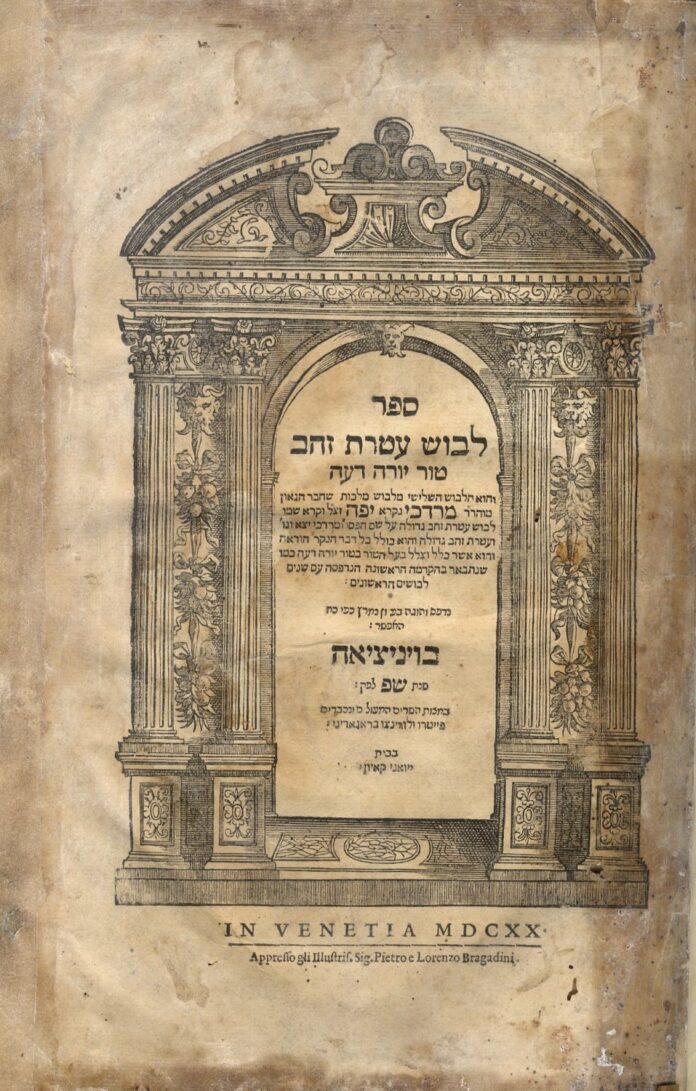

Today, 3 Adar, is the Yahrtzeit of הרב מרדכי יפה
A Man of Ten Garments
Today, the 3rd of Adar, we mark the yahrtzeit of one of the most remarkable Torah personalities of the early modern era — HaRav Mordechai Yaffe of Prague, whose influence on Jewish law, mysticism, and philosophy echoes through the centuries to our very day. He passed from this world on 3 Adar 5372 while serving as the Chief Rabbi of Posen, leaving behind a legacy as carefully structured — and as layered — as the ten volumes of his masterwork, the Levush Malchus.
But to understand the Levush, we must first understand the man. And to understand the man, we must begin with a remarkable story.
One afternoon, while walking on the outskirts of town, HaRav Mordechai Yaffe — a man of striking appearance and noble bearing — found himself approached by a gentile woman who, captivated by his handsome face, sought to draw him into sin. He faced what every person of faith fears: temptation that is sudden, close, and powerful.
The Rav’s eyes swept the road. Nearby — a canal, foul-smelling and filled with sewage.
Without a moment’s hesitation, he leaped in.
The stench permeated all ten garments he wore. The woman, repulsed, fled. And HaRav Yaffe emerged — clothes ruined, dignity perhaps bruised, but his neshamah (soul) as pristine and unblemished as the moment Hashem had fashioned it.
Family tradition holds that in the merit of this supreme act of self-sacrifice — this willingness to destroy his external appearance in order to guard his inner purity — the Almighty granted HaRav Yaffe the ability to author ten volumes of halachic discourse. He named them Levushim — “garments” — one for each of the soiled robes he had worn that day. What had been soiled in service of Heaven became the very symbol of his life’s work.
And when HaRav Yaffe turned his eyes Heavenward after this ordeal, tradition records that he offered a heartfelt prayer: “May the next ten generations that descend from me be repulsive in appearance, so that they should not encounter the challenges associated with physical beauty.” That prayer was answered. For ten full generations, his descendants bore little resemblance to their distinguished ancestor — until, in the eleventh generation, both the outer beauty and the radiant inner character of the Levush returned.
There is perhaps no better introduction to Rav Mordechai Yaffe than this story. Here was a man who understood that the garments of the body mean nothing if the garments of the soul are torn. Here was a man who would sacrifice everything external — appearance, comfort, dignity — to protect the sacred internal. And here was a man whose greatest literary achievement was built not merely on scholarship, but on the hard-won spiritual victories of a lifetime.
Origins of Greatness — Prague, c. 1530
HaRav Mordechai ben Avraham Yoffe was born around 5290 (1530 CE) in the holy community of Prague — a city already distinguished in Torah, already steeped in centuries of Jewish memory. The Altneuschul, perhaps the oldest functioning synagogue in Europe, cast its shadow over a kehilla that had survived crusades, blood libels, and expulsions, yet continued to produce Torah giants with stubborn regularity.
Into this world came Mordechai Yaffe — and his lineage alone was enough to make the angels take notice.
His ancestry traced back through an unbroken chain of Torah luminaries to Rashi himself — Rabbeinu Shlomo Yitzchaki (1040–1105), whose commentary on the Torah and Talmud remains indispensable to every Jewish student in every generation. Further back still, family tradition traced his line to Hillel HaZaken, the great Nasi of the Sanhedrin, and ultimately to the royal house of Malchus Beis David — the dynasty of King David himself.
This was not merely a matter of family pride. In the world of Torah, yichus — lineage — carries spiritual weight. It speaks of accumulated Torah, accumulated self-sacrifice, accumulated connection to the Divine. Young Mordechai entered the world carrying all of that on his shoulders, and he spent the rest of his life proving worthy of it.
Sitting at the Feet of Giants (c. 1550–1561)
If lineage was the foundation, education was the architecture. And HaRav Yaffe built his intellectual home under the greatest roofs available in 16th-century Europe.
The Rema — Rabbi Moshe Isserles of Kraków
The first and perhaps most profound influence on the young Mordechai Yaffe was HaRav Moshe Isserles (1530–1572), the towering Rema of Kraków. The Rema, whose glosses to the Shulchan Arukh would become the definitive guide for Ashkenazi Jewry for centuries, was both halakhist and humanist. It was the Rema who insisted that his student study not only Gemara and poskim, but also mathematics, astronomy, and philosophy. This insistence would shape everything that followed.
Imagine the scene: a young scholar from Prague arriving in Kraków, fully prepared to immerse himself in Talmud — and his teacher, one of the greatest rabbis alive, pushing open doors the student had barely noticed. “You must understand the cosmos,” the Rema seems to have said. “You must grapple with philosophy. Torah is not afraid of knowledge — Torah is the source of all knowledge.”
That vision never left HaRav Yaffe.
The Maharshal — Rabbi Shlomo Luria of Lublin
He also learned under the great Maharshal — HaRav Shlomo Luria (1510–1574) — at his renowned yeshiva in Lublin. Where the Rema sought clarity and accessibility in psak halacha, the Maharshal demanded something harder: rigorous intellectual precision, critical analysis of text and tradition, and an unflinching pursuit of the truth that lay behind the received tradition. His magnum opus, the Yam Shel Shlomo, was not a work for the faint of heart — it was a relentless wrestling match with the Talmud itself.
Between these two giants — the Rema’s breadth and accessibility, the Maharshal’s depth and severity — HaRav Yaffe developed what would become his own distinctive voice.
Rabbi Mattithiah Delacrut — The Kabbalist
The third pillar of his education was Rabbi Mattithiah ben Solomon Delacrut, a kabbalist who initiated HaRav Yaffe into the mysteries of the Zohar HaKadosh and the inner dimensions of Torah. Delacrut wrote commentary on astronomical and mathematical works alongside his mystical writings — a combination that must have resonated deeply with the young scholar who was already being shaped to see the unity of all knowledge.
Three teachers. Three worlds — halacha, critical analysis, mysticism. And one student determined to hold all three together.
Exile and Elevation — Venice, 1561–1572
Just as HaRav Yaffe was establishing himself as Rosh Yeshiva in his native Prague, history intervened with characteristic brutality. In 5321 (1561), Emperor Ferdinand I ordered the expulsion of all Jews from Bohemia. With no more ceremony than that, HaRav Yaffe — scholar, teacher, community leader — found himself a refugee.
He made his way to Venice.
In another man, exile might have meant bitterness, stagnation, the slow erosion of potential. For HaRav Yaffe, Venice became a crucible. The city’s Jewish ghetto — established in 1516 and home to Sephardic, Italian, and Ashkenazic communities — offered a remarkable panorama of Jewish diversity. Here were different minhagim, different approaches to scholarship, different ways of being Jewish. The young rabbi from Prague absorbed it all.
He also spent a decade immersed in the study of astronomy — not as a distraction from Torah, but as an expression of it. The Jewish calendar, with its intricate weaving of lunar months and solar years, demands astronomical sophistication. The calculations that govern Rosh Chodesh, that determine the great festivals, that synchronize the Jewish people’s experience of time — these are not merely mathematical exercises. They are acts of sanctification. To understand the heavens, for HaRav Yaffe, was to understand the divine architecture of time itself.
Venice was also a capital of Hebrew printing. The presses that had produced the first complete printed Talmud (Daniel Bomberg’s masterwork, 1520–1523) were still active. Torah knowledge was being disseminated at an unprecedented pace. HaRav Yaffe watched, absorbed, and planned.
He was already beginning to envision the Levush.
Four Decades of Leadership (1572–1612)
When HaRav Yaffe finally emerged from Venice in 5332 (1572), he began four extraordinary decades of rabbinic service — a career that reads like a map of the greatest Jewish communities of Eastern Europe.
Grodno (1572–1588): Sixteen years as Rav of this important Lithuanian community, part of the mighty Polish-Lithuanian Commonwealth — then home to the largest concentration of Jews in the world.
Lublin (1588–1592): One of the most prestigious rabbinic posts in all of Poland. Here, at the crossroads of the great Lublin fairs — where Jewish merchants and scholars from across the continent gathered — HaRav Yaffe rose to become one of the leaders of the Va’ad Arba Aratzos, the Council of Four Lands. This remarkable institution was the parliament of Jewish self-governance in Eastern Europe, coordinating communal life, representing Jewish interests before the Polish government, and adjudicating disputes between communities.
Kremenetz: Service in Volhynia, deepening his connection to the diverse tapestry of Eastern European Jewish life.
Prague (1592–1599): Thirty-one years after being expelled as a young man, HaRav Yaffe returned to his birthplace — now as its Rav. The homecoming must have been extraordinary. The city had transformed under Emperor Rudolf II, who had made Prague his imperial capital. The great Maharal of Prague was also serving the community during this period. HaRav Yaffe walked the same streets his childhood self had walked, but now as one of the undisputed masters of Torah of his generation.
Posen (1599–1612): His final posting, as Chief Rabbi of one of the oldest and most distinguished Jewish communities in Greater Poland. He would serve here until his final breath on 3 Adar 5372 — the day whose yahrtzeit we mark today.
The Levush Malchus — A Masterwork Fifty Years in the Making
Throughout all of this — the exile, the wanderings, the years of communal service, the political engagements, the endless demands of rabbinic leadership — HaRav Yaffe was writing.
For nearly fifty years, he labored over his magnum opus. The concept had come to him in youth: a comprehensive code of Jewish law that would serve the Ashkenazic communities of Bohemia and beyond. Then Rabbi Yosef Caro’s Shulchan Arukh appeared, and HaRav Yaffe paused. Was there still room for his work?
He decided yes — but the reason why reveals everything about his character and vision.
The Shulchan Arukh was too brief. For all its brilliance, it gave rulings without sufficient reasoning. Even when Rabbi Moshe Isserles added his Mappah — his glosses incorporating Ashkenazic practice — the result remained, in HaRav Yaffe’s view, too compressed, too spare, too silent about the “why” behind the “what.”
And the Beis Yosef — Caro’s massive earlier work — was too expansive for practical use.
HaRav Yaffe would build the bridge. His Levush Malchus would be “midway between the two extremes” — providing clear rulings while explaining their reasoning, tracing their sources, illuminating their logic, and — most distinctively of all — connecting them to their mystical roots.
The Ten Levushim
The work was organized into ten sections — ten “garments,” echoing the story of his great trial:
- Levush HaTechelet — The laws of Orach Chaim: daily life, prayer, Shabbat, and Yom Tov.
- Levush HaChur — Yoreh De’ah: kashrut, family purity, mourning.
- Levush Ateret Zahav — Even HaEzer: marriage and divorce.
- Levush Ir Shushan — Choshen Mishpat: civil and commercial law.
- Levush Avnei HaChoshen — Additional material on Choshen Mishpat.
- Levush HaOrah — An elucidation of Rashi’s commentary on Torah.
- Levush Simchah VeSason — Sermons for holidays and weddings.
- Levush Pinnat Yikrat — Commentary on Maimonides’ Guide of the Perplexed.
- Levush Eder Yakar — Commentary on the laws of the Jewish calendar and Abraham bar Hiyya’s Tzurat HaAretz.
- Levush Even Yikrat — Commentary on Menahem Recanati’s kabbalistic Torah commentary.
For the final three volumes, HaRav Yaffe issued a striking pedagogical instruction: study them in sequence — first philosophy, then astronomy, then Kabbalah. This was not arbitrary. It reflected a profound understanding of spiritual development: the human intellect must first be strengthened and disciplined through rational inquiry before it can safely ascend to mystical heights.
The Bridge Between Worlds — Halacha and Kabbalah United
Of all HaRav Yaffe’s contributions to Jewish thought, perhaps none is more remarkable — or more consequential — than his integration of kabbalistic insight into practical halacha.
Later scholars would describe the Levush as “an exception among the codifiers in treating ritual-legal matters from a kabbalistic standpoint.” And they would add that HaRav Yaffe’s approach “tended to draw together the Talmudists and kabbalists, otherwise in danger of an open breach.”
Read that again. In danger of an open breach.
By the 16th century, the world of Torah scholarship was pulling in two directions. On one side stood the great Talmudists — masters of legal analysis, rigorous, text-driven, suspicious of what they saw as the emotionalism and obscurantism of mystical teaching. On the other side stood the kabbalists — heirs to the Zohar, inspired by the revolutionary teachings emerging from Safed, convinced that legal observance without its mystical dimensions was a body without a soul.
HaRav Yaffe refused to choose sides, because he understood that there were no sides. Torah is one. Halacha without Kabbalah is a map without a destination. Kabbalah without Halacha is wings without feet. His Levush demonstrated, volume after volume, that every legal ruling pulses with spiritual meaning, and that every mystical insight must eventually find expression in concrete observance.
This was not merely a theoretical position. It was a vision of Jewish wholeness — of a people who study law and experience transcendence as a single, unified act of devotion.
Torah Embraces the Cosmos — Science and Philosophy
HaRav Yaffe lived in an age of intellectual revolution. The year 1543 — when he was a teenager in Prague — saw the publication of Copernicus’s challenge to everything humanity thought it knew about the heavens. The printing press was reshaping the transmission of knowledge. Philosophy was pressing hard against religious certainty throughout Europe.
HaRav Yaffe did not flinch. He engaged.
His commentary on the Rambam’s Guide of the Perplexed — the great medieval synthesis of Torah and Aristotelian philosophy — showed a scholar unafraid to wrestle with the hardest metaphysical questions: the nature of God, the purpose of the commandments, the mystery of prophecy. His decade of astronomical study in Venice bore fruit in a detailed commentary on the laws of the Jewish calendar and on Abraham bar Hiyya’s geographical-astronomical masterwork, Tzurat HaAretz.
The message was clear, and it echoed his beloved teacher the Rema: Torah does not fear knowledge. Torah is the source of all knowledge. The astronomer who maps the heavens and the sage who sanctifies the new moon are engaged in the same enterprise — the honoring of a cosmos created and governed by the One G-d.
A Living Chain: The Author’s Descent from the Levush
The Levush taught that Torah is not merely a text — it is a living inheritance, passed from hand to hand, generation to generation, like a flame that never dims. It is therefore with a profound sense of personal connection that this biography is written, for the author is himself a direct descendant of HaRav Mordechai Yaffe — fifteen generations removed, yet bound to his ancestor by an unbroken chain of names, memory, and mission.
The genealogical line, preserved through extraordinary effort and the merit of the family’s dedication to its heritage, runs as follows:
שלשלת היוחסין
The Genealogical Chain
- מו”ר ר’ מרדכי יפה בן ר’ אברהם — HaRav Mordechai Yaffe, the Levush himself
- ר’ פרץ בן מו”ר ר’ מרדכי יפה — Reb Peretz, son of the Levush
- ר’ אברהם בן ר’ פרץ יפה
- ר’ אליעזר יפה בן ר’ אברהם יפה
- רב יצחק יפה בן ר’ אליעזר יפה
- ר’ שלום זלקין בן ר’ יצחק יפה
- ר’ נחום בן ר’ שלום זלקין יפה
- ר’ יהודה בן נחום
- ר’ משה בן ר’ יהודה
- ר’ יהודה קנטור בן ר’ משה קנטור המכונה ר’ משה חסיד מעיר גרודנו — Reb Yehudah Kantor, son of Reb Moshe Kantor, known as Reb Moshe Chassid of Grodno
- הרב יעקב קנטור בן ר’ יהודה קנטור
- מירל בת הרב יעקב קנטר ובעלה ר’ אברהם הופמן — Mirel, daughter of HaRav Yaakov Kantor, and her husband Reb Avraham Hoffman
- ר’ משה בן אברהם וזוגתו מירל
- ר’ נתן יוסף בן משה הופמן
- ר’ יאיר ניסן בן ר’ נתן יוסף הופמן — the author
Note the remarkable detail at generation ten: Reb Moshe Kantor is described as Reb Moshe the Chassid, from the city of Grodno — the very city where the Levush himself served as Rav from 1572 to 1588. That his descendants maintained a presence in his first rabbinic posting across so many generations suggests a rootedness, a loyalty to place, that mirrors the Levush’s own loyalty to his people wherever he served them.
It is humbling to write the biography of an ancestor. It is also clarifying. The story of HaRav Mordechai Yaffe is not merely history — it is inheritance. The ten garments soiled in a canal. The ten volumes of the Levush. The fifteen generations of the chain. All of it speaks of a single, seamless truth: that Torah, once planted in a family, does not easily leave it.
Legacy and Yahrtzeit Reflection
HaRav Mordechai Yaffe passed from this world on 3 Adar 5372 — the day we mark today — while serving as Chief Rabbi of Posen, his pen finally stilled after nearly fifty years of building his monument to Jewish wisdom.
In the years and centuries that followed, he became known simply as “the Levush” — or the “Ba’al HaLevushim,” the Master of the Garments. When a Torah scholar is remembered not by his name but by his work, it is the highest tribute the tradition can offer. The Rambam. The Rosh. The Rema. The Levush. These are not just names — they are pillars.
The Levush Malchus has been reprinted in every generation. It sits on the shelves of yeshivot from Bnei Brak to Brooklyn. It is cited in responsa, consulted in shuls, studied in batei medrash. When a posek today considers a question about Shabbat or kashrut, about marriage law or civil law, the Levush is often in the conversation.
But perhaps the most lasting legacy of HaRav Mordechai Yaffe is not any specific ruling or commentary. It is the model he embodied — of a Torah scholar who understood that authentic Jewish life requires integration. Integration of halacha and Kabbalah. Integration of law and meaning. Integration of Torah and wisdom in its broadest sense. Integration of inner purity and outer action.
He demonstrated this with his scholarship.
He demonstrated it with his life.
And he demonstrated it, most vividly, on the day he leaped into a canal of sewage rather than compromise a single thread of his inner garment.
The author can be reached at [email protected]