
 JBizNews
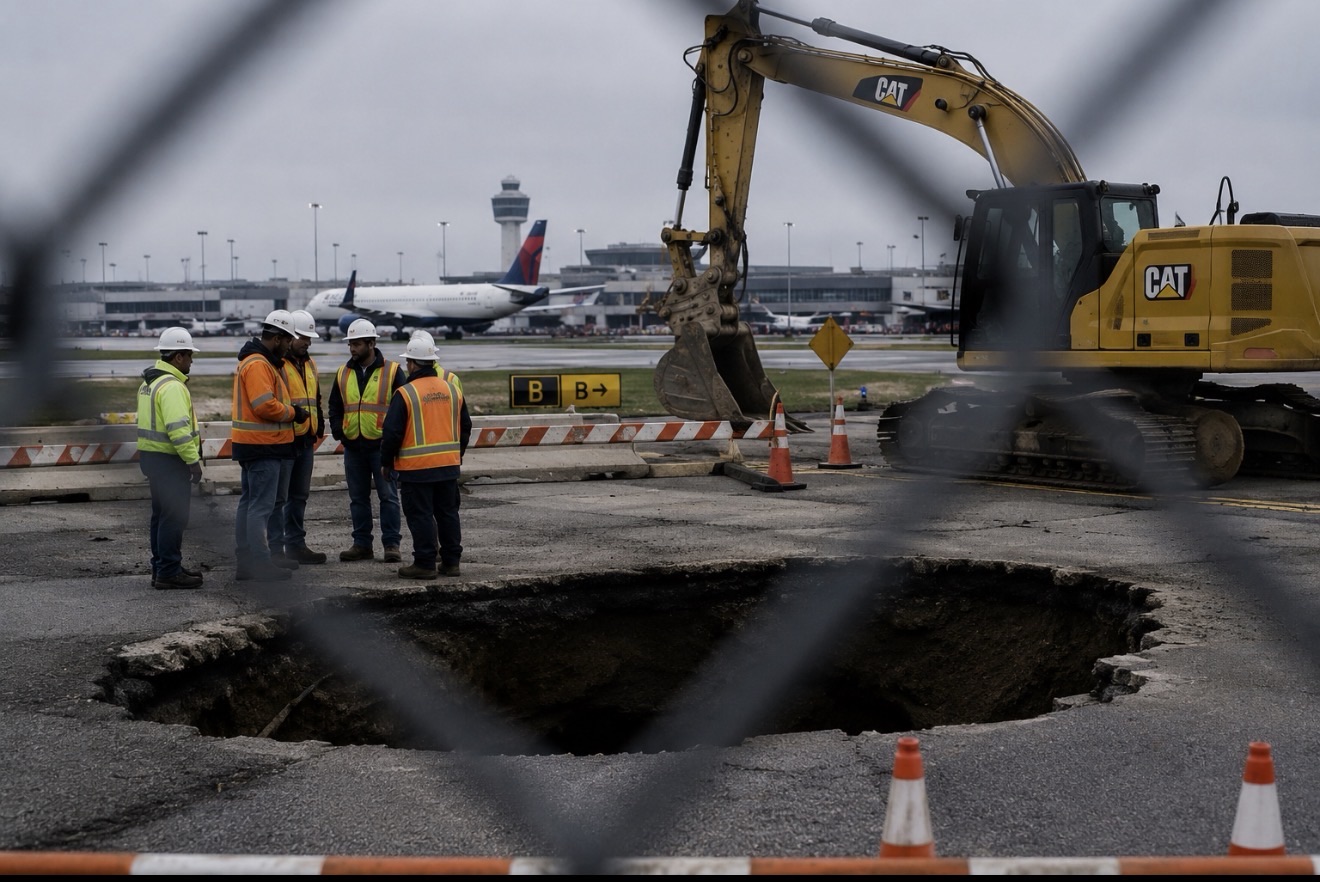
LaGuardia Runway Reopens After Sinkhole Shutdown, Capping a Costly Pre-Holiday Travel Mess
The Port Authority of New York and New Jersey announced on Friday, May 22, 2026, that Runway 4/22 at LaGuardia Airport reopened at 7:45 p.m. local time, ending a two-and-a-half-day closure that snarled travel during the unofficial kickoff to the Memorial Day weekend and exposed how a single piece of damaged airfield pavement can cascade through the U.S. aviation system. “Following a thorough inspection of LaGuardia’s airfield pavement using ground-penetrating radar, areas of concern were identified and proactively repaired. Those repairs are now complete, and Runway 4/22 has reopened. Our investigation into the cause of the sinkhole is ongoing,” the Port Authority said in a statement.
The sinkhole was first spotted at approximately 11 a.m. Wednesday, May 20, during a routine morning inspection of the airfield. The opening developed on taxiway Bravo, near but not directly on Runway 4/22, in an area where a new underground fuel pipeline had been constructed to bring jet fuel closer to aircraft and reduce the need for fuel trucks crossing the airfield. The runway was immediately taken out of service while engineers conducted core samples and sonar scans to check for additional weak points underground.
The business cost piled up quickly. According to flight-tracking service FlightAware, nearly 290 flights were canceled and more than 310 were delayed at LaGuardia on Wednesday alone, compounded by severe evening thunderstorms. Thursday saw another 51 cancellations. Friday delivered the biggest hit yet as the airport headed into the long weekend with one runway still down: by mid-morning Friday, 130 flight delays and five cancellations were already on the board, and the numbers grew through the day.
For the airlines that anchor LaGuardia — primarily Delta Air Lines, American Airlines, United Airlines, JetBlue Airways, Southwest Airlines, and Spirit Airlines — the disruption translates directly into real money. Industry estimates put the cost of a single canceled domestic flight at between $20,000 and $40,000 when factoring in crew repositioning, passenger compensation, hotel vouchers, rebooking expenses, and lost revenue. A three-day operational hit at one of the busiest domestic hubs in the country can push aggregate airline losses into the tens of millions of dollars before any indirect costs are counted.
LaGuardia, which mostly handles domestic travel, runs about half the daily traffic of nearby John F. Kennedy International Airport, but its location in Queens makes it the preferred gateway for business travelers heading to Manhattan. A disruption at LGA ripples outward to Boston Logan, Reagan National, Chicago O’Hare, Atlanta Hartsfield-Jackson, and other connected hubs, since aircraft and crews scheduled to fly in and out are forced to reposition. The Federal Aviation Administration advised travelers throughout the closure to check directly with carriers and posted real-time updates at fly.faa.gov.
Travelers absorbed the brunt. Sally Marchetto and her family, flying home to St. Louis, ended up rebooking onto separate flights and staying in an Airbnb in Queens. “Tomorrow, I’m leaving at 9 a.m., and my 80-year-old parents will have to go at like 2:30,” she told local reporters. Ossining resident Lee Weinberg lost a full day getting to Kansas City after Delta canceled his flight at 9:30 p.m. the night before. Olijuah Williams of Queens, headed to Atlanta, had his flight scrapped entirely. The stories repeated across hundreds of stranded passengers, many of whom turned to Airbnb, Marriott, Hilton, and Hyatt properties around the airport — a small windfall for hospitality businesses in East Elmhurst, Astoria, and Long Island City at the expense of the airlines.
For LaGuardia itself, the timing was awful. The airport has spent more than $8 billion over the past decade on a comprehensive redevelopment, replacing the aging terminals that former Vice President Joe Biden once compared to a “third-world country.” The new Terminal B and renovated Terminal C, anchored by Delta, were meant to symbolize a modern, reliable LGA. A sinkhole and a runway shutdown undercut that narrative in the worst possible week.
The episode also highlights a broader business concern: aging U.S. airport infrastructure. LaGuardia’s runway and taxiway system, like much of the nation’s airfield pavement, dates in parts to the mid-twentieth century. The American Society of Civil Engineers in its most recent infrastructure report card gave U.S. aviation a “D+” grade, citing deferred maintenance, capacity constraints, and outdated ground systems. The Bipartisan Infrastructure Law signed in 2021 allocated $25 billion for airport improvements, but disbursement has lagged demand, and large hubs like LGA continue to operate at or near full capacity with limited margin for surprise repairs.
This was not LaGuardia’s only operational crisis of 2026. The same runway was the site of a fatal collision in March between an Air Canada Express CRJ-900 regional jet operated by Jazz Aviation and an airport fire truck. Two pilots were killed. The National Transportation Safety Board, chaired by Jennifer Homendy, found that the airport’s ground surveillance system failed to generate a proximity alert and that the fire truck lacked a transponder to broadcast its location to air traffic control. That investigation remains open and has put fresh pressure on the Port Authority to upgrade ground-movement safety technology — a multimillion-dollar capital expenditure now likely to accelerate.
For investors, the larger story is exposure. Airline shares are tightly correlated to operational reliability at the major hubs. Delta, which has its largest New York presence at LGA, is most exposed to repeat disruptions. American Airlines and JetBlue carry significant LaGuardia schedules as well. Suppliers to airport modernization — including engineering and construction firms AECOM, Skanska, Turner Construction, and Jacobs Solutions — stand to benefit from any acceleration of infrastructure spending triggered by the year’s incidents.
Travelers will see residual delays through the weekend, the Port Authority warned, and the cause of the sinkhole remains under investigation. For the airlines, the airport, and the 70,000-plus passengers who pass through LaGuardia each day, the message from the past 72 hours is simple: in modern aviation, a single soft spot in the pavement can cost the industry millions and remind everyone how fragile the system really is.
— JBizNews Desk
© 2026 JBizNews. All Rights Reserved. Reproduction or distribution without written permission is prohibited.