
 JBizNews
Will the Dollar Stay King When Money Goes Digital? A Simple Guide to a Big Question
For a long time, the U.S. dollar has been the most important money in the world. Almost every country uses it to buy and sell things across borders. Oil is priced in dollars. Big international loans are made in dollars. Even when two countries that don’t speak English want to trade with each other, they usually agree to use dollars in the middle. People call the dollar the world’s “reserve currency” — like the main money everyone else trusts and saves.
But something is changing. People are using less and less paper money. Walk into a coffee shop in New York, London, or Tel Aviv and most people pay with their phone, a card, or a tap. Cash is slowly disappearing. And as money becomes digital, big countries are starting to ask a simple question: if money is just numbers on a screen now, why do we have to use America’s numbers? Why can’t we use our own?
This is the heart of the story. The world is moving to digital money, and the United States has to decide how to keep the dollar on top.
Here is the simple picture. Imagine the global economy as a giant playground. For 80 years, every kid who wanted to trade snacks had to first swap their snacks for dollar tokens. America made the tokens. America counted the tokens. If America didn’t like you, it could stop you from using the tokens — that’s what economic sanctions are. Now imagine the kids start saying, “Let’s just trade snacks directly. Or let’s make our own tokens.” That’s exactly what countries like China, Russia, India, Brazil, and others are starting to do.
The way they’re doing it is through something called a central bank digital currency, or CBDC. Think of it as official digital money made by a country’s central bank. China has one called the digital yuan or e-CNY. India has one called the e-rupee. Brazil has one called Drex. Europe is building one called the digital euro. The numbers are already big. China’s digital yuan has been used in more than 3.4 billion transactions worth about $2.3 trillion. India’s e-rupee has roughly 7 million users. These aren’t toys anymore.
A group of countries called BRICS — Brazil, Russia, India, China, South Africa, plus newer members like the UAE, Iran, and Indonesia — is now trying to link all their digital currencies together. The plan is simple. If an Indian company wants to buy something from a Brazilian company, they could do it directly in e-rupees and Drex without ever touching a dollar. India, which is hosting the 2026 BRICS summit, has formally proposed this idea, led by its central bank, the Reserve Bank of India.
For the dollar, this is a real threat — at least in theory. If enough world trade moves off dollar rails, the U.S. loses some of its power.
So what is America doing about it? Here’s where the story gets interesting.
Most countries are responding by building their own government digital money. America has decided to do the opposite. President Donald Trump signed an executive order banning a U.S. central bank digital currency. Federal Reserve Chair Jerome Powell, whose term ended May 15, 2026, told Congress he would not pursue one either. The reason is mostly political. Many Americans, on both the right and left, don’t want the government to be able to track every dollar they spend. Banks don’t want it either, because it could pull money out of the banking system.
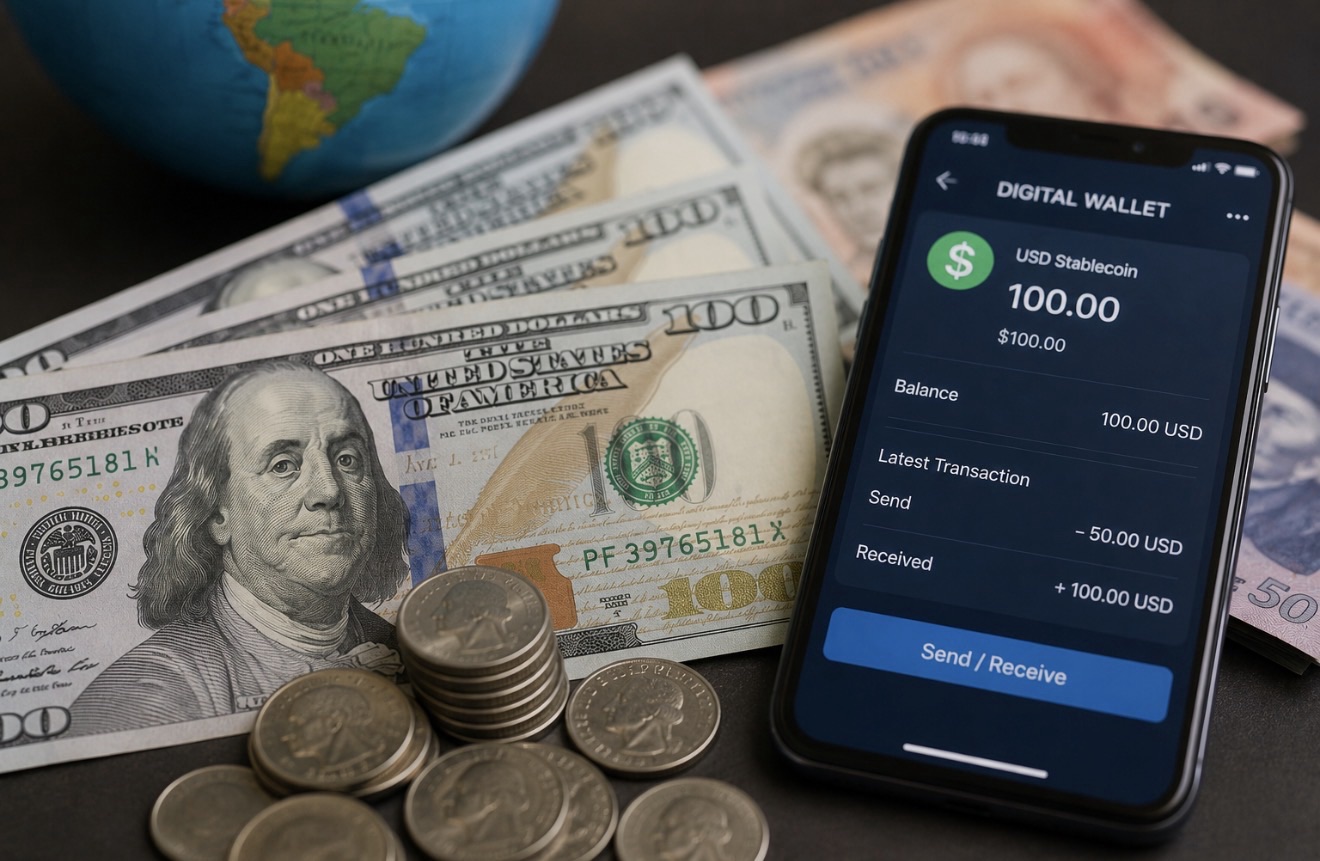
Instead, Washington has placed a bet on something called stablecoins. A stablecoin is digital money made by a private company, but each coin is backed by a real U.S. dollar — or by U.S. government bonds, which are basically promises from the U.S. Treasury. The two biggest are Tether (USDT) and Circle’s USDC. Together with smaller ones, the global stablecoin market is now worth about $200 billion.
Here’s the clever part. When someone in Argentina, Nigeria, Turkey, or Vietnam uses a dollar-backed stablecoin to save money or send a payment, they are — without thinking about it — buying dollars. The stablecoin company has to hold real dollars or U.S. Treasuries in the background to back the coin. Tether alone now holds about $100 billion in U.S. Treasuries, making it one of the biggest buyers of American government debt in the world.
So while China is building its own digital money to escape the dollar, America is letting private companies spread the dollar to every smartphone on the planet. It’s a different strategy with the same goal: keep the dollar on top.
Congress has been helping. The GENIUS Act, signed into law in July 2025, set the rules for how stablecoin companies have to operate in the United States. It banned them from paying interest to users, which protects American banks from losing deposits. House Financial Services Committee Chairman French Hill has said openly that growing the stablecoin market will “extend the reserve currency status” of the dollar around the world. That’s the official strategy in Washington.
The numbers behind dollar dominance still look strong. The U.S. dollar is on one side of 89% of all foreign exchange trades worldwide, compared to 29% for the euro and just 10% for the yuan. About 58% of global foreign-exchange reserves are still held in dollars. Oil, gold, and most major commodities are still priced in dollars. Even Saudi Arabia, despite years of speculation about it switching to yuan, still sells most of its oil in dollars.
But there are warning signs. Saudi Arabia, the UAE, Thailand, and Hong Kong are quietly testing a multi-country digital currency network called Project mBridge that can settle trades without dollars. Russia has been pushed off dollar rails by sanctions over the war in Ukraine and has been trading oil with China and India in local currencies. Iran, similarly cut off by sanctions, has joined the same effort. Argentina, Egypt, and parts of Africa are seeing huge growth in stablecoin use — which is good for the dollar — but they’re also exploring CBDC alternatives.
What does it all mean for normal people and investors?
A few simple things. First, the dollar isn’t disappearing anytime soon. The global system runs on it, and even the people trying to build alternatives know that replacing 80 years of dollar plumbing takes decades, not years. Second, the dollar is changing form. Less of it will be paper. More of it will be stablecoins on phones, instant payments through the Federal Reserve’s FedNow system, and digital tokens on bank apps. Third, the competition is real. China’s digital yuan and a future BRICS digital network are not going to overtake the dollar overnight, but they will chip away at its share — especially in regions like Africa, Latin America, and parts of Asia where America has less influence.
For U.S. companies, the cashless shift is mostly good news. Visa, Mastercard, PayPal, Block, Stripe, Coinbase, Robinhood, and the big banks all benefit when payments move to digital rails. U.S. Treasury demand from stablecoin issuers helps keep American borrowing costs lower than they would otherwise be. For foreign companies trying to escape the dollar, the path is harder than it looks — building parallel payment systems takes years and trust, and trust is something the dollar still has by default.
The bottom line is this. The world is going cashless, but cashless does not automatically mean dollar-less. The form of the money is changing, but the dollar’s role at the center of the global system is still mostly intact — for now. Washington’s bet is that stablecoins will carry the dollar into the digital age the same way Treasury bills carried it through the analog one. Beijing, New Delhi, and Brasília are betting the opposite. The race is on, and the next ten years will tell us who was right.
The dollar has been king for a long time. It still wears the crown. But for the first time in a generation, there are other players on the board.
— JBizNews Desk
© 2026 JBizNews. All Rights Reserved. Reproduction or distribution without written permission is prohibited.