
 JBizNews
U.S. Sends Nuclear-Powered Aircraft Carrier to Caribbean as Trump Tightens Cuba Squeeze, Sending Tremors Through Regional Trade
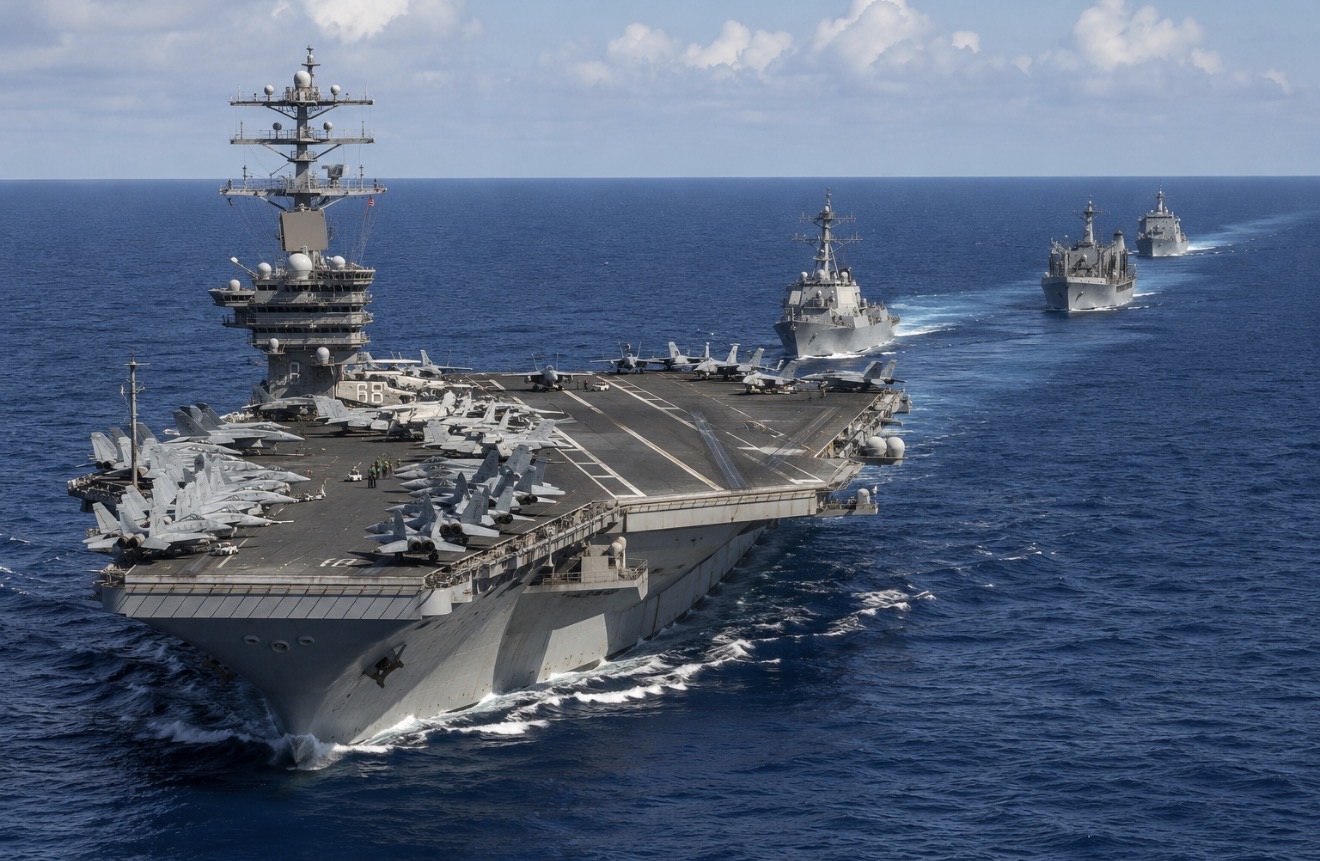
U.S. Southern Command, the Pentagon combatant command responsible for military operations in Central and South America and the Caribbean, announced on Wednesday, May 20, 2026, that the USS Nimitz aircraft carrier strike group has entered the Caribbean Sea as the Trump administration intensifies its economic, judicial, and diplomatic campaign against the Cuban government. The announcement, made through an official SOUTHCOM statement and a video posted to its X account, called the deployment “the epitome of readiness and presence, unmatched reach and lethality, and strategic advantage.”
The USS Nimitz is a nuclear-powered U.S. Navy aircraft carrier, effectively a floating military airbase capable of carrying dozens of fighter jets, surveillance aircraft, helicopters, and thousands of sailors and Marines. The broader carrier strike group includes guided-missile destroyers, support ships, radar systems, and combat aircraft designed to project American military power anywhere in the world without relying on foreign bases.
The strike group, deployed as part of the multinational Southern Seas 2026 maritime exercise, includes the carrier USS Nimitz (CVN 68), the embarked Carrier Air Wing 17 of nine squadrons flying F/A-18C/E/F Super Hornets, EA-18G Growlers, E-2D Hawkeyes, C-2A Greyhounds, and MH-60R/S Sea Hawks, the guided-missile destroyer USS Gridley (DDG 101), and the fleet oiler USNS Patuxent (T-AO 201). The carrier had recently completed joint naval exercises with the Brazilian Navy off Rio de Janeiro before transiting into SOUTHCOM’s area of responsibility.
The timing carries unmistakable political weight. The carrier’s arrival coincided with three coordinated moves by Washington the same day. The U.S. Department of Justice unsealed a federal criminal indictment against 94-year-old former Cuban leader Raúl Castro in connection with the 1996 shootdown of two civilian aircraft operated by the Miami-based exile group Brothers to the Rescue, in which four people were killed. Secretary of State Marco Rubio, the Florida Republican and son of Cuban immigrants, released a Spanish-language video urging Cubans to reject what he called the island’s communist leadership. And President Donald Trump posted a presidential statement linking Cuba to the captured former Venezuelan leader Nicolás Maduro, writing that the indictment and removal of Maduro “sent a clear message to his socialist allies in Havana: this is our hemisphere, and those who destabilize it and threaten the United States will face consequences.”
For business and markets, the deployment reads as the climax of a months-long pressure campaign that has already reshaped the regional economic landscape. According to U.S. Treasury and State Department records, the Trump administration has imposed more than 240 sanctions on Cuba since January 2026. U.S. Navy and Coast Guard assets have intercepted at least seven oil tankers carrying fuel destined for the island. Trump signed an executive order on May 1 expanding restrictions on Cuba’s energy, defense, mining, and financial services sectors. The cumulative result, according to regional energy analysts, is an 80% to 90% collapse in Cuban energy imports, triggering blackouts lasting up to 25 hours per day across more than 55% of the island’s territory.
The economic implications stretch well beyond Cuba’s borders. The Caribbean is one of the most important commercial corridors in the Western Hemisphere, anchoring trade flows between the Port of Houston, Port of New Orleans, Port of Miami, and Latin American export hubs. Roughly 40% of U.S. waterborne foreign trade transits through the region. Major shipping lines including A.P. Moller-Maersk, Mediterranean Shipping Company, Hapag-Lloyd, CMA CGM, and Crowley Maritime route container traffic through nearby waters. Any sustained military presence raises insurance, routing, and compliance costs for commercial operators, even without direct military conflict.
Cruise operators are especially exposed. Royal Caribbean Cruises, Carnival Corporation, Norwegian Cruise Line Holdings, and MSC Cruises all run major Caribbean itineraries, including stops in Jamaica, the Bahamas, the Cayman Islands, Aruba, and the Dominican Republic. The Caribbean cruise market generates roughly $30 billion annually in passenger spending across the region. Cruise stocks briefly fell last year when the USS Gerald R. Ford deployed to the Caribbean during the operation that resulted in Maduro’s capture. Investors are now watching closely for a similar market reaction tied to the Nimitz deployment.
The pressure campaign has also disrupted regional energy markets. With Cuba’s imports collapsing, fuel flows from Venezuela — historically Havana’s main supplier through subsidized oil agreements — have sharply declined. PDVSA, Venezuela’s state oil company now operating under a transitional government after Maduro’s removal, has reduced shipments to Cuba. The shift has tightened diesel and heavy fuel oil supplies across parts of the Caribbean and Central America, raising costs for utilities, freight operators, and businesses dependent on imported energy.
Financial institutions are also feeling the impact. Cuba has been largely cut off from U.S. banking channels since the 1960s, but some European and Canadian banks have continued facilitating trade and remittance flows. Trump’s May 1 executive order expanded restrictions on financial services tied to Cuban entities, increasing compliance pressure on banks including Banco Santander, BNP Paribas, and Royal Bank of Canada. Money-transfer channels used by Cuban families are facing increased scrutiny as Washington tightens enforcement.
The Cuban-American business community in South Florida, centered in Miami-Dade County, has emerged as one of the strongest supporters of the administration’s hardline approach. The community includes major real estate, hospitality, banking, and trade interests that have long favored stronger pressure on Havana. Rubio, before becoming secretary of state, was one of the most influential advocates of that position in Washington. Florida Governor Ron DeSantis has also aligned the state’s economic and political agenda with the administration’s broader Caribbean strategy.
CIA Director John Ratcliffe met with Cuban officials last week, warning that negotiations would not remain open indefinitely. The administration is reportedly seeking concessions involving political prisoners, migration controls, and counternarcotics cooperation. Cuban President Miguel Díaz-Canel rejected the indictment against Castro, calling it “a political maneuver, devoid of any legal foundation.”
For defense contractors, the deployment is quietly positive. Companies including Lockheed Martin, Northrop Grumman, RTX, General Dynamics, and Huntington Ingalls Industries benefit from ongoing carrier operations, maintenance cycles, munitions demand, and naval support contracts. Huntington Ingalls, which built all active Nimitz-class aircraft carriers, is also constructing the Navy’s next-generation Gerald R. Ford-class fleet. The USS Nimitz, commissioned in 1975, is scheduled for retirement in March 2027 following this deployment, making this one of its final major operations.
Regional governments are now navigating increasingly difficult trade and diplomatic calculations. Countries including Mexico, Jamaica, Colombia, and the Dominican Republic maintain significant migration, trade, tourism, and remittance ties with both Washington and Havana. Many are now assessing whether the administration’s tougher Cuba posture could expand more broadly across the hemisphere.
The Nimitz will eventually return to Naval Station Norfolk in Virginia after completing its Caribbean mission. But the message sent by its arrival — to Havana, Caracas, Beijing, and global markets — is likely to outlast the carrier itself.
— JBizNews Desk
© 2026 JBizNews. All Rights Reserved. Reproduction or distribution without written permission is prohibited.