
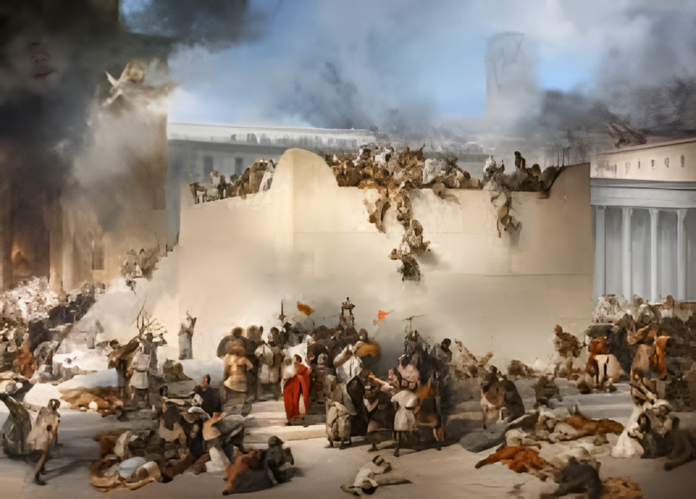

New York (VINNEWS/Rabbi Yair Hoffman) The period of the Nine Days is a time to mourn the Beis HaMikdash. It seems that there is a debate among the Rishonim as to what exactly we are mourning. Is it our lowly spiritual state that caused the loss of the Beis HaMikdash? Or is it the loss of the Beis HaMikdash itself? Or perhaps both?
The halachos of mourning that we observe help us focus on what we should be feeling. Below is a synopsis of these halachos, organized by topic.
WHAT IS ALREADY FORBIDDEN FROM THE THREE WEEKS
The Nine Days restrictions come on top of the restrictions already in place during the Three Weeks. Those include haircutting and shaving, dancing and listening to music, reciting Shehecheyanu, doing dangerous activities, and getting married.
CLOTHING: WEARING FRESH CLOTHING
One may not wear freshly laundered or pressed clothing on weekdays during the Nine Days (SA OC 551:3). The prohibition includes clothing, sheets, and towels.
One option for clothing that must be worn during the Nine Days is to rub it on a floor that was not recently cleaned. The poskim disagree about whether this rule applies to clothing worn to absorb sweat, such as underwear and socks.
Fresh bedding and towels should not be used. However, one may make a bed for a guest with freshly laundered linen (Mesoras Moshe).
CLOTHING: WEARING NEW CLOTHING
New clothing may not be worn — even small items like socks (SA OC 551:3). Someone who has only new clothing available should rub it on a floor that was not recently cleaned.
CLOTHING: WEARING SHABBOS CLOTHING
Shabbos clothing may not be worn during the week. If it is needed for a date, many poskim permit it. For a simcha such as a bris, a posek should be consulted.
CLOTHING: SHABBOS CLOTHING ON SHABBOS
Our custom is to wear freshly laundered Shabbos clothing on Shabbos during the Nine Days — though not brand-new clothing. This applies even when Shabbos is Tisha B’Av. If the clothing needed for Shabbos is at the cleaners, one may pick it up. Fresh bedding should not be used even for Shabbos, but a fresh tablecloth may be used.
CLOTHING: WASHING AND IRONING
Washing and ironing clothing is prohibited during the Nine Days, even if the clothing will not be worn until afterward (SA OC 551:3). This generally applies even when the work is done by a non-Jew. All clothing is included, as is a sheitel.
Sheitels may not be washed and set (Rav Elyashiv, Halichos v’Hanhagos p. 66). Rav Scheinberg, however, permitted it when absolutely necessary (cited in Rivevos Ephraim VI 291:3).
There are exceptions. One may wash an item that got stained and will be ruined if it is not cleaned right away. According to many poskim, spot cleaning is permitted. If all of a person’s clothing is dirty and unwearable, many poskim hold it is better to wash than to buy new clothing. One may sort laundry now to be washed after Tisha B’Av. Polishing shoes is permitted.
CLOTHING: CHILDREN’S CLOTHING
One may wash clothing for young children who cannot keep their clothing clean. Other clothing may not be added to the load. Children’s clothing may be lightly ironed if it is very creased.
CLOTHING: SEWING
One may not sew new clothing or make significant alterations to old clothing. Light sewing, such as attaching a button or fixing a ripped seam, is permitted.
SHOPPING: CLOTHING
One may not purchase any clothing during the Nine Days. The exception is Tisha B’Av shoes for someone who does not own a pair.
There are two leniencies. If there is an unusual sale taking place, one may buy clothing. And if one is out of town and will not be able to shop there after Tisha B’Av, one may shop there.
SHOPPING: GENERAL (NON-CLOTHING)
Shopping for items that bring simcha, such as silver utensils, should be avoided. However, one may purchase a necessity — a new air conditioner, for example — even though it will bring simcha.
Standard non-simcha items needed during the Nine Days may certainly be purchased. Significant purchases meant for after the Nine Days should be avoided if possible.
EATING MEAT AND DRINKING WINE
The Gemara forbids eating meat at the last meal before Tisha B’Av. Nonetheless, the custom of all Israel is not to eat meat from Rosh Chodesh Av until chatzos — halachic noon — on the 10th of Av (SA OC 551:9, citing the Rashba).
Meat and wine are permitted at a siyum, the celebration marking the completion of a tractate of Talmud or an order of Mishna. Meat and wine are also permitted on the Shabbosim of the Nine Days.
Meat and wine may not be consumed at Melaveh Malka (Igros Moshe OC IV 21:4).
HAVDALLAH WINE
According to Rav Elyashiv zt”l (Halichos v’Hanhagos p. 11), the Havdallah wine during the Nine Days should be given to a boy of about six or seven — even younger if he has reached the age of brachos — as long as he is not old enough to understand mourning. That understanding generally begins around age seven and a half or eight, though older if he does not yet grasp the concept.
If such a boy is not available, the wine should be given to a boy under bar mitzvah. If no boy is available, the man himself may drink the wine.
OTHER RESTRICTED ACTIVITIES
Additional activities restricted during the Nine Days include bathing, planting, and construction.
CUTTING NAILS
Some poskim prohibit cutting nails during the week in which Tisha B’Av falls, except for mikvah purposes. Even when Tisha B’Av falls on Shabbos, some poskim prohibit cutting nails that week — except on Friday, in honor of Shabbos.
THE WEEK IN WHICH TISHA B’AV FALLS
Many Sephardic Jews observe a number of the Nine Days restrictions only during the week in which Tisha B’Av falls.
THE EIGHTH OF AV
Pleasure trips are forbidden on Erev Tisha B’Av after chatzos — halachic noon (Vilna Gaon on Ramah, end of 553).
The custom is not to learn Torah after halachic noon on the 8th of Av. The reason is that Torah causes the heart to rejoice (see Tehillim 19:9).
THE SEUDAH HAMAFSEKES
Generally, on the eighth of Av, before Tisha B’Av begins, we eat a mourner’s meal called the Seudah HaMafsekes. When Erev Tisha B’Av falls on Erev Shabbos., however, it is not done.
The custom is to eat one cooked item, such as a cold hard-boiled egg, along with bread and ashes. We eat while sitting on the floor, and we do not eat the meal in a group. Leather shoes may be worn during the meal, though the mood should be somber.
THE NINTH OF AV
Because the loss of the Beis HaMikdash was such a national tragedy, the halachos of Tisha B’Av combine the laws of Yom Kippur with the laws of mourning.
We therefore observe the five inuyim of Yom Kippur: (1) no eating or drinking, (2) no washing, (3) no anointing, (4) no wearing leather shoes, and (5) no marital relations.
In addition to the Yom Kippur inuyim, (6) we do not study Torah except for passages that bring on sadness, (7) we do not extend greetings to others, (8) we do not work, and (9) we do not sit on a chair. The last two may be done after chatzos — halachic noon.
When one needs to wash hands, such as after using the restroom, one washes only up to the knuckles.
CUSTOMS IN SHUL
In shul, the custom is to dim the lights, based on the verse in Eichah (3:6), “He placed me in darkness.” We also remove the curtain that covers the Sefer Torah in the ark. This is based on the Midrash that interprets the verse in Eichah (2:17), “He tore His royal garments.”
After Maariv, Eichah is read and a number of Kinos are recited. On the following day, additional Kinos are recited. Most of these Kinos were written during the Crusades. A number of Kinos were added during the Holocaust as well, and many shuls have the custom to recite those too.
THE TENTH OF AV UNTIL CHATZOS
The burning of the Beis HaMikdash continued into the tenth of Av — indeed, most of it burned then. We therefore refrain from eating meat and drinking wine until halachic noon on the tenth (SA OC 558).
The Mishna Berurah rules that we also refrain from bathing, cutting hair, listening to music, and washing clothes until halachic noon on the tenth.
If the tenth of Av falls on a Friday, one may launder immediately after Tisha B’Av ends. Haircuts and bathing, however, should wait until Friday morning (Eliyahu Rabbah 559:31). Music is permitted only at noon. If necessary, bathing and haircutting may be done on Motzaei Tisha B’Av, if one will be unable to do them on Friday.
FOOTNOTE ON RECORDED MUSIC
[i] Some report that the position of Moreinu Rav Elyashiv zt”l is that tapes recorded without musical accompaniment are permitted during the Three Weeks and Sefira, and that the theory that the tape recorder is itself a musical instrument is erroneous. This is not merely an unsubstantiated oral ruling; the provenance is rather clear. It is printed in the sefer of Rav Shlomo Zalman Auerbach’s grandson, Rav Tuvya Freund shlita, entitled Shalmei Moed, p. 453, footnote 40. The sefer carries haskamos from Rav Azriel Auerbach shlita, Rav Zalman Nechemia Goldberg zt”l, and Rav Yehoshua Neuwirth (of Shmiras Shabbos KeHilchasa), with a michtav bracha from Rav Shmuel Auerbach zt”l. This was also the position of Moreinu HaRav Shlomo Zalman Auerbach zatzal.
According to this, both Rav Shlomo Zalman and Rav Elyashiv hold that tapes with music are forbidden, while tapes of singing without music are permitted, both during Sefira and during the Three Weeks.
However — and this is a significant however — according to Rav Dovid Morgenstern, as told to this author by Rav Morgenstern, this question was posed to Rav Elyashiv during Sefira of 5765 by a grandson of Rav Elyashiv. Rav Elyashiv repeated his answer, in Rav Morgenstern’s presence, five times. He said it was clearly forbidden, because the tape recorder is considered a musical instrument. Clearly, there is a contradiction between Rav Freund and Rav Morgenstern as to Rav Elyashiv’s position.
The author can be reached at [email protected]