
 Jewish Breaking News
Israeli Doctors Test Groundbreaking Ultrasound Therapy That Treats Enlarged Prostate Without Surgery
Israeli doctors have begun testing a potentially transformative treatment for enlarged prostate that targets obstructive tissue without inserting instruments into the body, making an incision or hospitalizing the patient.
The first-in-human clinical trial is underway at Rambam Health Care Campus in Haifa, where urologists are testing the LOTUS-1 system developed by Israeli medical technology company NINA Medical. The device combines ultrasound imaging with high-intensity focused ultrasound, known as HIFU, to destroy selected prostate tissue through the skin.
Benign prostatic hyperplasia, or BPH, is a noncancerous enlargement of the prostate that becomes increasingly common as men age. Because the prostate surrounds part of the urethra, its growth can obstruct urine flow, causing urgency, a weak stream, repeated nighttime bathroom visits and difficulty fully emptying the bladder.
An estimated 94 million men aged 40 and older were living with the condition globally in 2019. U.S. health data indicate that BPH affects roughly 29% to 33% of men aged 65 and older, making it the most common prostate problem among men over 50. In advanced cases, prolonged obstruction can contribute to urinary retention, infections, bladder stones and damage to the bladder or kidneys.
Medication is usually the first line of treatment, either relaxing the muscles surrounding the prostate or gradually shrinking the gland. However, the drugs do not work adequately for every patient and can produce side effects, including sexual dysfunction.
Patients whose symptoms continue may undergo procedures in which surgical instruments are passed through the urethra to cut, vaporize or remove obstructive tissue. Those procedures can require anesthesia, hospitalization and catheterization, while carrying risks that include bleeding, infection, scarring and changes in sexual function.

NINA Medical’s system attempts to achieve the same fundamental result without entering the urinary tract. The patient sits in a specialized treatment chair while the device is positioned externally against the perineum, the area between the genitals and anus.
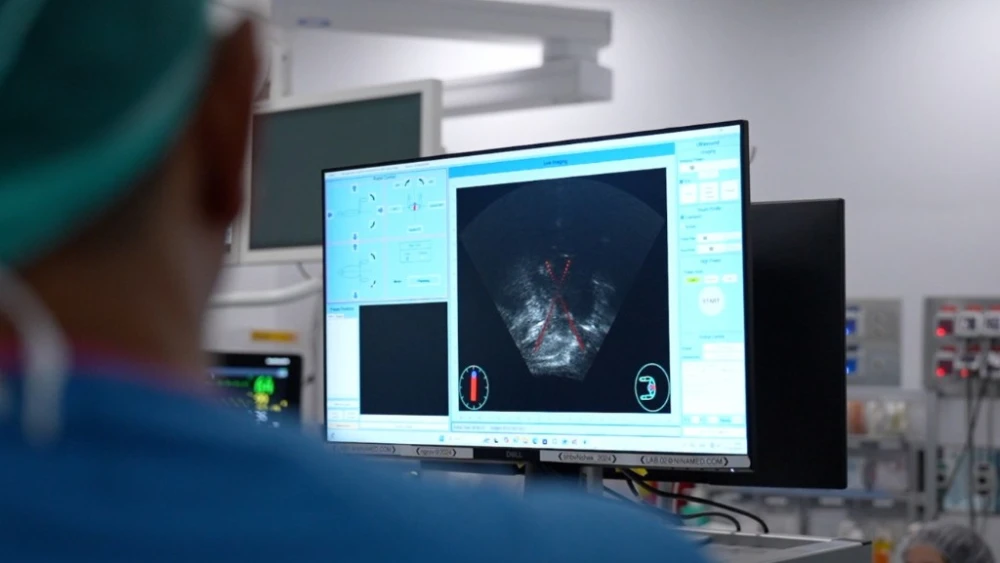
Conventional ultrasound first maps the prostate and surrounding structures. Focused sound waves are then directed toward selected points inside the gland, producing controlled heat that destroys targeted tissue. As that tissue contracts, researchers hope pressure on the urethra will decline and urine flow will improve.
A central innovation is the system’s ability to display the path and focal point of the therapeutic beam at low intensity before the full ablation energy is delivered. Developers say this allows doctors to confirm precisely where the energy will land, reducing the risk of damaging nearby healthy tissue.
Each activation can reportedly treat an area ranging from approximately the size of a pea to an olive in about one minute. Including preparation, the entire procedure lasts roughly 20 to 30 minutes. Patients can then get dressed and return home without hospitalization, and the procedure could potentially be repeated when necessary.

Three patients have undergone treatment at Rambam and have been monitored for approximately three months. Researchers are assessing both patient-reported improvement and objective measurements of urinary function and quality of life.
The results remain preliminary. The small trial is primarily designed to establish safety and feasibility, not to prove long-term effectiveness. Larger clinical studies and longer follow-up will be required before the technology can receive regulatory approval or be considered an alternative to established treatments.
Still, the trial marks a significant step for a system NINA Medical has been developing since the company was established in 2019. The company remains in the research-and-development stage and has received support through the Israel Innovation Authority.
Should the technology prove safe and effective, treatment for one of the most common conditions affecting older men could shift from the operating room to a routine outpatient appointment, without incisions, urethral instruments or a hospital stay.