 Vos Iz Neias
Reading the Air: Why the Same Smoke Gets Three Different Numbers
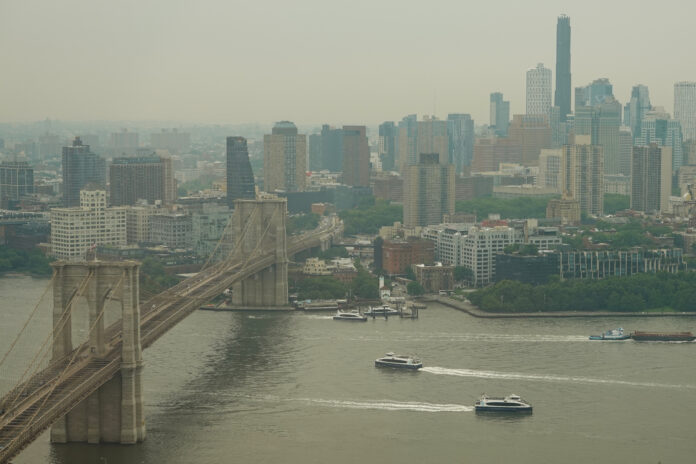
New York (VINNEWS/Rabbi Yair Hoffman) Smoke from roughly eight hundred Canadian wildfires settled over New York this week and turned a number most people ignore for eleven months of the year into the most important figure of the day: the Air Quality Index. What few realize is that the number does not mean the same thing in every country. A traveler who checks the air in Brooklyn on Monday, Toronto on Tuesday, and Yerushalayim on Wednesday is reading three different scales built on three different philosophies. One of them runs backwards.
This Week in New York
On Wednesday, July 15, city Emergency Management and the Health Department issued an advisory as a plume from fires in western Ontario arrived in the middle of a heat wave. By 2:30 that afternoon the AQI hit 155, squarely Unhealthy. Governor Hochul extended an advisory statewide.
Thursday was the worst of it. The index stood at 162 in the morning, climbed past 201 into Very Unhealthy territory, and Mayor Mamdani stressed at a morning news conference that at those levels the effects reach everyone, not only asthmatics and the elderly. New York got off lightly compared to the Midwest. Chicago closed its beaches and pools. Milwaukee registered 460, and Bradford Beach on Lake Michigan held about fifteen people on a July day that would normally draw thousands. Toledo reached 775. Michigan’s Western Upper Peninsula hit 785.
Today, Friday, brings partial relief as a northerly flow pushes the smoke west, though Western New York remains under an advisory and most of New Jersey stays under an alert. Rain is expected around midday Saturday, and federal officials say it should bring major improvement — falling droplets collect particles and carry them to the ground. Forecasters expect Moderate air by early Sunday afternoon.
What the Index Actually Measures
Air pollution is invisible and the body is a poor detector of it. Monitoring stations measure ozone, fine particles known as PM2.5, coarser PM10, carbon monoxide, sulfur dioxide, and nitrogen dioxide. During a wildfire, PM2.5 is what matters: particles roughly thirty times smaller than the width of a human hair, small enough to slip past the body’s filters, reach deep into the lungs, and enter the bloodstream.
Each country runs those same measurements through its own formula. That formula is where the philosophies part ways.
The American Ladder: Higher Is Worse
The EPA scale runs from 0 to 500 in six color-coded bands.
| AQI | Category | Meaning |
| 0–50 | Good | Little or no risk. |
| 51–100 | Moderate | Acceptable; unusually sensitive people may be affected. |
| 101–150 | Unhealthy for Sensitive Groups | Sensitive groups may feel effects. |
| 151–200 | Unhealthy | Everyone may begin to feel effects. |
| 201–300 | Very Unhealthy | Health alert; more serious effects. |
| 301+ | Hazardous | Emergency conditions for the entire population. |
The number 100 is not arbitrary. It marks the National Ambient Air Quality Standard, the legal limit set to protect public health. Below the line is compliance; above it is a problem.
The method calculates a sub-index for each pollutant and reports only the worst one. If ozone scores 60 and PM2.5 scores 180, the AQI is 180. The system deliberately refuses to average away the danger. The scale is also not linear: 300 does not mean twice the pollution or twice the harm of 150, because the breakpoints stretch and compress according to what the health research shows at each concentration.
When the Scale Runs Out of Room
The EPA’s published breakpoints stop at 500. Thursday’s readings did not. Toledo’s 775 and the Upper Peninsula’s 785 are not typographical errors, but they are not quite what the scale was designed to express either. Numbers beyond 500 come from extending the formula past its published range.
The AQI was built to answer a regulatory question — whether the air complies with the Clean Air Act — and 100 marks that line. A wildfire does not care about the Clean Air Act. When smoke drives concentrations to levels the drafters never contemplated, the index keeps counting, but the categories stop distinguishing. Milwaukee at 460 and the Upper Peninsula at 785 are both simply Hazardous. The scale has no vocabulary left.
The Canadian Question: Combined Risk
Canada, the source of this week’s smoke, took a different road. Its provinces once used indices built around what industry could realistically achieve rather than what lungs could tolerate. That approach was judged inadequate, and the replacement — the Air Quality Health Index — was designed from the ground up as a health tool rather than a compliance tool.
| AQHI | Health Risk | General Population Advice |
| 1–3 | Low | Ideal for outdoor activities. |
| 4–6 | Moderate | No need to change activities unless symptoms appear. |
| 7–10 | High | Consider reducing strenuous outdoor activity if symptoms appear. |
| Above 10 | Very High | Reduce or reschedule strenuous outdoor activity. |
The difference is philosophical. The American index asks which single pollutant is worst right now. The Canadian index asks what the combined health risk is from breathing this particular mixture, on the theory that pollutants do not attack the body one at a time and neither should the warning system. It splits its advice into separate columns for at-risk people and everyone else, and it suggests changes that reduce a person’s own contribution to the problem rather than only defensive measures.
The elegance has a cost. A scale of 1 to 10 offers less resolution than one of 0 to 500. The difference between an American 155 and an American 195 is meaningful, and a Canadian 7 blurs it.
The Israeli Scale: Zero Is the Boundary
Israel’s Ministry of Environmental Protection produced something genuinely unusual, and anyone who assumes it works like the American version will read it exactly wrong. It tracks seven pollutants, including total nitrogen oxides — a measure few other countries report, reflecting dense highway traffic in a narrow coastal strip. The calculation begins conventionally, computing a sub-index for each pollutant and taking the highest.
Then comes the twist. The Ministry subtracts that result from 100. The result is a diverging scale running from a high of 100 down through zero and into negative territory, as far as −400. Higher is better and lower is worse — the precise opposite of the American arrangement.
| Israeli AQI | Category | Meaning |
| 51 to 100 | Good | Clean air; ordinary activity is fine. |
| 0 to 50 | Medium | Noticeable pollution; sensitive people should pay attention. |
| −1 to −200 | Low | Poor air quality; caution warranted. |
| −201 to −400 | Very Low | Severely polluted air. |
Zero is not the bottom of the scale; it is the boundary. Crossing from positive to negative is psychologically vivid in a way that climbing from 99 to 101 is not. A negative number reads instinctively as a deficit, something owed, something wrong. The design turns arithmetic into intuition. The breakpoints are also stricter than the American ones for fine particles: Israel treats a 24-hour PM2.5 average of 18.6 micrograms per cubic meter as the point where air leaves the top band, while the current EPA table still counts a comparable concentration as Moderate.
Three Systems, One Agreement
| System | Strength and Weakness |
| United States | Most granular and legally anchored to enforceable standards. But it reports only the worst pollutant, understating the burden of breathing several at once, and its categories lose all resolution above 300. |
| Canada | Most medically sophisticated, built around combined risk and honest that lungs do not encounter pollutants in isolation. Coarse at the top of the scale. |
| Israel | Broadest coverage and the most psychologically clever design. But it is unfamiliar: a visitor who sees 45 in Tel Aviv and thinks of the American 45 will conclude the air is excellent when it sits in the Medium band. |
One principle unites all three. Every system singles out the same people for protection: children, the elderly, pregnant women, and those with respiratory or cardiovascular conditions.
What to Do With the Number
Anyone can feel the effects — coughing and wheezing, headache, stinging eyes, scratchy throat, chest pain, rapid heartbeat, fatigue. Those outdoors this week described it in strikingly consistent terms: a metallic taste, an acrid campfire smell, a burning in the eyes within moments of stepping outside.
\When the index is elevated, reduce or eliminate outdoor exertion, keep windows closed, and run an air purifier or air conditioner. Sensitive groups should move activities indoors entirely. Shortness of breath, coughing, dizziness, or unusual fatigue are signals rather than annoyances.
Cardiologists added a warning this week: wildfire smoke is a heart problem as much as a breathing problem, because those fine particles reach the bloodstream and stress the cardiovascular system. The CDC notes that people with diabetes and heart disease face elevated safety risk alongside asthmatics, children, and pregnant women.
And speaking of safety, the AQI is actually anumber that tells a person whether the air outside will harm him engages at least six distinct Torah obligations — and the sixth is the one that makes ignoring the forecast, rather than merely being harmed by it, a matter of halacha.
First, there is the Mitzvah of “veNishmartem me’od b’nafshosaichem” (Dvarim 4:9) — the Mitzvah of protecting our health and well-being. Fine particles that reach the bloodstream and stress the heart fall squarely within it.
Second, few have heard of the second Mitzvah. The verse later on (Dvarim 4:15), “Rak hishamer lecha,” is understood by most Poskim to comprise an actual second Mitzvah (See Rav Chaim Kanievsky zt”l, Shaar HaTeshuvos #25) — to take special care. Special care is precisely what a published index makes possible: the danger is invisible, but it has been measured and posted.
Third, there is the Mitzvah of “V’Chai Bahem — And you shall live by them” (VaYikra 18:5).
Fourth, the verse in Parshas Ki Saytzai (Dvarim 22:2) discusses Hashavas Aveidah with the words “vahashaivoso lo — and you shall return it to him.” The Gemara in Sanhedrin (73a) includes within these words the obligation of returning “his own life to him as well.” This is the source for the Mitzvah of saving a life, and appears to be the general Mitzvah the Shulchan Aruch refers to in Orach Chaim 325.
Fifth, “Lo Saamod Al Dam Rayacha” — a negative Mitzvah of not standing idly by your brother’s blood (Shulchan Aruch CM 426:1 and the Rambam). This extends to one’s own household: an elderly parent, a child with asthma, a neighbor who does not know the mask distribution sites exist.
Sixth, there is the Mitzvah of “Lo Suchal l’hisalaym” — a negative commandment associated with the positive Mitzvah of Hashavas Aveidah, from the verse in Dvarim (22:3), “You cannot shut your eyes to it.” The Netziv (HeEmek She’eilah) refers to this Mitzvah as well.
That sixth Mitzvah deserves a further word. The others are engaged once a person knows the air is dangerous. “Lo Suchal l’hisalaym” addresses the prior step — the decision not to look. When a state agency publishes a number every hour, free of charge, on any phone, the claim that one did not know becomes difficult to sustain. The forecast is available. Shutting one’s eyes to it may perhaps be subsumed in the aveirah that this pasuk describes.
The author can be reached at [email protected]