
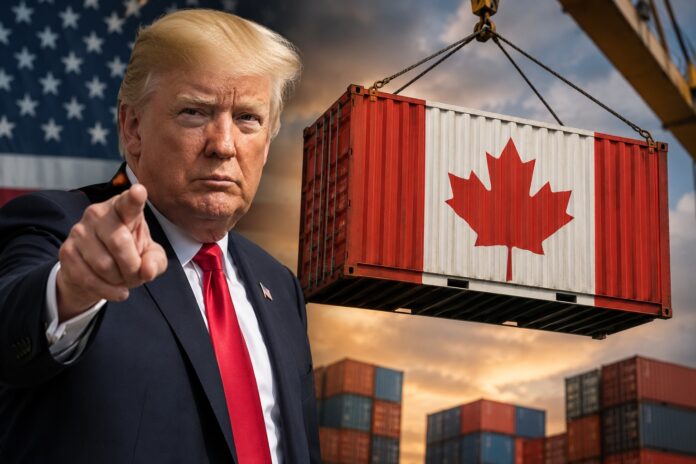

Posting on Truth Social, Trump declared that, “The cost of this pollution must of necessity be added to tariffs Canada is currently paying,” according to Reuters.
Trump also criticized Canada for failing to better manage the widespread wildfires that have sent smoke into large portions of the United States for weeks.
“Canada must do more to prevent these massive wildfires,” Trump wrote. “The smoke is pouring into the United States, affecting millions of Americans. This cannot continue. They need to get their forests under control and protect both Canadians and their neighbors.”
The president’s remarks came as smoke from hundreds of active fires across Canada continued drifting into the Midwest, Great Lakes region, Northeast, and Mid-Atlantic, triggering air quality warnings and public health advisories for millions of Americans.
Reuters noted that Trump’s comments connect the ongoing wildfire emergency with his broader trade policy toward Canada. His administration has already announced plans to impose a 35% tariff on certain Canadian imports beginning Aug. 1, while products covered under the U.S.-Mexico-Canada Agreement will continue to be handled separately.
The Washington Post reported this week that smoke from the Canadian wildfires could impact air quality for nearly 100 million people across the United States, with hazy skies stretching from the Upper Midwest through the Northeast.
According to ABC News, Canada is battling more than 800 active wildfires, including several of the largest blazes burning in western Ontario. Favorable wind patterns have carried thick smoke southward into the United States.
The smoky conditions have significantly reduced visibility and worsened air quality in major cities such as Chicago, Detroit, Cleveland, Buffalo, New York, and Philadelphia. Public health officials have advised children, seniors, and those suffering from asthma, heart disease, or other respiratory illnesses to remain indoors whenever smoke concentrations are high.
Wildfire smoke is especially dangerous because it contains microscopic PM2.5 particles, which are capable of traveling deep into the lungs and entering the bloodstream, increasing the risk of respiratory distress and other serious health problems.
The latest wave of smoke is part of another intense wildfire season in Canada, continuing a trend that has repeatedly affected the United States in recent years. During Canada’s historic 2023 fire season, smoke blanketed much of the Northeast, turning skies orange and producing some of the worst air quality measurements ever recorded worldwide.
The fires have also forced thousands of residents to evacuate communities across multiple Canadian provinces while millions of acres of forest have been consumed. Fire crews remain engaged in battling hundreds of blazes that are still burning.
As of Friday, Canadian officials had not publicly responded to Trump’s proposal that the economic costs associated with the wildfire smoke should be incorporated into U.S. tariffs on Canadian goods.
{Matzav.com}