
 Matzav
US Hammers Bridges Around Key Iran Port of Bandar Abbas On Seventh Straight Night of Airstrikes
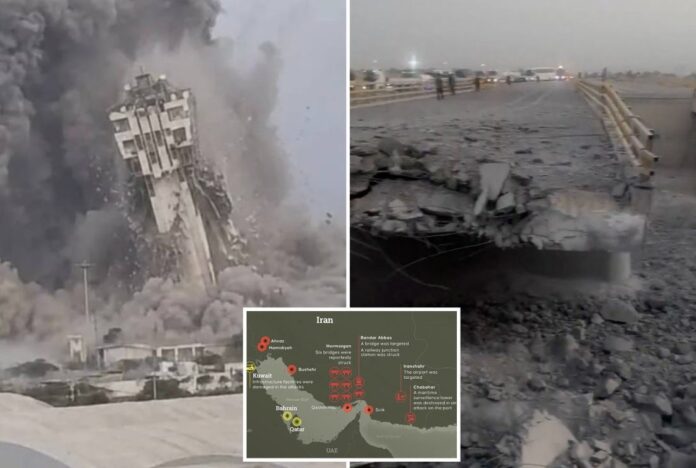
American forces intensified their military campaign against Iran on Friday by striking key transportation infrastructure around the strategic port of Bandar Abbas, marking the seventh straight day of U.S. air operations aimed at weakening Tehran’s control over the Strait of Hormuz. The attacks come as President Donald Trump signals that last month’s ceasefire agreement with Iran has effectively collapsed.
Among the targets hit were multiple road and railway bridges serving Bandar Abbas, a critical hub for Iranian military logistics. U.S. aircraft also destroyed a prominent white surveillance tower in the southern city of Chabahar, a port situated along an important trade corridor connecting Iran with neighboring Afghanistan.
According to U.S. Central Command (CENTCOM), the tower formed part of the Islamic Revolutionary Guard Corps’ long-standing maritime surveillance system used to monitor commercial shipping traveling through the Strait of Hormuz.
“The destruction of the tower directly degrades IRGC’s ability to coordinate attacks on innocent civilian crew members,” CENTCOM said in a post on X. “Furthermore, the strike protects freedom of navigation in regional waters for all vessels, except for ships attempting to violate the ongoing U.S. naval blockade against Iran.”
The renewed military campaign began after Tehran allegedly fired on three commercial vessels and failed to reopen the Strait of Hormuz as required under the U.S.-Iran memorandum of understanding and ceasefire agreement, prompting Washington to resume hostilities last week.
The initial wave of Friday’s strikes concluded shortly after President Trump declared during a nationally televised address that the United States was “winning big in Iran, and you will see the fruits of that labor very, very shortly.”
Only hours later, CENTCOM launched another series of attacks.
The expanded offensive follows President Trump’s announcement that the ceasefire negotiated with Tehran was no longer in effect after Iran failed to meet its commitments under the agreement.
“The Islamic Republic of Iran has asked us to continue ‘talks,’” Trump said on July 10. “We have agreed to do so, but the United States has stated to them, in no uncertain terms, that the Cease Fire is OVER!”
The latest escalation came after negotiations collapsed last weekend, leading Washington to begin its renewed bombing campaign against Iranian targets.
Following the launch of Operation Epic Fury by the United States and Israel on Feb. 28, Iran effectively shut down the Strait of Hormuz to commercial shipping, sending global oil prices sharply higher and giving Tehran significant leverage during subsequent negotiations.
With maritime traffic through the strategic waterway falling to its lowest level in three weeks, Brent crude climbed above $86 per barrel, approaching its highest price in a month.
Iranian state television reported that the strikes in Hormozgan Province damaged at least six bridges and left at least eight people dead. Iran’s Health Ministry said the latest round of fighting has resulted in at least 39 fatalities and more than 400 injuries.
Although alternative routes into and out of Bandar Abbas remain operational, analysts say additional U.S. strikes could further disrupt both Iranian military supply lines and the flow of commercial goods serving the country’s population of roughly 90 million people.
The port of Chabahar, developed in part with Indian support, has also become a recurring target of American airstrikes during the current conflict.
Iran has maintained that it alone should control the Strait of Hormuz and has argued that vessels transiting the waterway should pay fees to Tehran, despite the international community’s longstanding recognition of the strait as an international shipping lane.
President Trump has recently warned that the United States could expand its campaign by targeting Iran’s electrical grid, bridges, and energy infrastructure while enforcing a renewed naval blockade designed to halt Iranian oil exports. He has also pledged to begin striking additional oil and energy facilities next week if Tehran continues to reject negotiations.
A White House spokesperson told the BBC that the United States “carried out strikes exclusively on military targets, including military logistics infrastructure.”
CENTCOM also announced that U.S. naval forces intercepted several commercial vessels attempting to breach the blockade. According to the command, three ships were redirected, one vessel was disabled after refusing to comply with instructions, and another was boarded “to ensure full compliance.”
MarineTraffic.com reported that only eight vessels transited the Strait of Hormuz on Thursday—the fewest in three weeks. Seven of those ships traveled along a route favored by Iran, while none used the route nearest Oman that has been encouraged by the United States.
Maritime security concerns continue to disrupt commercial shipping throughout the region. Lloyd’s List Intelligence reported Thursday that some oil tankers are navigating the strait with their tracking systems switched off, while many others have opted to remain in port rather than risk the voyage.
Although an increasing share of Middle Eastern energy exports is now moving through pipelines, industry analysts say those routes remain insufficient to compensate for the sharp decline in tanker traffic through the Strait of Hormuz.
{Matzav.com}