
 Matzav
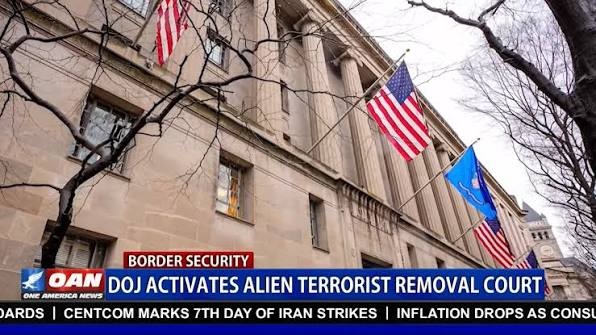
Trump Administration Activates Never-Before-Used ‘Alien Terrorist’ Deportation Court
The Trump administration has taken the unprecedented step of activating a little-known federal court that has never before been used, seeking to fast-track the deportation of foreign nationals designated as “alien terrorists” or certain members of their immediate families.
Earlier this week, the Justice Department filed the first application ever submitted to the Alien Terrorist Removal Court, a special tribunal established by Congress in 1996 but left unused for nearly three decades. The July 15 filing remains under seal, and a cover sheet indicates that the contents are classified.
Chief Judge Joan Ericksen, a U.S. District Court judge appointed by President George W. Bush, convened a closed hearing on Thursday before issuing an order directing the Justice Department to revise and strengthen its submission.
“The government could benefit from the opportunity for more thoughtful consideration,” the Minnesota-based George W. Bush appointee wrote in her one-page order. She noted that she had lingering questions about the actions taken by the Justice Department target and how they connect to the laws providing for the removal of “alien terrorists.” An updated response is due Wednesday.
The move marks another effort by the Trump administration to expand its use of existing immigration laws in pursuing deportations. Although the Alien Terrorist Removal Court has never previously been utilized, it became part of a legal dispute last year when the administration sought to quickly remove more than 100 Venezuelan nationals it identified as members of Tren de Aragua, a transnational gang that President Trump designated as a terrorist organization.
During those proceedings, U.S. District Judge James Boasberg questioned why the administration had not attempted to use the specialized court that Congress specifically created for such cases.
“In fact, Congress has an answer for us, doesn’t it? Because they created the Alien Terrorist Removal Court,” he said. “You can always go to the ATRC, which would be a first, but that’s what it’s there for, right?”
Representing the administration at the time, Justice Department attorney Drew Ensign argued that the existence of the tribunal did not prevent the government from relying instead on the Alien Enemies Act to deport suspected terrorists without first obtaining judicial review.
Federal law requires that any request to remove an individual through the Alien Terrorist Removal Court receive approval from the attorney general or deputy attorney general. In this case, the application was authorized by Acting Attorney General Todd Blanche and must include a factual statement explaining why the individual has been designated an “alien terrorist” and certifying that the person’s continued presence poses a threat to national security.
The statute broadly defines the conduct that may qualify someone for removal under the law. It covers individuals affiliated with designated terrorist organizations, those who “endorse or espouse terrorist activity,” as well as the spouses and children of individuals classified as “alien terrorists.” The law also gives the secretary of state authority to designate someone as an “alien terrorist” if that individual “intends while in the United States to engage … in activities that could endanger the welfare, safety, or security of the United States.”
If the court approves the government’s application, the individual named in the filing would then receive a public hearing to challenge the designation. Any appeal from the court’s decision would be heard by the U.S. Court of Appeals for the District of Columbia Circuit.
Legal scholars have long debated why the tribunal remained unused since its creation. Many have argued that its procedures—which permit judges to consider classified evidence that may not be disclosed to the individual facing deportation—could raise significant constitutional due process concerns.
Although the court has never handled a case until now, it consists of five federal judges appointed by Chief Justice John Roberts, operating under a structure similar to that of the Foreign Intelligence Surveillance Court, which reviews government requests involving suspected foreign intelligence activities.
In addition to Chief Judge Ericksen, the current members of the Alien Terrorist Removal Court include Judge Timothy DeGiusti of Oklahoma, Judge Karin Immergut of Oregon, Judge Kenneth Karas of New York, and Judge Sara Lioi of Ohio.
The existence of the newly filed application was first uncovered today by journalist and legal researcher Seamus Hughes, who operates the CourtWatch project.
{Matzav.com}