
 JBizNews
House Sets Up Floor Fight Over $95 Billion Iran War Package as Senate Republicans Balk
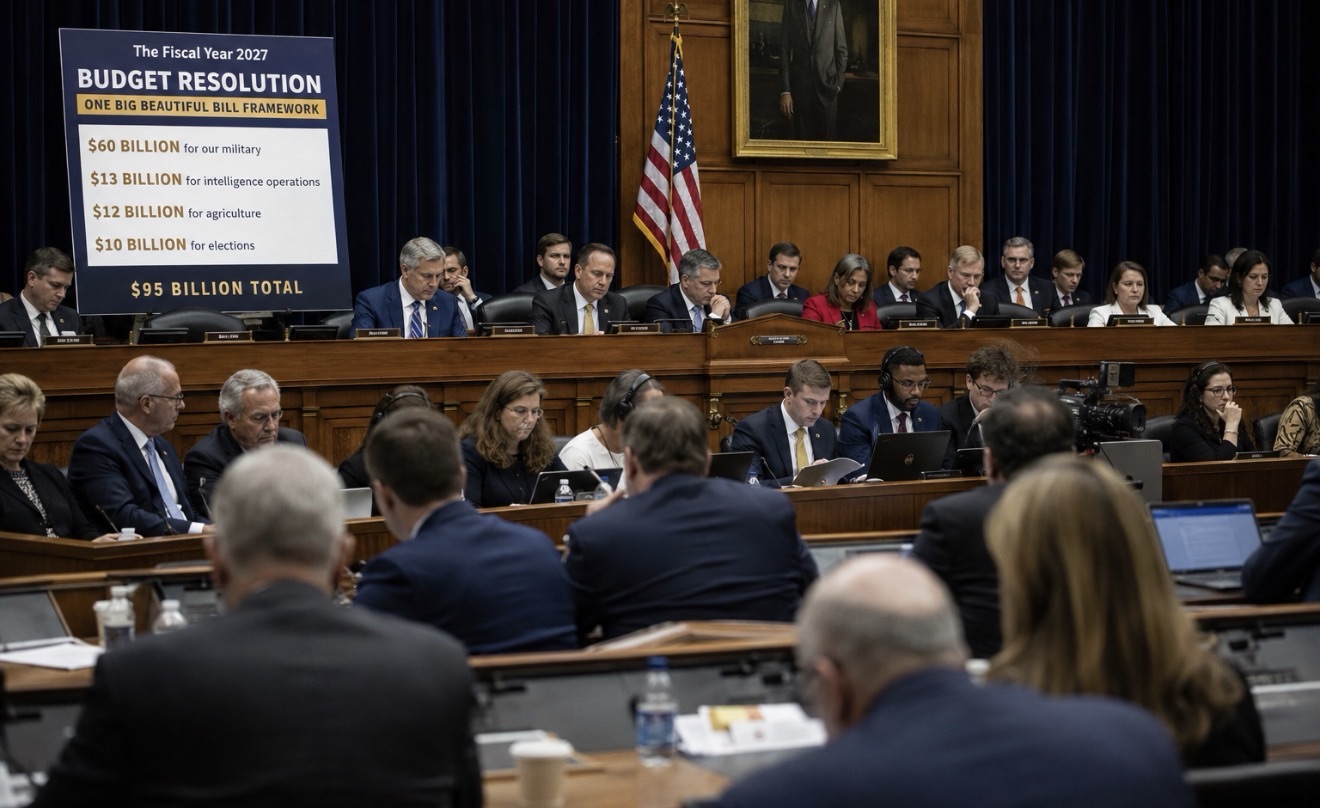
WASHINGTON — According to the House Budget Committee’s Fiscal Year 2027 Budget Resolution approved Thursday, the committee voted 20-14 to advance a $95 billion reconciliation framework directing spending instructions to four House committees for national defense, intelligence, agriculture and election administration. The measure now heads toward a House floor vote this week, where it faces uncertain prospects amid opposition from Senate Republicans despite support from Speaker Mike Johnson.
Rather than appropriating money immediately, the 47-page resolution establishes reconciliation instructions that authorize designated committees to draft legislation carrying up to $95 billion in additional spending authority. The House Armed Services Committee received the largest allocation at $60 billion, followed by $13 billion for the House Intelligence Committee, $12 billion for the House Agriculture Committee, and $10 billion for the House Administration Committee, which oversees federal election matters. Those committees have until September 11 to produce legislative text.
Speaker Mike Johnson has branded the initiative the SAVE and Protect Act, while Republicans have internally referred to the effort as Reconciliation 3.0, making it the third major reconciliation package pursued during this Congress.
For businesses, the proposal represents a significant signal, although no contracts, grants or funding have yet been approved.
The largest implications center on the defense industry. While the resolution authorizes $60 billion for the Armed Services Committee, that figure falls below the administration’s earlier request for approximately $67 billion in supplemental defense funding related to the Iran conflict and remains substantially below the broader $350 billion reconciliation defense proposal connected to a projected $1.5 trillion national defense budget.
Earlier administration planning outlined approximately $21 billion for munitions replenishment, $17.3 billion for operational expenses, $12.1 billion for classified defense programs, $5.1 billion for cybersecurity and autonomous technologies, and approximately $2.4 billion for drone capabilities. None of those categories appear as binding allocations within the budget resolution itself. Instead, the House Armed Services Committee will determine how any eventual funding is distributed once reconciliation legislation is drafted.
For defense manufacturers, missile producers, cybersecurity firms, drone developers, logistics providers and military suppliers, the resolution establishes only the overall funding ceiling. The eventual committee legislation will determine which sectors ultimately receive procurement opportunities.
Agriculture also receives significant attention through a proposed $12 billion allocation intended to address financial pressures facing American farmers following higher transportation, fertilizer and production costs associated with the Iran conflict and continued disruptions affecting international shipping routes through the Strait of Hormuz.
Earlier federal planning contemplated economic assistance for crop producers together with disaster relief for agricultural businesses affected by severe weather. The budget resolution leaves the specific distribution entirely to the Agriculture Committee, which will determine eligibility, program structure and funding priorities during the reconciliation drafting process.
Election administration represents another potentially significant business opportunity. The proposal directs $10 billion to the House Administration Committee, with lawmakers expected to develop legislation addressing proof-of-citizenship requirements and related election administration initiatives.
The final legislation could ultimately involve investments in identity verification systems, election infrastructure, technology modernization, database integration and grants supporting implementation by state election agencies. Those details, however, remain subject to committee negotiations and future legislative drafting.
The political landscape remains highly uncertain.
Republicans currently hold a narrow 218-212 House majority, leaving Speaker Johnson with limited room for defections if Democrats remain united against the measure. Fiscal conservatives have questioned adding another $95 billion without corresponding spending reductions, while others argue the package is necessary to strengthen national security, support agriculture and modernize election administration.
The Senate presents an even greater challenge.
Several Republican senators have expressed reservations regarding both the size of the package and its overall fiscal impact. Because both chambers must ultimately adopt identical budget resolutions before reconciliation legislation can advance, negotiations between House and Senate Republicans are expected to continue throughout the summer.
Current plans call for committees to draft legislation during the August recess before Congress returns in the fall to consider the final reconciliation package ahead of the November midterm elections.
Speaker Johnson has personally led negotiations surrounding the proposal, including meetings with President Donald Trump at the White House and strategy discussions with House Republicans at Camp David, as leadership attempts to unify the conference behind the legislation.
For businesses involved in defense procurement, agricultural production, cybersecurity, election technology and government contracting, the budget resolution should be viewed as a roadmap rather than an award.
The funding instructions establish congressional priorities, but no contracts have been awarded, no grants approved and no procurement decisions finalized. Those outcomes will depend entirely on the reconciliation legislation drafted by the committees over the coming weeks and whether Congress ultimately approves a final package.
JBizNews Desk | Washington
© JBizNews.com All Rights Reserved. Reproduction or distribution without written permission is prohibited.