
 Matzav
Ancient Manuscript Solves Centuries-Old Mystery of Rashi’s Burial Site in France
A centuries-old mystery surrounding the burial place of Rashi has reportedly been resolved following the discovery of an ancient manuscript in Oxford University’s library. The newly uncovered document, together with additional historical manuscripts and maps found this year, points to the precise location of Rashi’s burial in the French city of Troyes. The discovery has already prompted efforts to establish a proper monument at the site.
Rashi—Rabbeinu Shlomo Yitzchaki, the greatest commentator on Tanach and the Gemara—was born in Troyes in the Hebrew year 4800. At the age of 20, he traveled to Germany to study Torah, returning to France a decade later to lead a yeshiva and compose the monumental commentaries that became foundational to Torah learning. He passed away on the 29th of Tammuz in the year 4865.
Following the expulsion of the Jews from France during the era of the Rishonim, the tombstones in the Jewish cemetery of Troyes were uprooted, and the city’s Jewish community disappeared for centuries. Although French Jewish tradition consistently maintained that Rashi had been buried in Troyes, later rumors claimed he had instead been buried in Prague or Worms.
Those reports were always viewed with skepticism, particularly since both Prague and Worms maintained continuous Jewish communities that preserved no tradition identifying Rashi’s burial place there. Nevertheless, the conflicting claims created enough uncertainty that many historians eventually concluded that the exact location of Rashi’s grave was unknown.
This year, as talmidim of the Vizhnitz London Yeshiva prepared for a trip to the gravesites of the Rishonim in France under the leadership of Rav Levi Yitzchak Hager, son of the Vizhnitz-London Rebbe, they undertook extensive research into the question. Their investigation led them to an ancient manuscript housed in Oxford’s library that, for the first time, provides what they describe as a clear historical source confirming that Rashi was buried in Troyes.
The manuscript, known as Seder HaYuchasin of the sages of France during the era of the Rishonim, was written in France toward the close of the fifth millennium of the Hebrew calendar. Portions of the work were previously cited by the Maharshal in his Teshuvos (Siman 29), but the complete manuscript has only now come to light. Because of its difficult handwriting, earlier researchers who examined it reportedly overlooked its most significant passage.
In its account of Rashi’s passing, the manuscript states: “In the year 4865, the lamp of Israel was extinguished, the crown of glory fell, and he was laid to rest with his fathers in Troyes!”
The newly discovered source also reinforces a statement by Rabbeinu Tam, Rashi’s grandson, who referred to Troyes in his Sefer HaYashar (Teshuvos, Siman 16) as “the city of my fathers’ graves,” echoing the language of Nechemiah. While that phrase alone did not explicitly identify Rashi’s burial place, the newly discovered manuscript—written in France only a few generations after Rashi, while the Jewish cemetery still existed—states directly that Rashi was buried alongside his ancestors in Troyes.
Following the discovery, researchers contacted historians of the city of Troyes working on behalf of the French government. They were told that, independently, additional medieval Christian writings had recently been uncovered identifying Troyes as Rashi’s burial place. Researchers also located detailed historical maps identifying the precise boundaries of the former Jewish cemetery, with a full report expected to be published later this summer.
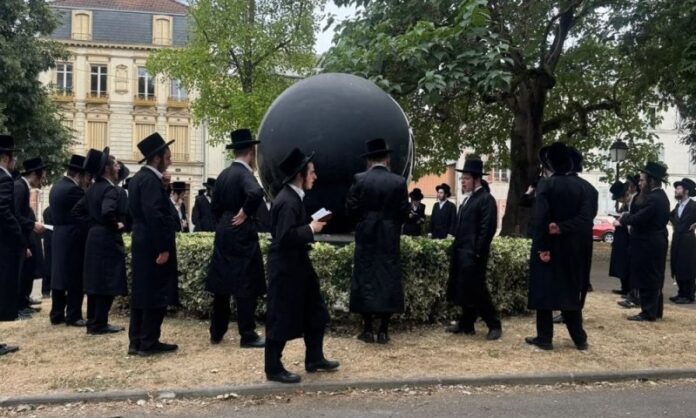
Last week, talmidim of the Vizhnitz London Yeshiva traveled to the gravesites of the Rishonim in France as a reward from the yeshiva administration for faithfully maintaining daily written records of their learning throughout the year. After davening at the resting place of the Baalei HaTosafos in Ramerupt, they continued to nearby Troyes, where they davened within the grounds of the historic Jewish cemetery believed to contain Rashi’s kever.
While there, the talmidim completed Maseches Bava Basra, which they had studied throughout the year, timing the siyum to coincide with Rashi’s yoma d’hilula. In doing so, they fulfilled Rashi’s own words in Yevamos (122b): “On the day that a great person dies, it is established in his honor, and every year when that day arrives, Torah scholars gather from all around and come to his grave together with the rest of the people to establish a yeshiva there.”
Rav Yisrael Meir Gabbai, chairman of Oholei Tzaddikim, who participated in the trip, met while in Troyes with local attorneys and representatives of the local Jewish community and French government to begin the legal and logistical process of erecting a permanent monument marking the precise location of Rashi’s burial. The goal, organizers said, is to enable Jews from around the world to visit the site, daven there, and seek yeshuos for both spiritual and material needs.
{Matzav.com}