
 JBizNews
Bain–NielsenIQ Report: U.S. Grocery Sales Drop Into “Volume Contraction” as Shoppers Cut Items, Not Just Brands
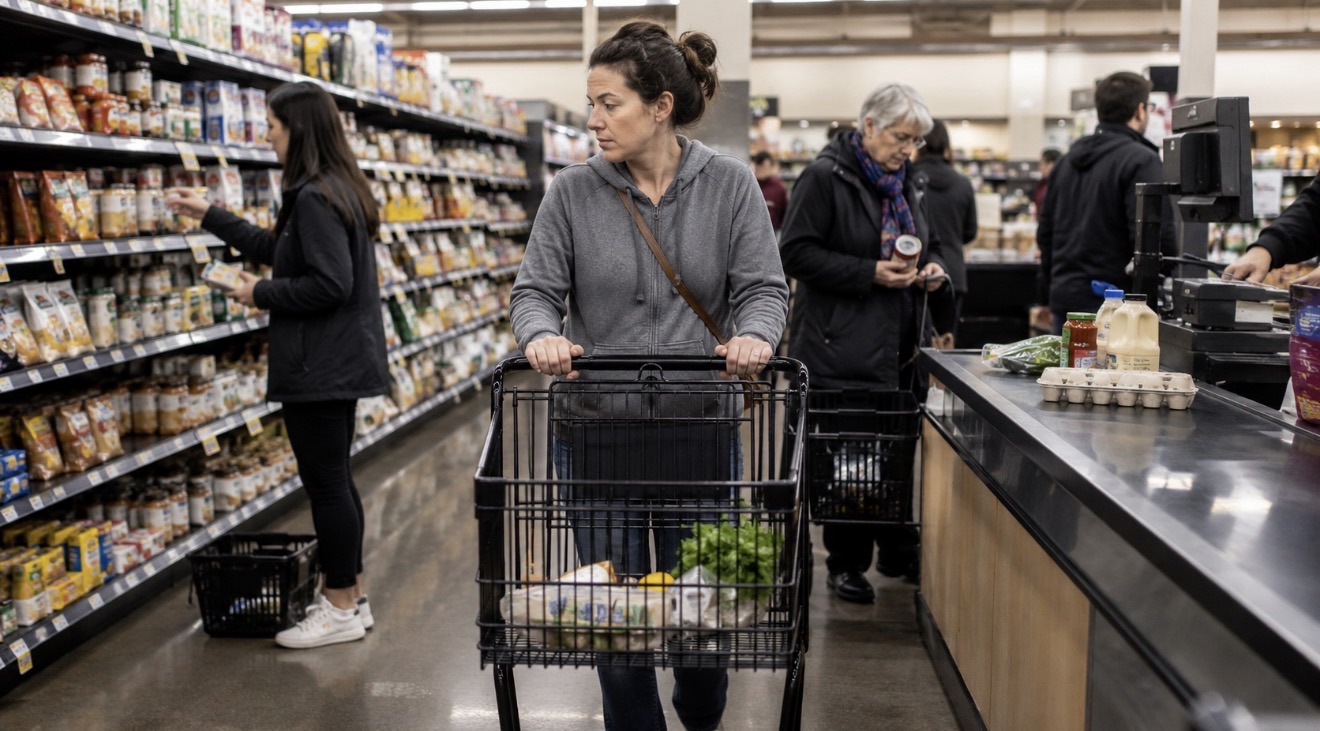
The American grocery cart is shrinking, and a new industry analysis out Tuesday marks the moment the shift became undeniable. After more than a year of shoppers trading down to cheaper brands and hunting for deals, households have moved to a starker form of belt-tightening: they are simply buying fewer items. Unit sales at U.S. grocers have fallen roughly 2% year over year across most of the past four months through June, a decline holding steady across every region of the country, according to research released by Bain & Company in partnership with NielsenIQ.
What makes the pullback notable is that it is happening while prices keep rising, not falling. A basket that runs a family through the week now costs roughly a third more than it did in 2019, and grocery prices are still climbing 2% to 3% a year. Kurt Grichel, who leads Bain’s retail practice in the Americas, put it in concrete terms — a grocery run that once totaled around $300 before the pandemic can now push past $400, a gap wide enough that even higher-income shoppers have started to change their behavior. Paying more while taking home less is the new math at the register.
Why buying less changes the game
For most of the post-pandemic stretch, grocers and food makers could count on rising prices to lift revenue even when the number of items sold stayed flat. That cushion is gone. When price increases slow and volume falls at the same time, the business becomes a contest for market share, where one chain’s gain comes directly at a competitor’s expense rather than from a growing pie. The report describes a sector where the total pool of demand is no longer expanding, forcing retailers to win customers away from one another rather than ride a rising tide.
So far the winners are the value channels. Discounters, dollar stores, warehouse clubs, and mass retailers are pulling shoppers and trips away from traditional supermarkets. But the analysis cautions that the volume problem does not disappear even for those gaining ground — fewer items sold is a headwind for every format. The grocers expected to pull ahead are those that price sharply on the specific staples customers track most closely and build loyalty through promotions and private-label brands shoppers trust.
The inflation backdrop
The squeeze comes even as broader inflation appears to be cooling. Overall consumer prices fell 0.4% in June on tumbling energy costs, but food-at-home prices rose 0.2% — their fifth monthly increase of 2026 — a reminder that relief at the gas pump has not reached the checkout aisle. Eggs jumped 4.3% for the month and dairy rose 1.2%, while a few categories, including coffee and nonalcoholic beverages, offered modest declines. The takeaway for shoppers is that a falling headline number does not translate to a cheaper cart, because the categories driving the relief are not the ones that fill it.
Compounding the pressure, many lower-income households have absorbed a double hit, contending with reduced federal food-assistance benefits and tighter eligibility rules at the same time grocery costs remain elevated. For those families, buying fewer items is less a choice than a necessity.
A pattern visible across the border
Fresh data out Tuesday from Canada underscored how persistent food inflation has become across North America. There, grocery prices outpaced the country’s overall inflation rate for the 17th consecutive month, running at 3.9% against a headline rate of 2.8%, with chicken up 5.7% and bread and rolls climbing roughly 6% even as cheaper gasoline slowed the top-line figure. It is the same disconnect between food costs and household budgets now visible on both sides of the border.
What it means for tri-state businesses
For grocers, restaurants, and suppliers across New York, New Jersey, and Connecticut, the message is direct. Consumers are not just seeking bargains; they are removing items from the cart altogether, and that behavior shows up first in discretionary and premium categories. Operators leaning on price increases to protect margins may find the strategy backfiring as customers respond by trimming volume.
The retailers positioned to hold their ground will be those offering a credible value story — sharp pricing on the staples families track, paired with loyalty programs and store brands that keep shoppers coming back. The broader takeaway from Tuesday’s report is that the era of automatic grocery revenue growth has ended. With prices still elevated and carts shrinking, earning a customer’s trip now means convincing them the trip is worth taking.
JBizNews Desk | New York
© JBizNews.com All Rights Reserved. Reproduction or distribution without written permission is prohibited.