
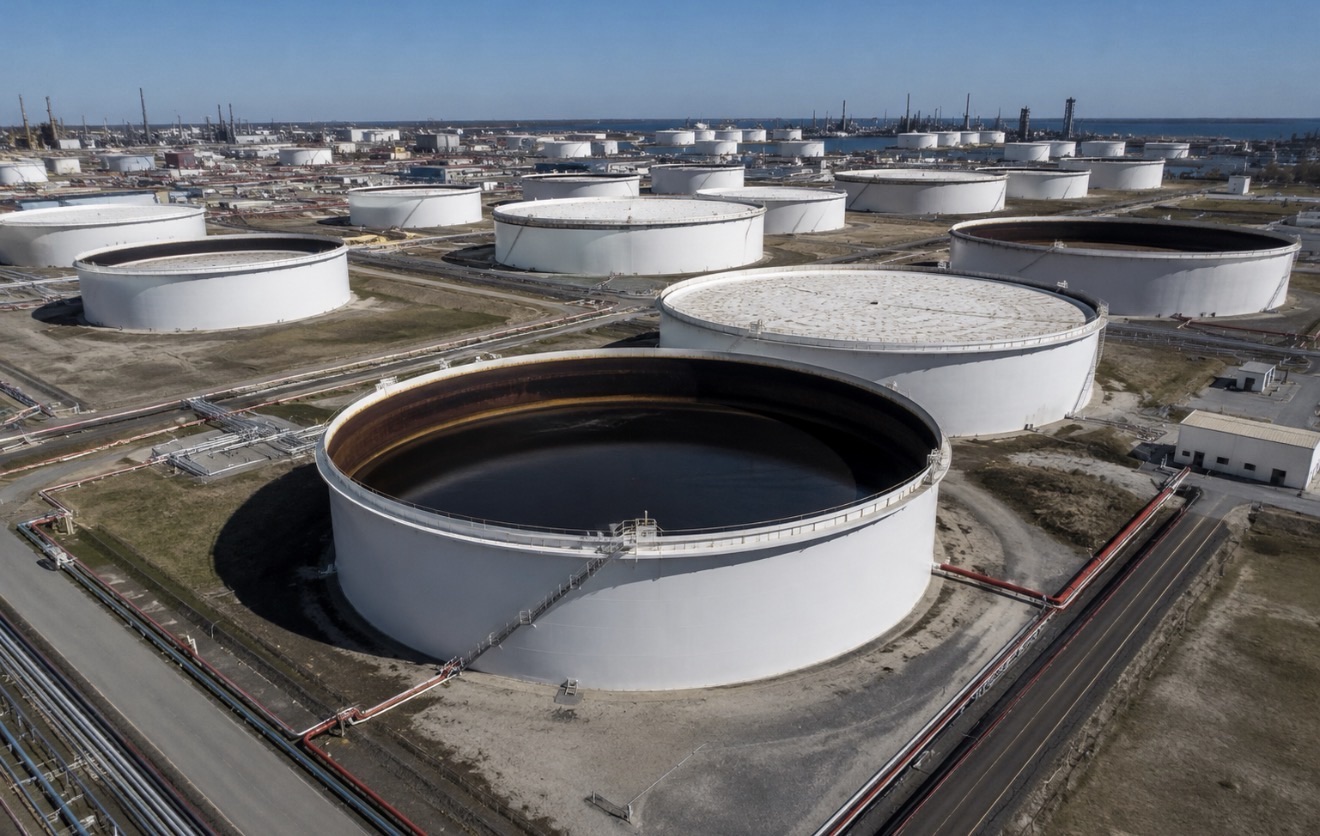

NEW YORK — The United States is sitting on its smallest crude oil buffer in nearly half a century, a quiet warning signal flashing beneath a market that has otherwise managed to keep panic at bay. Domestic inventories have fallen to roughly 43 days of supply, the lowest reading in 45 years, as the war between the United States and Iran continues to strangle the flow of oil through the world’s most important energy chokepoint.
The drawdown reflects five months of disruption in the Strait of Hormuz, where fighting that began on February 28 has repeatedly interrupted the roughly one-fifth of global oil that normally transits the waterway. Even with American naval escorts keeping tankers moving, the cumulative strain on supply has steadily eroded the reserves that cushion the domestic market against shocks.
What makes the moment unusual is how calm prices have remained relative to the underlying tightness. U.S. crude trades near $81 a barrel, elevated by historical standards but well below the levels above $112 seen at the height of the wartime scare earlier this year. That gap has become one of the more puzzling disconnects in the market: inventories at a multi-decade low, an active conflict at a critical shipping lane, and yet a price that suggests something closer to unease than alarm.
Consumers are feeling the strain more directly than the futures screens let on. The national average price for a gallon of gasoline has climbed back to $4, more than ten cents higher than a week earlier and up sharply from the $3.15 average of a year ago. For households already stretched by rising costs elsewhere, the return to $4 fuel functions as a tax on nearly every trip to work, every grocery run, and every shipment that moves by truck.
The thin supply cushion changes the risk calculus for the months ahead. When inventories run low, the market loses its shock absorber. Any fresh interruption — a new round of attacks in the Gulf, a mine strike on a tanker, a disruption to the bypass pipelines that have been carrying a portion of the region’s crude overland — would hit a system with far less slack than usual. In that environment, a relatively small physical disturbance can translate into an outsized price reaction, because there is simply less oil in storage to draw down while the disruption plays out.
For businesses, the implications ripple outward from the pump. Elevated and potentially volatile fuel costs raise the price of freight, aviation, manufacturing, and agriculture, and they complicate planning for any company that budgets around energy as a major input. Airlines have already flagged billions in added fuel expenses tied to the war-driven surge, and those costs tend to migrate into ticket prices, shipping rates, and ultimately the shelf prices consumers pay.
The administration has leaned on expanded domestic production and naval protection of shipping lanes to keep barrels moving, and officials insist the flow through the region is recovering. But recovery in transit volumes has not yet rebuilt the reserves that the conflict has drained. Until inventories climb back toward historical norms, the American energy market will remain unusually exposed — steady on the surface, but running closer to the edge than it has in a generation.
The coming weeks will test whether the current fragile balance holds. A durable easing in the Gulf would allow supplies to recover and prices to drift lower. A renewed escalation would meet an oil market with little margin for error and a public already watching the number on the gas station sign climb.
JBizNews Desk | New York, N.Y.
© JBizNews.com All Rights Reserved. Reproduction or distribution without written permission is prohibited.