
 JBizNews
JPMorgan and Goldman Stand to Collect Roughly $100 Million Each Arranging SoftBank’s Record AI Loan
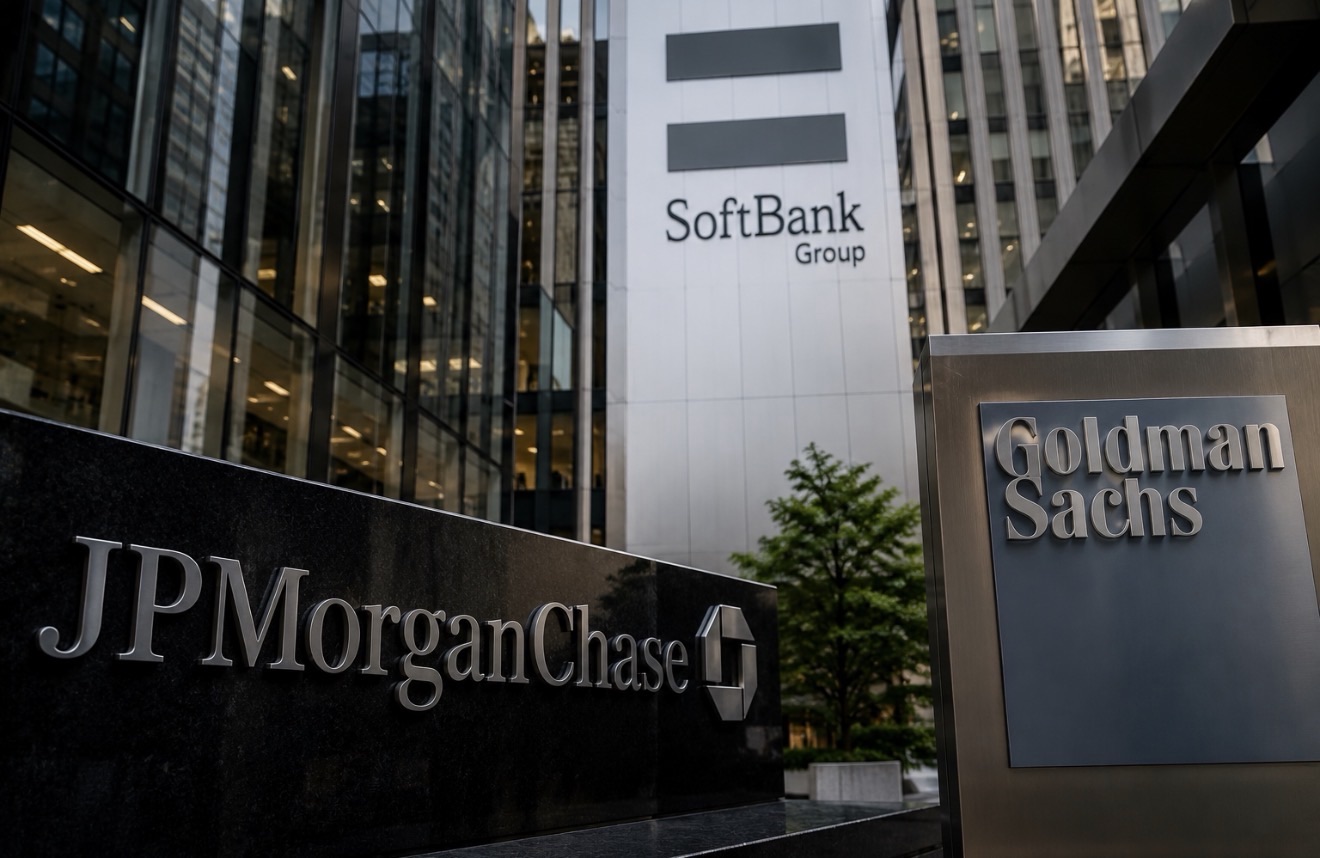
JPMorgan Chase and Goldman Sachs are each in line for fees approaching $100 million for arranging the largest borrowing in SoftBank Group’s history, a payout that shows just how profitable the financing behind the artificial intelligence buildout has become for Wall Street’s biggest firms.
The fees flow from the $40 billion unsecured bridge facility SoftBank signed on March 27, underwritten by a syndicate that pairs JPMorgan and Goldman with Japanese lenders Mizuho Bank, Sumitomo Mitsui Banking Corporation and MUFG Bank. The proceeds went chiefly toward SoftBank’s $30 billion follow-on investment in OpenAI, part of the ChatGPT maker’s $110 billion capital raise — the largest private funding round on record, one that valued the company at roughly $852 billion. With the new commitment, SoftBank’s total stake in OpenAI now sits near $64.6 billion.
What makes the fee pool so rich is the structure of the deal itself. The facility carries no collateral, meaning SoftBank pledged no specific assets against $40 billion in credit. Banks price that kind of exposure aggressively, and a loan of this scale generates arrangement and underwriting fees far larger than a conventional secured facility would. The 12-month term compounds the point: the loan is designed to be short, with SoftBank obligated to repay or refinance by March 26, 2027. Lenders willing to extend unsecured money at that size, on that clock, expect to be paid accordingly.
There is a second motive behind the two American banks taking the lead roles. JPMorgan and Goldman are positioning themselves for what could be a far bigger prize — lead underwriting assignments on an OpenAI public offering, an event that would rank among the largest listings ever attempted. The bridge loan functions as both a fee-generating instrument today and a relationship anchor for the mandates to come. Chairman and Chief Executive Masayoshi Son has stated that repayment would likely come through existing assets and additional financing, a plan that leans heavily on SoftBank’s ability to convert its AI holdings into liquidity.
The scale of these paydays is easier to grasp against a recent benchmark. When SpaceX went public in June — the largest IPO in history — the banks running the deal split a fee pool of about $500 million, with the lead firms each taking home close to $100 million. That SoftBank’s lenders can approach similar figures on a single loan, rather than a landmark stock sale, signals how much the AI financing cycle has reshaped where investment banking revenue is now made. The reported fee arrangement was detailed by Bloomberg.
For SoftBank, the record loan is one piece of an increasingly aggressive borrowing program. Son has funded his AI push through a mix of debt and asset sales, including trimming stakes in Nvidia and T-Mobile US, and the company has continued to seek fresh credit lines. On July 1, SoftBank reopened talks with a consortium expected to include Goldman Sachs, JPMorgan and Mizuho Financial Group for a $10 billion loan backed by its OpenAI stake — a facility that had stalled earlier over the difficulty of valuing a private company. To ease lender concerns this time, SoftBank offered to guarantee repayment, giving banks recourse if the pledged OpenAI shares lose value.
Credit-rating agencies have taken note of the strategy. On July 16, S&P Global Ratings revised its outlook on SoftBank to stable from negative while affirming the company’s BB+ long-term rating, a modest vote of confidence as the conglomerate leans further into leverage. SoftBank’s price-to-earnings ratio, meanwhile, remains well below the industry average, reflecting continued investor caution about the size of Son’s bets.
The through-line connecting all of it is the assumption that OpenAI will eventually reach the public market at a valuation large enough to make today’s borrowing look conservative. If that listing materializes, SoftBank gains the liquidity to clear its March 2027 obligation, and the banks that arranged the bridge financing stand to earn a second, larger round of fees underwriting the offering. If the timeline slips, the pressure of an unsecured, short-dated $40 billion facility falls back on SoftBank’s balance sheet and its willingness to keep selling down long-held positions.
For now, the immediate winners are clear. Two banks are set to book nine-figure sums for structuring a single loan, a reminder that in the current cycle, the surest money in artificial intelligence is often made not by the companies building the technology, but by the institutions financing the race to own it.
JBizNews Desk | Wall Street
© JBizNews.com All Rights Reserved. Reproduction or distribution without written permission is prohibited.