
 JBizNews
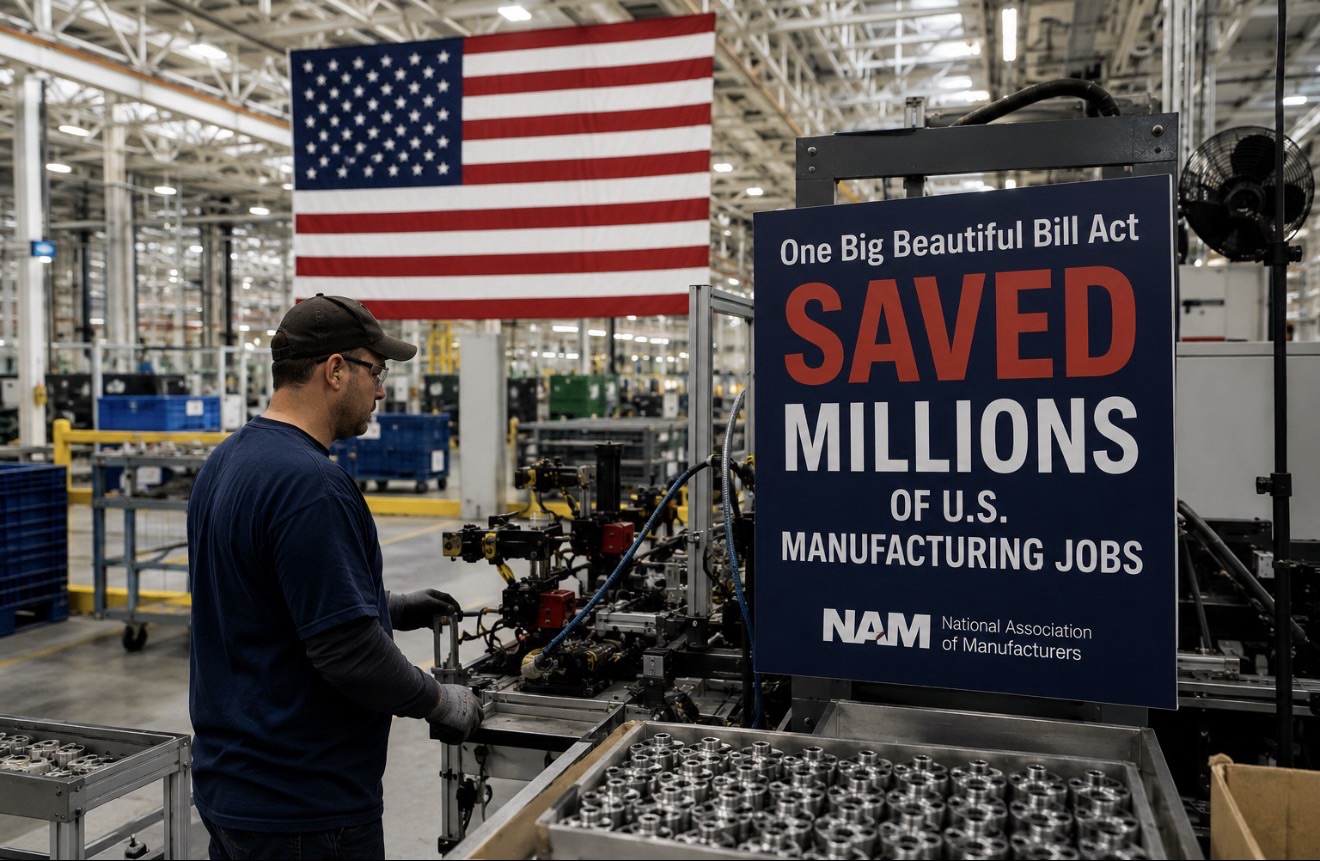
One Big Beautiful Bill Act Saved Millions of U.S. Manufacturing Jobs: NAM
The National Association of Manufacturers marked the first anniversary of the One Big Beautiful Bill Act this week with a 50-state analysis crediting the law’s tax provisions with protecting millions of American manufacturing jobs, hundreds of billions in wages and more than a trillion dollars in economic output that the association says would otherwise have been at risk.
Signed into law in July 2025, the One Big Beautiful Bill Act — designated H.R. 1 — locked in a package of measures aimed squarely at the factory floor. Chief among them: 100% immediate expensing for newly built and improved U.S. factories, full and immediate depreciation of machinery and equipment, permanent research-and-development expensing, restored interest deductibility, and a permanent 20% deduction for small and pass-through manufacturers. The law also preserved the 21% corporate tax rate that manufacturers had warned was central to their global competitiveness.
According to NAM’s modeling, the stakes of letting those provisions lapse were severe. The association estimates the law protected nearly six million jobs across the broader economy, preserved more than $1 trillion in economic output and safeguarded roughly $540 billion in wages — figures NAM frames as losses avoided rather than a fresh headcount, drawn from a landmark study it produced with EY.
The new state-by-state breakdown puts numbers to that national total. California led every category, with NAM crediting the law with saving 708,000 jobs, $134 billion in GDP and $67 billion in wages. Texas ranked second at 547,000 jobs, $107 billion in GDP and $51 billion in wages. Florida followed with 399,000 jobs and $36 billion in wages preserved. The analysis paired each state’s estimate with a real manufacturer putting the provisions to work.
Those examples ran from coast to coast. In Jacksonville, Johnson & Johnson has committed more than $1 billion to expand operations, with the company’s chief technical operations and risk officer, Kathy Wengel, tying the investment to a stable corporate tax rate. In California, Robinson Helicopter said immediate R&D expensing is letting it deploy new R88 aircraft as airborne control centers for fire-surveillance drones. Will Fulton, the company’s vice president of business development, said the deduction speeds the company’s ability to bring lifesaving products to market. Texas-based WilliamsRDM pointed to R&D expensing as the reason it can keep investing in engineering, prototyping and testing for aerospace, defense and energy customers.
NAM packaged the state stories under a new collection it titled “Manufacturing Tax Wins Across America,” positioning the material as evidence for Congress to keep the provisions in place. Association President and CEO Jay Timmons said the accounts show manufacturers now have the confidence to “invest, hire, raise wages and expand facilities,” and argued that tax policy amounts to far more than numbers on a spreadsheet.
The industry’s case has leaned heavily on the link between predictable tax treatment and hiring. Snap-on Chief Executive and NAM Vice Chair for Tax and Finance Policy Nick Pinchuk said manufacturers have seen firsthand how “long-term tax uncertainty translates into workforce certainty,” describing the law as an investment in the American worker. That argument tracks the sector’s structure: NAM reports that more than 70% of manufacturers employ fewer than 20 people, making the permanence of the small-business and pass-through provisions especially consequential for the shops that make up the bulk of the industry.
The manufacturing sector remains a heavyweight in the national economy, employing close to 13 million people and contributing roughly $3 trillion annually. It also accounts for a majority of private-sector research and development, which is part of why the R&D expensing provisions drew such sustained attention from the association during the legislative fight.
Not every assessment of the law is uniformly positive. Independent forecasters have flagged that the act front-loads its economic benefits while widening federal deficits in the years ahead, and analysts tracking clean-energy manufacturing have documented project cancellations tied to the rollback of prior renewable incentives. Those crosscurrents sit alongside the manufacturing gains NAM is highlighting, and they are likely to shape the debate as lawmakers weigh the law’s longer-term fiscal trajectory.
For manufacturers, though, the anniversary message was one of consolidation rather than debate. Having spent much of 2025 warning about what expiration would cost, the industry is now pointing to investment announcements, expansion plans and hiring commitments as proof the provisions are working — and pressing Congress to leave them untouched.
JBizNews Desk | New York
© JBizNews.com All Rights Reserved. Reproduction or distribution without written permission is prohibited.