
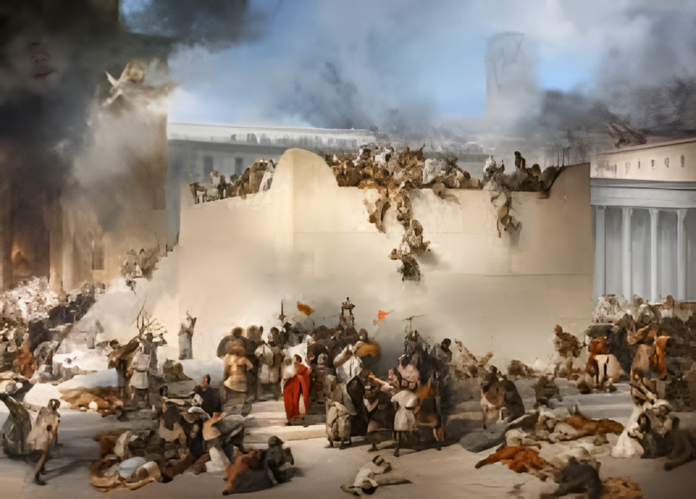

New York (VINNEWS/Rabbi Yair Hoffman) Until this past decade, Tisha B’Av was observed largely through text. Now watching online videos have added another element of observance. The kinnos are recited, Eichah is chanted, the Gemara in Gittin is reviewed, and the churban is encountered in writing and reciting these words — words carried across nineteen centuries by a nation that refused to forget.
This is as it should be. Chazal preserved the memory in the only vessel that could survive exile.
But there is another new element that time has introduced to us – other than the Tisha b’Av videos. Beneath the Old City of Yerushalayim, six meters below the pavement where Jews walk today, there is a second archive. It is written in ash and fractured limestone, and it has been read only in the last sixty years. What it says corresponds, with a precision that is almost difficult to absorb, to what our mesorah has said all along.
The Street That Was Crushed
For greater readability, this article was kept to less than 2500 words. So let’s begin at the southwestern corner of Har HaBayis. Herod’s expansion of Har HaBayis was carried on retaining walls of a scale that had few parallels in the ancient world. At the southwest corner a monumental staircase rose on a broad stone arch, identified in 1838 by Edward Robinson and bearing his name ever since.
The arch carried people up from the Lower Market, across the Tyropoeon street, and into the Royal Stoa on the esplanade above. It was completed only decades before it was destroyed.
Beneath it ran a paved street, some twenty-eight feet wide, bordered by raised curbstones, lined with shops built into the vaults beneath the staircase. This was the commercial artery of the approach to the Mikdash. Olei regel walked it three times a year.
When Benjamin Mazar’s excavations cleared that street beginning in 1968, they found it under the stones that had been thrown down upon it. The Herodian ashlars from the walls above lie where they landed, and the pavement beneath them is crushed and buckled from the impact. The excavators did not reconstruct this scene. They uncovered it and left it. A visitor to the Davidson Center today stands beside a street that was smashed by falling masonry in the summer of 70 CE and never repaired, never cleared, never built over until the debris of the Tyropoeon Valley buried it entirely.
The ashlars were not the only thing that came down. Running across the southern end of Har HaBayis, Herod had built the Royal Stoa, a colonnaded basilica of four long rows of Corinthian columns forming three halls, the central one roofed at an especially great height. On the side facing the mount it stood unwalled, so that the Mikdash itself remained in view across the esplanade. Josephus judged it more worthy of description than anything else under the sun.
Mazar’s excavations along the southern wall recovered hundreds of limestone fragments from that structure — column bases and drums, Corinthian capitals, Doric friezes, modillion cornices — many of them well preserved and carved with floral and geometric motifs. They confirm, in stone, the magnificence Josephus described. But they also testify to something further. Many of the fragments were coated in a fine white crust, taken at first for decorative plaster.
Orit Peleg-Barkat and the geologist Aryeh Shimron established that it is not plaster at all. It is mineralogical residue left on the stone by a conflagration whose flames often exceeded a thousand degrees centigrade.
That figure should be held in mind. It will appear again, independently, half a mile away and four hundred feet higher, in the fractured walls of a private house in the Upper City.
The Gemara in Taanis and the kinnos speak of stones cast down. Here they are, still down.
Among the fallen blocks at the southwest corner, Mazar’s team recovered in 1968 a large maakeh – a parapet stone of a distinctive shape, lying on its side on the Herodian pavement roughly five feet from the corner. A niche had been cut into its inner face. Above the niche, incised in square Hebrew script, were the words — read right to left — l’beis ha-tekiah l’ha… The final word is broken. Scholars have proposed l’hachriz, to announce, or l’hakohen, for the kohen.
The first two words are complete and unambiguous: to the place of the trumpeting.
Josephus, in Wars IV.9.12, describes the point on the roof of the chambers of the Kohanim where a kohen would stand to sound the trumpet in the late afternoon announcing the approach of Shabbos, and again the following evening announcing its conclusion. The stone marked that station. It was a wayfinding sign, of the plainest kind, cut for the kohen whose task it was to tell all of Yerushalayim that Shabbos was imminent.
The blast could be heard across the City of David to the south and throughout the Upper City to the west. Every Jew in the city organized the week around it.
In many communities it is still done. We do it in Far Rockaway, although some question whether it is a chillul Hashem or not, since many goyim do not exactly appreciate it.
Regardless, the Romans threw that stone off the wall. It fell to the street below and lay there, face down among the rubble, for nineteen hundred years. The original is now in the Israel Museum; a facsimile stands at the site. There is no more concise physical statement of what was lost: the stone that announced the entry of Shabbos, hurled into the street and left in the dirt.
This was not incidental damage. Josephus records that the sanctuary caught fire when a soldier flung a burning brand through a gateway without orders, but what followed was deliberate policy: Titus ordered the city destroyed first by fire and then razed to the ground stone by stone. The fallen ashlars on the Herodian pavement are that order, carried out and never undone.
The Burnt House
In January 1970, Nachman Avigad’s excavation in the Jewish Quarter reached a room roughly a meter below the surface, with stone walls and a beaten earth floor. Avigad later wrote that no house witnessing the catastrophe of the Churban Beis HaMikdash in 70 CE had yet been excavated, and that his team was emotionally unprepared for what stood before them.
What emerged was a basement complex — a small courtyard, several rooms, a kitchen, a mikveh — part of a larger structure extending beyond the excavation limits, constructed near the beginning of the first century CE. Everything lay beneath a thick layer of ash, charred wooden roof beams, and collapsed stone. The limestone walls were scorched black and fractured, the fracturing consistent with temperatures exceeding a thousand degrees Celsius. Avigad concluded that this was systematic arson, not accidental fire, matching Josephus’s account precisely. The threshold is the same one the Royal Stoa fragments record. Two sites, two materials, two independent lines of laboratory evidence, one temperature.
Beneath the burn layer were the household’s belongings, in place. Dozens of ceramic and stone kailim. Glass perfume containers. Storage jars still holding grain. Cooking pots where they had been set down. Coins minted between 67 and 69 CE, fixing the date beyond argument.
And a stone weight, inscribed with a name: Bar Kathros.
The Kathros family is known from the Gemara. The passage in Pesachim 57a records the lament over the priestly houses that abused their power — woe to the house of Kathros, woe to their pens. The Gemara names them as one of the families whose conduct contributed to what came. In 1970 an archaeologist’s trowel turned that name from a line of aggadatah into a street address in the Upper City, and found the address burned to the ground.
There is one more find in that house. In the ash of the kitchen lay the bones of a young woman’s forearm, and beside it an iron spear.
The Upper City fell roughly a month after the Mikdash and the Lower City. Josephus records that when the legions finally stormed it they met little resistance, because much of the population was already dying of starvation and disease. This house belonged to a wealthy priestly family living within sight of the Mikdash. It did not save them. Organized resistance in the city ended on the twenty-sixth of September, 70 CE — some seven weeks after the Mikdash burned, deep into Elul, with the yamim noraim already approaching.
The Grain and the Tamid
The Upper City did not starve because the Romans were thorough. It starved because Jews had burned Jewish granaries. When the legions closed around Yerushalayim in the spring of 70 and cut every line of supply, the large stocks of grain within the walls had already been destroyed — not by the besiegers, but during the factional fighting among the defenders themselves. The siege did not create the famine. It sealed a city that had already burned its own food.
Yoma 9b assigns the churban to sinas chinam. The material and historical record does not prove that judgment, and cannot. But it does preserve the mechanism with an exactness that is hard to look away from. The storage jars in the Burnt House still held grain when the roof came down on them, in a quarter of a city where thousands were dying of hunger.
Through all of it the kohanim held to the avodah. The fighting raged, the walls fell one after another, and the customary offerings continued to be brought. The korban tamid was suspended only when there were no lambs left in the city to offer. The mishnah in Taanis records the cessation of the tamid as one of the five calamities of the seventeenth of Tammuz. Three weeks later the Mikdash was ash.
The most affecting artifact of the churban may be the smallest, and it emerged only recently.
The rebels minted their own coinage during the revolt, and the legends on those coins track the collapse of their hopes with terrible clarity. The coins of the second year read l’cheirus Tziyon — for the freedom of Zion. Freedom is a thing men achieve by their own hand, and in year two they still believed they would achieve it.
The Year Four coins, minted between Nissan of 69 and Adar of 70 CE, carry a different legend. The word cheirus is gone. In its place: l’geulas Tziyon — for the redemption of Zion.
Dr. Yuval Baruch of the Israel Antiquities Authority, who has worked that site for over twenty-five years, observed that the mood of the besieged rebels had shifted from euphoria and the anticipation of imminent freedom to a dispirited yearning for redemption. Another IAA scholar put the distinction more sharply: freedom is something people strive for through human action, but a plea for redemption suggests they were no longer relying on themselves. It was a cry for divine intervention.
Year Four coins are rare, for the obvious reason that the mint had less than a year left to operate.
In July of last year, excavators at the Jerusalem Archaeological Garden near the southwest corner of Har HaBayis recovered one such coin. Bronze, well preserved. A goblet on the obverse ringed by the words l’geulas Tziyon in ancient Hebrew script. On the reverse a lulav flanked by two esrogim, and the words shnas arba — year four.
Esther Rakow-Mellet, the IAA excavation director, described waiting anxiously for days while the coin was cleaned, and finding that it was a greeting from the Jewish rebels of Year Four. She noted that the find came a few days before Tisha B’Av.
Consider what is on that coin. A besieged population, months from annihilation, chose to stamp its money with a lulav and two esrogim. The symbols of Sukkos. Zman simchaseinu. They were starving, they knew the walls would not hold, and they put the emblems of rejoicing on their currency and asked not for freedom but for geulah.
Archaeology does not prove the Hashkafa of the causes of churban, and no excavation can adjudicate the question Chazal themselves answered in Yoma 9b regarding sinas chinam. The spade recovers what was done, not why it was permitted.
But the spade has established a great deal. That Yerushalayim burned in a deliberate, systematic conflagration in 70 CE. That the burning reached the wealthiest priestly quarter of the Upper City. That the walls of Har HaBayis were dismantled and their stones cast onto the streets below, where they crushed the pavement and were left. That a family named in the Gemara for its misconduct lived in a specific house that was destroyed in that fire. The correspondence between the material record and the received account is close, detailed, and in places startling.
The Kinnah Beneath the Pavement
There is a particular quality to the Second Temple destruction layer that distinguishes it from most archaeological horizons. It is generally the case that cities are rebuilt, that debris is cleared, that later construction cuts into and disturbs what came before. In Yerushalayim, at these locations, it was not. The stones lie where the legions threw them. The trumpeting stone lay face down on the pavement for nineteen centuries. Avigad’s rooms sat sealed beneath their own collapsed roof, undisturbed, until 1970.
The city was not restored to its owners in a condition permitting them to sweep up. That is itself the historical fact the layer records.
]Every year the kinnos are recited and every year the words are the same. What is new, in this generation, is that the stones have been permitted to give aidus alongside them. Jews who read of the churban in Eichah can now walk the street where it happened, look at the fallen ashlars, and read the sign that told the kohen where to stand to announce Shabbos.
The nation that was exiled from that street returned to it and dug it out with its own hands. That fact belongs to a different day on the calendar. But it is worth knowing, on the ninth of Av, who is holding the trowel. May the Mikdash be rebuilt soon in our days. Amain!
Sources
Josephus, The Jewish War, Books IV and VI. Nahman Avigad, Discovering Jerusalem, and the Jewish Quarter Excavations final reports (Israel Exploration Society), particularly Volume IV on the Burnt House of Area B. Benjamin Mazar, Temple Mount excavations 1968–1978. Israel Antiquities Authority announcements on the Year Four revolt coinage, Jerusalem Archaeological Garden–Davidson Center. Corpus Inscriptionum Iudaeae/Palaestinae, Jerusalem Part 1, on the Trumpeting Place inscription. Talmud Bavli, Pesachim 57a; Yoma 9b; Gittin 55b–58a. Orit Peleg-Barkat and Aryeh Shimron, on the Royal Stoa fragments and the burn residue, Biblical Archaeology Review, March/April 2010. John Merrill, “The Era of Roman Domination,” in Ancient Israel: From Abraham to the Roman Destruction of the Temple, 4th ed., ed. John Merrill and Hershel Shanks (Biblical Archaeology Society, 2021). Mishnah Taanis 4:6.
The author can be reached at [email protected]