
 Vos Iz Neias
An Open Letter to Mayor Zohran Mamdani on His Tisha B’Av Greetings
Dear Mr. Mayor,
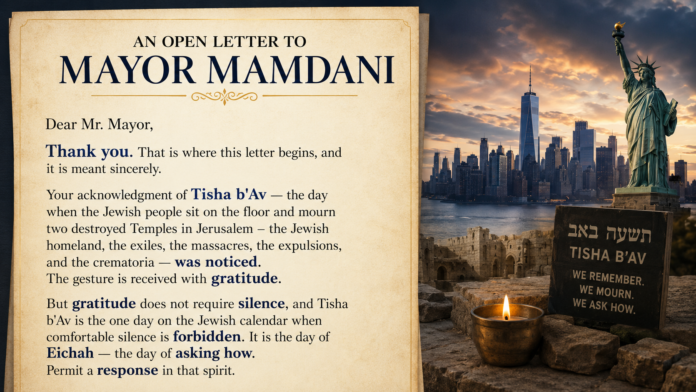
Thank you. That is where this letter begins, and it is meant sincerely. Your acknowledgment of Tisha b’Av — the day when the Jewish people sit on the floor and mourn two destroyed Temples in Jerusalem – the Jewish homeland, the exiles, the massacres, the expulsions, and the crematoria — was noticed. The gesture is received with gratitude.
But gratitude does not require silence, and Tisha b’Av is the one day on the Jewish calendar when comfortable silence is forbidden. It is the day of Eichah — the day of asking how. Permit a response in that spirit.
The Words of the Previous Week
In the days before this fast, the mayor made characterizations of the war in Gaza that do not survive contact with the evidence. In the Jewish tradition, truth is the seal of G-d. It is not a rhetorical flourish. It is the signature He signs His name with.
The word deployed was “genocide.” It was deployed as description rather than accusation — as though its meaning were settled rather than legally precise, as though repetition were proof.
It is not a synonym for war. Not for tragedy. Not for a high casualty count, or rubble, or suffering — and Gaza has all three in abundance, and no honest person denies it.
Genocide is a legal term with a fixed definition: the intent to destroy a national, ethnic, racial, or religious group, in whole or in part. Intent. Not outcome. Not appearance. Not what a photograph looks like when it is cropped correctly.
That distinction is not pedantry. It is the entire difference between a war crime and a war — and between a nation defending itself and a nation that has forfeited its right to exist.
Also this is not a war just because of October 7th. This is a defensive war because of Hamas’s declaration, intent, and preparation for continued attacks just like October 7th.
When you were asked directly whether the Hamas attack of October 7 constituted a genocide, you answered: “I consider Oct. 7 to be a horrific war crime.” You further added that it should be opposed with every fiber of our being, and grounded your position in a belief in the universality of humanity — insisting that one cannot pick and choose which crimes against humanity to oppose.
Twelve hundred people were murdered in a single morning. Families burned in their homes. Women raped beside the bodies of their friends. Infants taken. Two hundred fifty-one human beings dragged into tunnels. That was a war crime.
And the war fought afterward, by the country those people were taken from — that was the genocide.
Who John Spencer Is
There is a man,a teacher at West Point, who has actually did look into Gaza.
John Spencer chairs urban warfare studies at the Modern War Institute at West Point and co-directs the Institute’s Urban Warfare Project. He spent twenty-five years as an infantry soldier, including two combat tours in Iraq. He wrote Connected Soldiers and co-authored Understanding Urban Warfare.
He is not a rabbi. He is not a lobbyist. He is not a political actor. He is a man who has led soldiers under fire, trained militaries in urban combat for decades, and taught the laws of war.
And here is what separates him from nearly every voice that dominated last week’s discourse: since October 7, 2023, he has entered Gaza four times, embedded with the Israel Defense Forces. He has interviewed Israel’s prime minister, its defense minister, the IDF chief of staff, the leadership of Southern Command, and dozens of commanders and soldiers at the front. He read the orders. He watched the targeting process. He saw soldiers accept real risk to themselves rather than harm civilians.
His conclusion: nothing he has seen or studied resembles genocide or genocidal intent.
The question that follows is simple. How many times has the Mayor been inside Gaza?
What He Found When He Examined the Evidence
Spencer took up the most credentialed version of the accusation — the case made by Professor Omer Bartov of Brown University in the New York Times, an actual scholar of genocide — and dismantled it piece by piece.
Bartov’s case rests on five statements by Israeli leaders. Consider what they amount to.
Netanyahu said on October 7 that Hamas would “pay a huge price” for the murder of 1,200 people and the abduction of 251. That is not a call for genocide. It is what any national leader on earth says after the worst terrorist attack in his country’s history.
Netanyahu said Hamas would be destroyed and that civilians should evacuate combat zones — which is not evidence of a desire to destroy a people, but precisely what professional militaries do when fighting an enemy that hides among civilians.
The “remember Amalek” line was presented as the smoking gun. Spencer notes that the phrase is engraved at Yad Vashem in Jerusalem and appears on the Holocaust memorial in The Hague. In both places it functions as a warning to remain vigilant against those who would destroy you — not as an instruction to kill.
A phrase carved into Holocaust memorials was submitted as proof of genocidal intent. Sit with that. The words we placed on the graves of the murdered were entered into evidence as the murder weapon.
Gallant’s “human animals” remark, describing Hamas fighters, is not a war crime — and Spencer observes that after the slaughter and rape of October 7, many would understand the sentiment.
Unable to locate genocidal intent among the people actually directing the war, Bartov reached instead for far-right politicians like Bezalel Smotrich and Nissim Vaturi. These men do not command troops, issue orders, or shape battlefield decisions. Spencer, who read the actual orders, reports that they focus on destroying Hamas, rescuing hostages, and protecting Gazan civilians wherever possible — which renders the rhetoric legally irrelevant.
That is the case. Five quotations, one of them lifted off a Holocaust memorial, and two politicians with no command authority.
That is what an entire city was asked to believe on the strength of.
What the Army Actually Did
Against that, set the record Spencer documents from inside.
Israel warns before strikes by text message, phone call, leaflet, and broadcast; opens corridors and pauses operations so civilians can leave; and tracks civilian presence down to the individual building. Spencer personally watched missions delayed and scrapped because children were nearby. He watched Israeli troops take incoming fire and be ordered not to return it, because civilians might be hit.
Soldiers were ordered to absorb enemy fire rather than risk killing a civilian.
That is not a mitigated form of genocide. It is its inverse. Genocide does not order its own men to bleed in order to spare the other side’s children.
On aid, Spencer states flatly that no military in history has delivered more humanitarian assistance to an enemy population during wartime. Over 94,000 trucks carrying more than 1.8 million tons of aid have entered Gaza. Israel has supported hospitals, repaired water pipelines, expanded clean water access, and enabled more than 36,000 patients to leave Gaza for treatment abroad. The IDF coordinated millions of vaccine doses and supplied fuel for hospitals and infrastructure. The Gaza Humanitarian Foundation alone has delivered more than 82 million meals.
Name the genocide that vaccinated its victims. Name the extermination that repaired the water supply. History is invited to produce one.
The Numbers
Bartov cited Hamas health authority figures without question — 58,000 dead, 17,000 of them children. Spencer points out that these come from a terrorist organization, that they blend civilians with combatants, and that they classify anyone under eighteen as a child even though Hamas fields teenagers and younger children as fighters. The figures are not independently verified and have been shown to contain fabricated names, ages, and sexes. Civilian deaths in Gaza are a genuine tragedy — and they are also a deliberate component of Hamas’s strategy. An organization that stores rockets in schools is not a neutral statistician of the dead.
Then the argument that should end the conversation. If casualty totals alone established genocide, every major war in modern history would qualify. Two million civilians died in Korea — an average of 54,000 per month. Iraq and Afghanistan killed hundreds of thousands. The campaign against ISIS flattened entire cities and killed tens of thousands. None of them was called genocide. Not one.
The word is reserved for Jews. That reservation is itself worth a moment’s reflection.
Spencer’s summary is blunt: what is happening in Gaza is tragic, but it is not genocide, and it is not illegal.
Words spoken from City Hall do not stay in City Hall. They travel. They are heard in Crown Heights and Borough Park, on the Columbia campus, outside shuls on Riverside Drive. And a word like “genocide” does not merely describe. It authorizes.
Tell a young man that the Jews are conducting a genocide, and you have not merely informed him. You have handed him a moral emergency — and emergencies license conduct that ordinary times forbid. The logic is not subtle: if genocide is underway, then anyone who does not oppose it by any available means is complicit. The grocer in Midwood becomes a legitimate target of that emergency. The teenage girl in a day school uniform on the 4 train becomes a legitimate target. The man in a yarmulke walking home on a Friday afternoon becomes a legitimate target.
New York has already watched this sequence run. It has watched swastikas appear on synagogue doors. It has watched Jews assaulted on its streets, in daylight, in this century.
The words come first. They always come first. There has never once been an exception. Jews hold four thousand years of data on this sequence, and Tisha b’Av is the day set aside to review the file.
A peaceful Tisha b’Av was wished upon us. But peace on Tisha b’Av is not a mood. It is a condition. It requires that Jewish children get home from school. It requires that a man in a shtreimel not calculate his route. It requires that the accusation flung casually into a microphone not become the justification whispered before the fist is thrown.
The central request your Jewish constituents are asking costs nothing but courage.
Retire the word.
Not because it is uncomfortable. Because it is false — and because a man who has been inside Gaza four times, who read the operational orders, who has commanded soldiers in combat and taught the law of armed conflict for decades, examined this accusation in detail and found it unsupported.
Spencer’s own closing: the law matters, precision matters, and above all, truth matters.
It takes a large man to say he was wrong. The Mayor wished us a peaceful fast; that wish can be honored with a single act of precision, and precision, this once, would be a form of protection.
Retract the word. Or defend it — publicly, against Spencer’s evidence, on the merits, with the operational orders on the table. Either is honorable. What is not honorable is repetition without examination.
And apply the universality that was invoked. If the standard is truly universal, then say plainly that October 7 was a genocidal act, or stop applying that word to the war that followed it. The one thing the standard cannot mean is one vocabulary for Jewish dead and another for Jewish soldiers.
But look first.
May the Al-mighty grant the Mayor the strength to do the harder, better thing.
The author can be reached at [email protected]