
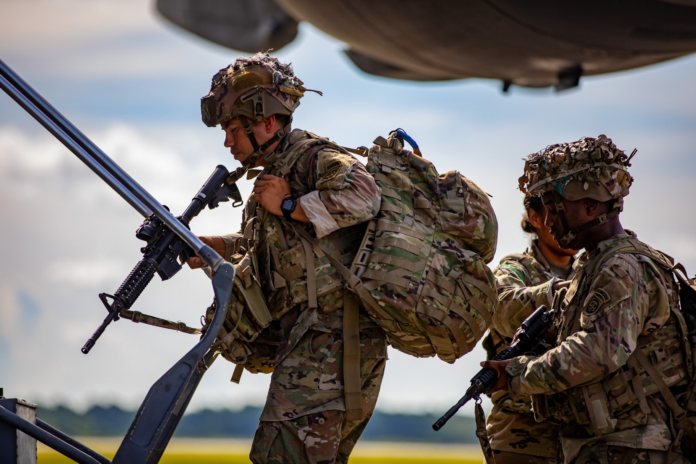

President Donald Trump is significantly increasing the American military footprint across the Middle East, broadening the range of options available for potential action against Iran as the conflict enters its fifth month and Tehran continues threatening international shipping in the Strait of Hormuz.
According to a report by The Wall Street Journal, citing U.S. officials and other sources familiar with the deployments, the United States has either dispatched or placed on heightened alert additional special operations forces, fighter aircraft, long-range bombers, aerial refueling planes, and more than 150 medical personnel throughout the region.
The expanded military posture comes in the wake of the deaths of four American service members in recent Iranian attacks and amid ongoing discussions within the Trump administration over possible additional military operations.
On Wednesday, U.S. Central Command announced that it had completed a twelfth straight day of strikes inside Iran, saying the operations are intended to weaken Tehran’s ability to threaten civilian vessels and commercial shipping in regional waterways.
The Pentagon declined to comment on specific force deployments, citing operational security concerns, while the White House emphasized that Trump “always has all options at his disposal.”
Trump also warned that the United States would retaliate forcefully if Iran targets ships passing through the Strait of Hormuz, declaring that America would destroy “one bridge or power plant” for every attack carried out by the Islamic Republic against maritime traffic.
Iranian Foreign Minister Abbas Araghchi responded by warning that any U.S. strike against Iranian infrastructure would provoke a “powerful and decisive response.”
Secretary of State Marco Rubio likewise cautioned Iran against attempting to dominate one of the world’s most strategically important maritime corridors.
“If we create a precedent … where a nation state can decide that they are going to control an international waterway, charge a toll, and if you don’t pay them, blow up your ships, we have created a very dangerous precedent,” Rubio said during a summit in the Philippines.
The Journal reported that the expanded American military presence could also strengthen operations against Yemen’s Iran-backed Houthi terrorists, who have recently threatened to blockade Saudi shipping routes in the Red Sea.
Those concerns intensified Wednesday after two Saudi oil tankers were reportedly struck by projectiles near the Bab al-Mandeb chokepoint, highlighting the growing risks facing global energy supplies.
Meanwhile, Congress moved to reinforce the military effort by advancing additional defense funding. The Republican-controlled House approved a $95 billion budget framework that allocates approximately $73 billion for military and intelligence programs while also passing its version of the annual National Defense Authorization Act.
War Secretary Pete Hegseth told lawmakers that the conflict has so far cost an estimated $37.5 billion.
Despite the mounting financial burden, Trump and senior administration officials have maintained that sustained military pressure is essential to prevent Iran from acquiring a nuclear weapon and to safeguard freedom of navigation through the Strait of Hormuz, a waterway through which roughly 20 percent of the world’s traded oil normally passes.