
 Matzav
Nearly 150,000 Mail Ballots Rejected In California’ Primary Despite Efforts To Count Every Vote
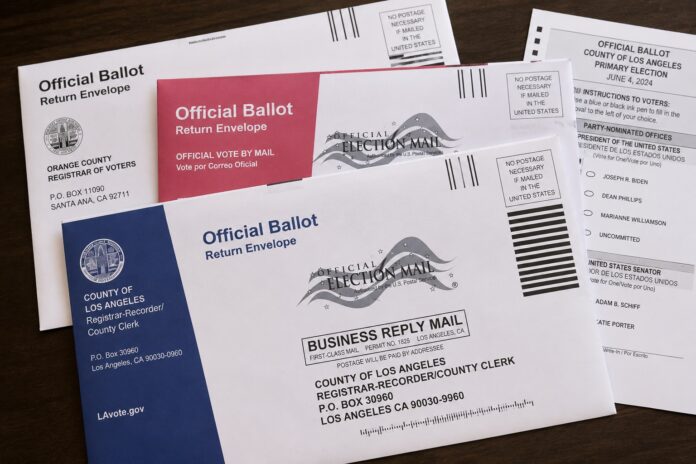
Almost 150,000 vote-by-mail ballots cast in California’s June primary were rejected, marking a noticeable increase from recent elections despite the state’s continued efforts to expand mail voting and make it easier for every eligible ballot to be counted.
California has long faced criticism over its lengthy vote-counting process, which often stretches for weeks after Election Day. Over the years, state lawmakers have adopted a series of election reforms aimed at increasing voter participation, including automatically mailing ballots to every registered voter and allowing ballots to be counted if they arrive up to seven days after the election, provided they were postmarked by Election Day.
Even with that extended grace period, newly released data from the California Secretary of State’s office shows that the overwhelming reason ballots were rejected was because they arrived too late to qualify. Election experts believe many of those ballots received postmarks dated after Election Day, making them ineligible under state law. Some have suggested recent operational changes at the U.S. Postal Service may have affected when postmarks are applied.
State records show that 148,241 mail ballots were rejected in the June primary, representing 1.73% of all mail ballots submitted.
That total exceeds the June 2024 primary, when 108,982 ballots were rejected, or 1.56% of mail ballots cast. In the 2022 primary, 105,818 mail ballots were rejected, producing a rejection rate similar to that of 2024.
Late-arriving ballots accounted for 93,479 of the rejected votes in June, making lateness by far the most common reason ballots were disqualified. By comparison, approximately 70,000 ballots were rejected for lateness in the 2022 primary and roughly 76,000 in the 2024 primary, although voter turnout was lower in both of those elections.
Kim Alexander, president of the nonpartisan California Voter Foundation, said the increase in late ballot rejections raises significant concerns. She suggested the rise may be tied not only to Postal Service procedures but also to a surge of voters who waited until the final days of the campaign to cast ballots in the closely watched and highly competitive race for governor.
“Ballots rejected due to lateness are caused primarily to being postmarked too late to count, not because they arrived too late to count,” Alexander wrote in an email.
Mindy Romero, director of the nonpartisan Center for Inclusive Democracy, said rejection rates naturally fluctuate from election to election, but the growing number of ballots rejected because of lateness deserves closer examination.
The issue has also attracted attention in Washington. In January, a group of mostly Democratic U.S. senators sent a letter to the U.S. Postal Service expressing concern that recent mail-processing changes could affect postmark dates during an election year that will determine control of Congress.
Under updated Postal Service policies, a postmark may reflect the date a piece of mail was processed at a regional facility rather than the day it first entered the postal system. Because recent consolidations have moved processing operations farther from some communities, critics fear the changes could delay postmark dates for mailed ballots.
Similar concerns surfaced in Wisconsin this week, where Democratic Sen. Tammy Baldwin and Gov. Tony Evers urged the Postal Service to address delivery delays after hundreds of ballots arrived too late to be counted in the state’s April election. Meanwhile, a federal judge in June blocked President Donald Trump’s executive order that sought to establish a federal voter registration list and restrict eligibility for mail-in ballots.
Earlier this year, California election officials advised voters to return their mail ballots well before Election Day, warning that Postal Service changes could result in slower mail delivery.
Among California counties, Tulare County recorded the highest mail-ballot rejection rate in the June primary at 3.52%. Alpine County and Merced County followed closely, each reporting a rejection rate of 3.36%.
Lateness was not the only reason ballots were discarded. Nearly 44,000 ballots were rejected because election officials determined the voter’s signature did not match the signature on file. More than 8,300 ballots were rejected because the return envelope lacked a signature altogether.
Another 743 ballots were voided because those voters had already cast a ballot through another method. Additional rejected ballots involved missing ballots inside return envelopes or multiple ballots submitted in a single envelope.
The state’s data did not categorize rejected ballots by party affiliation.
California continues to trail many other large states in the speed of counting votes. States such as Florida and Texas typically report election results much more quickly, while California’s counting process has become one of the slowest in the nation.
Following the June primary, President Donald Trump again criticized California’s prolonged vote-counting process, renewing longstanding complaints about the state’s election system. At the same time, the Department of Justice launched an investigation into election procedures in Los Angeles County.
Despite the large number of rejected ballots, election experts say there is no evidence of widespread fraud involving mail voting. A 2025 report by the Brookings Institution found that instances of mail-ballot fraud remain extremely rare, identifying roughly four cases for every 10 million mail ballots cast.