
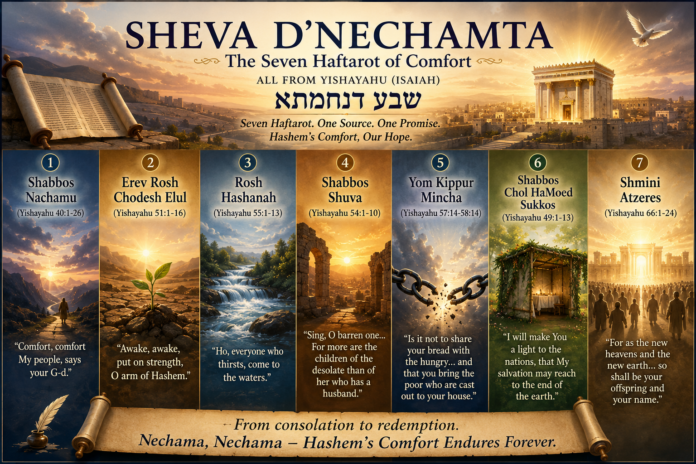

New York (VINNEWS/Rabbi Yair Hoffman) This week starts the seven haftaros of comfort, and Shabbos Nachamu is the first of them. All seven come from one single sefer of Navi — Yeshayahu. He lived before the destruction. He saw it coming. And he also saw the comfort that would come afterward. Not one of the seven is taken from any other sefer, because his is the book of comfort.
The Gemara in Bava Basra (14b) says something surprising: Yeshayahu’s book is entirely comfort. But an obvious question jumps out right away. The book is also packed with harsh criticism and with prophecies of destruction. So how can anyone call it a book of comfort?
The Maharsha answers that most of his prophecy is about the churban — and that is exactly why the book is named for comfort. Ruin and comfort are two halves of one message. The navi who saw the destruction most clearly was the very one trusted to deliver the comfort.
But there is another problem. Rashi on our haftarah writes that the comfort begins in chapter forty. Yet Yeshayahu’s prophecies do not end until chapter sixty-six. Twenty-seven chapters out of sixty-six is not even half the book. So why should the whole book be named after a section that does not even take up most of it? That question deserves real study.
And why was the job of comforting given to Yeshayahu more than to any other navi? The Midrash quoted in Yalkut Shimoni and in the Tanna d’Vei Eliyahu explains that he volunteered. The pasuk in chapter six records that the Holy One asked, whom shall I send, and who will go for us? Yeshayahu answered, here I am, send me (Yeshayahu 6:8).
The Holy One then warned him: My children are difficult and stubborn. If you are willing to take their insults and their curses, then go. Yeshayahu said he was ready for it — ready for a nation that would hit him and mock him. Because of that, the Holy One said about him that he loved righteousness and hated wickedness, that he loved to defend His children and hated to condemn them, and that therefore Hashem, his Hashem, anointed him with the oil of gladness above his fellows (Tehillim 45:8). The one willing to absorb their curses was the one fit to deliver their comfort.
Nachamu Nachamu — Why Say It Twice?
The doubled word (Yeshayahu 40:1) has drawn several explanations.
The Alshich understands it as pointing to two destructions and two comforts. Yeshayahu saw in prophecy both the destruction of the First Beis HaMikdash and the comfort that followed it, and the destruction of the Second Beis HaMikdash and the comfort that would follow that one. So the doubled Nachamu hints at a double comfort answering two disasters.
A second approach looks at how comfort actually works. Normally comfort comes slowly. A person shaken by tragedy gradually goes back to living, but the wound stays open underneath the recovery. But if a person comes to understand that the disaster itself contained his rescue — that the very blow was the salvation — that is comfort of a completely different kind. That is what the doubled Nachamu means: that we should merit to see how the very bad things were actually for our good.
It is like a man who crossed a bridge and, because of a delay that had frustrated him, was saved when the bridge collapsed behind him. The delay was never the misfortune he thought it was.
This idea has a much deeper root, and the Ramchal develops it at length. He opens his Maamar HaGeulah with a pasuk in Michah: do not rejoice over me, my enemy, for though I have fallen I will rise; though I sit in darkness, Hashem is a light for me (Michah 7:8). That pasuk, the Ramchal says, announces a secret — that Israel can be confident that they will be redeemed, and that the complete redemption will come speedily in our days.
In Otzros Ramchal he explains why. The Holy One wanted to reveal His Oneness to the created world in an actual, visible way, and the only way to do that was to start with darkness. When darkness hides everything, there is room for evil to exist and for the light to be found inside it — and then the evil is wiped out and turned into good, and every broken thing is put back together.
The Ramchal spells this out in Da’as Tevunos as well. Even though the world is usually run by a system of reward and punishment, and especially in the time of ikvesa d’Meshicha, sometimes the Holy One runs things instead by the system of mazal, where reward and punishment are not what determines the outcome. That is why we should not be surprised when, in a generation like this one, the righteous are pushed down low and cry out and are not answered, while the wicked prosper. It is not because the righteous lack the merit to fix what is broken. It is because that very hour is what gives birth to the complete repair, so that in the end the Holy One’s oneness will be revealed.
Rav Chaim Friedlander, quoting the Ramchal in Klalim Rishonim, writes the same thing — that the Master, blessed is He, does not always run the world by one system. Sometimes He uses reward and punishment, and sometimes He uses the system of mazal, which is a decree and does not follow a person’s actions. That is what people call the well-known question of why the righteous suffer, and it is a matter that only the greatest people are able to stand inside of.
And in the final exile, the Ramchal says, the Holy One is using that second system most of the time. The purpose behind it is a general repair for the entire world. In order for the great revelation of His oneness to be born, the greatest concealment has to come first — and so the darkness of ikvesa d’Meshicha is the greatest darkness of all, precisely so that from inside that darkness the light will be even more visible and the oneness will be revealed even more fully in the future.
There is one more piece to it. For the darkness itself to be turned into repair — for it to become good — there has to be free choice. There has to be darkness, and it has to be our job to bring light into that darkness by fixing what is broken and flipping the evil over into good. That is the light of the future, after the repair of all the darkness that came before it.
Sparks in the Darkness
The Ramchal explains the pasuk in Michah (7:8) further. When the world was created, many holy sparks fell into the hands of the forces of impurity, and it became our job to pull them back out. That was one reason for the exile. There was another reason as well: so that the Shechinah would not be received in disgrace. And there is one more — many sparks were sunk inside impurity through the sin of Adam HaRishon and through the sins of every generation after him, and when that happens the impure forces rejoice, because it looks like proof of their power.
In his commentary on Michah the Ramchal adds that Israel went down into exile in order to repair those sparks and lift them back into holiness. And as Chazal said (Pesachim 87b), Israel was exiled among the nations only so that converts would be added to them — those converts being the sparks of holiness that had fallen into the hands of the impure side.
The impure side does not know that this whole thing is going to destroy it and that it has no future against the nation of Israel. That is the meaning of do not rejoice over me, my enemy, for though I have fallen I will rise (Michah 7:8) — because only when Israel finishes drawing all those sparks out of exile will Mashiach come. Chazal say (Yevamos 62a; Avodah Zarah 5a) that the son of David does not come until all the souls in the body are used up, meaning all the souls sunk in the impure side, the body of impurity. Then the Shechinah goes out together with Israel from the exile, and the redemption comes.
That is what though I sit in darkness, Hashem is a light for me (Michah 7:8) means. The oneness whose whole job is to bring the world to its repair is present even during the time of concealment, and it is what helps Israel bring the world to that repair.
The Building That Lasts
There is a question that has to be asked here. If the sparks needed to be pulled out, and Israel could have done that job while still sitting on their own land with the Beis HaMikdash standing, then why was exile necessary at all? The Mekubalim answered it: if the Jewish people had not sinned, all those repairs would have been done while they were on their own soil, and all those sparks would have been drawn into the Beis HaMikdash and repaired right there. Israel would never have needed to go down into exile at all.
But the Ramchal’s principle still stands — the light is only recognizable when it comes out of darkness. So how could the future redemption ever have arrived if Israel had stayed on their land with the Beis HaMikdash intact?
The answer is spelled out in the Zohar in Parashas Pinchas. A wise non-Jew once came before Rabbi Eliezer HaGadol and asked him three questions. The first was: you say a third Beis HaMikdash is going to be built for you, but Chagai only writes that the glory of this last house will be greater than the first (Chagai 2:9) — which means there was a first house and a second house, and no third house is mentioned anywhere.
He asked two more questions, and Rabbi Eliezer said to him: elder, do not come near me, I have no answer that you can accept. Because of that insult Rabbi Eliezer’s eyes filled with tears and he made a vow. But afterward, when his anger cooled, Rabbi Eliezer said that those same questions that the wicked man had asked, he had once asked himself — and that he had asked Eliyahu those very questions in the heavenly academy. And this was the answer he received.
When Israel went out of Egypt, the Holy One wanted to make them like the angels above and wanted to build a Beis HaMikdash for them, bringing it down from above so that it would be a copy below of what stands above. That is the meaning of You shall bring them and plant them on the mountain of Your inheritance, the place You made for Your dwelling, Hashem (Shemos 15:17) — meaning a place that You made, not a place made by human hands. That was going to be the first Beis HaMikdash.
But once they sinned in the wilderness and died there, and their children entered the land, the two Batei Mikdash that were built were built by human hands. And because they were rooted in the sin, they did not last. That is what the pasuk means when it says, the Sanctuary of Hashem that Your hands established (Shemos 15:17) — that is the second Beis HaMikdash, and it was made by hands. Since they sinned, it had no permanence in it.
Shlomo HaMelech knew this. He said in Tehillim, if Hashem does not build the house, its builders labor in vain (Tehillim 127:1) — that he did not build a house that would have permanence to it. And in the days of Ezra the same thing happened: the sin caused them to have to build it themselves, and so it did not last. Now that the Beis HaMikdash is destroyed, the Holy One wants to build it and Israel does not build it. And only in the future will He build it, as it is written, the builder of Yerushalayim is Hashem (Tehillim 147:2) — He, and no one else.
And that building is not something we push forward. It is not built by human actions, because a building made by human actions has no permanence in it.
The Zohar adds that in the future the Holy One will build two Batei Mikdash — that the two houses of Hashem that will be built are the first house and the second house, and that He will bring them both down from above. The first will be hidden and covered, and the second will be revealed. The one that stands on the ground and is called the second house will be the one that everyone in the world can see, and everyone will fear it and rejoice completely. The first, the hidden one, will come and rest on top of the revealed one, and everyone will see the clouds of glory surrounding the revealed house, while the first house stays hidden inside those clouds — hidden in its making, reaching all the way up to heaven. And because the visible house is the one that reveals what is hidden, the glory of the last house will indeed be greater than the first (Chagai 2:9).
The Zohar’s whole point is now clear. If the Holy One had wanted Israel to build the Beis HaMikdash by their own hands, they would have been like the angels above. And if they had gone out of Egypt without having sinned, the world would have reached its final repair immediately — because the light that gets revealed out of darkness was the darkness of the exile in Egypt, and the receiving of the Torah is what brought them to the level Adam HaRishon had before the sin, as it is said, I said, you are angelic beings, and all of you are sons of the Most High (Tehillim 82:6). That is exactly the Zohar’s phrase, that they would have been reckoned like the angels above.
That is the light revealed out of the terrible darkness of the Egyptian exile, which is the root of all the exiles. But because they sinned, the Beis HaMikdash was not built by the hand of Hashem. And because they sinned when they entered the land, it was not built by the Holy One but only through Shlomo, and it had no permanence.
The second Beis HaMikdash could likewise have been a leftover of the great light of the Beis HaMikdash above, and then the light would have been revealed out of the darkness of exile and of Haman’s decree. But they did not merit it, and so the matter remained standing for the future.
The Malbim explains the doubling based on the pasuk, speak to the heart of Yerushalayim, for her host has been filled (Yeshayahu 40:2). One reading points to Mashiach coming at his appointed time, and the other to a redemption that comes early, if Israel earns it and is favored. Since there are two possible roads to Mashiach — arriving on schedule or arriving early — comfort is written twice, once for each road.
The Midrash reads the doubling against the language of sin and punishment. Because Yerushalayim sinned double, as it is written that she sinned grievously (Eichah 1:8), she was punished double, as the pasuk says she received from the hand of Hashem double for all her sins (Yeshayahu 40:2). And so she is comforted double: Nachamu Nachamu. The other prophecies of comfort are doubled the same way, as in the pasuk, I will rejoice greatly in Hashem (Yeshayahu 61:10).
The doubled sin itself can be read two ways. It was a sin that pulls more sins after it, and it was a sin whose punishment brings more punishment in its wake — a stiff-necked matter and a more serious transgression. There is one more thought here as well: the more successful a person is, the more serious his sin. Israel’s sin, coming from a nation of that stature, counted double for that reason alone.
What the Comfort Is Waiting For
The navi announces the comfort. But comfort like this has a mechanism — something it depends on, something that brings it. And the blessing we say every single morning names that mechanism openly.
The second blessing of Krias Shema before Shacharis asks that He put in our hearts to understand and to comprehend, and all the words of the study of His Torah; that He light up our eyes in His Torah, and unite our hearts to love and fear His Name; and that He bring us in peace from the four corners of the earth and lead us upright to our land.
The order needs explaining. What is the gathering in of the exiles doing inside a blessing whose whole subject is successful, deep Torah study? The blessing is about learning — understanding, comprehension, eyes that are lit up — and then, with no transition at all, it asks to be gathered in from the four corners of the earth.
Rav Chaim Kanievsky zt”l answered from a passage in Bava Basra (8a–b) on the pasuk in Hoshea, even though they scatter themselves among the nations, now I will gather them (Hoshea 8:10). Ulla said that the pasuk is spoken in Aramaic, and Rashi explains that the Aramaic word yisnu means yishnu — they will learn — the way the Targum translates the word for teaching.
Read that way, the pasuk says something completely different from how it first sounds. If they all learn — and even if only most of them do, but they learn with real effort and throw themselves into Torah — then now I will gather them. The gathering in depends on the learning. That is why the two requests sit in one blessing.
The Beis HaLevi — Which Torah Redeems
The Beis HaLevi sharpens the point. He writes that the future redemption will come only through the merit of the Oral Torah. He proves it from that same pasuk in Hoshea (8:10), and from the Midrash in Vayikra Rabbah that teaches that the exiles are gathered in only through the merit of the Mishnah, and from the Gemara in Bava Basra (8a–b) explaining that the pasuk was said in Aramaic — if they will all learn, then now I will gather them — with the Aramaic pointing specifically to the Oral Torah.
The reason goes straight to the heart of what went wrong. The sin of the Second Beis HaMikdash was not the same as the sin of the First. The Second Beis HaMikdash was built at a time when the righteous of Israel were already worried about the survival of faith and had already received the Oral Torah from our Sages. The safeguard was already in place. And precisely there, Israel split into factions over the Oral Torah, each one interpreting it its own way. Division entered their hearts, and hatred and fighting followed. That is the heresy of the Oral Torah, and that is what caused the destruction.
From here the logic runs in only one direction. A redemption has to be preceded by a repair of the sin that caused the destruction it reverses. If that principle held for the Second Beis HaMikdash, it holds even more for the redemption still ahead of us.
That is why the exiles are gathered in only through the merit of engaging with the Mishnah, which is the entire body of the Oral Torah. The heresy in the Oral Torah is what caused the sin. Therefore repairing that heresy — Israel strengthening their faith and increasing their engagement with the Oral Torah — is what will earn the redemption and restore them in their faith. This whole picture, the Beis HaLevi concludes, is now plainly visible to the senses. No further proof is needed.
Talmud Torasecha — How Exact the Words Are
The Iyun Tefillah, written by the author of the Kesav V’HaKabbalah, notices how precise the blessing’s wording is. It does not say the words of Your Torah. It says the words of the study — talmud — of Your Torah.
The reason is that the Written Torah is sealed. A person cannot fulfill even one of its commandments the way the Giver of the Torah intended without the Oral Torah that explains it, because the Oral Torah handed down to us is what teaches the true meaning of what is written. So the blessing is not asking generally for Torah. It is asking for the Oral Torah — the same Torah the Beis HaLevi identified as the condition for the redemption.
There is proof for this from the Midrash Tanchuma, which reads that it does not say talmud but rather the Oral Torah, and it requires study. And elsewhere in Tanchuma: the Oral Torah is not learned except by one who loves the Holy One with all his heart, with all his soul, and with all his might (Devarim 6:5).
This explains what the blessing does next. Right after asking for the words of the study of His Torah, it turns to love — unite our hearts to love and to fear Your Name. That is not a change of subject. Love is the requirement that comes before the Oral Torah, and the blessing asks for them in order.
The Rambam and the Order of the Parshiyos
The Rambam writes in Hilchos Krias Shema (1:2) that a person recites three sections and that these are Shema, and this is the meaning of the phrase, if you will surely listen (Devarim 11:13). He rules that the section of Shema comes before the others because it contains the unification of the Name and the love of Him — and you shall study it (Devarim 6:7) — because that is the great principle that everything depends on. The key word is talmud. And the point gets sharper when you notice that talmud appears in the first section and not in the second. That is exactly why the first one comes first.
The same pattern shows up in the Rambam at the beginning of Hilchos Talmud Torah, where he establishes that a Torah scholar is obligated to teach. It is worth noticing which pasuk he picks. The pasuk and you shall teach them to observe belongs to the second section (Devarim 11:19). But the pasuk the Rambam actually uses — and you shall teach them to your children, and you shall speak of them — appears in the first (Devarim 6:7). From it Rava derives, from and you shall write them (Devarim 6:9), that a Torah scholar must put his own study before that of his son. The obligation is grounded in the first section, because that is where and you shall study it is written.
The Mishnas Ya’avetz, quoting the Midrash Tanchuma, supplies the key. In the first section it says with all your might (Devarim 6:5). In the second section it does not (Devarim 11:13). That difference is not an accident, because the two Torahs make different demands.
The Written Torah is stated in general terms; the Oral Torah is stated in details. The Written Torah is little; the Oral Torah is much. The Oral Torah demands a price. It is not found with someone chasing the pleasure of the world, its honor and its greatness. It is found in someone who pushes himself hard over it — someone for whom study comes with difficulty, someone who takes on great pain for it. A person only truly acquires it if he loves the Holy One with all his heart, with all his soul, and with all his might.
And where is that love stated? In the pasuk, and you shall love the Lord your Hashem with all your heart and with all your soul and with all your might (Devarim 6:5) — which stands in the first section and nowhere else.
That this love is nothing other than talmud comes out from what is written immediately afterward: and these words which I command you today shall be upon your heart (Devarim 6:6). And what is that? That is the study which is upon the heart. And it continues, and you shall teach them to your children (Devarim 6:7), which is the study that requires review. So the chain in the first section runs unbroken — from love with all your might, to words upon the heart, to teaching and review. Love and the study it produces are one single subject.
The second section is built differently. It says with all your heart and with all your soul (Devarim 11:13), and it does not say with all your might. And it is the second section that spells out reward: and I will give the rain of your land (Devarim 11:14), and so on. That is the reward of people who engage in the commandments of the Written Torah and who are not engaged in study.
The Sages point out that no such spelled-out reward appears in the first section. That omission fits perfectly, because the first section is the section of talmud, and talmud is not traded for rain.
Everything lines up. Whoever loves wealth and pleasure and comfort cannot acquire the Oral Torah because of how intense the pain in it is — great pain, one year and the next. So with all your might appears only where talmud appears, and talmud appears only in the first section.
What comes out of all this is that the Oral Torah is called talmud. That is what the Rambam means when he writes that it is our study that everything depends on — he is naming the Oral Torah. It is acquired only by someone who loves the Holy One with all his heart, which is why the section containing with all your might is the section that has to come first. And this is why Rashi wrote that yisnu is the Targum’s rendering of yishnu, they will learn — because the same vocabulary of teaching and review that marks the first section is the vocabulary of the Oral Torah everywhere.
Now the blessing reads perfectly. Having asked for the words of the study of His Torah, which is the Oral Torah, and for the love that alone acquires it, it continues: gather us together from the four corners of the earth. Because it is through the merit of if they will all learn that now I will gather them (Hoshea 8:10).
The Land Itself
Beyond the reward that the Oral Torah brings, the gathering in of the exiles is itself a condition for Torah study to succeed. The blessing’s phrase, lead us upright to our land, is a reward on its own. At the same time it is the return that lets the learning flourish. The relationship runs both ways.
The Olas Tamid writes exactly this — that the request for the gathering in of the exiles is placed after the prayer for the study of Torah and its endurance, based on the Gemara in Chagigah (5b), which states that once Israel was exiled from its place, there is no greater loss of Torah than this.
The Sifri on Devarim (piska 37) reads: and the first of the dust of the world (Mishlei 8:26) — why is its name called tevel? Because it is spiced with Torah. And what is the spice inside it? Torah itself. From here we learn that the nations have no Torah, and from here we learn that Torah is found in the Land of Israel.
Vayikra Rabbah teaches the same on the pasuk, and the gold of that land is good (Bereishis 2:12) — that there is no Torah like the Torah of the Land of Israel and no wisdom like the wisdom of the Land of Israel. And there the bdolach and the shoham stone (Bereishis 2:12) are read as Mikra, Mishnah, and Talmud.
The Ba’aser writes that ten measures of wisdom came down into the world, and the Land of Israel took nine while the entire rest of the world took one — and that ten portions of Torah came down into the world, and the Land of Israel took nine while the entire rest of the world took one. And the Sages said in Bava Basra (158b) that the air of the Land of Israel makes a person wise.
This is what we are praying for when we say, lead us upright to our land, and through it we will merit all the words of the study of His Torah. Maybe this is also included in the words of the Gemara (Chagigah 5b), that once Israel was exiled from its place there is no greater loss of Torah than this. The loss here is a loss in the quality of Torah, as is well known in the name of the Chasam Sofer. Exile does not just cut down how much is learned. It changes what the learning is.
The Treasuries Being Prepared
Now go back to the Ramchal’s Maamar HaGeulah, which opened all of this. He writes that in the redemption there will be found many great and strong plans and understandings, known to the wise. When wisdom spreads out in the world, then people will see and know how great is Hashem — because at the very moment Israel thought the Holy One had turned His face away from them and abandoned them, that was precisely when He was preparing good and blessing for them.
At that time He was preparing enormous treasuries for them, treasuries so wide and so great that they have no end and no limit. All the precious and pleasant things in the world were placed inside those treasuries, along with every treasured possession of kings, at every time and every hour, until they were filled. And what is in those treasuries is more than any mouth can say, more than any ear can hear, and more than any heart can even begin to grasp.
When the great rest arrives, and the exile is over, all these treasuries will be opened in the world. And out of them will come every consolation and comfort, in exchange for the hard labor Israel worked through in exile.
The Ramchal illustrates this with the well-known story of Yirmiyahu, who was asked by a wise man how Israel could weep over wood and stones. There was already the sword, and there was no weeping for the past. Yirmiyahu answered him that all his wisdom was about wood and stones — and to his question, that this was already the past. The old man did not have the ability to understand, and Yirmiyahu said that the mourner cries over something else. We are not weeping over the past, but rather over the future, because on the strength of this weeping we are building the redemption and the third Beis HaMikdash, speedily in our days.
On this great secret it says, gladden us according to the days You afflicted us, the years we saw evil (Tehillim 90:15). The explanation is that all the days Israel was in exile they saw no light, and the light that should have been theirs during those days was not lost — the Holy One stored it away in the treasuries. And when the time comes for those treasuries to be opened, all that light will come out at once, and there will be a joy for Israel unlike anything the world has ever seen. The world will settle into rest and quiet, and there will be no more sorrow at all.
So the phrase gladden us according to the days You afflicted us is about the quality of our days, not their quantity. The days that were lost cannot be repaid in kind, since only about six thousand years remain — so how could our joy match the number of the days we were afflicted? The answer is that the measure is quality, not count.
Some hold, following the Leshem, that this is meant literally, based on the Bris quoting Rabbi Yishmael, that the pasuk the light of the moon will be like the light of the sun (Yeshayahu 30:26) means that not only will the light of the sun grow stronger, but the sun itself will become sevenfold immediately after the coming of Mashiach. There will also be a slowing of the sun’s movement, so that a full circuit will take seven days instead of one — and the day that now takes twenty-four hours would take seven days in the first week, and the following week the time would double again, and so on. So the days would become extremely long, and all the time of the days of our affliction would be paid back in full.
The Ramchal writes elsewhere, in Mishkeni Elyon, that Yechezkel HaNavi was shown a third Beis HaMikdash in enormous detail (Yechezkel 40–48). His point is not only that this is a vision of what will be in the future, but that at the moment the first Beis HaMikdash was destroyed below, it was destroyed above as well — because if not for the sin, the last house could have reached the complete repair — and at that moment the third house was already built above. What Yechezkel saw was a perfected house already built above, waiting to come down below at the time the Creator desires. Had they merited it, it would have come down in the days of Ezra. But they did not merit it, so the second house was built somewhat like the first, and yet even though the Shechinah rested in it, it was not like the third house, because the lower house was not entirely comparable to the upper one. In the future, though, the upper house will spread downward, and its holiness will be on a level even higher than the first house. The first house was rooted in the secret of wisdom; the third house is rooted in the secret of the crown.
Because of all this, the difficulty of Israel’s labor in exile is now understandable in a different light, and so is the Meharsha’s teaching at the Gate of Prayer, which raises the question of what happens to all the prayers that Israel has been praying for thousands of years, asking for the redemption, when the redemption still has not come. The answer is that all those prayers are found in a treasury set aside for exactly this purpose, and all of them together are working to bring the redemption that will come speedily in our days — because it takes all those thousands upon thousands of prayers to bring the redemption.
Zechariah and Uriah
The same idea unlocks a Gemara at the end of Makkos (24a–b). Rabban Gamliel, Rabbi Elazar ben Azariah, Rabbi Yehoshua, and Rabbi Akiva went up to Yerushalayim. They saw a fox come out of the place of the Holy of Holies, and they cried, while Rabbi Akiva laughed. Rabbi Akiva explained himself from the pasuk, and I will take for Myself trustworthy witnesses to testify, Uriah the Kohen and Zechariah ben Yeverechiah (Yeshayahu 8:2).
The question is obvious. What does Uriah have to do with Zechariah? Uriah lived in the time of the first Beis HaMikdash and Zechariah in the time of the second. But Uriah prophesied about the destruction of the Beis HaMikdash (Michah 3:12; Yirmiyahu 26:20) and Zechariah prophesied about the future redemption (Zechariah 8:4) — so once Uriah’s prophecy was fulfilled, it is known that Zechariah’s prophecies would be fulfilled too. And the Gemara asks in what way these two are trustworthy witnesses, and what the connection between them is.
According to the Ramchal the answer is clear. The fulfillment of the prophecy of destruction is itself what brings the redemption, because during the exile the Holy One is preparing those enormous treasuries — treasuries that are filled through the pain of Israel’s exile and through all their prayers and requests. That is why Chazal said (Ta’anis 30b) that whoever mourns over Yerushalayim merits and sees her rebuilding. He is building the future redemption with his own hands, through his mourning.
Why the Seven Are Not Interrupted
There is a halachic detail that follows from this same idea. From the seventeenth of Tammuz onward we read three haftaros of affliction and then the seven of consolation, and the Shulchan Aruch in siman four hundred seventeen (Orach Chaim 428:8) rules that one does not interrupt the seven of consolation even when Rosh Chodesh Elul falls on Shabbos. This is based on what the Beis Yosef writes in the name of the Abudraham — that one does not skip the three of affliction or the seven of consolation for any other haftarah at all.
It is understandable that the seven of consolation should not be interrupted. But why should the three of affliction be joined to them and treated the same way? The answer is that the three of affliction and the seven of consolation together are ten, corresponding to the ten sefiros. The three of affliction are the first three, and the seven of consolation correspond to the seven lower ones. And this fits exactly with what the Ramchal explained — that the exile and the affliction themselves are what build and prepare the redemption. They are joined together, which is precisely why one does not interrupt between them.
On the Mountain of the Herald
Get yourself up onto a high mountain, herald of Zion; lift up your voice with strength, herald of Yerushalayim; lift it up, do not fear; say to the cities of Yehudah, behold your Hashem (Yeshayahu 40:9). Yerushalayim herself is cast as the herald, carrying the news of redemption out to the cities of Yehudah.
The Sefer Rokeach draws out a hint in this pasuk: it contains twenty words. So does the blessing in the Amidah that begins, the offshoot of David Your servant. So does the pasuk beginning, for Hashem has comforted Zion (Yeshayahu 51:3). So does the blessing that opens with the choosing of Israel, and the blessing beginning, sound the great shofar for our freedom — each one of twenty words.
Some explain the number as matching the forty days that Moshe received the Torah, twenty and twenty. So too the blessing beginning that the offshoot may flourish contains twenty words, with the matter here reflecting the ten sefiros, because after Mashiach everything is doubled — and this comfort is itself doubled.
The Tur in siman four hundred seventeen writes that the blessing of the shofar contains twenty words just as this pasuk does, and that the shofar blast in the blessing of shofaros is meant to recall the shofar blast of the redemption. There is an explanation for the blessing of forgiveness as well, which also has twenty words, matching the twenty times the word forgiveness is written in the Torah, as the Kolbo notes in siman eleven. And perhaps here too the psukim of the herald and of Mashiach point toward that same forgiveness.
Rashi brings here a parallel pasuk from Yeshayahu chapter fifty-two: how lovely upon the mountains are the feet of the herald, announcing peace, heralding good, announcing salvation, saying to Zion, your Hashem reigns (Yeshayahu 52:7). In our haftarah the herald is described in the feminine — Yerushalayim herself. There the herald is described in the masculine. The same messenger, in two genders.
Rashi resolves it by explaining that if Israel earns it, the herald will come quickly and lightly, as a male. And if they do not earn it, the herald will come as a female — slowly and late, all the way until the very end of days. This is exactly the well-known teaching of Chazal (Sanhedrin 98a, on Yeshayahu 60:22): if they merit it, the redemption comes in a hurry; if they do not merit it, it comes only at its appointed time.
And that brings us back to where the Malbim started, because the doubled Nachamu holds both roads open. Which one the herald takes is not fixed. And everything laid out above — about the Oral Torah and the learning that gathers the exiles in — is the answer to what decides it.
Faith, and the Song That Comes From It
All of this gives us strength in faith and in confidence — as the Ramchal says at the beginning of his words, that we will be redeemed with a complete redemption speedily in our days. Yaakov Avinu asked for exactly this when he said, I am working to bring my son to the throne and he is saying, why have you done evil to me (Bereishis 43:6; cf. 42:36). And from that we learn something more: that even when there is concealment, that is the very time when the Holy One is working to bring the King Mashiach to the throne and preparing all the treasuries for the future.
In the Maamar HaGeulah the Ramchal explains the pasuk, look from the peak of Amanah (Shir HaShirim 4:8), and says that the word he uses for looking refers to song. The peak of Amanah means that when they arrive at faith they will say song. He explains there that the moment is a pleasant and lovely secret: know that this song is the highest of all, and know that the entire world rises in song, and at the time of the redemption there will be a great ascent for every level and every luminary. And he adds that because of that ascent, this song will be sung to the standard-bearers of the exiles — to Amanah, faith — because that ascent will come through this song.
The Ramchal adds something to this in Otzros Ramchal, in his commentary on the mitzvos. The thirteenth mitzvah is to read Krias Shema, and he explains that the phrase when you lie down and when you rise up (Devarim 6:7) shows that sometimes, as it says, the morning stars sang together and all the sons of Hashem shouted (Iyov 38:7) — meaning that all the appointed angels who were sent to carry out a mitzvah do not go out from before the King until they say song. Only afterward do they go on their way, and when they finish they come back and bow before the King and say song again.
The point is that the strength of song is what they take with them, and when they succeed they have to rise up in their service before the King, and it is not received except through song. That is what when you lie down and when you rise up means — that this is the song of a person, because when the soul receives inside itself the duty to carry out His service, blessed is He, a person has to say song before the King, and that song rises above all the songs in the world. And it must be said twice a day, in the morning and in the evening, when the soul returns it.
The essence of song is praise, the way an entire chapter of song is the praise of all created beings. And the greatest praise of all is faith in Hashem and accepting the yoke of His kingdom. When Israel went out of Egypt they were redeemed through the merit of faith, as Chazal say, and then they said song. So it turns out that Israel was born as a nation in Egypt, and they went out through the service of Hashem by way of song, and they completed their faith through song. They ended the song with the pasuk, Hashem will reign forever and ever (Shemos 15:18) — which the Rambam notes is the closing of the song. And in the future they will be redeemed through the merit of faith, and then they will return all the service of the six thousand years to the Holy One in song, as we bless, and we will thank You with a new song for our redemption.
The Gra of Mishkelov writes similarly that faith is the root of everything and the beginning of creation, which is renewed every single day through the act of Bereishis, and that faith is tied to the heart constantly, without any interruption at all. Even for one moment, the righteous person lives by his faith (Chavakuk 2:4), and stopping that faith is stopping his life. Faith is with us in exile, and this is the secret of the Shechinah being in exile, and in this time we are standing in a bitter exile. And even though the kinds of heresy have multiplied and people with arms and daring have grown strong, and brazenness has finished off everything, still the point of faith has not been cut off from us — and from there we will rise up in the future, and the whole earth will be filled with the knowledge of Hashem (Yeshayahu 11:9) and with the secret of faith in its fullness.
The Yalkut Shimoni on Yeshayahu describes it. On the great day of judgment the Holy One will gather all the nations to the valley of Yehoshafat (Yoel 4:2, 4:12) and bring them down to Gehinnom, and Israel will be afraid, and they will say to Rashb”a that perhaps He will do the same to us. And when He says to them, who are you, they answer Him, we are Your nation. And the Holy One asks, who testifies for you? And they say to Him, Avraham. And they call Avraham, and the Holy One says to him, are you testifying that these are My nation? And he says, yes.
Then the Holy One asks, who testifies further? And they say to Him, Yitzchak. And Yitzchak comes on the strength of the promise, You shall spread out to all the lands (Bereishis 28:14). And the Holy One asks, who testifies further? Until Yaakov comes and says, did You not say that it will not be for you? And they say Shema Yisrael (Devarim 6:4), and at that hour the Holy One passes before them. Because of the merit of faith, they say to Him, Shema Yisrael — Israel is already redeemed.
And afterward it is written that the Holy One brings all the nations out of their Gehinnom, and they see the goodness of Israel and say how pleasant this nation is, how much He loves this nation. Pharaoh argues and says, this nation is different, how much He loves them. And the Holy One answers him, you are fools, because you knew Me and you did not trust in Me, but Israel trusted in Me and said My holy Name twice a day, in the day and in the evening — and I will give them a good reward. So we have it, that in the merit of faith and of saying Krias Shema twice a day they will be redeemed. And that is the meaning of look from the peak of Amanah (Shir HaShirim 4:8) — that they will look out from the strength of faith, and everything will rise up on the strength of that song.
The Yalkut concludes with a teaching of Rabbi Yitzchak. In the year that the King Mashiach is revealed, all the kings of the nations of the world will be provoking one another. The king of Persia will provoke the king of Arabia, and the king of Arabia will go to Edom to take counsel from them, and the king of Persia will go back and destroy the whole world. And all the nations of the world will be shaken and terrified and will fall on their faces, and pains will grip them like the pains of a woman giving birth. And Israel will be shaken and terrified and will say, where can we go, where can we go? And He will say to them, My children, do not fear. Everything I have done, I have done only for you. Why are you afraid? The time of your redemption has arrived. And the final redemption is not like the first redemption — because with the first redemption you had pain, and you were subjugated by kingdoms afterward. But with the final redemption there will be no pain for you and no subjugation by kingdoms afterward.
The Order of the Seven Haftaros
The order of the seven haftaros of comfort is recorded in the Tosafos to Megillah (31b), and their opening words spell out the pattern: Nachamu (Yeshayahu 40:1), Vatomer Tzion (Yeshayahu 49:14), Aniyah So’arah (Yeshayahu 54:11), Anochi Anochi Menachemchem (Yeshayahu 51:12), Rani Akarah (Yeshayahu 54:1), Kumi Ori (Yeshayahu 60:1), Sos Asis (Yeshayahu 61:10).
Here a question comes up. Aniyah So’arah is a passage of complaint — storm and affliction. Why should it come before Rani Akarah, before the barren woman is told to sing? You would expect the haftaros to climb steadily, each one more comforting than the last.
The Abudraham and the Levush explain that the order encodes something other than a steady climb. It is a dialogue between the Holy One and Knesses Yisrael — and read that way, the order is exact.
It opens with Hashem telling the neviim to comfort His people: Nachamu (Yeshayahu 40:1). But Israel refuses comfort delivered through messengers. She wants it from Him directly, and she answers back: Tzion said, Hashem has forsaken me (Yeshayahu 49:14).
So in the third week the response is Aniyah So’arah (Yeshayahu 54:11) — the afflicted and storm-tossed one who has still not been comforted. The complaint is not a step backward. It is her half of the exchange, still standing.
Only in the fourth week does the reply come from Hashem Himself: I, I am He who comforts you (Yeshayahu 51:12). That is what she had been holding out for. Then comes Rani Akarah (Yeshayahu 54:1), and with it real comfort. Kumi Ori (Yeshayahu 60:1) is comfort as well. And finally Knesses Yisrael answers, Sos Asis — I will rejoice greatly in Hashem (Yeshayahu 61:10) — because now the comfort has come from Him.
Much of the material in this article was based on Chazon L’Moed (Rav Aryeh Leib HaKohen Shapira), Kovetz HaKinah V’HaNechamah (Rav Chizkiyahu Yosef Weil), and Minchas HaLevi — Moadei HaShanah (Rav Chananya ben Chaim Yehoshua HaLevi Segal).
The author can be reached at [email protected]