
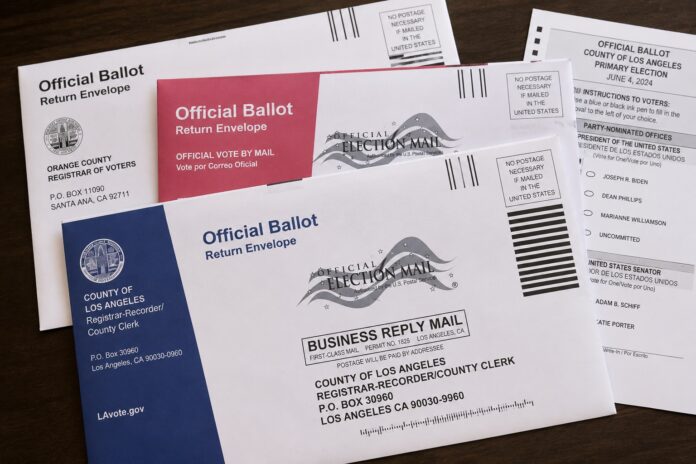

A federal appeals court has refused to reinstate key portions of President Donald Trump’s executive order aimed at tightening mail-in voting rules, dealing a significant setback to the administration just months before this year’s midterm elections and potentially setting the stage for a Supreme Court battle.
In a 2-1 ruling issued today, the 1st U.S. Circuit Court of Appeals rejected the Justice Department’s request to temporarily lift a June court order that blocked several provisions of Trump’s March executive order while the administration continues its appeal.
The Justice Department had previously indicated that, if unsuccessful before the appeals court, it could seek emergency intervention from the U.S. Supreme Court.
Administration attorneys argued that the lawsuit challenging the executive order was filed too early because federal agencies had not yet completed the process of adopting the policies necessary to carry out the president’s directives. The appeals court disagreed, concluding that the states challenging the order already faced imminent election deadlines and had begun preparing for the anticipated changes.
“As the district court reasoned, the (executive order) lays out a clear set of rapidly approaching deadlines by which states must coordinate with federal officials and comply with new voting procedures,” the majority wrote. “The Plaintiff States have no practical choice but to respond to the (order) now.”
Trump signed Executive Order 14399 in March as part of his broader election integrity initiative.
Among its provisions, the order instructs the Department of Homeland Security to create lists of verified U.S. citizens eligible to vote and provide that information to the states. It also directs the U.S. Postal Service to develop new standards governing mail-in ballots and orders the Justice Department to prioritize investigations into state and local election officials who issue federal ballots to individuals determined to be ineligible to vote.
The legal challenge was filed by 23 states and the District of Columbia, led by California, Massachusetts, Nevada, and Washington. The plaintiffs argue that the Constitution gives states primary authority over the administration of federal elections and contend that the president exceeded his constitutional powers by directing federal agencies to impose new election procedures.
In June, U.S. District Judge Indira Talwani sided with the states, ruling that several portions of the executive order were likely beyond the president’s legal authority. She barred federal agencies from enforcing those provisions in the plaintiff states through the Nov. 3 federal elections.
Today’s decision does not resolve the merits of the case but leaves the lower court’s injunction in effect while the administration’s appeal moves forward.
{Matzav.com}