
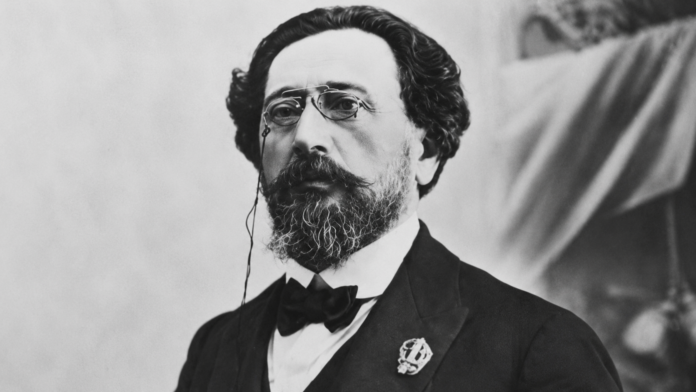

NEW YORK (VINNEWS/Rabbi Yair Hoffman) What follows is a portrait of a non-Frum Russian Jewish lawyer named Oscar or Yisroel Gruzenberg. He was a lawyer that the Chofetz Chaim himself had gone to see. This is his story.
It was the Seventeenth of Tammuz, and the boys went out for a walk.
The date was the 17 Tammuz 5675 — in the secular calendar – the twenty-ninth of June, 1915. That afternoon was long and hot. A handful of bochurim from the Chofetz Chaim’s yeshiva, temporarily lodged in Vilna, went out past the edge of the city into the fields.
A man walked with them. He had introduced himself earlier as a leather merchant from Meretch, a wandering dealer of the sort one met everywhere in those years. He came from a frum family. He knew how to talk. He had befriended the three German bochurim in particular — boys stranded on the wrong side of a front line — and had even slipped them pocket money.
Somewhere along that walk, into the jacket pocket of a boy named Efraim Leibowitz, he placed a folded sketch. It was a drawing of the defensive forts of Kovno.
Then he said his goodbyes and disappeared, permanently.
The leather merchant who had embedded himself in the Chofetz Chaim’s Yeshiva was no leather merchant at all. he was an agent of the Ochrana, the Tsar’s secret police, and he had spent months on this project. He intended to make his career move out of his actions.
The war had begun on Tisha B’Av — the first of August, 1914 — when Germany declared war on Russia. By the spring of 1915 the Russian front in Poland and Lithuania had broken open. The Great Retreat was underway. Warsaw would fall on the fifth of August. Kovno itself — those very forts, the fortress city on the Neman River— would fall on the eighteenth of August, six or seven weeks after that walk. Vilna would fall on the eighteenth of September.
A drawing of the Kovno forts, in a Jewish boy’s pocket, in June of 1915, was not an abstract accusation. It was the most explosive object that could have been planted on a human being anywhere in the Russian Empire that summer.
And the empire was ready to believe it. As the army fell back, the High Command needed an explanation for the defeats that did not implicate itself. It found one. Chief of Staff Yanushkevich and the headquarters staff settled on Jewish treachery as the answer.
The machinery moved fast. There were mass expulsions of Jews from the front-line provinces of Kovno and Courland. There were communities of generations emptied in twenty-four and forty-eight hour notices, wherein hundreds of thousands were driven east in sealed freight cars. There was the taking of communal hostages — rabbis and respected householders held against the good behavior of the towns they came from; and a steady stream of espionage prosecutions before courts-martial, most of them resting on nothing at all.
Gruzenberg would later devote two chapters of his memoirs to this period. He titled them “The Delirium of War.”
The Yeshiva in Wartime
The Chofetz Chaim had already made his decision the previous summer.
When the war broke out on Tisha B’Av of 1914, he divided the yeshiva in half. One half remained in Radin — then not in Poland at all, but in the Vilna Governorate of the Russian Empire; it would become Polish only after the borders were redrawn in 1921 — under the mashgiach Rav Yosef Nenedik and his son-in-law, the rosh yeshiva Rav Tzvi Hirsch Levinson. The other half he took with him, and for the time being they settled in Vilna.
Among them were three German bochurim. A decision was made not to register them with the authorities. Registering them would raise questions no one wanted asked: subjects of an enemy power, of military age, living in a fortress zone. It was a reasonable decision. It was also, in retrospect, the opening the provocateur needed.
That night, Ochrana agents raided the house where the boys were staying — the home of Reb Leib Matlis, the Chofetz Chaim’s brother-in-law. They arrested Efraim Leibowitz on charges of espionage. They arrested the two German bochurim. They arrested Reb Leib.
Efraim Leibowitz had no idea where the drawing had come from.
Penza
They took him east.
Penza sits far away from where Jews lived – some four hundred miles southeast of Moscow, on the approaches to the Volga, deep in the Russian interior — and, crucially, far outside the Pale of Settlement. A Jew could not legally live in the province of Penza. A Jew could be imprisoned there.
That is the whole cruelty of it in a sentence: a yeshiva bochur from Vilna was sent to a place where his presence was a crime, to serve time for a crime he had not committed.
He sat there, one supposes, through the fall of Vilna, through the Tsar’s assumption of personal command, through the winter offensives and the Brusilov summer. One or two years into his imprisonment — which would place it somewhere in 1916 or early 1917 — he noticed that one of his guards bore a Jewish name.
He called out to the man. He asked him to get word to the Chofetz Chaim that he was alive and where he was being held.
The guard did it.
And back across those hundreds of miles came a message of chizuk from Radin.
Like Yoseph HaTzaddik, he sat alone in a prison. A boy alone in a prison in the Russian interior, with no lawyer, no visitors, no language in common with anyone around him, and no reason on earth to expect that anyone knew he existed — received a letter of strengthening from the Chofetz Chaim.
The Ben Brafman of Tsarist Russia
The Chofetz Chaim also went looking for a lawyer, and there was only one name.
Oskar Osipovich Gruzenberg was born in Ekaterinoslav in 1866, the grandson of a rabbi and the son of a maskil who raised his children on Russian rather than Yiddish and sent them to a Russian gymnasium in Kiev. He was, by every measure, an assimilated man. He was also the most formidable Jewish defense attorney in Russia, and the closest thing Russian Jewry had to a shield.
Twice, a career was offered him on condition of baptism, and twice he refused. When he finished law school in 1889, the government decreed in that same year that non-Christians could join the bar only by personal permission of the Minister of Justice — which meant, in practice, never.
Gruzenberg spent the next sixteen years as a permanent “lawyer-in-training.” During that entire period, by his own account, not a single Jew was approved.
He defended Jews charged in the pogrom trials. He defended Jews charged with treason during the war, again and again, on evidence he described as the flimsiest imaginable. He made it a rule from the beginning of his career never to accept a fee, or even expenses, in a civic or political case.
And in 1913 he stood up in Kiev as chief counsel for Mendel Beilis, the brick-factory clerk accused of the ritual murder of a Christian boy — and won.
Bava Basra
The Beilis trial ran thirty-three days, from late September into the end of October, 1913. The prosecution’s expert on Judaism was Father Justin Pranaitis, a Russian Orthodox priest who had built a career on the claim that Jewish texts commanded the use of Christian blood.
This author got hold of the transcripts of the trial. Under cross-examination, Pranaitis was asked whether he was an expert in Judaism. He said he was. He was asked to identify major figures of Jewish history, and the questions were easy, and he answered them.
Then came the question that quite feasibly turned the tide on the case.
Who was Bava Basra? And in what era did she live?
The priest replied that he certainly knew of her, that she had played an important role in saving the Jewish people — but that he could not, at the moment, recall precisely when she had lived.
The courtroom, packed with Jews, dissolved in laughter, and the prosecution’s expert never recovered.
For as even a barely educated Jew knows, Bava Basra is a tractate of the Talmud.
Gruzenberg told the jury that they had the power to destroy Beilis, but that they did not have the power to disgrace the Jewish religion — which he called an ancient anvil on which its enemies had broken many sturdy hammers.
The Journey
Gruzenberg was asked to take Efraim Leibowitz’s case. He did not accept it.
And so the Chofetz Chaim went to ask Gruzenberg himself.
He was then a seventy-eight year old man— born in 1838, and by the summer of 1916 approaching eighty. He traveled to meet Gruzenberg, in a country at war, on wartime trains, across a rail system buckling under mobilization, as a Jew whose right to be in most of the cities he passed through was a matter of paperwork and official mood. The Chofetz Chaim’s biographer places the meeting in Moscow.
The conversation between them is not recorded at length, and one wishes very much that it were. What is recorded is the advice.
Gruzenberg told him that the case would be heard in a military court rather than a civilian one, and that this changed everything. A courtroom of officers under wartime jurisdiction was not a jury of Kievan peasants who could be reached. What Efraim Leibowitz needed was a military lawyer — and, Gruzenberg said, a Christian one at that.
Instead, he named a Captain Zvyazik.
Nothing further is known about this military lawyer. No biographical trace of him has surfaced, and he appears nowhere in Gruzenberg’s own memoirs, which are otherwise crowded with the names of colleagues, judges, and prosecutors.
Something should be said in Gruzenberg’s defense here, because “he refused the case” sounds worse than it was. He took no fees in cases like this, so there was no money in it either way. He had spent the war years running from court-martial to court-martial on behalf of Jews accused of exactly this crime. He knew precisely what those courtrooms were. In one such case — the Warsaw tailor Holzmann, condemned to hang for supposedly signaling the Germans with the smoke from his chimney — Gruzenberg described looking into the faces of the three judges and finding their eyes stone-cold dead, a curtain of steel lowered, no way in. He got Holzmann’s sentence commuted only by bursting into the sickroom of the Chief Military Prosecutor and pleading with a feverish general in his nightshirt.
He was not being dismissive of the Chofetz Chaim. He was telling him the truth as a man who had already lost in those rooms.
Vitebsk, December 1916
The trial was held in Vitebsk — a city inside the Pale, in the Belarusian provinces, the city Chagall had painted before he left it — in December of 1916.
Efraim Leibowitz was convicted. He was sentenced to twelve years.
It is impossible to read that sentence without noticing the date. Nine weeks later, in the last days of February 1917, the Tsar’s government collapsed. On the twenty-first of March, 1917, the Provisional Government abolished every religious and ethnic restriction in Russia at a stroke, and a delegation of Jewish organizations from across the country chose Oskar Gruzenberg to stand before the Petrograd Soviet and speak for them.
The empire that manufactured the sketch, the police force that planted it, the court that believed it, and the Minister of Justice whose ministry had lent its name to the Beilis prosecution — all of it was gone within a season of that verdict.
The Man Who Was Not Frum
The title of Gruzenberg’s memoirs is Yesterday, and there is a chapter in it called “My Jewish Heritage.” Anyone who wants to understand why the Chofetz Chaim went to see this particular non-observant lawyer should read it.
A year before his father died, the young Gruzenberg overheard a friend mocking his father for going to daven on his own father’s yahrtzeit, twenty years after the death. The father answered that he had promised his father. The friend scoffed and said that Gruzenberg’s sons would never run to the prayer house for him. The father looked at his son and said quietly that it would be a pity — that a person ought to remember his parents.
The father died of anthrax not long after. In the mid-1870s, the boy arrived after the burial and read the kaddish off a slip of paper at the graveside.
Then he kept the year. Three times a day, eleven months, ten men required each time.
The nearest minyan was a prayer house of artisans who started work before five in the morning and davened only afterward, which meant he could never finish before half past eight — exactly when gymnasium classes began. He was late every single day for eleven months. He was punished, mocked by the younger boys, made to stand under the clock during recess, and finally scolded by his own friends, who thought he was simply lazy.
He never told them. He wrote that if he had, the teachers would have praised his devotion — and to profit from the loving memory of his father seemed to him – an awful thing to do.
In the autumn of 1888 his own infant son died at seven months, and the house filled with bearded men in long coats speaking a language he barely understood, and a thin Jew walked before the small coffin rattling a cup of coins and calling out that tzedakah saves from death. Gruzenberg wrote that his Christian friends stepped aside at the funeral to make room for these strangers, and that he understood, standing there, that they had a claim on him. Along with the body of his child, he said, they had taken his soul.
He closed that chapter by quoting what he called the reproachful voice of the prophet: if you are not for us, who is — and if not now, when?
It was Hillel, and not a Navi, and it is found in Pirkei Avos.
That single footnote is the whole portrait. He did not know where the line came from. He lived by it anyway.
The Chofetz Chaim Again
The Chofetz Chaim returned to Radin after the war and died there in 1933, at ninety-four.
Gruzenberg was swept aside by the Bolsheviks he had once defended in court, left Russia in the spring of 1921, and spent his last two decades in exile — Berlin, then Riga, then Nice, where he died in 1940 as the German army was coming again. Gruzenberg passed away on December 27, 1940. His yahrtzeit is 27 Kislev. He
was buried in the Trumpeldor Cemetary in Tel Aviv. There is a street in Tel Aviv named after him. Yehei zichro Boruch.
The author can be reached at [email protected]