

NEW YORK (VINNEWS/Rabbi Yair Hoffman)
“But you cannot do that to the family!”
“The family does not realize what they need! We have to do it!”
“It is killing them! And they suffered enough!”
These are arguments of good people, askanim, that happen behind closed doors. Sometimes it is resolved one way. And sometimes the other way. But let’s start at the beginning.
There is a problem in our community which happens every so often that is kind of awkward to talk about – but should be addressed. Every so often we read about someone, perhaps a talmid chochom, perhaps a giver to the community, that has tragically passed away without insurance and noe there are a number of yesomim. Of course, the ideal is to address the problem beforehand with adequate insurance, but the fact is that in today’s economy an insurance policy of 3 million dollars is what is neccessary and the cost for a 20 year term policy is roughly $700 per month. This is difficult for a large family to be paying.
The question is, should a large scale fundraising campaign be made? Often the family doesn’t want it because it is embarrassing to them. On the other hand, the askanim of the community feel that it is necessary because otherwise the funds that the family will require are just too much for a quiet approach to select gvirim.
So how do we answer this dilemma? Klal Yisroel always looks to Chazal for guidance.
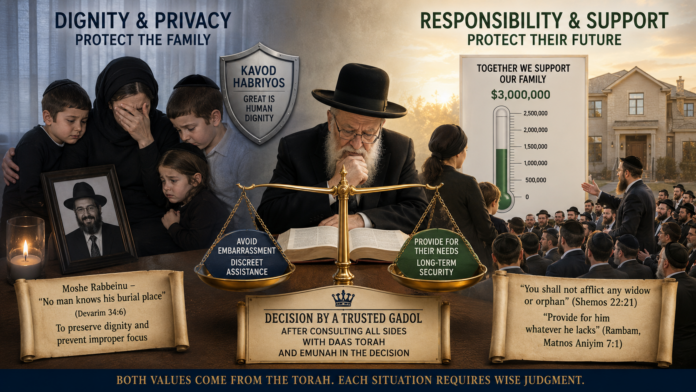
When Moshe Rabbeinu departed from this world, the Torah tells us that Hashem Himself buried him: “And He buried him in the valley in the land of Moav” (Devarim 34:6). Chazal explain that the Holy One Himself occupied Himself with Moshe’s burial (Sotah 14a), teaching us that gemilus chasadim at moments of death is among the loftiest of all mitzvos.
But there is another remarkable aspect of Moshe Rabbeinu’s passing. The Torah tells us that “no man knows his burial place until this day” (Devarim 34:6). The Midrash (Dvarim Rabbah 11:10) explains that one reason his burial place was concealed was to prevent it from becoming a site of inappropriate focus or even idolatrous worship. We see from here that there are times when preserving the dignity of the deceased and the proper interests of those left behind – outweighs public attention.
Yet Chazal also emphasize an equally compelling value: the obligation of the community to sustain those who cannot sustain themselves.
The Mishnah (Pe’ah 8:7) teaches that one who genuinely requires assistance should not hesitate to accept it, while one who refuses needed charity out of misplaced pride may ultimately come to genuine poverty. The Rambam (Hilchos Matnos Aniyim 10:18) codifies this principle, explaining that preserving one’s dignity is important, but not at the expense of leaving one’s family destitute. False pride is not a Torah value.
Indeed, Chazal viewed the support of widows and orphans as one of the highest communal obligations. The Torah repeatedly warns us regarding the almanah and yasom. “You shall not afflict any widow or orphan” (Shemos 22:21). The Gemara (Bava Basra 8b) teaches that the leaders of a city are empowered to compel contributions for communal needs, and among the most pressing of those needs are those who suddenly find themselves without support.
The Rambam writes (Hilchos Matnos Aniyim 7:1) that we are obligated to provide a needy person with dei machsoro asher yechsar lo—whatever he genuinely lacks. This obligation is not limited to food. It includes restoring, as much as possible, the stability that has suddenly been shattered. An almanah raising young children has lost far more than an income. She has lost security. The community therefore bears responsibility to restore that security to the extent it can.
On the other hand, preserving human dignity (kavod habriyos) is itself a cardinal Torah value. The Gemara in Berachos (19b) declares, “Great is human dignity.” Chazal repeatedly structured communal institutions so that recipients of charity would not be publicly embarrassed. The Gemara (Kesubos 67b) relates how anonymous gifts were preferred whenever possible. The Rambam famously lists anonymous giving among the highest levels of tzedakah (Hilchos Matnos Aniyim 10:7-14).
This is where the tension lies.
If a discreet effort among a handful of benefactors can realistically provide for the family’s long-term needs, then maintaining the family’s privacy is certainly the preferable course. Why publicize things if it is unnecessary?
But then again – what if the numbers simply do not work?
What if the family requires several million dollars to replace decades of lost earnings, educate children, marry them off, and simply survive? If only a public campaign can realistically generate those funds, then the very concern for the family’s dignity may paradoxically require setting aside some measure of that privacy in order to preserve everything else.
Perhaps this reflects another teaching of Chazal. The Gemara (Kesubos 67b) tells us that Hillel once personally ran before a formerly wealthy man who had become impoverished because that was the level of support necessary to preserve his dignity. Chazal did not say, “That is too much.” They asked instead: “What does this person actually need?”
Every tragedy presents a different answer.
It would seem of course that there is no universal formula. The question is not merely whether a public campaign is embarrassing. The question is whether avoiding that embarrassment will ultimately cause even greater hardship to the widow and the yesomim. That determination requires the judgment of experienced Poskim and rabbanim, trusted askanim, and those who understand both the family’s emotional needs and its financial realities.
Sometimes protecting a family’s dignity means shielding them from public attention.
Sometimes protecting their dignity means ensuring that they will not spend the next twenty years worrying how to pay tuition, make weddings, or keep a roof over their heads. Both values emerge from the Torah. This author would suggest that the issue should be decided by a gadol that the father was close to – and that the decision should rest only with that Gadol. The Gadol should be informed of the the family’s view – which, in and of themselves can have varied opinions. There is a Midrash that backs up this idea. The Midrash explains that when Rivkah imeinu said the words, “VaTomer im kain – lamah zeh anochi” she had regretted her davening so much for children – when she found out that she was carrying Aisav in her womb. Initially, it was her destiny to birth the twelve shvatim. That was taken away from her because she regretted what she had done – after having consulted Daas Torah – in vatailech lidrosh es Hashem. The lesson that this Midrash teaches is that once we consult Daas Torah properly – we should never have regrets.
The author can be reached at [email protected]