
 Matzav
“AGAINST THE LAW”: Rand Paul Warns Fauci of ‘Repercussions’ After Repeatedly Invoking Fifth Amendment
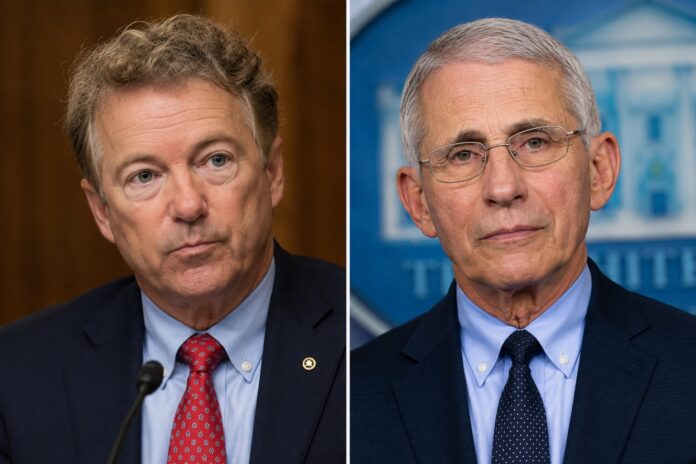
Sen. Rand Paul (R-Ky.) warned Dr. Anthony Fauci that he could face serious consequences after the longtime public health official repeatedly invoked his Fifth Amendment right against self-incrimination during a contentious Senate hearing on Wednesday, announcing plans to pursue a contempt of Congress resolution against him.
Following Fauci’s repeated refusals to answer questions, Paul accused him of obstructing Congress and said the Senate Homeland Security and Governmental Affairs Committee would vote on Aug. 5 on a measure holding Fauci in contempt.
“It’s against the law to obstruct an investigation of Congress. There will be repercussions for your refusal to testify,” Paul told Fauci, the longtime top government health official who led the pandemic response.
Ordinarily, invoking the Fifth Amendment protects witnesses from being penalized for declining to answer questions that could expose them to criminal liability, since the Constitution guarantees that right against self-incrimination.
Paul and other Republicans, however, argue that Fauci’s legal circumstances are unique because Joe Biden issued him a sweeping pardon covering all official conduct from 2014 through 2025. They contend that, with federal prosecution for actions during that period effectively off the table, Fauci cannot legitimately claim fear of federal criminal charges for questions related to those years.
Even so, Fauci could still theoretically face state or local criminal charges in some circumstances, as well as federal prosecution if he were to make false statements under oath. Fauci has maintained that he believes Paul’s objective is to trap him into making statements that could later be used in a perjury case.
The legal dispute is further complicated by Congress’ authority to hold uncooperative witnesses in contempt. The Senate could seek a civil contempt order compelling Fauci to testify, exposing him to possible fines or even jail if he continued refusing. Although Congress also retains the rarely used power of “inherent contempt,” which could allow the Senate sergeant-at-arms to arrest and detain a witness, that authority has not been exercised in nearly 100 years.
Lawmakers also have the option of pursuing criminal contempt by referring the matter to the Justice Department. Paul pointed to previous contempt cases involving Trump advisers Peter Navarro and Steve Bannon, both of whom were convicted after refusing to cooperate with the House Jan. 6 investigation. Unlike Fauci, however, Navarro and Bannon declined to appear altogether and based their refusals on executive privilege rather than the Fifth Amendment. Each ultimately served four-month prison sentences.
After Paul declared that Fauci would face consequences, Fauci’s attorney, David Schertler, attempted to address the committee, arguing that the Constitution protected his client’s actions. Paul instead directed security officers to escort Schertler from the hearing room.
“It was outrageous for Sen. Paul to exclude his counsel for counsel making a legitimate legal point,” Schertler said in a statement. “It proves the baseless and vindictive nature of this proceeding and Rand Paul’s personal vendetta against Dr. Fauci.”
Legal experts have also noted another potential complication for Fauci. If a court ultimately determines that his invocation of the Fifth Amendment was not legally justified, he may not be able to defend himself by arguing that he relied on his attorneys’ legal advice. A 1961 ruling by the U.S. Court of Appeals for the D.C. Circuit held that an advice-of-counsel defense is unavailable to individuals charged with willfully defying Congress.
Although some judges have questioned the reasoning behind that decades-old precedent in more recent cases, the appeals court has thus far declined to reconsider the ruling.
During the hearing, Paul accused Fauci of concealing the true origins of COVID-19—which Paul believes emerged from a Chinese laboratory that received U.S. research funding—and criticized him over school and church closures implemented during the pandemic. Fauci repeatedly refused to answer those questions.
“On the advice of counsel, I respectfully decline to answer based upon my rights under the Fifth Amendment to the Constitution,” he said.
In his opening statement, Fauci argued that Paul’s investigation was motivated by a desire to prosecute him rather than uncover facts, citing what he described as the senator’s long-running campaign against him.
Fauci said in his opening statement he thought Paul aimed to entrap him, citing his “obvious obsession with calling for my prosecution, his repeated slanderous comments about me, and recently his publicly releasing my unredacted personal diary aimed at embarrassing and intimidating me.”
Paul closed the hearing by indicating that the investigation was far from over, saying he would explore “appropriate actions” to pursue Fauci further.
{Matzav.com}