
 Matzav
Report: President Trump Pushing RFK Jr. to Pursue Reducing Childhood Vaccines
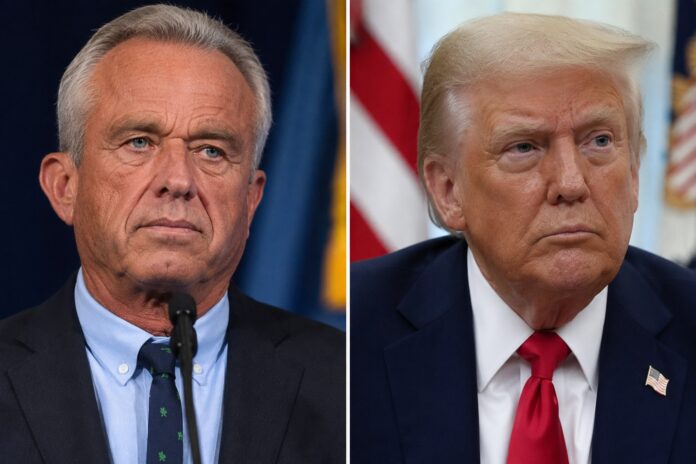
President Donald Trump is reportedly urging Health and Human Services Secretary Robert F. Kennedy Jr. to move more aggressively in reducing the number of recommended childhood vaccines, advancing a priority that has remained a focus throughout Trump’s second term, according to a Wall Street Journal report.
Citing people “familiar with the matter,” the Journal reported that Trump questioned Kennedy in May about “why he wasn’t doing more to probe the alleged connection between vaccines and autism.” According to the report, Kennedy was “taken aback” because he had previously understood that he was expected to downplay vaccine-related issues until after the midterm elections. The Journal said Trump’s comments made clear that he wanted the issue moved to the forefront.
“The president steers nearly every conversation with his health secretary back to the issue, some of the people said,” the Wall Street Journal reported. According to the report, Trump wants Kennedy to reduce the number of vaccines recommended for children by revising federal guidance. The effort is tied to Trump’s stated goal of lowering autism rates among children. Autism diagnoses have risen sharply over the past quarter century. Federal data showed the prevalence among 8-year-olds was 1 in 36 as of 2020, while Kennedy later said the rate had increased to 1 in 31 children as he unveiled a series of studies aimed at identifying “precisely what environmental toxins” may be contributing to autism.
“The epidemic is real,” Kennedy said at the time.
“Instead of listening to this canard of epidemic denial, all you have to do is start reading a little science, because the answer is very clear, and this is catastrophic for our country,” Kennedy continued, adding, “This is added to already astronomical healthcare costs. And then there’s an individual injury. These are kids that — this is a preventable disease. We know it’s an environmental exposure. It has to be. Genes do not cause epidemics.”
While Kennedy has faced criticism from left-wing opponents for questioning vaccine policies, he has consistently maintained that his objective is simply to ensure the public has access to “good information.”
Last September, Trump drew widespread attention during a press conference with health officials when he cautioned pregnant women about taking acetaminophen, commonly sold as Tylenol, citing what he described as a “very increased risk of autism.”
“I think I can say that there are certain groups of people that don’t take vaccines and don’t take any pills that have no autism. That have no autism. Does that tell you something? That’s currently, is that a correct statement by the way?” Trump said.
“There are some studies that suggest that. Yeah, with the Amish for example,” Kennedy said.
Trump has repeatedly said he supports vaccines while also arguing that the media and medical establishment should be more willing to examine whether some vaccines or ingredients could carry risks.
Last year, the Trump administration directed the U.S. Centers for Disease Control and Prevention to remove the coronavirus vaccine from its recommended immunization schedule for healthy children and healthy pregnant women.
During the same period, Kennedy announced that a mercury-based preservative previously used in certain influenza vaccines would be eliminated from flu shots distributed in the United States.
Under the current childhood immunization schedule, infants receive more than a dozen vaccine doses during their first six months of life. Including annual influenza vaccinations and COVID-19 shots, children could receive more than 72 injections by the time they reach 18 years of age.
In March, President Trump signed an executive order “to acknowledge a recent Department of Health and Human Services (HHS) scientific assessment on childhood vaccines as a guiding resource for the Federal Government.”