
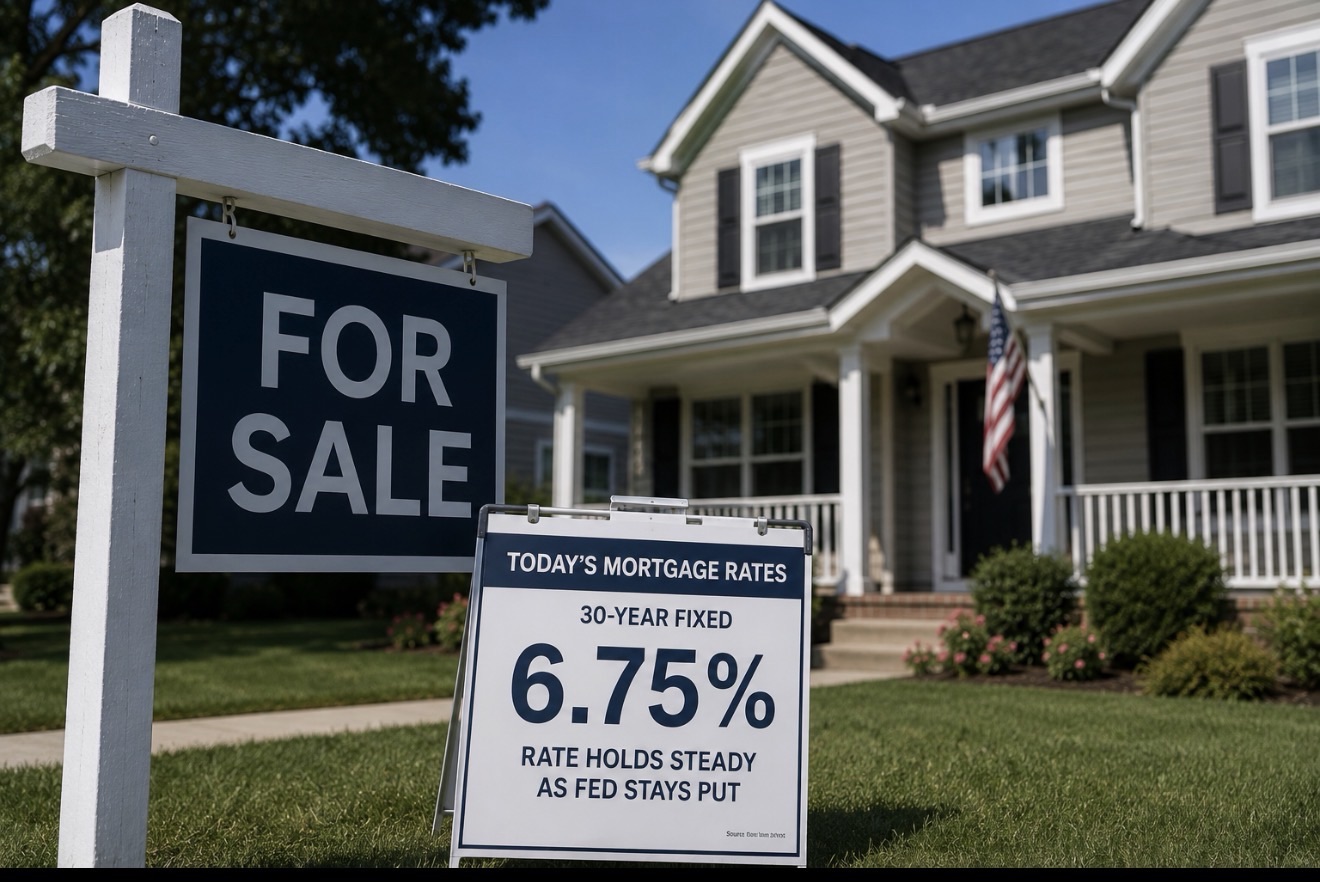

Record June home prices and a 5% drop in pending sales point to a slow summer, with the Iran war keeping upward pressure on rates
The average rate on a 30-year fixed mortgage sat close to 6.75 percent on Wednesday, according to daily surveys published after the Federal Reserve left its benchmark rate unchanged for a fifth consecutive meeting.
The figure varies by who is counting. Bankrate put the 30-year fixed average at 6.75 percent Wednesday. Forbes Advisor, using Mortgage Research Center data, reported 6.73 percent, up 0.06 percentage points from the prior week, with the 15-year fixed at 5.95 percent APR. Zillow data provided to U.S. News showed the 30-year purchase rate at 6.827 percent, down from 6.877 percent the previous day, with refinancing at 6.963 percent and the 15-year at 5.929 percent.
Those spreads reflect different survey methods and loan mixes rather than genuine disagreement. The operative point is that rates have been parked in the mid-to-high 6s and did not move meaningfully on the Fed decision.
Why the Fed hold doesn’t move the mortgage
Mortgage rates fell through the last three months of 2025 after the Fed cut at its September, October and December meetings, bringing the policy rate to a 3.50 to 3.75 percent target range. The FOMC has held there through 2026.
The 30-year mortgage tracks long-term inflation expectations and the Treasury market, not the overnight rate — which is why five holds have produced no relief. Rates on home loans have risen since the start of the U.S. war in Iran in late February, with the Middle East conflict pushing oil prices higher, feeding manufacturing and transport costs, and translating into inflation that keeps rates elevated.
That chain is the whole story of the 2026 housing market. Anyone waiting for the Fed to fix affordability has been waiting on the wrong institution.
Prices at a record, sales falling
The demand side is where the strain shows. The National Association of Realtors reported on July 9 that the median price of existing homes rose to $440,600 in June, an all-time high. On July 16, NAR said June pending home sales fell more than 5 percent.
Lisa Sturtevant, chief economist at Bright MLS, said higher rates point to a slow summer market, and that the June pending-sales data suggests a steeper-than-usual drop-off in closed sales through July and August. Pending sales lead closings by roughly one to two months, so the June figure is a forecast of what the late-summer numbers will show.
Record prices alongside falling transaction volume is a specific condition: sellers are not cutting, buyers are not stretching, and the market clears at lower volume rather than lower prices.
Incomes are keeping pace, barely
One counterweight is worth noting. The Bureau of Labor Statistics reported that median weekly earnings for the nation’s 121 million full-time wage and salary workers rose 4.6 percent in the second quarter of 2026, outpacing inflation.
Wages growing faster than prices is the healthiest number in the current data. It is not enough to close the affordability gap when the median home is at a record and financing costs near 7 percent, but it means household balance sheets are improving rather than eroding.
What tri-state buyers and owners should look at
The jumbo market matters disproportionately here. The conforming loan limit for 2026 is $832,750 across most of the country, though it runs higher in designated high-cost areas. The average 30-year jumbo rate stood at 6.882 percent, essentially unchanged on the day. Across much of Westchester, northern New Jersey, Long Island and Fairfield County, the median transaction sits above the standard conforming line, putting a meaningful share of local buyers into jumbo pricing.
FHA financing is running cheaper — the average 30-year FHA rate was 6.098 percent, up from 6.063 percent the prior day. For buyers with modest down payments or credit in the mid-600s, that spread of nearly three-quarters of a point against the conventional 30-year is significant, and it is often overlooked.
For owners considering a refinance, the arithmetic remains unfavorable. Refinancing at 6.963 percent only helps borrowers who took a higher rate earlier in the cycle or who are pulling equity for a specific purpose.
What would actually change it
Two things, and neither is a Fed cut. The first is energy. If oil retreats and holds, headline inflation cools and long rates follow. That depends on the Strait of Hormuz, not on Washington.
The second is inventory. Falling pending sales with record prices means supply is not arriving. Owners sitting on mortgages issued at 3 percent have no financial reason to list, and that lock-in is what holds prices at records while volume declines.
Rates may begin to decline if inflation eases or the economy weakens. For anyone underwriting a purchase this fall, the sound assumption is the rate on offer today, not the one hoped for next spring.
JBizNews Desk | New York
© JBizNews.com All Rights Reserved. Reproduction or distribution without written permission is prohibited.