
 JBizNews
US Refineries Hit 97% of Capacity — and Fuel Inventories Are Still Falling Behind
Record summer output is heading overseas as the Iran and Russia conflicts drain global supply; diesel back above $5 a gallon
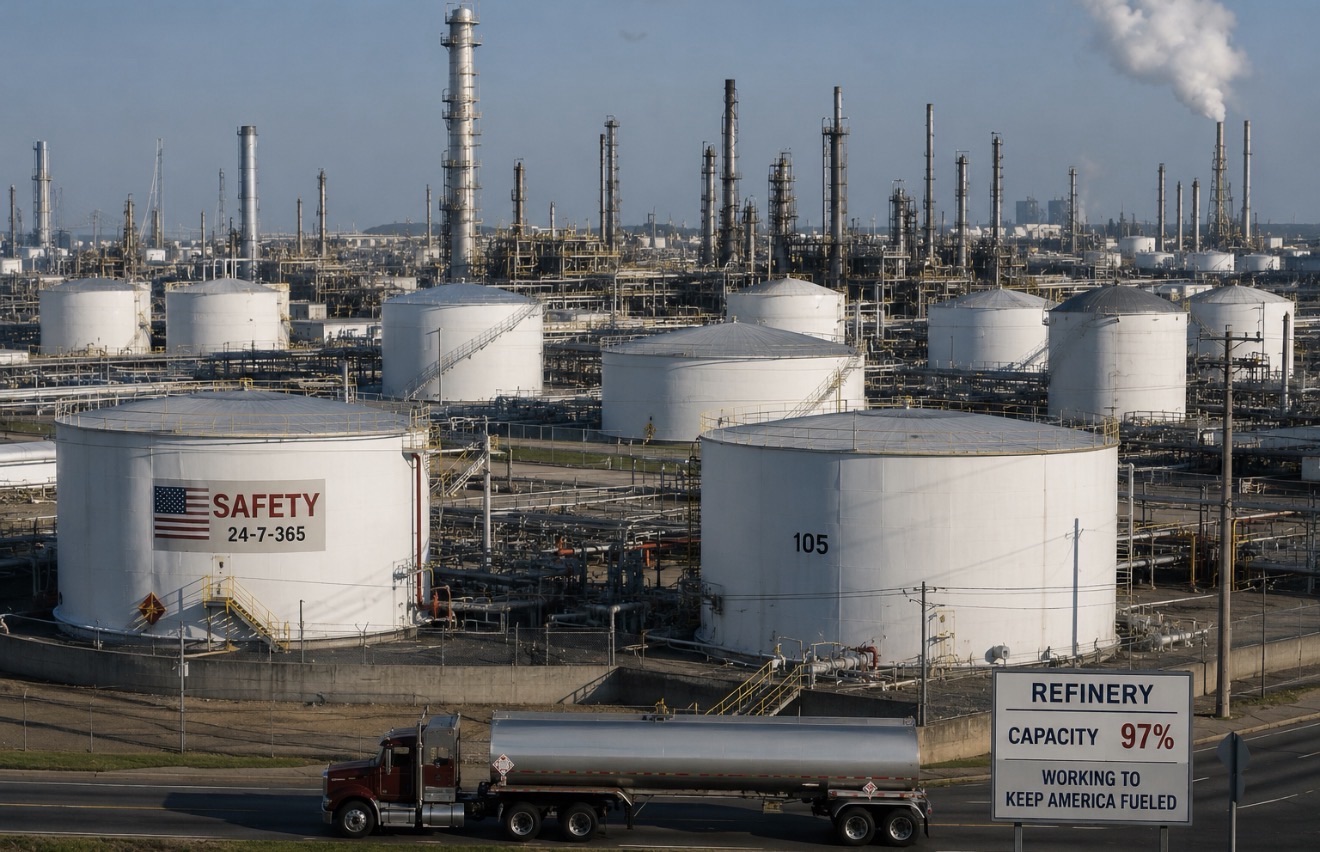
American refineries ran at 97.2 percent of operable capacity in the week ending July 24, producing an average of 9.9 million barrels per day of gasoline, according to Energy Information Administration data released Wednesday. It is the hardest the domestic refining system has been pushed since before the pandemic — and it is not keeping domestic inventories whole.
Crude oil inventories stood at 404.5 million barrels, about 6 percent below the five-year average for this point in the year. Total motor gasoline inventories rose slightly on the week but remain 7 percent below the five-year average. Distillate fuel inventories, which cover diesel and heating oil, increased by 1.1 million barrels and sit roughly 10 percent below the five-year average.
Running flat out and still losing ground on stockpiles is the defining condition of this market.
Where the fuel is going
The answer is overseas. Refiners produced an average of 5.3 million barrels a day of distillate fuel in July, putting the month on pace for the most diesel the United States has ever made in July and one of the highest months on record outside winter heating season. The country is tracking toward its second-largest month of distillate exports on record, behind only summer 2022, with buyers from South America to Europe competing for cargoes.
Renewed fighting in the Middle East is again threatening shipments through the Strait of Hormuz, while Russia has banned most fuel exports following sustained drone strikes on its refineries. Two major export sources have been pulled or partially pulled from the global market at the same time, and American refiners are filling the gap at premium margins.
That has pushed refining crack spreads — the margin between crude cost and product price — to record levels. Gasoline crack spreads are up roughly 60 percent from a year ago, while diesel and jet fuel spreads run more than double 2025 levels, according to EIA data.
The economics are working exactly as designed. The problem is that they point the product away from American storage tanks.
What it costs at the pump
Diesel is back above $5 a gallon at retail after easing during a short-lived U.S.-Iran ceasefire. Gasoline has moved above $4 a gallon. West Texas Intermediate stood at $83.43 a barrel on July 17, nearly $11 higher than a year earlier.
Demand is not cooperating either. Over the four weeks through mid-July, gasoline supplied to the market averaged 8.9 million barrels a day, up 1.4 percent from a year ago; distillate supplied averaged 3.7 million barrels a day, up 2.2 percent; and jet fuel demand ran 9.1 percent above the year-ago period.
Why this is a tri-state business problem
Diesel above $5 is a direct cost line for every trucking company, freight broker, distributor, contractor and food wholesaler operating in the region. It moves through to delivered cost on essentially everything, with a lag of a few weeks. Firms operating on annual contracts priced when diesel was lower are absorbing that difference themselves.
The timing compounds it. Diesel demand is about to peak as farmers begin the fall harvest — the same fuel, the same constrained supply, a seasonal demand spike arriving on top of export-driven drawdowns.
Then comes the heating season. Distillate covers home heating oil, and the Northeast is the largest heating oil market in the country. Analysts expect further tightness as refinery maintenance season approaches, with low inventories raising the risk of higher prices heading into winter. Buildings, schools and multifamily properties across the tri-state area that heat with oil should be looking at their winter procurement now rather than in October.
The structural constraint
The capacity simply is not there to run any harder. The United States operates 132 refineries with a combined 18.4 million barrels per day of capacity. Roughly 1.1 million barrels per day of daily capacity was lost between 2020 and 2021, about a third of global capacity losses in that period, and only some has been recovered through expansion of existing plants. California has lost two refineries recently and now imports more product. One new refinery is under construction in Texas, designed for light shale crude.
Refiners have also deferred maintenance to capture current margins — shutdowns averaged 470,000 barrels per day from January through May, down from 700,000 a year earlier and 900,000 in 2024, with little maintenance scheduled for the back half of the year. Deferred maintenance eventually has to happen, and when it does, output drops.
One more variable: extreme summer heat reduces refinery efficiency, since the process depends on cooling capacity to separate crude into finished products.
The takeaway for anyone budgeting fuel costs is that record production is not a signal of comfort. It is a system at its ceiling, meeting global demand, with the domestic cushion thinning.
JBizNews Desk | Washington, D.C.
© JBizNews.com All Rights Reserved. Reproduction or distribution without written permission is prohibited.