
 Matzav
Behind Closed Doors: Vance and Netanyahu Confront Growing Rift Over Iran Strategy
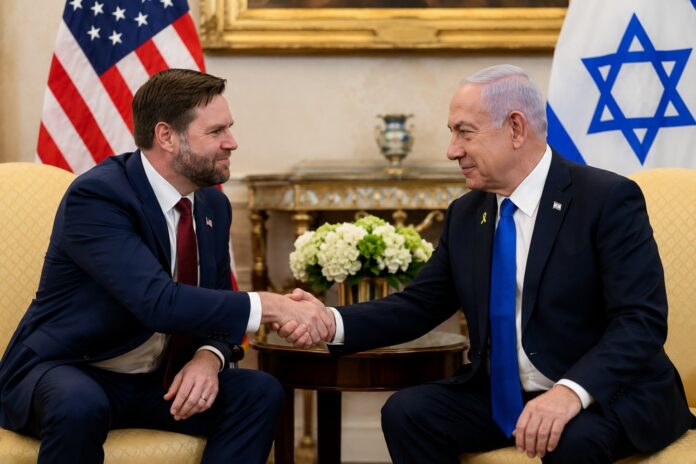
Vice President JD Vance and Israeli Prime Minister Binyomin Netanyahu held a private face-to-face meeting earlier this week in an effort to address mounting disagreements over U.S. policy toward Iran and broader Middle East strategy. While officials from both governments acknowledged that the conversation was unusually candid, they described it as constructive and said both sides remain committed to working together.
The meeting took place at Blair House after months of private friction between the two leaders over the Trump administration’s diplomatic efforts with Iran and Netanyahu’s approach to the ongoing regional conflict, according to Axios.
An Israeli official said Netanyahu used the meeting to express concern over Vance’s recent public remarks criticizing the Israeli government and questioning Israel’s standing within the Republican Party.
“It was a frank and candid conversation,” the official said.
An American official echoed that description, calling the discussion “direct.”
Vance’s office declined to comment publicly on the meeting. However, another U.S. official said the vice president and the Israeli prime minister held a “cordial and productive conversation about Middle East issues that are important to both countries.”
“The vice president and the prime minister agreed to continue pursuing opportunities for Israel and the United States to cooperate in areas of mutual interest and shared goals,” the U.S. official said, emphasizing that the meeting was not hostile and that the two leaders continue to maintain a productive working relationship.
Vance has become one of the leading voices within President Donald Trump’s administration advocating continued diplomatic engagement with Iran, particularly after the ceasefire reached on April 8.
He also played a prominent role in defending the U.S.-Iran memorandum of understanding, an agreement that Netanyahu reportedly opposed behind closed doors while refraining from publicly attacking it in hopes it would ultimately collapse.
That agreement eventually fell apart.
In recent months, the policy divide between Washington and Jerusalem has become increasingly public.
During June, Vance warned Israeli officials against publicly criticizing the Trump administration’s diplomatic efforts, saying members of Israel’s government should not attack “the only powerful ally” they have.
Appearing on Joe Rogan’s podcast in July, Vance went further, alleging that certain members of the Israeli government were engaged in an influence campaign designed to push the United States away from diplomacy and toward prolonging the conflict.
During that same interview, he also asserted that Jeffrey Epstein had connections to “the highest levels of Israeli intelligence.”
Officials familiar with the relationship said Netanyahu has privately objected to several of Vance’s public comments, including claims that the Israeli premier encouraged opposition to the Iran agreement and failed to demonstrate sufficient loyalty to President Trump.
At the same time, there have been accusations that individuals aligned with Netanyahu in both Israeli and American media have sought to politically weaken Vance.
According to officials, this week’s meeting gave both leaders an opportunity to address those disputes directly rather than through public statements.
This was not the first time the two men reportedly clashed behind closed doors. During a telephone conversation in March, Vance challenged Netanyahu’s optimistic assessment of the war, including predictions that Iran’s government was on the verge of a popular uprising that could bring down the regime.
{Matzav.com}