
 Matzav
“TERRIBLE”: Trump Reacts After 50,000 Migrants Storm Spain’s Border in Deadly Mass Crossing
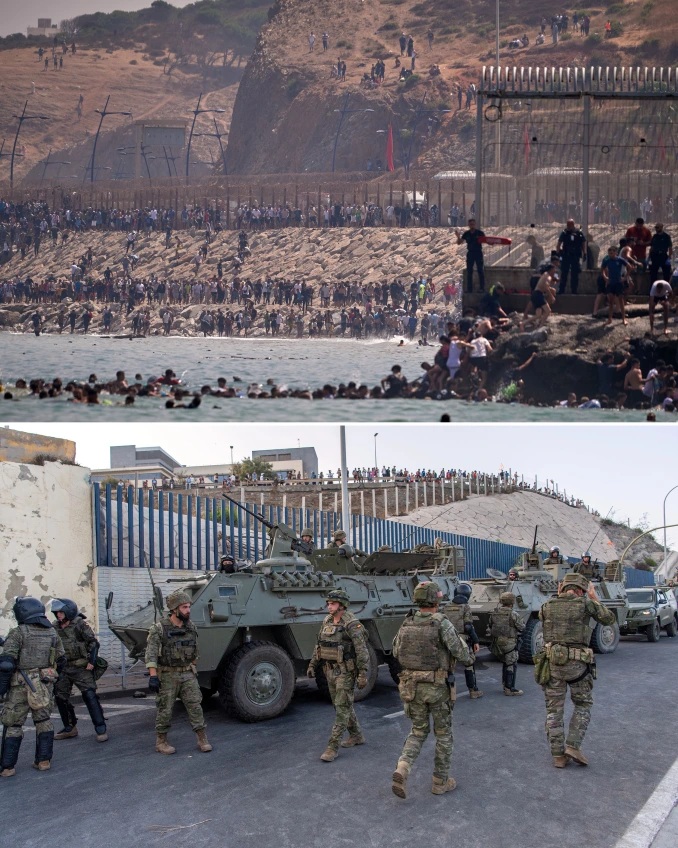
Spain raced Friday to respond to an unprecedented migration crisis after approximately 50,000 people poured into the Spanish enclave of Ceuta from neighboring Morocco, leaving dozens dead and triggering political fallout across Europe. President Donald Trump called the situation “terrible” as European governments moved to tighten border controls.
Spanish Prime Minister Pedro Sánchez traveled to Ceuta, a small Spanish territory on Morocco’s northern coast, where he condemned the mass incursion as “a violation of Spain’s territorial sovereignty.”
Officials said the disaster claimed a heavy human toll. The Spanish government’s representative in Ceuta confirmed that 57 bodies had been recovered on the Spanish side of the border, while warning that additional fatalities may have occurred inside Morocco.
Spain’s Interior Ministry told NBC News that roughly 50,000 migrants crossed into Ceuta on Thursday—an astonishing figure that exceeds half the enclave’s normal population. By Friday, officials said approximately half of those migrants had already returned to Morocco.
The unprecedented surge placed enormous political pressure on Sánchez, whose pro-immigration policies have drawn criticism both at home and abroad. Trump, who has repeatedly clashed with the Spanish leader, described the unfolding crisis in blunt terms, calling it “terrible.” Vice President JD Vance also weighed in, describing the scenes as an “unfortunate reminder of the consequences of mass migration and the radical left-wing globalist policies.”
The crisis quickly reverberated across Europe. France announced it would increase security checks along its border with Spain, while Italy temporarily suspended passport-free travel for flights arriving from Spain, citing security concerns.
Spanish authorities reinforced security throughout Ceuta, deploying military personnel to coastal areas and major roadways in an effort to restore order and manage the massive influx of migrants.
Dramatic footage from the scene showed thousands of people swimming around maritime barriers, floating on inflatable tubes, and forcing their way through border gates before sprinting into the Spanish territory.
Humanitarian organizations said most of those who died drowned during the crossing, while others were killed in crushing stampedes as crowds surged toward the border.
Although the majority of those arriving were young men, authorities also observed families crossing with women and young children.
Among them was 33-year-old Moroccan Ahmed Karim, who said he left his country in search of economic opportunity.
“Many people want to go to Europe, America, but they don’t have the opportunity,” Karim said.
Another migrant, Jadid Zacaria, expressed relief after successfully reaching Spain.
“It’s been a very tough experience to go from the ocean. It was very tough,” he said.
Spain has long served as one of Europe’s primary gateways for migrants seeking better economic prospects or fleeing violence. Ceuta and the nearby Spanish enclave of Melilla are the European Union’s only land borders with Africa. While both territories have periodically experienced migration surges, officials said the sheer scale of Thursday’s crossing was unlike anything seen in recent years.
Moroccan authorities did not immediately comment on the incident, and officials have not yet determined what sparked the sudden mass movement.
Spanish officials in both Madrid and Ceuta suggested the surge may have been fueled by a recent ruling from Spain’s Supreme Court holding that migrants arriving by sea cannot automatically be deported, unlike those who enter by land or scale the border fence.
Sánchez accused migrant-smuggling networks of exploiting and misrepresenting the court’s decision, while acknowledging that the ruling may have contributed to confusion and encouraged the massive crossing.
Some migration advocates in Morocco questioned that explanation, arguing that most migrants would likely have been unaware of a complex legal decision issued by Spain’s highest court.
The crisis has once again exposed Europe’s deep divisions over immigration, with several governments moving quickly toward stricter border enforcement while Spain has generally maintained a more welcoming stance.
Italian Prime Minister Giorgia Meloni announced on X that suspending free-travel arrangements was necessary to “safeguard national security” and prevent the crisis from spreading beyond Spain.
France also signaled a tougher approach. Interior Minister Laurent Nuñez said he had ordered authorities “to immediately step up checks at the Spanish border,” although he did not specify what additional measures would be implemented.
French opposition leader Marine Le Pen argued that the events underscored the need for tougher immigration policies.
“In the face of the massive and coordinated influx of migrants into Spain — encouraged by the Spanish government — France must immediately strengthen its border controls,” she said on X.
In Britain, Nigel Farage warned that the consequences could soon extend across the English Channel, saying “before long many will be crossing the English Channel to enter Britain illegally,” while criticizing Spain’s recent immigration amnesty program.
Trump offered his first public remarks on the crisis during a phone interview with Fox News, characterizing the massive border breach as simply “terrible.”
Israel also entered the debate following repeated diplomatic disputes with Spain over the war in Gaza.
“Before it continues lecturing us, it’s time it explained to the world why it still maintains colonial enclaves in Africa,” Israeli Ambassador to the United Nations Danny Danon wrote in a post on X.
{Matzav.com}