
 Vos Iz Neias
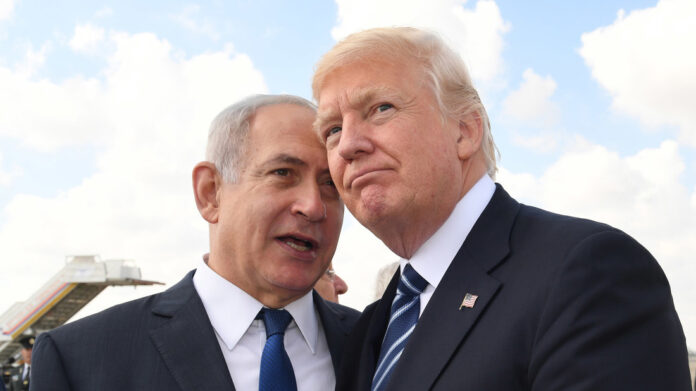
As Trump Weighs Military Options, Netanyahu Insists He’s Only ‘Junior Partner’
NEW YORK (VINnews) — As U.S. President Donald Trump weighs a response to Iran’s surprise missile attack, a dramatic American military plan has emerged that could significantly alter the course of the conflict in the region.
According to The Wall Street Journal, U.S. Central Command chief Adm. Brad Cooper has presented the president with an option for an intense and sustained air campaign against the Islamic Republic, one that could last between 10 and 14 days.
The decision now rests with Trump. Just last week, aboard Air Force One and near a ceremony honoring four American service members killed in action, the president held an impromptu meeting with his top national security advisers to discuss military options. The meeting included Chairman of the Joint Chiefs of Staff Gen. Dan Caine, Defense Secretary Pete Hegseth, and Adm. Cooper, who is directing operations from his headquarters in Florida.
Although Cooper is often overshadowed by Caine and Hegseth, who have more frequent access to the Oval Office, he was the official who developed the detailed plan for a major strike against Tehran.
According to sources cited in the report, the goal of the extended air campaign would be to cripple Iran’s missile capabilities, particularly those controlled by the Islamic Revolutionary Guard Corps (IRGC).
However, the plan has drawn warnings from senior officials, including Gen. Caine, who cautioned that a prolonged campaign could deplete U.S. stocks of air defense interceptors. Those interceptors are also needed to address threats from other global rivals, including China, Russia and North Korea.
Another option available to Trump is a more limited strike intended to preserve room for diplomacy. Trump addressed the situation in an interview with Fox News, saying: “We’re going to beat the hell out of them,” while also leaving the door open to negotiations, adding: “We’ll let them keep talking.”
So far, smaller retaliatory strikes have failed to deter Tehran from launching missiles toward U.S. bases in Jordan or threatening vessels in the Strait of Hormuz, threats that have contributed to a sharp rise in oil prices.
Adm. Cooper reportedly believes that only a large-scale campaign to destroy Iran’s missile infrastructure would change the strategic balance and reduce reliance on expensive defensive interceptors.
Memories of the previous round of fighting continue to influence decision-making in Washington. The last joint U.S.-Israeli campaign, which began in February, ended with a ceasefire agreement in April, shortly after an American F-15E fighter jet was shot down. At the time, Hegseth claimed that Iran’s missile program had been “functionally destroyed,” but Trump recently said U.S. intelligence estimates indicate that Iran still retains more than 20% of its missile arsenal.
Israeli Prime Minister Benjamin Netanyahu is also closely monitoring developments. Following Netanyahu’s meetings with Hegseth and Trump, U.S. officials said Israeli forces could play an active role if the administration decides to resume a large-scale campaign against the Iranian regime.
During an ABC News interview, Netanyahu stressed that he did not pressure Trump or urge him to resume military strikes against Iran, rejecting reports that he sought to influence the president’s decision-making.
Netanyahu emphasized the balance between the two countries, saying that the United States remains Israel’s senior ally. “We are close allies, with the United States being the senior partner in this system. I am a junior partner, but as prime minister of Israel, wherever I must stand firmly for my country’s security and national interests, I do so without hesitation,” he said.
In the interview, Netanyahu revealed that his discussions with Trump focused on three possible approaches to dealing with Iran: pursuing a broader diplomatic agreement, maintaining increased pressure around the Strait of Hormuz, or taking additional military action. Netanyahu said the two leaders openly reviewed the options as allies but stressed that the final decision belongs solely to Trump.
The Israeli prime minister also expressed deep skepticism about negotiations with Iran’s current leadership, accusing Tehran of using talks to delay action.
“I remain very skeptical about their methods. Experience has shown that they always lie and deceive, and mainly act to buy valuable time,” Netanyahu said. “If massive pressure, whether economic or diplomatic, can bring about some change, it is worth trying, but it must be done with constant caution and suspicion.”