
 Matzav
New Poll: Netanyahu and Eisenkot Deadlocked at 23 Seats as Bennett’s Party Continues to Slide
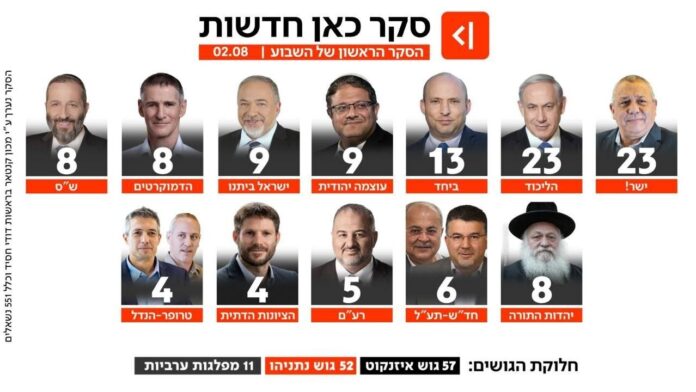
A new Kan News poll shows Israeli Prime Minister Binyamin Netanyahu’s Likud and Gadi Eisenkot’s Yashar party locked in a tie at 23 Knesset seats each, while Naftali Bennett’s Beyachad party and Yair Golan’s Democrats continue to lose support. The survey also indicates that the opposition bloc maintains an advantage over Netanyahu’s coalition.
According to the poll released Sunday evening, Likud gained one seat compared to last week’s survey, reaching 23 mandates, while Eisenkot’s Yashar climbed by two seats to match Likud at 23.
At the same time, Bennett’s Beyachad party slipped by one seat to 13, while the Democrats dropped two seats to just eight. Hadash-Ta’al, meanwhile, picked up one seat and now stands at six mandates.
Elsewhere in the poll, Otzma Yehudit remained unchanged at nine seats, as did Yisrael Beiteinu with nine. Shas and United Torah Judaism also held steady with eight seats each. Religious Zionism, however, fell by one seat and now stands at just four mandates. In addition, the joint party led by Yoaz Hendel and Chili Tropper cleared the electoral threshold with four seats.
The broader bloc picture showed little movement. Netanyahu’s coalition bloc remained at 52 seats, while the opposition led by Eisenkot stood at 57. Arab parties collectively held 11 mandates.
The poll also tested a scenario in which two new right-wing parties entered the race—one headed by Gilad Erdan and Yuli Edelstein, and another led by Ofer Winter. In that scenario, neither party crossed the electoral threshold. The Democrats gained one seat to reach nine mandates, while Otzma Yehudit fell from nine to eight.
Another scenario examined the impact of MK Yoav Segalovich joining Mansour Abbas’ Ra’am party. Even with Segalovich on its slate, Ra’am remained at five seats, and the overall balance between the political blocs did not change.
On the question of who is best suited to serve as prime minister, Netanyahu outperformed Bennett by a comfortable margin. Forty percent of respondents said Netanyahu was best suited for the job, compared with 31% who chose the Beyachad leader.
Netanyahu also led Eisenkot in the head-to-head matchup, although by a much narrower margin. The survey found 40% viewed Netanyahu as the better choice for prime minister, while 36% favored Eisenkot.
When respondents were asked to choose between Bennett and Eisenkot, the Yashar leader held a commanding advantage, receiving 37% support compared to just 15% for Bennett.
The poll also asked Israelis about a potential agreement with Hamas regarding Gaza. Forty-five percent of respondents said Israel should oppose such a deal, while 27% said Israel should support it. Another 27% said they were unsure.
{Matzav.com}