
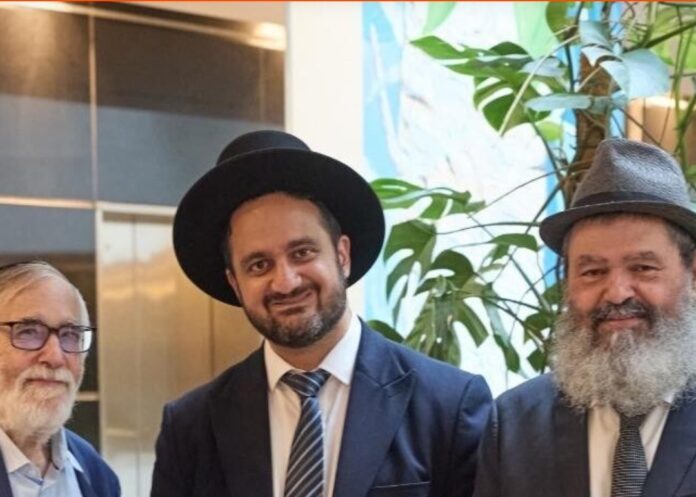

BRUSSELS (VINnews)-Iran’s chief rabbi says war and government restrictions complicate daily life for the country’s Jews, but the community can still practice its religion and maintain its institutions.
Rabbi Yehuda Gerami, speaking during a visit to Brussels for a meeting of the Alliance of Rabbis in Islamic States, told The Wall Street Journal that his focus remains on Jewish life rather than politics.
“I’m not a politician. What interests me is Jewish life, not politics,” Gerami said.
He estimated Iran’s Jewish population at about 20,000, though independent assessments place the figure closer to 8,000 to 10,000. Synagogues, ritual baths and other religious needs remain available, he said.
“Whatever the Jewish community needs, it exists in Iran,” Gerami told the newspaper.
The community, one of the oldest continuous Jewish diasporas, has shrunk dramatically from more than 100,000 before the 1979 Islamic Revolution. Iranian Jews face limits, including a ban on contact with relatives or friends in Israel, which Gerami acknowledged puts people under stress.
The ongoing conflict involving Iran, Israel and the United States has added further strain, he said. Still, Gerami described long-standing peaceful coexistence with Muslim neighbors and noted that Iranian synagogues generally do not require the security measures common elsewhere.
“Interestingly, in Iran we’ve always lived in peace with the Muslims,” he said.
Gerami, born in Tehran after the revolution, studied in Jerusalem and later received rabbinic ordination in Baltimore. He has served as chief rabbi since 2011 and holds both Iranian and American citizenship.
He frames the decision of many Jews to remain as rooted in birthplace and Iranian culture.
“We know the culture and are proud of the culture,” he said.
Community observers note that the remaining population has become more religiously observant over time, which some believe has helped sustain institutional continuity under the Islamic Republic.
Gerami’s public role often involves carefully navigating the political environment, including past statements distancing Judaism from Zionism and affirming loyalty to Iran. Those moves are widely understood as protective of the small community that still operates synagogues and holds religious ceremonies, such as weddings, inside the country.
“I’m not a messenger for anybody in the world. I’m a messenger for my community,” he said.