
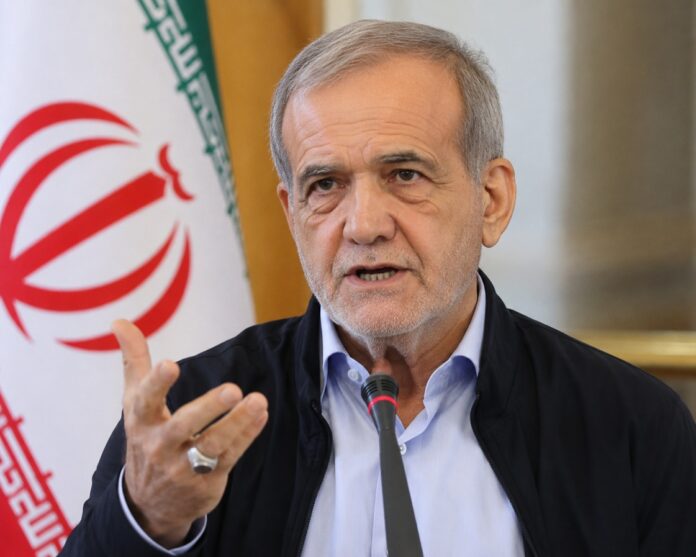

Iranian President Masoud Pezeshkian has pledged Tehran’s full backing for Hamas as negotiations over Gaza’s future continue, assuring the terror group’s leadership that Iran will support whatever course of action it chooses.
According to Iranian state media, Pezeshkian spoke Wednesday with Hamas Political Bureau chairman Khalil al-Hayya and reaffirmed Iran’s commitment to stand behind the terrorist organization throughout the ongoing diplomatic process.
During the conversation, Pezeshkian reportedly promised to support “every step, initiative, and decision” taken by the Palestinian Authority and Gaza’s leadership as negotiations over Gaza’s future move forward.
“The hearts and spirit of the Iranian people and officials are always with the Palestinian people, and Tehran will continue to support and stand alongside the Palestinian people,” Pezeshkian said.
Earlier in the day, Hamas Political Bureau member Basem Naim, who also serves on the group’s negotiating team, said Hamas is still waiting for an official reply from mediator Nikolay Mladenov “regarding what was agreed upon with him and the mediators concerning the roadmap for implementing Phase 2, especially in light of the high level of responsibility demonstrated by the movement in dealing with what was proposed to it.”
Naim also said Hamas “highly appreciates the mediators’ statement holding the enemy accountable for the ongoing crimes and the deliberate obstruction of the agreement.”
Meanwhile, reports Tuesday indicated that Israel’s defense establishment has tightened the approval process for military operations in Gaza following new directives issued by the country’s political leadership.
Under the revised policy, targeted eliminations will now require the personal authorization of IDF Chief of Staff Lt. Gen. Eyal Zamir, significantly narrowing the authority previously held by lower-ranking commanders.
A security source emphasized that the new directive does not affect situations in which Israeli troops face an immediate threat. In those circumstances, forces will continue responding without delay under existing rules of engagement.
The change applies only to preplanned offensive operations against individuals who are not considered an immediate danger, including terrorists under intelligence surveillance. Previously, such missions could also be approved by regional or division commanders.
On Monday, mediators Qatar, Egypt, and Turkey released a joint statement sharply criticizing Israel, arguing that continued IDF operations targeting Hamas terrorists in Gaza could jeopardize the current ceasefire.
“The mediators stress the need for Israel to comply with all of its obligations under international law and to fully uphold its commitments under the ceasefire agreement, affirming that the continuation of these violations constitutes a breach of the agreement and undermines the efforts aimed at implementing its second phase, particularly following Hamas and the Palestinian factions’ announcement of their acceptance of the roadmap, especially the provision concerning the confinement of weapons,” the statement read, claiming that “these violations threaten the path toward de-escalation and exacerbate the suffering of civilians in the Gaza Strip.”
The three mediating countries also called on the international community “to assume its responsibilities and exert the necessary pressure on Israel to fulfill its obligations under international law and the ceasefire agreement, in a manner that ensures the completion of President Trump’s peace plan.”
The diplomatic push came after an extensive meeting involving the Board of Peace, Prime Minister Binyamin Netanyahu, and senior Israeli officials. According to the Board of Peace, the discussions focused on eliminating terrorist weapons in Gaza, preparing for a transition to civilian governance, and establishing long-term security for both Israeli citizens and Gaza’s Arab population.
The Board of Peace said oversight of Gaza’s demilitarization would be carried out by an International Stabilization Force together with an Implementation Verification Committee, which would include representatives from both the United States and the Board of Peace.