
 Matzav
Rav Yitzchok Zilberstein: “Even Our Manhigim Don’t Know What Tomorrow Will Bring”
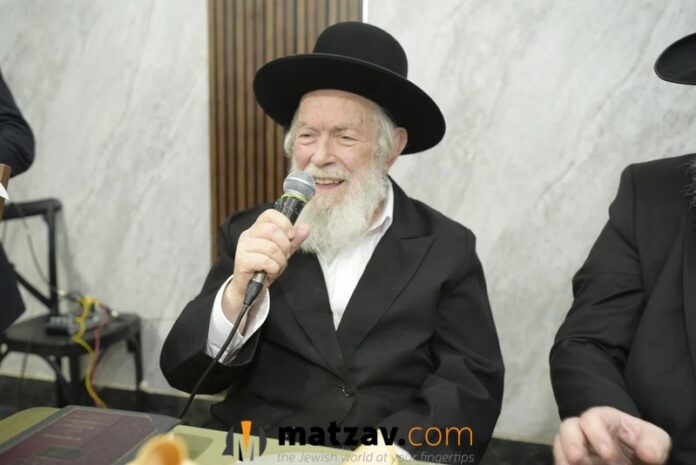
Rav Yitzchok Zilberstein, a member of the Moetzes Gedolei HaTorah, delivered powerful words of chizuk at the bar mitzvah of his great-grandson, expressing confidence that the next generation of bnei Torah will safeguard Klal Yisroel. He also shared a moving story illustrating how wisdom and good judgment can prevent conflict and transform anger into harmony.
The simcha, held in Bnei Brak, celebrated the bar mitzvah of the bochur Dovid Segal, son of Rav Yosef Halevi Segal, one of the prominent avreichim in Kollel Ponovezh, and grandson of Rav Avraham Yaakov Zilberstein.
Rav Zilberstein listened attentively and with obvious nachas as the bar mitzvah bochur delivered his drashah. The drashah focused on whether one recites Shehecheyanu upon purchasing a new pair of tefillin. The young bochur concluded by citing his great-grandfather’s psak that the accepted custom is not to recite the berachah directly on the tefillin. Instead, one should take a new fruit, recite Shehecheyanu over it, and have in mind to include the new tefillin as well.
Following the drashah, Rav Zilberstein addressed those gathered with heartfelt words directed to the broader tzibbur.
“Klal Yisroel does not know exactly what tomorrow will bring. We simply do not know. Even our leaders themselves do not know what tomorrow will be. But there is one thing we do know. What do we know? That children like this, who are growing up here, will protect us in every way. That is our foundation—a sweet child standing here and speaking such beautiful divrei Torah. Ashreichem v’ashrei chelkechem.”
Rav Zilberstein then shared a story to illustrate the importance of acting with wisdom and sensitivity.
“As is well known, on Erev Yom Tov many people travel from Bnei Brak to Yerushalayim, each one going to spend Yom Tov with his Rebbe or Rav. A large crowd was waiting at a bus stop when bus after bus passed by completely full. Since they had filled up at earlier stops, none of them stopped at the final station. The people waiting there became extremely angry. They were upset not only because some of the buses had left late, but also because none of them stopped.”
“They said that if another bus came by, they would smash its windows. Then a very wise driver arrived and did something incredibly clever. His bus was actually scheduled to travel from Bnei Brak to Tiveria. He stopped, got off the bus, and asked the crowd, ‘I see there’s a big commotion here. What’s going on?'”
“They explained that every bus was passing without taking on passengers and that everyone was furious. The driver responded, ‘I’ll call my supervisor. Look, there is a tremendous chesed that can be done for the people of Bnei Brak. There simply aren’t enough buses.’ He then requested permission to change his route from Bnei Brak–Tiveria to Bnei Brak–Yerushalayim.”
“And that is exactly what he did. He immediately changed the destination sign so that instead of Tiveria, it read Bnei Brak–Yerushalayim. It is unbelievable. He was a Bnei Brak resident, but more importantly, he had tremendous seichel. The people showered him with blessings, telling him, ‘You saved us. You are a wise man. May Heaven bless you.’ No one cursed him. Instead, everyone blessed him and described how long they had been waiting.”
“What did I learn from this? I learned something truly remarkable. If a person wants to be a proper Jew, he must also be a Jew with seichel! That driver understood that had he arrived from the outset as a Yerushalayim bus, they would have broken his bones because of their anger and frustration. So what did he do? He simply changed the destination and route number. It is unbelievable. What does Tiveria have to do with Yerushalayim? But he had seichel. With that wisdom, he saved everyone from machlokes, lashon hara, and every other negative trait. Instead of curses, there were endless blessings, and everyone wanted to kiss him.”
“That is what it means to be a true oved Hashem. A true oved Hashem is someone who sees anger and tension among people and, through wisdom, transforms it into blessing. Such a person will receive tremendous reward.”
Rav Zilberstein concluded with a call for every Jew to strive to create a Kiddush Hashem through refined conduct and noble character.
“We must know that the greatest mitzvah today is to make a Kiddush Hashem. Proper behavior. Refined behavior. Nobility and gentleness, just as our family knows how to conduct itself, following the example of Rav Elyashiv and our grandparents from every side.”
“HaKadosh Baruch Hu should help that this young boy grow to greatness, and may HaKadosh Baruch Hu help all of Klal Yisroel that we should be blessed with seichel, to know how to conduct ourselves and fulfill the will of the Creator. May HaKadosh Baruch Hu grant us every blessing, and let us say Amen.”
{Matzav.com}