
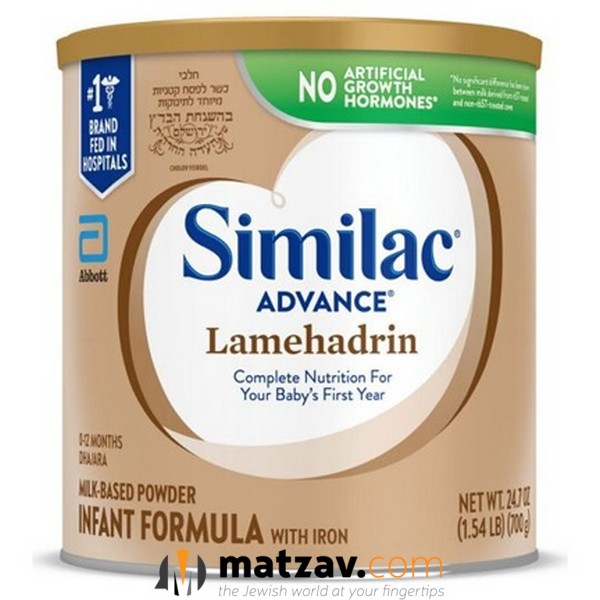

In a major breakthrough for Orthodox Jewish families across New York, the state has approved the first cholov Yisroel infant formula for purchase through the Women, Infants and Children (WIC) program, ending a long-standing challenge for low-income parents seeking formula that meets their kashrus standards. The change follows a three-year advocacy effort led by the Metropolitan Council on Jewish Poverty (Met Council) in partnership with the Hochul administration.
The issue first came to Met Council’s attention in early 2023 when an Orthodox mother attending one of the organization’s events explained that although she qualified for WIC assistance, she was unable to purchase infant formula that met her family’s cholov Yisroel requirements. While New York’s WIC program offered kosher-certified formulas, none met the stricter cholov Yisroel standard observed by many Chareidi and other Orthodox families.
David Greenfield, Met Council’s CEO and executive director, said the problem represented a significant financial burden for struggling families.
“She just said, ‘Look, I have a problem,’” Greenfield recalled. “‘I qualify for WIC, but I can’t buy formula.’”
Greenfield noted that infant formula is one of the largest expenses facing new parents.
“If you ask anyone who has a baby, the two most expensive items are always formula and diapers,” Greenfield said. “That really was a tremendous pain point, and that’s why we decided to focus on that.”
Following discussions with Gov. Kathy Hochul’s office, Met Council worked closely with the New York State Department of Health to identify a cholov Yisroel formula that satisfied all federal nutritional requirements for inclusion in the WIC program. State officials approved the formula on Wednesday, and it is expected to be added to New York’s list of WIC-approved formulas later this month.
Greenfield described the approval as a seemingly modest regulatory change that will have a meaningful impact on thousands of families.
“It’s a small technical change, but it’s obviously going to make a very significant difference by opening this up to the lowest-income New Yorkers who struggle to make ends meet,” he said.
According to Greenfield, the change is expected to benefit tens of thousands of Orthodox families annually in communities including Borough Park, Williamsburg, Flatbush, Crown Heights, Far Rockaway, Monsey, and Kiryas Joel.
Rabbi Moshe Elefant, CEO of the Orthodox Union’s kosher division, welcomed the decision.
“The inclusion of a cholov Yisroel option for infant formula is an achievement that improves the lives of the most vulnerable New Yorkers,” Rabbi Elefant said.
“It’s also an important step in ensuring that the program delivers on its mandate to bring nutritious food to those in need.”
Greenfield explained that one of the biggest hurdles was helping state officials understand that kosher certification alone did not address the needs of families who specifically require cholov Yisroel products.
“If you’re the state department of health, it’s a little bit confusing, because you’re like, ‘Well, we’re already providing kosher,’” he said. “It’s understanding that there are different levels of kosher.”
He added that Met Council emphasized the cultural and religious importance of accommodating those standards.
“The emphasis we really emphasize is that it’s as much a cultural issue as it is a religious issue,” Greenfield said. “One of the things that we try to educate government officials on is that kosher provision has standards as well. There’s a difference between a plain K versus a Triangle K versus an OK.”
“Once they understood it, they embraced this concept and the idea that this is something that is doable,” he added.
An earlier obstacle involved federal nutrition rules. Previously available cholov Yisroel formulas fell just 0.1 milligrams short of the U.S. Department of Agriculture’s minimum iron requirement. Rather than seek an exemption, Met Council eventually identified a British-manufactured cholov Yisroel formula that fully met the federal standards, allowing it to qualify for approval.
Greenfield praised Gov. Hochul for her administration’s willingness to work with the Jewish community to resolve the issue.
“I’ve worked with, I don’t know, the last half-dozen governors in New York state,” he said. “I’ve never found a governor who is more personally invested in trying to help her Jewish constituents than Gov. Kathy Hochul.”
He added, “I can’t think of a single Jewish issue that we’ve come to the governor with where she hasn’t worked very hard to try to accommodate the concerns of the community.”
Calling the approval an example of behind-the-scenes advocacy making a tangible difference, Greenfield said the accomplishment may not generate major headlines but will ease a significant burden for many families.
“This isn’t glamorous. It’s not going to get us into Time magazine or the New York Times,” he said. “But this is the kind of work that can only be done with a dedicated team of people who are really looking at the nuances of rules and regulations.”
JNS contributed to this report.