
 Matzav
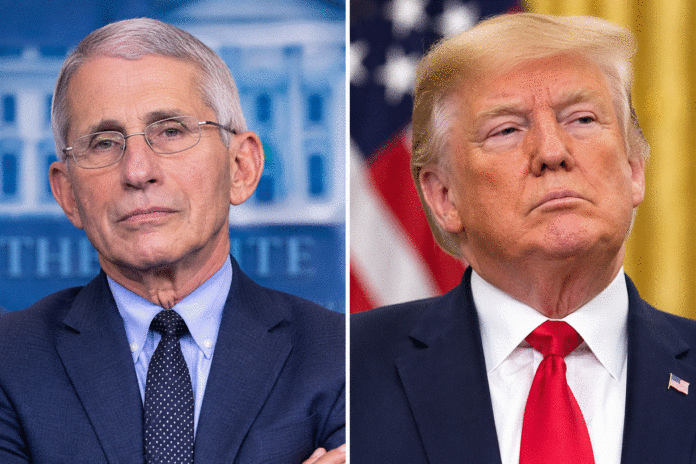
‘Maybe He Should’: Trump Says He’s Open To Fauci Facing Criminal Charges
President Donald Trump said Thursday that he would be open to the Justice Department pursuing criminal contempt charges against Dr. Anthony Fauci following a Senate committee’s vote to hold the former health official in contempt of Congress. Trump argued that Fauci’s conduct was more serious than that of two of his former advisers who were prosecuted and jailed for contempt during the Biden administration.
Speaking to reporters on Aug. 6, Trump was asked whether the Justice Department should prosecute Fauci. In response, he pointed to the cases of Steve Bannon and Peter Navarro, both of whom were charged with contempt of Congress after refusing to comply with subpoenas issued by the House committee investigating the Jan. 6, 2021, Capitol attack. Both were convicted and served four-month prison sentences.
“Merrick Garland prosecuted two very decent people and sent them to jail,” Trump said, referring to President Joe Biden’s attorney general.
“So when you see that happen, you sort of say, maybe he should,” Trump said of Fauci. “What he did was far more serious than a lot of crimes, frankly, but they prosecuted two people when nothing like that has ever taken place before.”
Earlier Thursday, the Republican-controlled Senate Homeland Security and Governmental Affairs Committee voted 8-7 along party lines to hold Fauci in contempt of Congress after he repeatedly declined to answer questions during last week’s hearing.
Fauci, who has faced continued scrutiny over his handling of the COVID-19 pandemic, invoked his Fifth Amendment right against self-incrimination throughout the hearing. Committee Chairman Sen. Rand Paul (R-Ky.) argued that Fauci’s reliance on the Fifth Amendment was invalid because President Joe Biden had already granted him a sweeping preemptive pardon.
Rather than forwarding the contempt resolution to the full Senate, as has traditionally been done in past contempt cases, Paul announced that he intends to personally deliver the committee’s criminal referral directly to the Justice Department.
Biden’s pardon, issued during his final full day in office, granted Fauci immunity from potential federal crimes committed between 2014 and 2025. Paul has maintained that because Fauci no longer faced federal criminal exposure for that period, he was required to answer the committee’s questions.
Fauci’s supporters have countered that testimony given in 2026 could still have exposed him to potential perjury allegations arising after the period covered by the pardon. They also note that Biden’s pardon offers no protection against possible state or local criminal charges.
David Schertler, one of Fauci’s attorneys, sharply criticized the committee’s action.
“It is a crude political stunt intended to punish Dr. Fauci for exercising his constitutional rights.”
“It is shameful and wrong that Senator Paul is abusing his power by trying to weaponize the Justice Department against an honorable public servant,” Schertler said.
During Trump’s second term, the Justice Department has brought criminal cases against several high-profile figures viewed as political adversaries of the administration, including former FBI Director James Comey, former National Security Adviser John Bolton, and New York Attorney General Letitia James.
Republicans have long accused Fauci of misleading the public and Congress regarding the origins of COVID-19 and other aspects of the federal pandemic response. Fauci served as director of the National Institute of Allergy and Infectious Diseases during both the Trump and Biden administrations and played a leading role in shaping the federal government’s response to the pandemic.
Sen. Gary Peters (D-Mich.), the ranking Democrat on the committee, objected to Paul’s decision to bypass the full Senate before referring the matter to the Justice Department. Peters argued that longstanding Senate practice requires the entire chamber—not an individual committee chairman—to authorize such a referral.
Paul rejected that argument, telling reporters that the committee has the authority to act independently because the referral falls “outside the ordinary bill making process.”
“I’ve made the decision that I don’t want to waste time over waiting a month and a half,” Paul told reporters.