
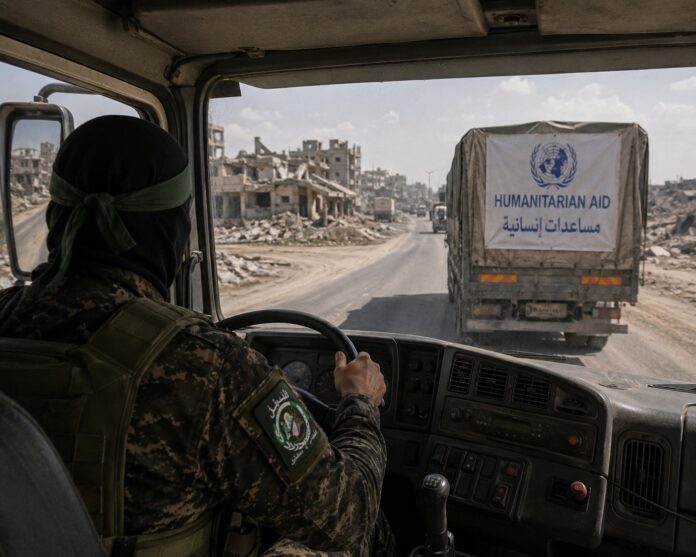

An alleged Hamas Nukhba terrorist who authorities say participated in the October 7 massacre was arrested in southern Gaza after being found behind the wheel of a humanitarian aid truck headed toward the Kerem Shalom Crossing, according to Israeli reports.
Channel 12 News reported that the suspect was detained in the Rafah area and later handed over to Israeli security forces for extensive interrogation.
According to Israeli security officials, the cargo aboard the truck was intended for Gaza’s private commercial sector. The shipment had first been received by a private merchant inside Gaza before the suspect picked it up for transport.
The arrest took place before the truck reached the Kerem Shalom Crossing. During the course of the investigation, authorities identified the driver as an individual who had allegedly taken part in the October 7 Hamas attack, leading to his immediate arrest and transfer for further questioning.
Last month, COGAT released figures showing that roughly 1.78 million tons of food entered the Gaza Strip between October 2025 and June 7, 2026. According to the report, that amount was nearly three times the monthly humanitarian requirement established by the World Food Program. COGAT said humanitarian shipments alone exceeded the WFP’s higher benchmark, with commercial imports adding even more food to the local supply.
The report also stated that food prices across Gaza dropped by approximately 72 percent between September 2025 and May 2026, attributing the decline to the combined impact of expanded humanitarian aid and increased commercial deliveries.
COGAT further asserted that Hamas remains the primary obstacle to the effective distribution of humanitarian assistance and to broader efforts to stabilize Gaza. The agency reiterated that Israel remains committed to facilitating aid deliveries in coordination with the United States, the United Nations, and other international partners.
In January, the IDF warned that Hamas was significantly rebuilding its capabilities through the large number of aid trucks entering Gaza each day, as well as through smuggling conducted along additional routes into the territory.
Military officials said dual-use items—including cigarettes, tobacco, electrical equipment, mobile phones, and agricultural materials with potential military applications—have entered Gaza not only aboard humanitarian aid convoys, but also through border crossings and other routes, sometimes under the cover of Israeli security operations and civilian contractors working near the border.
At the time, senior IDF officials recommended that Israel’s political leadership limit the Rafah Crossing to the movement of people only and prohibit the transfer of commercial goods from Egypt into Gaza, reversing the policy that had been in place before the October 7 attack.
The IDF also noted that, prior to the outbreak of the war, Hamas’s military buildup relied heavily on goods entering through the Rafah Crossing. Despite repeated warnings from defense officials that the flow of cargo was strengthening the terrorist organization, thousands of trucks continued crossing into Gaza each year until the war began.
{Matzav.com}