
 Matzav
Iran Escalates Hormuz Standoff, Warns Strait Won’t Fully Reopen Until U.S. ‘Corrects Its Behavior’
Iran’s top national security official has warned that the Strait of Hormuz will not return to normal operations unless the United States agrees to a sweeping list of Iranian demands, casting doubt on hopes for a full reopening of one of the world’s most critical shipping lanes even as diplomatic efforts continue.
The warning comes as Iran is reportedly nearing a limited agreement with Oman that would allow a restricted maritime corridor for certain vessels. The arrangement, however, would stop well short of restoring full commercial traffic through the strategically vital waterway.
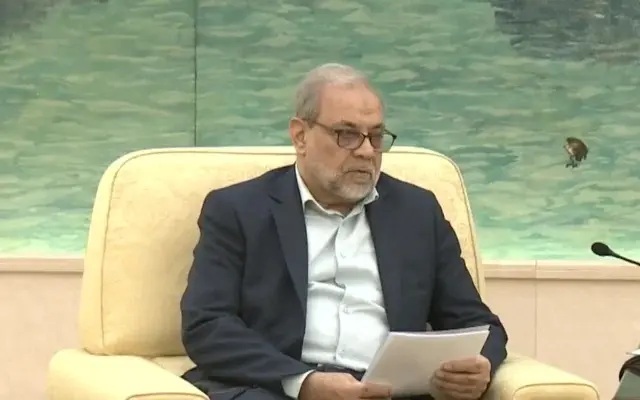
Mohammad Baqer Zolqadr, secretary of Iran’s Supreme National Security Council and a former deputy commander of the Islamic Revolutionary Guard Corps, outlined Tehran’s conditions for reopening the strait in a statement released Saturday.
Among Iran’s demands are a complete withdrawal of U.S. military forces from the region, an end to the American naval blockade, the lifting of sanctions against Tehran—including the release of frozen and confiscated assets—financial compensation for damage caused during the war, and an end to attacks on Iran’s regional allies.
“The Supreme National Security Council will never back down, neither in war nor in negotiations,” Zolqadr threatened, according to Iran’s state-run Tasnim News Agency.
Iran is also demanding permanent strategic authority over the Strait of Hormuz, along with the ability to impose transit fees of up to seven percent on vessels using the waterway.
Earlier Saturday, a spokesman for the Islamic Revolutionary Guard Corps similarly insisted that the strait would not be permanently reopened unless Washington accepted what Tehran described as its “legal and logical conditions.”
“The reopening of the Strait of Hormuz is subject to the specific mechanisms and conditions of the Islamic Republic of Iran and is not related to the negotiations between Iran and Oman,” IRGC General Hossein Mohebbi told reporters in Iran’s southern Hormozgan Province.
“Whenever the American side accepts the conditions of the Islamic Republic of Iran and abandons its interventionist approach, the conditions for reopening the Strait of Hormuz will certainly be provided.”
The remarks came despite ongoing diplomatic efforts led by President Trump’s special envoy, Steve Witkoff. According to reports, the proposal under discussion would establish a temporary shipping corridor jointly administered by Iran and Oman that would allow limited vessel traffic without tolls or special permissions.
The proposal would also include a 60-day negotiating period aimed at securing a permanent end to the conflict, with the United States agreeing to lift its naval blockade immediately upon the signing of the agreement.
President Trump recently suspended planned U.S. strikes against Iranian energy facilities, canceling a major military operation last weekend as diplomatic negotiations appeared to gain momentum. At the same time, he has repeatedly warned that military action could resume if the talks break down.
Meanwhile, the United Arab Emirates condemned what it described as a “hostile Iranian attack” after one of the Abu Dhabi National Oil Company’s vessels was struck by a missile while transiting the Strait of Hormuz early Saturday.
“Targeting commercial shipping and using the Strait of Hormuz as a tool of economic coercion or blackmail represents an act of piracy by Iran’s Revolutionary Guards Corps and constitutes a direct threat to the stability of the region,” the UAE Ministry of Foreign Affairs said in a statement posted on X.
The Gulf nation further called on Iran to halt its “unprovoked attacks” and demonstrate its commitment to a “complete and unconditional” reopening of the strategically important waterway.
With the threat of additional attacks still looming, commercial shipping through the Strait of Hormuz remains severely reduced, with recent traffic reported at less than 10 percent of the volume seen before the conflict began.