
 Matzav
Cottage Cheese Shortage Returns to Israeli Shelves, Renewing Questions About Competition and High Prices
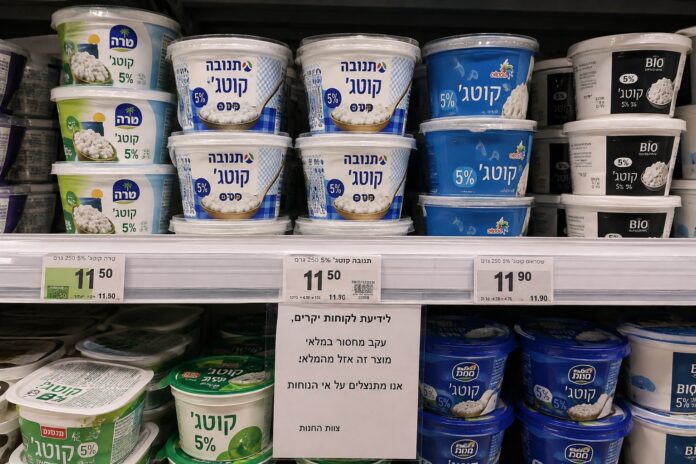
Israeli shoppers are once again finding empty refrigerator shelves where cottage cheese should be, with consumers across the country reporting that the popular staple—particularly Tnuva’s brand—has become increasingly difficult to find. The recurring shortage has reignited debate over competition in Israel’s dairy industry, market concentration, and the country’s persistent cost-of-living crisis.
According to a report aired on i24, many consumers have spent weeks searching unsuccessfully for cottage cheese. One shopper said, “Yesterday I went to two different supermarkets, and neither of them had cottage cheese.” Another expressed her frustration more bluntly: “What’s going on with the cottage cheese? There’s no cottage cheese. Do you know what I went through just to get cottage cheese?” An employee at one supermarket noted that “Tnuva cottage cheese sells out within an hour of arriving.”
According to Ynet and Yediot Achronot consumer affairs reporter Merav Kristal, the current shortage is not the result of a production failure but rather a malfunction in Tnuva’s automated warehouse system. She said disruptions caused by recent wars, holidays, and production changes led to software problems, while security concerns and insurance restrictions have made it difficult for technicians from Germany to travel to Israel to repair the system.
The latest shortage follows several other problems involving the product in recent months. Consumers previously complained that some cottage cheese spoiled unusually quickly, while another shortage in April was attributed to a reduced number of production days. Now, only a short time later, the product has once again disappeared from many supermarket refrigerators.
Prof. Yaron Zelicha, Israel’s former Accountant General at the Finance Ministry, criticized the repeated explanations for the shortages. “Every time it’s a different story. The problems always occur with the relatively inexpensive products, and yet we’re pushed toward buying the more expensive ones,” he said.
The situation has also renewed questions about competition in the dairy sector. According to figures cited in the report, Tnuva controls approximately 75 percent of Israel’s cottage cheese market, while Strauss and Tara share the remaining quarter. Reporter Roi Katz questioned how a single disruption could empty supermarket shelves across the country, asking how “one problem at one factory” could leave consumers unable to buy such a basic product.
Cottage cheese has long held symbolic significance in Israel beyond its role as a household staple. In the summer of 2011, soaring prices turned it into the face of the nationwide cost-of-living protests after the price of a container climbed to roughly seven shekels, up from about four shekels just a few years earlier. Public pressure eventually forced manufacturers to lower prices and avoid major increases for several years.
“The previous protest didn’t return cottage cheese to government price controls, but it did lower its price,” Kristal explained. She said food manufacturers “were frightened by that wave and realized they needed to keep the price of this cheese reasonable.” Even years later, she noted, cottage cheese remains one of the products consumers monitor most closely.
In recent years, however, prices have once again climbed to around seven shekels or more, alongside increases in the cost of other dairy products. At the same time, Israelis have faced higher expenses for electricity, insurance, municipal taxes, fuel, and parking, making cottage cheese a symbol of the broader question of how expensive everyday life has become.
Zelicha argued that increasing imports and reducing tariffs and import quotas would create greater competition and help lower prices. Kristal, however, noted that many countries produce dairy products domestically for reasons of food security and national resilience, adding that imported dairy products are not necessarily less expensive. Cottage cheese also presents additional challenges because of its relatively short shelf life.
The report also highlighted concerns about the concentration of Israel’s food industry. One interviewee remarked, “You think you have a choice at the supermarket, but you don’t realize that everything you’re buying on the shelf belongs to the same company.” Zelicha maintained that meaningful price reductions will only come through stronger competition and limits on the market power of major monopolies.
Consumers interviewed for the report described an ongoing struggle with rising living costs. “It’s wonderful here, my family is here and everything, but it’s just expensive. Everything is expensive here,” one shopper said. Another pointed out that roughly half of Israelis earn less than 9,000 shekels a month, asking, “How do you pay? How do you live?”
Despite the approaching elections, those interviewed predicted that the cost of living is unlikely to become the dominant campaign issue. They said security concerns continue to overshadow economic issues in Israel’s public discourse.
As for the possibility of another nationwide cottage cheese protest, the report suggested that many Israelis are weary after years of demonstrations and public campaigns. Even so, cottage cheese continues to occupy a unique place in Israeli life as a basic household staple whose absence is immediately noticed by consumers across the country.
In the meantime, some shoppers have found their own solution. The report demonstrated how cottage cheese can be made at home using ordinary milk. “As long as there’s milk, I’m fine,” one participant who prepares homemade cottage cheese said. Even so, the central question remains unanswered: Why does such a basic product continue to disappear from store shelves, and how can a single technical problem have such a sweeping impact across the country?