
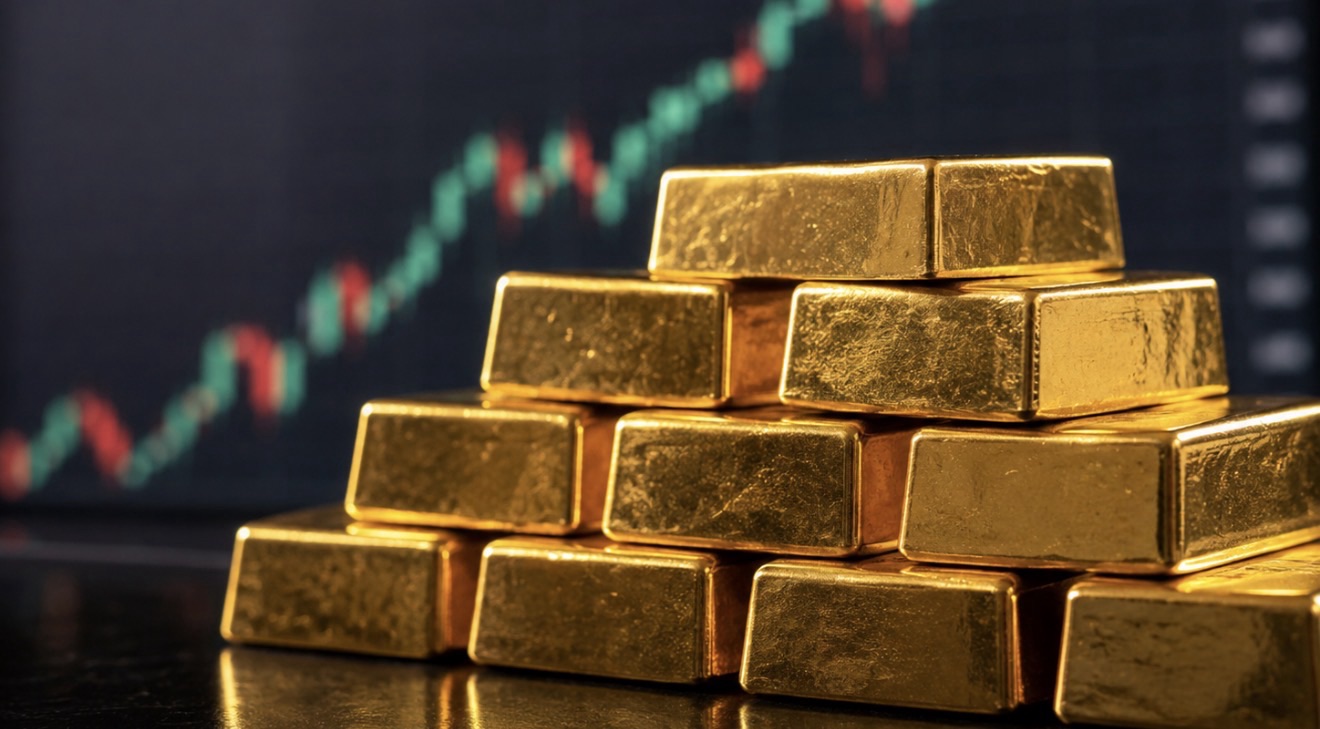

Gold just posted its strongest week in seven months, and the reason is simple: a bad jobs report made a Federal Reserve rate hike look a lot less likely, and gold always gains when the case for higher interest rates weakens.
Bullion climbed 7.4% over the week, its fastest advance since Jan. 19. Spot gold jumped 2.3% on Friday alone to $4,336.02 an ounce, touching its highest level since June 17, while U.S. gold futures settled up 2.3% at $4,399.70.
Here is the mechanism in everyday terms. Gold pays no interest and no dividend. When the Fed raises rates, cash and bonds start paying more, and holding a metal that pays nothing becomes expensive. When a rate hike looks less likely, that cost falls away and money moves back into gold.
The jobs number that did it
The Labor Department reported Friday that U.S. nonfarm payrolls fell by 23,000 in July, after a downwardly revised gain of 20,000 in June. Economists had been looking for an increase of 80,000. A negative print where the market expected a solid gain is the kind of surprise that resets rate expectations in a single morning.
Traders now put the odds of a quarter-point hike in September at roughly 44%, down from about 67% a week earlier. Separate futures pricing showed the probability of the Fed simply holding rates in September rising to 56.1% from 43.2% before the report landed.
The dollar softened and Treasury yields eased alongside it, both of which push in gold’s favor.
Where prices stand now
December gold futures opened Monday at $4,400 an ounce, unchanged from Friday’s close and the highest opening level since early June, before slipping to $4,391.50 by 8:22 a.m. Eastern. Spot gold was at $4,333.81 an ounce at 10 a.m. Eastern, down about $10 from the prior session. By midday the spot price had firmed to $4,375.89.
Gold has held above $4,300 through Monday, keeping last week’s gains even as oil prices moved higher on continued uncertainty over reopening the Strait of Hormuz.
The rest of the precious metals complex ran harder than gold. Silver gained 10.2% on the week to $65.34 an ounce, also its fastest weekly move in nearly seven months. Platinum rose 1% Friday to $1,745.87 and palladium added 0.4% to $1,376.90, with both finishing the week higher.
Why this year has been strange for gold
Gold normally thrives on war and inflation. This year it did not, and the reason matters for reading what comes next. Both metals started 2026 strong on expectations of an easier Fed — gold rose 8.7% in the week of Jan. 19 to $4,980 an ounce, silver 14.7% to $102.48. That reversed on Feb. 28, when the U.S. and Israel struck Iran and Tehran retaliated, driving oil and global inflation higher and pushing central banks toward rate hikes. Rising rates and wartime demand for cash pulled money out of both metals, and they only found support as Middle East tensions eased somewhat and the U.S. labor market began to cool.
In other words, the war worked against gold this year rather than for it, because it forced central banks to tighten. Last week’s payrolls number was the first real crack in that logic.
The central bank bid underneath
Behind the price action sits steady official buying. China’s central bank is expanding its gold storage in Hong Kong as part of a broader shift of sovereign reserves out of London, and it added 20 tons in July alone in what is now a 21-month buying streak. That is a floor under the market that does not move with weekly data.
UBS said Friday it expects gold to reach $5,000 an ounce in the first half of 2027.
What’s next
This week brings the July Consumer Price Index and Producer Price Index, along with jobless claims and the University of Michigan inflation expectations reading. A hot inflation print would put a September hike back on the table and take the wind out of last week’s move. A soft one extends it.
Gold miners are the second-order trade. Newmont, the largest holding in the major mining ETFs, has broken above its 150-day moving average, while the GDX and GDXJ funds are still testing theirs and gold itself remains below that line. Miners tend to move harder than the metal in both directions.
JBizNews Desk | Wall Street
© JBizNews.com All Rights Reserved. Reproduction or distribution without written permission is prohibited.