
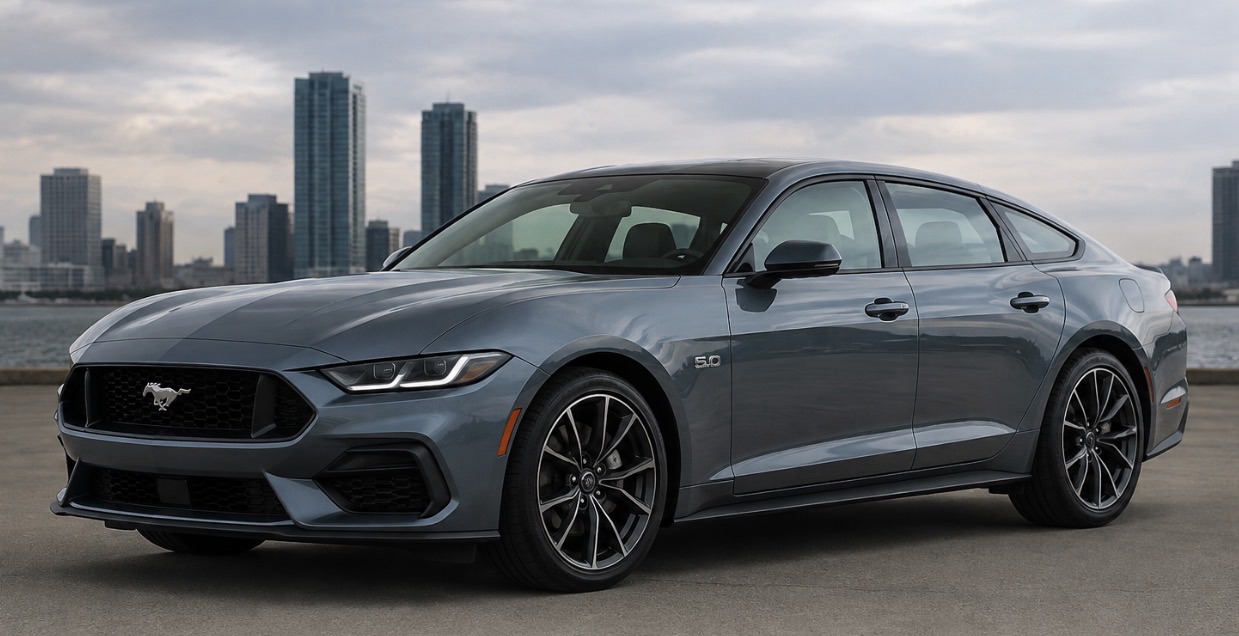

Ford has shown its dealers a working prototype of a Mustang with four doors, and told them it intends to sell it for less than $40,000 — the first time in the nameplate’s 62-year history that a Mustang sedan has moved from sketch to metal.
The car was rolled onto the stage at a private dealer meeting in Las Vegas earlier this week. Ford executives told the room the four-door Mustang would carry a starting price below $40,000, reach 60 miles per hour in under four seconds, and offer more rear-seat legroom than a Porsche Panamera. Dealers who saw it compared its size and proportions to the Panamera itself, and it marked the first time Ford put a physical prototype in front of them, after showing only a rendering in 2024.
Executive Chair Bill Ford and Chief Executive Jim Farley were both in the room. Dealers were told the car will not go on sale until the end of the decade, with 2028 and 2029 both still in play, and Ford did not specify the engine. The version shown was gas-powered with the potential for a hybrid, but not a full electric. Ford spokesman Mark Truby said the company does not comment on future product.
The business logic is plain. One dealer who attended said the goal is to “broaden the appeal and make it a vehicle that a young family can use.” That is a direct answer to the Mustang’s core problem: a two-door coupe can only sell to people willing to live with two doors. The Mustang is still the world’s bestselling sports car, but it sold just over 45,000 units in the United States last year, against more than 122,000 in 2015 and an all-time peak near 607,500 in 1966. Sales have rebounded this year, with 32,131 sold through July, up nearly 16%.
Ford is also walking back one of its own decisions. The company cleared its North American lineup of passenger cars years ago, leaving the Mustang as its only vehicle that is neither a truck nor an SUV. That left an open lane in the affordable performance-sedan market — and a rival has already driven into it. Dodge killed the Charger and Challenger in 2023, then brought the Charger back with a gasoline engine in 2025, and the 2026 lineup now offers both two-door and four-door versions. A Mustang sedan would land directly on top of it.
The price target is the most aggressive number in the pitch. A sub-$40,000 sticker would put the car far below the premium fastbacks it was visually compared to, and within reach of shoppers cross-shopping ordinary performance sedans rather than luxury cars. For context, Ford’s existing electric Mustang Mach-E starts at $37,795 for the 2026 model year.
Hitting that price requires Ford to avoid an expensive clean-sheet program. Reporting ahead of the dealer meeting indicated the car will likely ride on a stretched version of the S650 architecture that underpins today’s Mustang, and reworking an existing rear-wheel-drive platform costs far less than developing a new one. That is how a car that looks like a Panamera can be priced like a Camry.
The name is not settled publicly, but the paperwork points one direction. Ford used the Mach 4 name internally to identify the Mustang sedan when it showed the 2024 rendering, and has since trademarked it, covering both gas and electric applications.
The Mustang sedan was not the only product on display. Dealers also saw the Ford Fathom, the all-electric midsize pickup launching next year at a starting price under $30,000. The meeting placed unusually heavy emphasis on the service side of the business — performance parts, accessories and aftermarket offerings, a reminder that fixed operations, not new-vehicle margin, is where dealer profit increasingly sits.
For dealers, a four-door Mustang solves a showroom problem as much as a product one. A customer who walks in wanting a Mustang and walks out because there is nowhere to put a car seat is a lost sale that currently goes to Dodge, or to nobody. Adding a body style to a nameplate that already carries enormous brand recognition costs far less in marketing than launching a new name from scratch — the same arithmetic that made the Mach-E work in 2021 despite the objections of purists.
The caution is that this is a product plan, not a production commitment. Automakers regularly shelve vehicles between the dealer preview and the assembly line when the market moves, and nothing shown in Las Vegas has been publicly confirmed. But a physical prototype, a price target, a performance target and a trademark filing represent considerably more progress than a rendering on a screen.
JBizNews Desk | Detroit
© JBizNews.com All Rights Reserved. Reproduction or distribution without written permission is prohibited.