
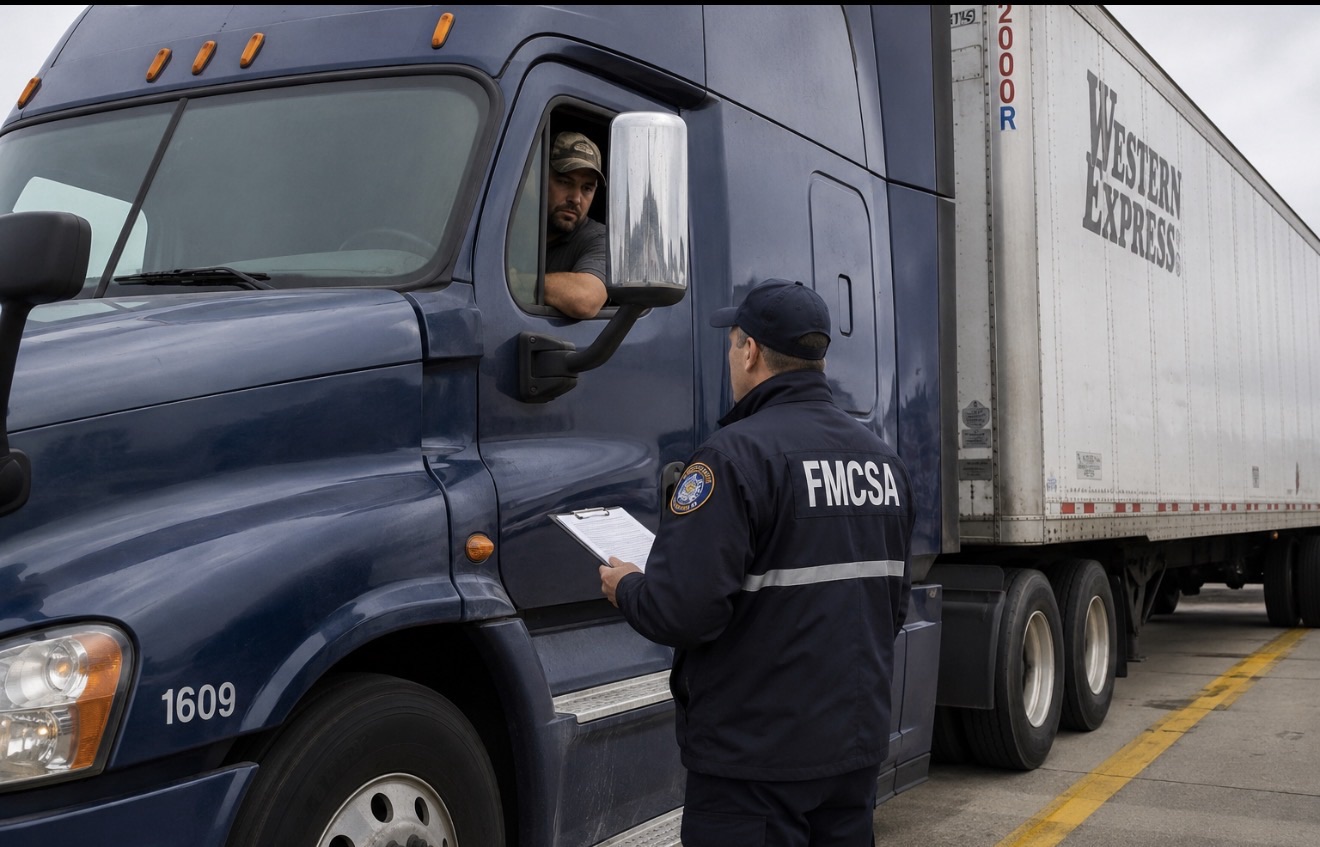

The federal government moved today to write the trucking industry’s English requirement directly into the rulebook, so that a driver who cannot read a road sign or answer an inspector’s questions must be pulled off the road — and so that no future administration can quietly reverse it.
The Federal Motor Carrier Safety Administration’s proposed rule was published in the Federal Register this morning under Docket No. FMCSA-2026-0826, with a 60-day comment window. Comments are due by October 9, 2026.
Here is the mechanic of it in plain terms. The English requirement itself already exists and has since the 1930s. What has been missing is a regulation saying what an inspector must do when a driver fails. That instruction has lived in a separate handbook — the out-of-service criteria maintained by the Commercial Vehicle Safety Alliance, an inspectors’ group — which is guidance, not law, and can be rewritten at any time. The proposal moves the consequence into the regulations themselves, adding a new paragraph to the driver-qualification rule stating that a driver in violation must be placed out of service immediately.
That distinction is the whole point of the rulemaking. States that take federal motor carrier safety grant money must keep their own laws compatible with the federal regulations — so once the requirement is codified, states have to adopt it regardless of how the inspectors’ handbook is amended later. Transportation Secretary Sean P. Duffy framed it as insurance against reversal, saying the codified version would prevent future administrations from weakening the standard the way the Obama administration did.
The enforcement history explains the urgency. A 2016 policy memo told federal personnel to cite drivers for English violations but not to park them, mirroring the inspectors’ group having dropped the violation from its criteria the year before. That reversed after an April 28, 2025 executive order directing the agency to rescind the memo and get the violation restored to the out-of-service list, which the safety alliance voted to do effective June 25, 2025. The alliance then petitioned the agency in October 2025 to put the requirement into regulation — the petition this proposal grants.
The numbers show what changed at roadside. In the first half of 2025, before the switch, 7,812 English violations were written nationally and only 33 produced out-of-service orders. From June 25, 2025 through March 19, 2026, inspectors wrote 60,399 violations and issued 19,045 out-of-service orders. The Transportation Department now puts the total pulled off American roads at more than 26,000.
The one carve-out involves the Mexican border. Drivers working strictly inside the designated commercial zones along the U.S.-Mexico border are cited but not parked. The proposal narrows that exception: if paperwork — bills of lading, dispatch records, interchange receipts — shows the trip continues past the zone, the driver goes out of service. Of roughly 41,563 violations written inside those zones during the enforcement period, the agency estimates about 16 percent would have drawn an out-of-service order under the tighter test.
For carriers, that is the cost line. The agency projects roughly 9,000 additional out-of-service orders a year in the border zones, and prices the disruption at about $800 per truck per day for an average two days to find a replacement driver and get the freight moving — $14.4 million annually across the industry. The agency is explicitly asking shippers and carriers to comment on whether that estimate is right and what the knock-on effect is on shipping costs and delivery times.
Worth noting for anyone reading it as a new burden: the agency’s position is that it is not adding a requirement at all. The English standard has been on the books since the Interstate Commerce Commission wrote it in December 1936, effective July 1, 1937, and the proposal codifies enforcement practice already in effect rather than creating a new obligation. The agency also says the rule sits comfortably inside the USMCA framework, since the standard applies to every driver operating in the United States regardless of nationality.
What comes next is the comment docket, then a final rule. The agency has said it will retrain federal and state inspectors on the border-zone test once a final rule publishes — roughly 100 federal border inspectors and 1,900 state enforcement personnel. Until then, the roadside practice stays as it has been since last summer: fail the interview or the road-sign check, and the truck stops.
JBizNews Desk | Washington
© JBizNews.com All Rights Reserved. Reproduction or distribution without written permission is prohibited.