
 JBizNews
Walmart Cuts School Prices as Parents Trim Budgets, Grocery Bills Keep Rising
Families are spending less per child on back-to-school shopping this year once inflation is accounted for, and the largest retailers have responded by cutting prices on the items every classroom list requires. The reason parents are squeezing that budget shows up elsewhere on the receipt: the grocery bill is still climbing.
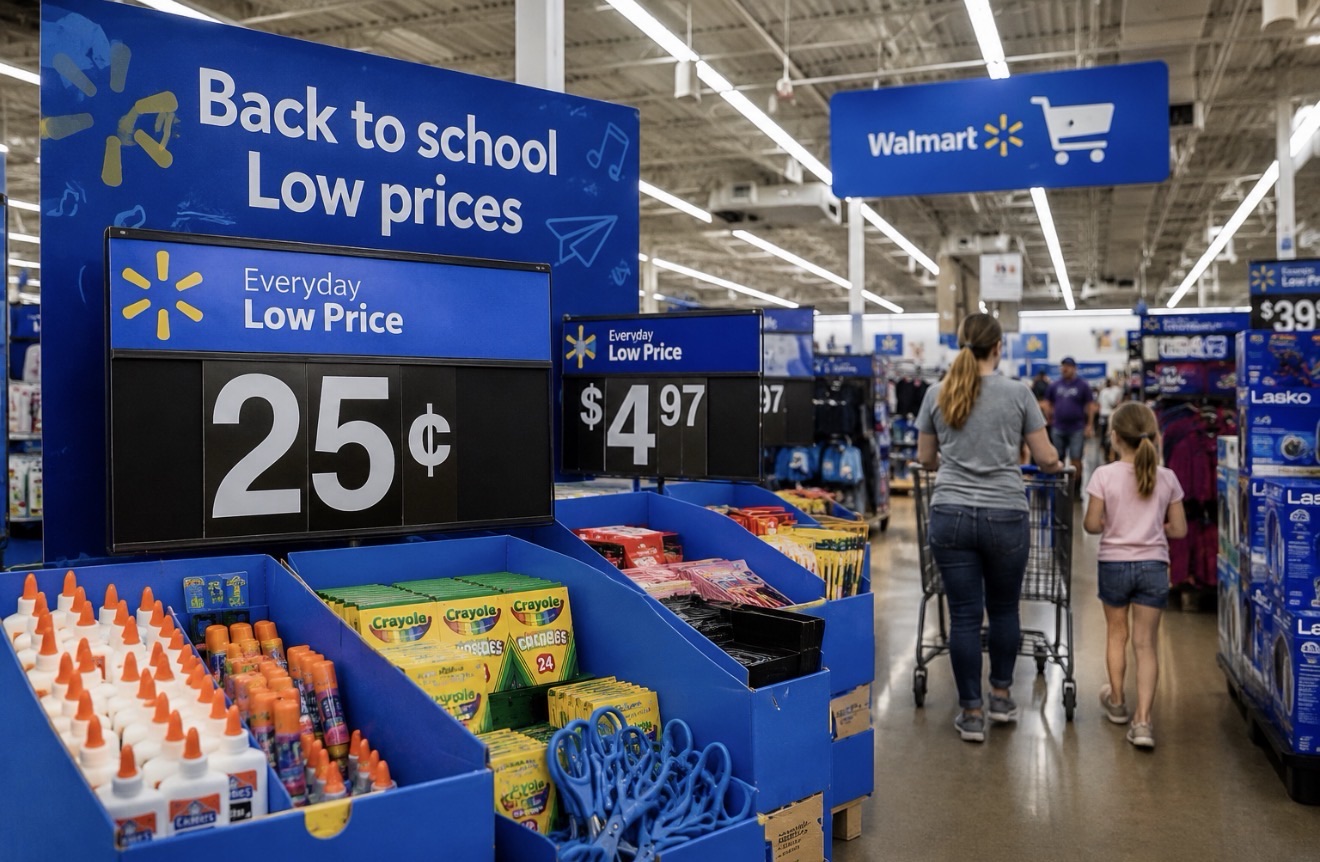
Walmart is offering its lowest prices since 2019 on 14 of the most common school supplies found on classroom lists nationwide, with some items starting at 25 cents. The retailer is also running 1,300 more price rollbacks than it did during last year’s back-to-school season.
It has the traffic to match. Seventy-seven percent of parents named Walmart as a back-to-school destination, well ahead of Target at just over 40% and Amazon at nearly 39%.
Deloitte’s annual survey of more than 1,200 parents puts expected spending at $557 per child for K-12 students, down $13 from a year ago and roughly 6% lower after adjusting for inflation. The total back-to-school market is estimated at $30.4 billion.
Parents shopping primarily in stores expect to spend $521 per child, compared with $614 for online shoppers. Mass merchants are expected to capture 80% of planned spending, with value for the money emerging as the deciding factor across channels.
Different surveys produce different dollar estimates. Jones Lang LaSalle put spending at $489 per child and rising, while PwC found parents expecting to spend an average of $922 across a broader basket of purchases. But the surveys agree on the larger behavior: households are watching prices closely.
Inflation remains a concern for 64% of parents in JLL’s survey, while nearly 69% say saving money is a top priority.
The most revealing number may be elsewhere in Deloitte’s findings. Fifty-seven percent of consumers said they expect the economy to get worse in the coming months, the highest share since 2020.
Parents are also delaying purchases, with spending expected to peak in late July and early August. For retailers, that means families who know they must eventually buy school supplies are increasingly waiting to see whether another promotion appears before the deadline arrives.
The pressure is easier to understand when the school-supply budget is viewed alongside the grocery bill.
Grocery prices have risen about 3.4% since January 2025, but some staples families buy every week have increased far more. Coffee is up roughly 35%, ground beef 23%, steak 21%, sugar and sweets 9%, chicken breast 5.3%, and fruits and vegetables 5.2%.
Bread, bacon and eggs have become cheaper over the same period, with egg prices retreating sharply as the bird-flu-driven shortage eased.
But falling egg prices do relatively little for the overall household budget. Eggs represent only about 0.8% of the typical grocery basket, compared with roughly 4.7% for beef and 10% for fruits and vegetables. A large decline in one highly visible item can therefore coexist with a grocery bill that remains considerably higher overall.
The Agriculture Department’s July forecast calls for grocery prices to rise approximately 2.7% during 2026 and restaurant prices around 3.5%. Prices in eight of the 15 food categories it tracks are expected to increase faster than their 20-year averages.
Beef remains one of the largest pressure points. Beef and veal prices were 11.8% above year-earlier levels in June and are forecast to finish 2026 about 10.7% higher. Fresh vegetables were 9.9% more expensive.
For a family spending $1,000 to $1,400 a month at the supermarket, even a modest increase means roughly another $40 a month for essentially the same basket.
That is close to the entire year-over-year reduction in back-to-school spending for one child.
The money did not disappear. It moved to the supermarket.
For retailers, the competitive lesson is becoming clearer. Price leadership is doing much of the work this season, and it is concentrating traffic rather than distributing it evenly.
Four out of every five back-to-school dollars are expected to go to mass merchants, while Walmart alone is attracting roughly three-quarters of surveyed shoppers.
For independent retailers and specialty stores, competing directly with a 25-cent notebook is unlikely to work.
The opportunity is in what the big-box price war does not easily provide: fitting and sizing for shoes and uniforms, school-specific supply bundles, extended hours immediately before classes begin, specialized merchandise and delivery for parents who waited until the last minute.
The spending difference between channels is also important. Online shoppers expect to spend $614 per child compared with $521 for in-store shoppers. The higher-value customer is increasingly the one buying from a screen, giving smaller retailers a channel where convenience and specialization can compete with sheer purchasing power.
Back-to-school spending will continue into September through replacements, dorm purchases and classroom replenishment.
But the character of this year’s shopper is already clear: parents still have money to spend, but they know exactly what it buys — and increasingly will drive past one store to save a few dollars at another.
JBizNews Desk | New York
© JBizNews.com All Rights Reserved. Reproduction or distribution without written permission is prohibited.