
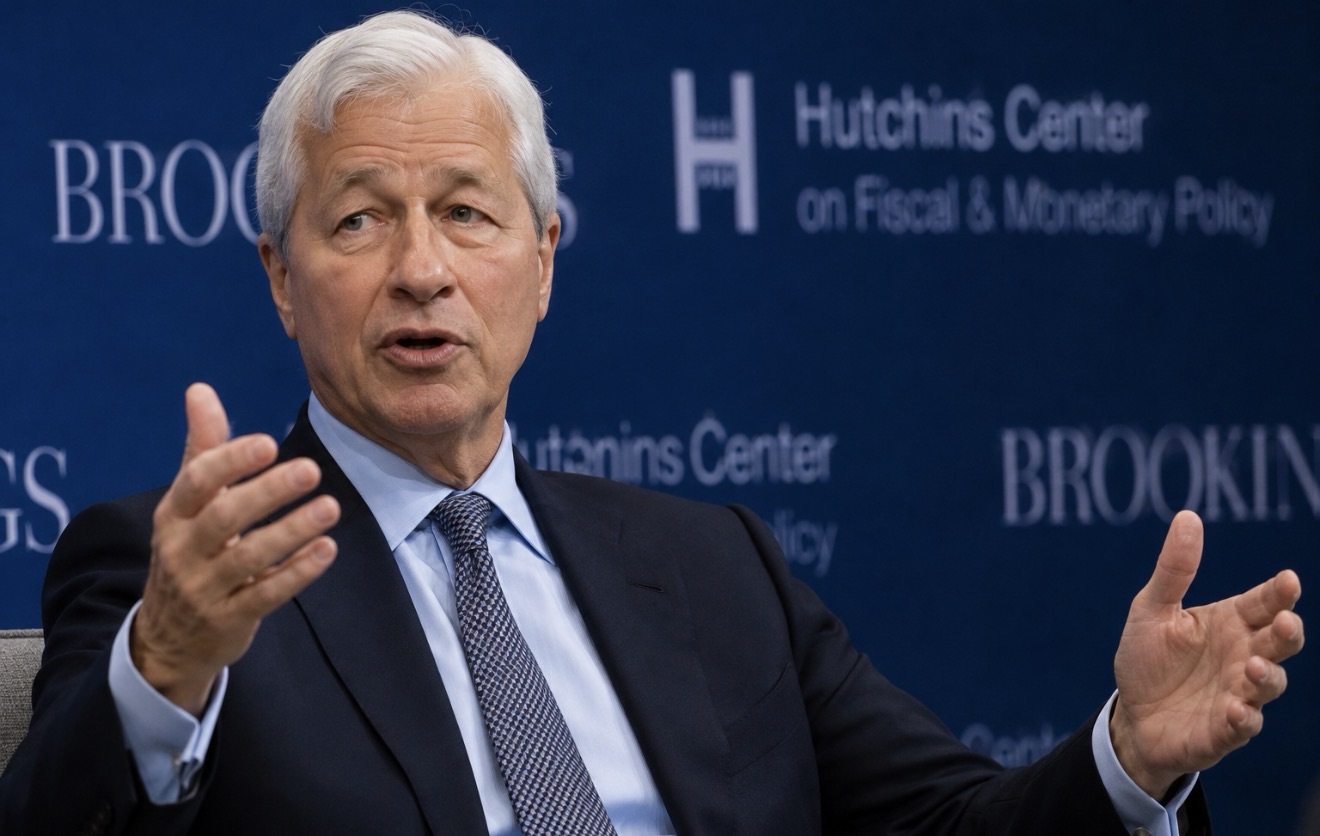

Jamie Dimon has put a condition on something most Americans treat as permanent: the dollar sits at the center of the global financial system because the United States has the strongest economy and the strongest military, and it stays there only as long as both remain true.
“If we’re not the strongest military in 25 years and the strongest economy, we won’t be the reserve currency either,” the JPMorgan Chase chief executive said on PBS’ “Firing Line with Margaret Hoover,” which aired over the weekend. “The world will be fragmented, and it’ll be very dangerous for us.”
Dimon framed the two as inseparable: to be safe, have the best military in the world, and to have the best military, have the best economy. He noted that reserve-currency status has historically followed the leading power that upholds rule of law and open capital flows, and said that if the U.S. loses its lead through debt, deficits or mismanagement, the status follows.
The trend line is already moving. The dollar accounts for about 57% of global foreign-exchange reserves, down from roughly 70% at the turn of the century. IMF data puts the decline at 72% in 2001 to 57% today.
That is erosion, not collapse, and the distinction matters for anyone doing business in dollars. Reserve-currency transitions run slowly — the British pound’s decline from dominance unfolded across roughly four decades, from the end of World War I to the post-Bretton Woods era, even though American economic supremacy was evident well before any formal shift.
Economists put less weight on the military piece than Dimon does. Eswar Prasad of the Brookings Institution told Fortune that institutions and economic dynamism — how quickly an economy innovates and reallocates resources — are far more important to reserve-currency status than an economy’s size or military power. He added that weakening U.S. economic and military strength, along with erosion of domestic institutions and geopolitical influence, will hurt dollar dominance, but the absence of any serious rival will prevent the dollar from being displaced as the dominant payment and reserve currency.
Dimon is not making the argument abstractly. His comments come alongside JPMorgan’s $1.5 trillion Security and Resiliency Initiative, aimed at strengthening U.S. domestic manufacturing, energy and defense capacity. He argued corporate America must partner with government on strategic vulnerabilities now, pointing to American reliance on potential adversaries for missile components and rare earths, and said the national interest matters more than his own bank — because if the country does poorly, JPMorgan suffers. He closed with the line that fighting a war is very expensive, and losing one is the most expensive.
For companies and consumers, reserve status is not a matter of prestige. It is why the U.S. can borrow at scale in its own currency, why oil and most commodity contracts settle in dollars, and why American importers face no exchange-rate friction on the majority of world trade. Losing that position would strip Washington of significant geopolitical leverage and push domestic borrowing costs higher, which reaches ordinary borrowers through mortgages and consumer credit.
Some think Dimon’s timeline is generous. Analyst Philip Pilkington argued that fallout from the Iran war could halve it, accelerating a shift toward a multi-polar monetary order within a decade, with energy shocks doing more lasting damage to the postwar financial architecture than the military strikes themselves.
The Federal Reserve continues to affirm the dollar’s strong international standing, and the Atlantic Council puts its share of global reserves near 58%. The U.S. Dollar Index is up 1.42% year to date, down 1.28% over the past month and roughly flat over the year. Market positioning shows continued appetite for gold as a hedge against long-run currency risk.
The debt arithmetic gives Dimon’s warning its edge. Reserve status is what makes large deficits financeable at low cost; large deficits are among the things that could erode reserve status. That circularity is the substance beneath the soundbite, and it is why the CBO’s revised $2.1 trillion deficit and Dimon’s 25-year warning are the same story told at different speeds.
JBizNews Desk | New York
© JBizNews.com All Rights Reserved. Reproduction or distribution without written permission is prohibited.