
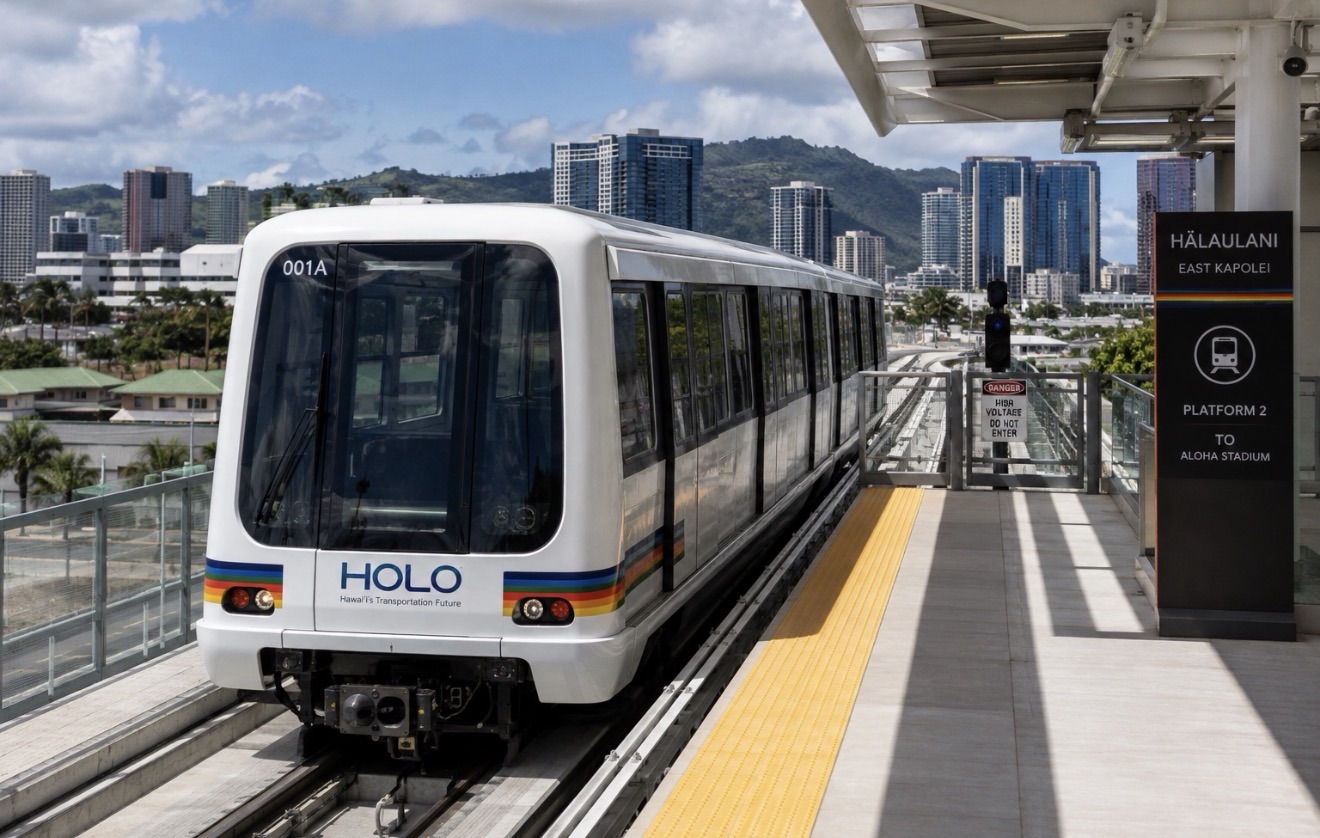

Honolulu is going to the municipal bond market this week for about $196 million, with roughly $9.4 million of it earmarked for Skyline — the automated rail line that has already cost more than three times its original estimate and still has five years of construction ahead of it.
The rail slice is small relative to the deal, which is worth understanding: Skyline is not being financed by this one sale. The system runs on a half-percent surcharge to Hawaii’s general excise tax, federal transit grants, and city general obligation bonds issued on behalf of the Honolulu Authority for Rapid Transportation, drawn down as construction bills come due. This week’s issue is one more increment in a funding stack assembled over nearly two decades.
What that stack has produced so far is already running. Skyline opened June 30, 2023, and has carried more than 5 million riders across 13 stations from East Kapolei to Kalihi, averaging close to 12,000 weekday passengers with better than 99% service reliability. Segment 2 opened in October 2025, adding five miles and four stations serving Joint Base Pearl Harbor-Hickam, Daniel K. Inouye International Airport, the Māpunapuna industrial area and the Kalihi Transit Center. The system set a weekday record of 12,902 rides in late January.
The trains are driverless and elevated almost the entire way, powered by third rail, with platform screen doors — the first large-scale publicly run U.S. metro built that way. Hitachi Rail supplied the cars and operates the line for Honolulu’s Department of Transportation Services.
The unfinished piece is the one that matters commercially, because it is the segment that reaches where people work. Segment 3 runs three miles from Kalihi Transit Center to Civic Center with six new stations — Mokauea, Niuhelewai, Kūwili, Hōlau, Kuloloia and Kaʻākaukukui — cutting through Iwilei, Chinatown and downtown Honolulu. Los Angeles-based Tutor Perini won the $1.66 billion design-and-construction contract for that work in August 2024, after resubmitting a bid on a job the city had shelved when pandemic-era pricing came in too high. Tutor Perini was the only bidder, and the contract came in about $300 million above what the agency had budgeted in 2020.
HART now expects the first guideway span in early 2027, major construction finished in 2030 and passenger service in 2031. Downtown utility relocation work wrapped up July 22.
The cost history is the reason this project draws attention well beyond Hawaii. The 18.9-mile, 19-station line was originally supposed to be done in 2020 for $3 billion, and HART has filed at least six recovery plans with the Federal Transit Administration explaining how it would finish given cost escalation. City documents attached to a 2025 bond official statement put the total estimated cost at about $10.076 billion — roughly $9.568 billion in capital plus about $508 million in financing charges.
For bondholders, the debt picture has actually been improving. Long-term debt tied to the project fell to about $815.4 million from $934 million a year earlier. Bonds the city issued on HART’s behalf account for roughly three-quarters of total liabilities and are scheduled to be fully retired by 2031 — the same year service is supposed to begin downtown. HART’s fiscal 2025 audit came back with a clean opinion.
Federal money remains contingent on delivery. The project secured a $1.55 billion full funding grant agreement from the FTA’s New Starts program in 2012. Awarding the downtown contract triggered release of the next $250 million under the amended agreement, and opening Segment 2 had $125 million of additional federal funding riding on it.
The line will also stop short of where planners once intended. Under the FTA-accepted 2022 recovery plan, Honolulu postponed the final 1.25 miles of guideway, the last two stations at Kakaʻako and Ala Moana, and the Pearl Highlands parking garage. HART says reaching Ala Moana Transit Center remains the goal, with buses bridging the gap from Downtown and Civic Center stations in the meantime — noting that original forecasts had only about 10% of riders headed to Kakaʻako or Ala Moana as final destinations.
Mayor Rick Blangiardi has set a target of 25,000 daily rides. Current weekday counts sit at roughly half that, on a system that is still missing its downtown terminus.
JBizNews Desk | Honolulu
© JBizNews.com All Rights Reserved. Reproduction or distribution without written permission is prohibited.