
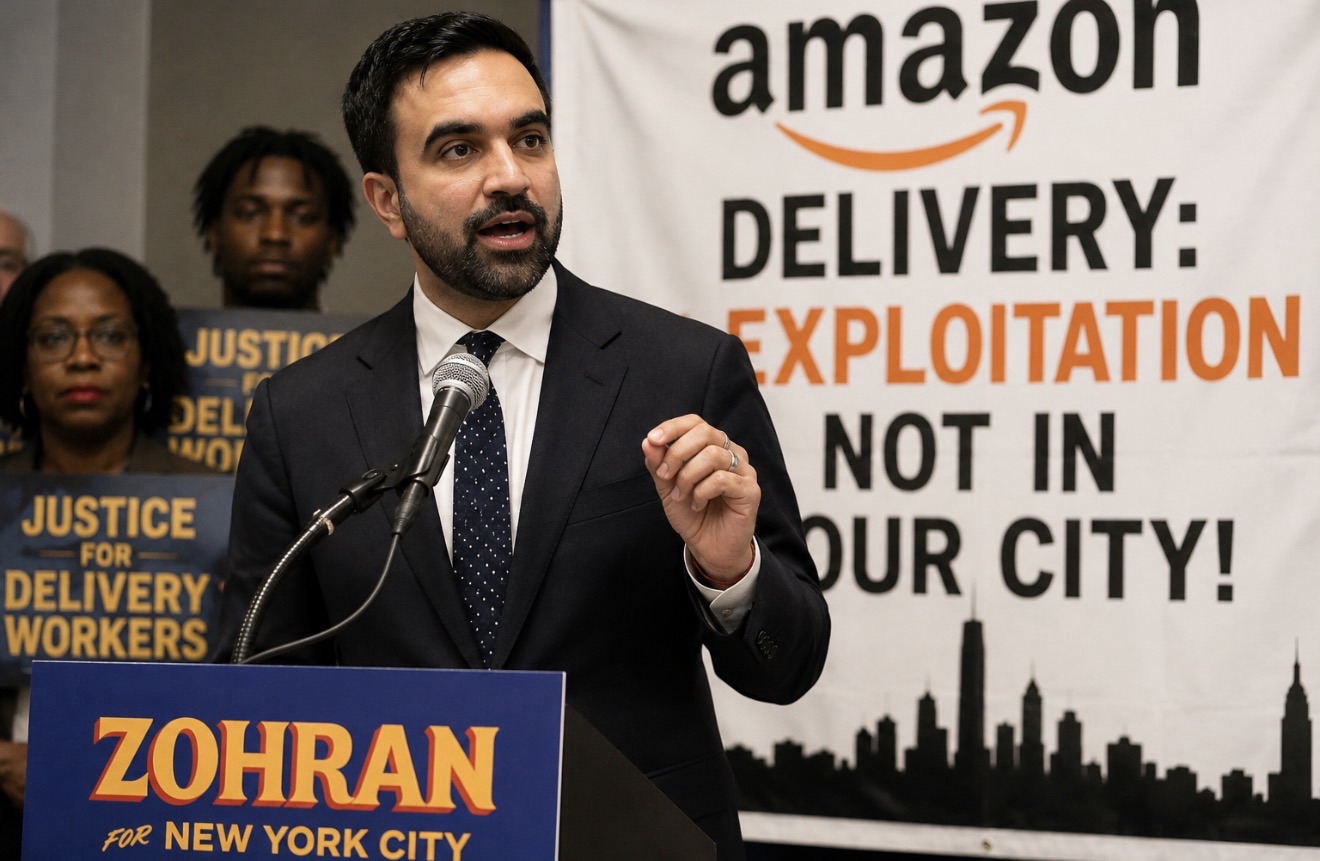

Here is the arrangement at the center of the fight, in plain terms: the driver in the Amazon vest, driving an Amazon van out of an Amazon warehouse, does not work for Amazon. He works for a small local firm the company contracts with. Amazon pays the wages and sets the schedules and the quotas, but when something goes wrong on the street — a crash, an injury — the contractor is the one on the hook, not Amazon. A bill before the New York City Council would end that split inside the five boroughs and put those workers on the payroll of the company that actually runs the operation.
Mayor Zohran Mamdani endorsed that bill on Monday, Aug. 10, in a video released by his office. It has not passed. The Delivery Protection Act is still in the hands of the City Council following a hearing held this spring, and Council Member Tiffany Cabán’s office has been amending it with input from workers, unions, safety experts and contractor owners. The mayor’s backing is what moved this week, not the law.
The mechanics are straightforward. Operators of certain last-mile warehouses and storage facilities would have to obtain licenses from the city’s Department of Consumer and Worker Protection and meet new safety, training and employment standards. Workers performing core warehouse and delivery functions would have to be directly employed by the facility operator, with third-party contracting for those jobs generally barred after a phase-in period. The license could be pulled if a company shows a pattern or practice of violations. Cabán calls it “the most important municipal labor bill in the country,” and it would be the first law of its kind in the United States.
City Hall’s argument is about control. The mayor’s office says corporations dictate “hiring standards, delivery routes, steep productivity quotas” while denying that the people making the deliveries are their employees. Cabán has put it more bluntly, describing drivers saddled with impossible quotas and failing vehicles, after which Amazon can say “not my employee, not my problem.”
The build-out is what made this a live issue. At least 18 large last-mile facilities have opened across New York City since 2017, 11 of them since 2020 — warehouses where packages are sorted and sent out for the final leg to the customer’s door. A 2025 report from the city comptroller found that 78% of areas near those facilities saw an increase in injury-causing crashes after they opened.
Amazon is fighting it on cost and on jobs. The company has said the bill could push it to move warehouses outside city limits, putting local jobs at risk. A study Amazon commissioned puts the consumer cost at $664 more per household each year if the company had to comply. Amazon has also framed its opposition around the small, often minority- and veteran-owned delivery firms it contracts with, though Cabán’s office counters that many of those firms have Amazon as their only client and operate out of Amazon’s own warehouses. A coalition of trade groups called New York Delivers rallied against the bill outside the spring hearing.
On the other side, the Teamsters have driven the campaign, and the New York City Central Labor Council has lined up behind it, with president Brendan Griffith arguing that the rules never kept pace with last-mile delivery becoming part of daily life, and that warnings of fewer jobs and higher prices describe choices companies would be electing to make. The votes are largely there: more than 30 of the Council’s 51 members have signed on as cosponsors.
For businesses outside the delivery sector, the consequence sits in the legal question underneath. The bill tests when a company that controls the work is legally the employer of the people doing it — the joint employer and independent contractor line that governs franchising, staffing agencies, construction subcontracting and gig platforms alike. Because the measure reaches into contractor status and the regulation of interstate commerce, passage is widely expected to trigger extended litigation with implications well beyond the city.
The pressure is not coming from City Hall alone. Days before Mamdani’s endorsement, New Jersey’s attorney general sued Amazon under federal antitrust law, alleging the company used its market power to hold down pay for delivery firms and their drivers. Amazon responded that the complaint is “not grounded in fact” and that its delivery partners are independent businesses.
What happens next is a Council vote on an amended bill, followed almost certainly by a court fight. Companies that rely on subcontracted labor in the city have a window before then: the practical test in the legislation is control — who sets the route, the quota, the schedule and the standards. Firms that direct the work while holding it at arm’s length on paper are the ones the bill is built to catch, and the time to review those contracts is now rather than after a licensing regime takes effect.
JBizNews Desk | New York
© JBizNews.com All Rights Reserved. Reproduction or distribution without written permission is prohibited.