
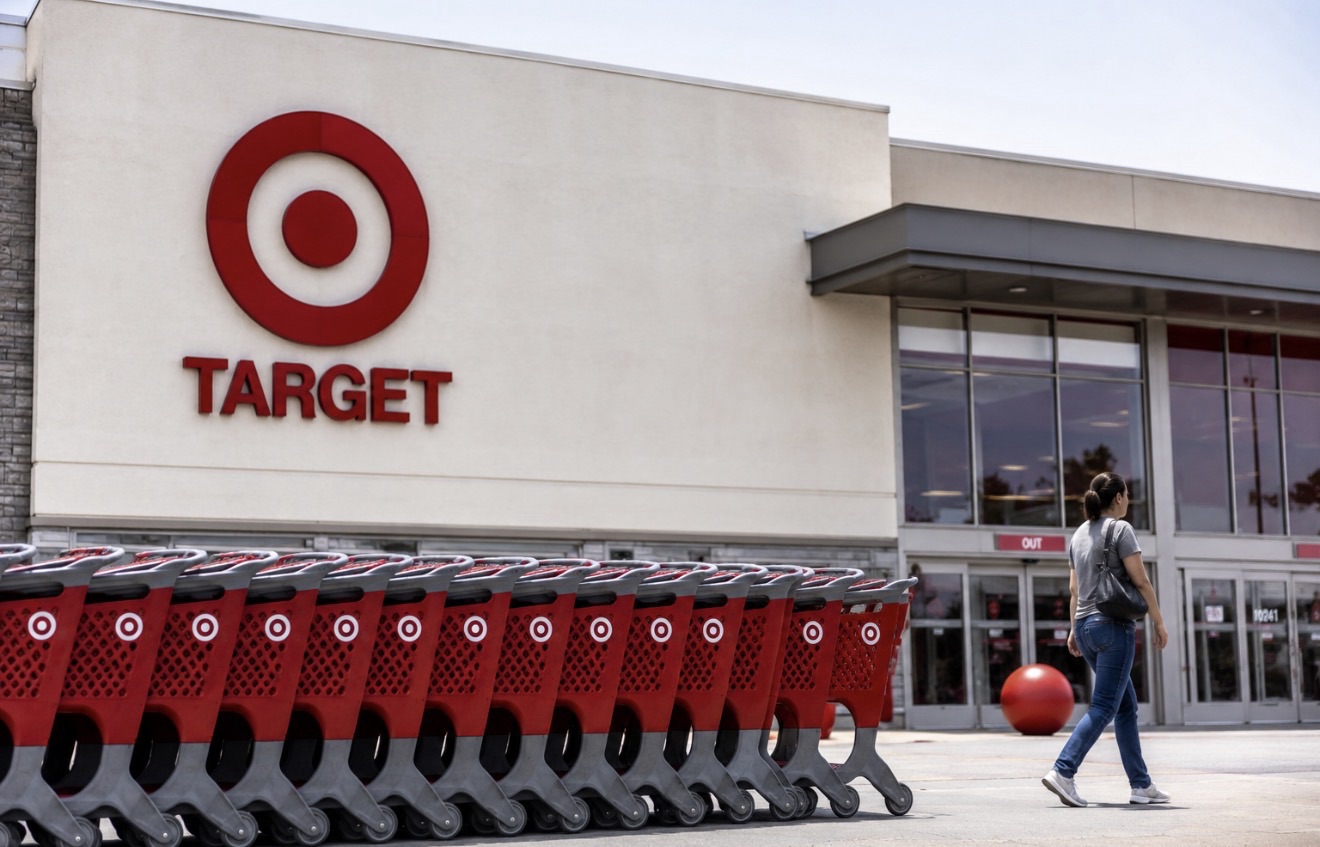

Target has created a chief artificial intelligence officer role for the first time and filled it from a rival’s bench. The retailer said Tuesday it named Chandhu Nair as chief AI officer and senior vice president, hiring him from Lowe’s, where he was senior vice president of stores, data, AI and innovation. Nair spent more than six years at the home improvement chain. Target also named Purvi Shah senior vice president of user experience — Shah has been with the company for four years.
The pairing is the point. Target is putting the executive who builds the AI and the executive who designs how customers encounter it on the same footing, rather than treating AI as a back-office technology function.
Nair’s brief spans employee tools, inventory management and how customers shop online. That is a wide remit at a company whose problem has been showing up in every one of those places at once.
The hire lands inside a turnaround. Target’s 2025 net sales fell 1.7% to $104.8 billion, and the company went through five straight quarters of revenue declines. Michael Fiddelke, who took over as chief executive earlier this year, responded in March with a $6 billion plan for 2026 — roughly $5 billion in capital spending to open 30 new stores and remodel more than 130, plus about $1 billion in operating investment aimed at store staffing, training, marketing and new technology including AI. He also cut prices 5% to 20% on more than 3,000 items across apparel, home, baby and grocery.
The early returns were better than expected. Target’s fiscal first quarter showed net sales up more than 6% and same-store sales up 5.6% — its first positive comparable-sales figure in five quarters — with traffic across stores and digital up 4.4% and digital comparable sales up 8.9%, driven by same-day delivery through Target Circle 360. Shares still fell nearly 4% that day as investors questioned whether the pace would hold through the rest of the year.
AI is threaded through what Fiddelke has promised next. Target Trend Brain, an internal tool trained on social media and fashion show data, helps designers decide what is trending. The company has partnered with OpenAI’s ChatGPT and Google’s Gemini to let shoppers buy products directly through those assistants, and the CEO wants agentic models that help customers find what they are looking for, along with better sales forecasting. Target also launched a conversational AI gift-finding tool last holiday season.
For a retailer with roughly 2,000 stores, the forecasting piece may matter more than anything customer-facing. Buying the wrong inventory is what produces markdowns, and markdowns are what have been eating Target’s margins.
The competitive backdrop explains the urgency. Walmart has been rolling AI tools and agents across its stores and supply chain for both customer experience and internal processes, Gap struck a partnership with Google’s Gemini this year, and Best Buy has arrangements with OpenAI and Google. Walmart said in June it was using AI to streamline employee work including translation and task management.
The job title itself is spreading fast beyond technology companies. Meta, Google and IBM have chief AI officers, and so do Eli Lilly, Pfizer, Accenture and PwC. What is different at a mass retailer is the measurement: a pharmaceutical company can point to research pipelines, while Target’s AI investment has to show up in traffic, basket size and gross margin within a few quarters or investors will call it overhead.
Nair is not the first person to build an AI function at Target. Ashwin Rao served as the company’s first head of AI from 2016 to 2022, leading teams that built models for pricing, merchandising, customer experience and supply chain logistics before leaving for building products distributor QXO. The difference now is seniority — the work reports in at the top rather than sitting inside the technology organization.
The announcement comes just over a week before Target has to show numbers. The company reports second-quarter results on Aug. 19, with Walmart following the next day. Target has told investors the quarter includes its largest food and beverage transition in more than a decade, the rollout of Target Beauty Studio to more than 600 stores, and an overhaul of nearly 75% of its decorative accessories assortment.
Whether the AI office becomes central or ornamental will be visible in those quarterly reports well before it is visible in any press release.
JBizNews Desk | Minneapolis
© JBizNews.com All Rights Reserved. Reproduction or distribution without written permission is prohibited.