
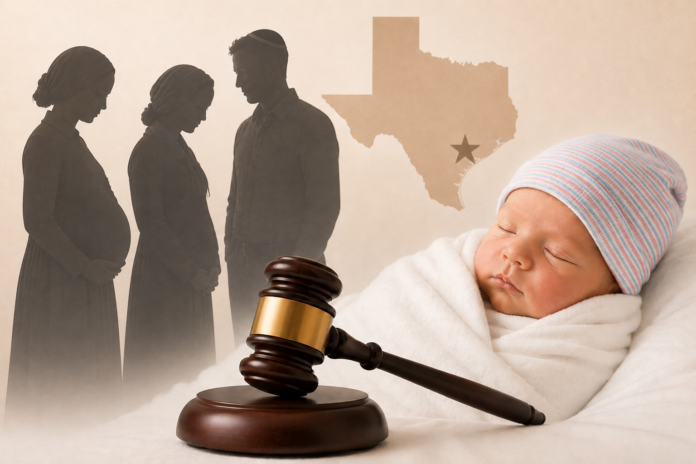

What would Halacha say if the surrogate and the parents were all Jewish?
New York (VINNEWS/Rabbi Yair Hoffman) A surrogacy fight featured in the New York Times on Thursday August 13th had stretched across three states. It ended this week in a Dallas delivery room. The case raises a set of questions that may someday be applicable halachically. But let’s get to some of the case’s details first.
What Happened
A woman in Alaska agreed to serve as a surrogate mother for a couple living in Los Angeles. The embryo was made from the couple’s own genetic material and then implanted in her womb.
At about twenty weeks of pregnancy, doctors found out that the baby, r”l, had a rare and serious heart defect called hypoplastic left heart syndrome. The left side of the heart does not form properly. A baby born with it needs a series of major surgeries in order to survive.
The intended parents decided to end the pregnancy. The surrogacy contract they had signed gave them that right. But the surrogate refused. After consulting with legal advisors, she traveled to Texas, where abortion is banned, to find doctors who could treat the baby instead. Also, a house-guest, Rabbi Yitzchok Brandys, informed me this morning that according to Texas law, the surrogate mother is the legal mother. Lawyers, anti-abortion organizations, and eventually the Texas attorney general all got involved. The baby was born on Wednesday in Dallas.
Now what if every person in this story had been Jewish, and that the case had come before a beis din instead of a courthouse. What would the halacha be?
There are as many as six different questions here, and perhaps more. Let’s take them one at a time.
Question One: Could the Parents Demand an Abortion?
The Rambam (Hilchos Rotzeach 1:9) rules that a fetus may be aborted only when it threatens the mother’s life. In that situation the fetus has the status of a rodef, a pursuer. Rav Moshe Feinstein zt”l in his famous teshuvah in Igros Moshe (Choshen Mishpat 2:69), ruled that abortion is a form of retzicha and is forbidden except to save the mother’s life.
Rav Moshe wrote that teshuvah in order to disagree with the Tzitz Eliezer (13:102 and 14:101-102), who had permitted abortion if it were to happen within 40 days of the pregnancy in a case of Tay-Sachs disease. But even the Tzitz Eliezer’s heter would not help here. Tay-Sachs is always fatal and involves terrible suffering. Hypoplastic left heart syndrome is different. With surgery, most of these children live into their teenage years and beyond. A condition that can be treated is simply not comparable. Also, the Tzitz Eliezer’s heter was only if the mother would have life-threatening psychiatric trauma as determined by a certified doctor. Here, that determination may not apply in regard to the Los Angeles couple.
Rav Shlomo Zalman Auerbach zt”l and Rav Elyashiv zt”l both ruled strictly in this general area as well. And twenty weeks is far past any point that even the most lenient opinions discuss. That is 140 days – not 40 days.
So the surrogate, in refusing, would have been doing exactly what halacha demands. The parents could not have hired her to do it either, because of the rule of ein shliach lidvar aveirah — a person cannot appoint an agent to commit a sin.
Question Two: Does the Contract Bind Her?
A clause in a contract that obligates a woman to have an abortion is a condition to violate a Torah prohibition. Such a condition is void halachically. This is because of the principle of masneh al mah shekasuv baTorah — a person cannot make a binding agreement to break the law of the Torah. [Rav Chaim Kanievsky zt”l invoked this principle forbidding the freezer of BMG fame].
There is a second problem with the contract as well. A contract cannot transfer ownership of a human being. A child is not property and cannot be the object of a kinyan. Poskim also raise the issues of asmachta (a commitment a person never seriously intended) and davar shelo ba la’olam (selling something that does not yet exist) regarding surrogacy contracts generally.
Question Three: Who Is the Mother?
This is the hardest question, and it is the one that would decide the custody fight.
Two women have a claim. One provided the egg — all of the child’s genetic material from the mother’s side comes from her. The other carried the pregnancy and gave birth.
The arguments on each side are strong.
The Nishmas Avrohom Vol. II Even ho’Ezer Siman 2:2 cites Rav Elyashiv zt”l that the birth mother is the halachic mother in such cases and not the donor mother. This is also the view of Rav Eliezer Yehudah Waldenberg, author of the Tzitz Eliezer (Vol. XV #45). However, in recent years, Rav Avrohom Sherman has been disputing that this was, in fact, Rav Elyashiv’s position. He stated that Rav Elyashiv held that it was just the DNA mother.
Rav Moshe Shternbuch, however, in his Teshuvos v’Hanhagos Vol. IV Siman 284 concludes that such a child has no halachic mother.
The Story of Dina
An interesting source in the discussion comes from psukim.
The pasuk lists “the sons of Shimon: Yemuel, Yamin, Ohad, Yachin, Zohar, and Shaul, son of the Canaanite woman” (Bereishis 46:10). Chazal explain that Shaul was the son of Shimon and Dina. After Shimon and Levi rescued Dina from Shechem, she was too ashamed to leave the city, and she made Shimon promise to marry her.
The Mefarshim immediately ask the obvious question. The shevatim had the status of Bnei Noach, who may marry a paternal sister. But Dina was Shimon’s sister from the same mother, and that is forbidden even to a Ben Noach (Sanhedrin 58a). How then was this permitted?
There is a well-known Maamar Chazal cited by Rashi on Bereishis 30:21. Leah knew through ruach hakodesh that Yaakov Avinu would father only twelve sons. When she became pregnant for the seventh time, she realized that another boy would leave Rachel Imeinu with fewer shevatim than even Bilhah or Zilpah. She davened so that Rachel Imeinu be spared that shame, and her male fetus became a female.
The Targum Yonasan (Bereishis 30:21) goes a step further. At the very time that Leah Imeinu conceived a boy, Rachel Imeinu conceived a girl. In answer to Leah’s tefillah, the two were exchanged. Rachel’s female fetus was moved to Leah and was born as Dina, and the male fetus conceived in Leah was moved to Rachel and was born as Yosef.
Several Rishonim — the Moshav Zekeinim miBaalei haTosfos and the Tosfos haShalem al haTorah on Bereishis 46, in the name of the Riva — use this to answer the question about Shimon. If Dina was conceived by Rachel, then Rachel was in some sense her mother, not Leah. That would make Dina only Shimon’s paternal sister, and permitted to him to marry back then.
These Rishonim appear to say that maternity follows conception, not birth. So in our case, the Los Angeles couple may be the parents.
The Maharsha holds that Leah’s fetus was not changed from male to female at all. Rather, it was swapped with Rachel’s female fetus — so calling her “Yaakov’s daughter” is exactly correct.
Proof One: The Convert Pregnant With Twins
The Gemara in Yevamos (97b) discusses a non-Jewish woman pregnant with twins who converts during her pregnancy. Her geirus works for the fetuses as well.
Normally a ger is considered like a newborn child and is no longer halachically related to his biological relatives. Yet the Gemara rules that these twins remain halachic brothers even after the conversion.
Some poskim see this as proof that the maternal relationship is created at birth, or at least during pregnancy. The twins converted in the womb, which should have erased their earlier relationship. The fact that they are still brothers must be because they gestated in the same woman and were born from her.
This proof can perhaps be challenged in two ways. First, Rashi in Yevamos 98a holds that the rule of a convert being like a newborn does not apply to fetuses at all — in which case the twins would remain brothers no matter what. Second, even if maternity normally runs through heredity, in an ordinary pregnancy the same woman supplies the egg and carries the child. So even if conversion cuts the original link, perhaps pregnancy and birth create it again.
Proof Two: The First Forty Days
The Gemara in Yevamos (69b) states that during the first forty days after conception an embryo is maya b’alma — merely water — and does not yet have the independent status of a nefesh. Some Acharonim hold that even those who require a fetus to have its own geirus would agree that no geirus is needed if the conversion happened during that period.
Implantation in a surrogate always takes place well within forty days of fertilization. Based on that, one could argue that the surrogate is certainly the mother, since the embryo only becomes established as a nefesh after it is already inside her.
This too, however, can be answered. Even during the maya b’alma stage the embryo carries the potential to become a child, along with all of its genetic traits — and that potential came from the woman whose egg was fertilized. This would put the ball back in the court of the Los Angeles woman.
Proof Three: The Three Partners
The Gemara in Niddah (31a) teaches that there are three partners in the creation of a person: Hashem, the father, and the mother. The father provides some genetic material, the mother provides other material. And Hashem gives the spirit and soul, the light of the face, sight, hearing, speech, the ability to walk, understanding, and insight.
On its face this Gemara seems to say that the connection between a child and a parent is exactly the biological material that the parent contributed. A surrogate contributes none of it. And the fact that the father’s contribution develops inside a woman’s body does not make her the father’s partner in place of him — so the same should hold for the egg donor whose contribution develops inside a surrogate.
The weakness here of all this is that this is Divrei Aggadetah, and halachic conclusions are generally difficult to draw from Aggadetah.
Proof Four: Back to Dina
The Rishonim who permitted Shimon to marry Dina because she was conceived by Rachel Imeinu seem to prove clearly that maternity follows heredity rather than pregnancy. But three problems have been raised.
Firstly, the Torah itself consistently calls Yosef the son of Rachel and Dina the daughter of Leah — the opposite of what the proof requires.
Secondly, the exchange of the fetuses may have happened at the very end of each pregnancy. If so, Rachel would have carried Dina for nearly the entire nine months, and that could be the real reason Rachel counts as her mother. That would prove nothing about a woman who supplies only an egg.
Thirdly, halachic conclusions are not drawn from maasei nissim — miraculous events.
The Three Positions
Most poskim agree that there is no airtight proof either way, and that each posek must decide by his own judgment. Some refuse to rule on the question at all, holding that this generation is not on the level to decide such weighty matters on judgment alone.
Three positions have emerged.
- Maternity is determined by heredity. The egg donor is the halachic mother.
- Maternity is determined by pregnancy and birth. The surrogate is the halachic mother.
- It cannot be determined. Both women must be treated as mothers, l’chumra.
The relevant sources include the Tzitz Eliezer (15:45, 19:40, 20:49 and 22:55) and the Nishmas Avraham (volume 4, Even HaEzer 2), which cites Rav Shlomo Zalman Auerbach zt”l and Rav Elyashiv zt”l. See also Yeshurun 21, page 535, by Rav Avraham Sherman, quoting Rav Elyashiv zt”l and Rav Avigdor Nebenzahl shlit”a. Rav Zalman Nechemia Goldberg zt”l wrote two essays on the subject, the first in Techumin 5, page 248, and the second in Asya 65-66, page 45. Rav Moshe Sternbuch shlit”a and Rav Shmuel Wosner zt”l also addressed the question.
A substantial number of contemporary poskim lean toward the birth mother, or toward treating the matter as a safek requiring both women to be considered. That said, the question remains genuinely open, and no one should assume it is settled.
In a Teshuvah sefer, where would this question even be placed? The answer touches all four sections of Shulchan Aruch. Whom must the child honor for kibbud Av v’eim? Which women are his maternal relatives, and therefore forbidden to him in marriage? Whom does he inherit from? For whom does he sit shiva? And most urgently — if the surrogate is not Jewish, does the child require geirus?
In the Texas case as it actually happened, that last question would be the whole ballgame. But in the version under discussion here, where everyone is Jewish, the child’s Jewishness is not in doubt no matter which opinion is followed. That removes the single most serious practical problem in surrogacy cases and leaves the questions of yuchsin, kibbud, yerushah — and standing in a custody fight.
Question Four: Who Gets Custody?
The father is the genetic father as at least a safeik, although I once heard a psak from Rav Elyashiv that it is clearly the father. Rav Moshe Feinstein did not hold of that position, but the Satmar Rebbe did (See his Teshuvos EH #1).
As for the mother, everything depends on Question Three. If the surrogate is the halachic mother, she has a real claim, not a nuisance claim. The Gemara in Kesubos (102b), codified in Even HaEzer 82:7, places a child under the age of six with the mother. Beis din retains the authority to depart from that where the welfare of the child requires it.
If the surrogate is the full halachic mother, the intended mother would have no halachic maternal status at all. If the egg donor is the full halachic mother, the picture reverses. And if the matter is treated as an unresolved safek, beis din would be left to decide on the basis of the child’s welfare rather than on a clean rule.
Question Five: Must the Baby Be Treated?
Once the baby is born, as happened here, he is a full nefesh. The thirty-day rule that people often cite affects aveilus and pidyon haben — it has nothing to do with the obligation to save a life. Shabbos is desecrated for a newborn precisely because of safek pikuach nefesh.
Two arguments might be raised against surgery.
The first is that a baby with a fatal heart malformation might be classified as a treifah. But even granting the classification, a treifah’s life must be saved, Shabbos is violated on his behalf, and here the treatment exists and can restore him to full viability.
The second is Rav Moshe Feinstein’s well-known position (Igros Moshe, Choshen Mishpat 2:73-74) that one is not obligated to prolong the suffering of a dying patient. That applies to chayei sha’ah — the last hours or days of a life that is ending. It does not apply to a child who has decades ahead of him after a series of repairs. Weighing the risk of the surgeries themselves is legitimate; the Gemara in Avodah Zarah (27b) permits risking chayei sha’ah for the chance at chayei olam.
Where parents refuse life-saving treatment for a minor, beis din acts as avihen shel yesomim, the father of orphans, and appoints an apotropos — a guardian — for the child. A child has independent rights. Parents are not owners.
That principle is the halachic parallel to what the Texas attorney general did, though beis din arrives at it through guardianship rather than through a state’s interest in the child.
Question Six: Is Surrogacy Permitted at All?
This question sits underneath everything else, and it is worth noting that the poskim are divided here as well.
The Tzitz Eliezer (15:45) opposed surrogacy in the strongest terms. Rav Elyashiv zt”l and Rav Wosner zt”l also opposed the practice. Rav Ovadia Yosef zt”l and Rav Zalman Nechemia Goldberg zt”l permitted it under conditions, and Rav Goldberg helped shape the safeguards written into Israel’s 1996 Embryo Carrying Agreements Law.
Related questions include whether an unmarried or divorced woman may serve as a surrogate, whether a married woman may, and whether a non-Jewish surrogate should be used or avoided.
A Closing Thought
Lila Rose, whose organization assisted the surrogate in the Texas case, put the objection to surrogacy in a single sentence: the child was being treated like a product, the product had a defect, and so the parties tried to send it back.
The Torah’s answer to that is contained in the Gemara in Niddah quoted above. There are three partners in the creation of a person, and the third partner is the One who gives the soul, the sight, the hearing, the speech, and the understanding. No contract signed between the other two partners can dispose of what the third one gave.
This article, of course, is a theoretical question. Any practical question in an actual case must be brought to Gedolei haPoskim.
The author can be reached at [email protected]